
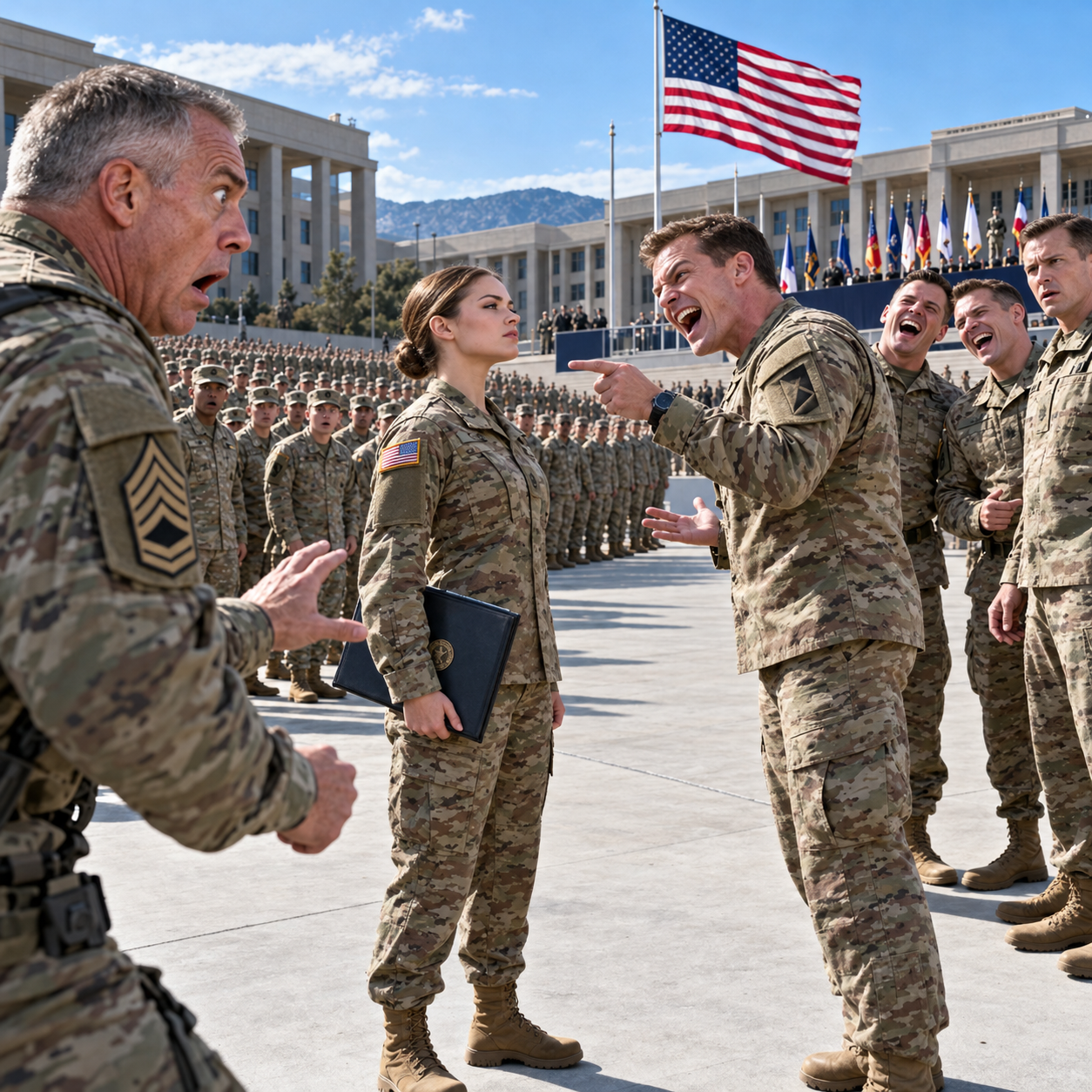
Company Formation. 90 Soldiers. The Captain Handed My Orders Back Unread. “Who Put A Teenager In Charge?” His Lieutenants Laughed. I Tucked The Orders Away. A Sergeant In The Second Rank Saw The Name. He Went White. I Answered The Captain. His Whole Platoon Stood. He Grinned. “Cute.” “Sir… Look At Her Orders Again.”
When Captain Grant Mercer asked whether I was old enough to lead his platoon, the lieutenants laughed, and ninety soldiers watched me stand there without defending myself. I answered with two words, and thirty-four men came to attention without receiving an order. The captain considered it an insult and punished every one of them. I didn’t argue or reveal what I knew. Eleven days later, a battalion sergeant major walked into his office carrying a memorandum he had refused to read, and everything changed.
## Part 1: The Woman Nobody Expected
I arrived at Fort Stewart on a Sunday evening with a duffel bag, a stiff left knee, and a brown folder that had spent most of the four-hour drive on the passenger seat. The Georgia heat hadn’t quite surrendered to October, and the air outside battalion headquarters smelled of wet pine needles and diesel exhaust. Behind the duty desk, a staff sergeant named Whitcomb glanced at my orders, then at the rank on my chest, and finally at my face. His expression changed so completely that I almost laughed, because I knew exactly what he was thinking.
“You’re the new platoon sergeant for Second Platoon?” he asked, checking the document again. I confirmed that I was, and he cleared his throat before telling me where to find temporary quarters. At thirty, I had been in the Army for eleven years, but my freckles, round cheeks, and five-foot-four frame regularly convinced strangers that I belonged in a college freshman orientation. I had learned that correcting the assumption usually took more energy than doing my job well enough to make it disappear.
Whitcomb handed over my room key, then hesitated as I reached for my bag. “Just so you know, Sergeant Ellery, Second Platoon has been through three platoon sergeants in fourteen months.” He said it like a mechanic warning someone about a car with an expensive noise under the hood. I thanked him, walked upstairs, and passed the platoon dayroom, where somebody had drawn four little soldiers on a whiteboard. Three had names crossed out underneath them, while the fourth stood beneath a question mark.
My room contained a narrow bed, a rattling air conditioner, and a window overlooking a parking lot full of dusty pickup trucks. I opened the brown folder and removed a white envelope with thirty-one signatures attached to a handwritten memorandum. Some names belonged to soldiers I hadn’t seen in more than two years, and others were unfamiliar, but every signature represented a decision someone had made despite having something to lose. I put the pages away without reading them again, because I already knew every line.
At 0545 the following morning, First Sergeant Tomas Reid greeted me in the company orderly room with coffee and an unusually serious expression. He was broad-shouldered, gray at the temples, and spoke with the deliberate patience of a man who had learned that shouting seldom improved anyone’s hearing. “Captain Mercer wanted Staff Sergeant Ralston from Third Platoon for your position,” he explained, sliding a roster across his desk. “Battalion sent you instead, and he considers that a personal rejection.”
“Has he reviewed my assignment packet?” I asked, although the answer was already becoming obvious. Reid glanced toward the commander’s closed door and said he had placed everything, including the supporting enclosures, on Mercer’s desk three days earlier. The captain had taken the folder home over the weekend and brought it back without breaking the elastic band around it. When Reid mentioned that Mercer planned to introduce me at morning formation, I understood that the captain intended to settle his disappointment in front of an audience.
Mercer’s office was decorated with framed military photographs, a neatly arranged display of challenge coins, and a picture of a black Labrador sitting beside a fishing boat. He was thirty-two, with an immaculate uniform and the confident posture of someone accustomed to winning conversations by outranking the other person. He kept typing for nearly a minute after I reported, then finally looked up and examined me from my boots to my hairline. “Sergeant Ellery, we’ll figure out whether Second Platoon is the best place for you after formation.”
“My orders specify Second Platoon, sir,” I replied, keeping my voice neutral. He smiled without warmth and said that orders established assignments but didn’t necessarily establish suitability. I noticed my unopened folder resting beside his computer, the elastic band exactly where Reid had described it. Instead of asking another question, I acknowledged his instructions and left, because the first thing I wanted to learn about this company was how its soldiers behaved when nobody important was watching.
At 0900, Bravo Company assembled beneath a broad live oak behind the barracks, ninety soldiers arranged in orderly ranks. Second Platoon stood on the left, thirty-four soldiers in camouflage, their faces almost indistinguishable beneath the shadows of their patrol caps. As Captain Mercer finished the routine announcements, I recognized a narrow-faced sergeant in the second rank whose name tape read SUTTER. He had grown heavier through the shoulders since I last saw him, but I would have recognized those watchful eyes anywhere.
“Sergeant First Class Mara Ellery, front and center,” Mercer announced, and I walked forward with my orders tucked under one arm. He looked at my face, then turned toward the formation with an exaggerated expression of amusement. “Aren’t you a little young to lead this platoon?” he asked, loud enough to reach the last rank, before adding, “Who decided somebody who looks fresh out of high school was qualified to supervise thirty-four infantrymen?”
Several soldiers laughed, including Lieutenant Nolan Price, my new platoon leader, who appeared uncomfortable almost immediately. I could have listed my qualifications, mentioned my combat experience, or asked Mercer to open the folder he was holding. Instead, I looked toward Second Platoon and answered the captain’s question with two quiet words. “They did.”
Sergeant Sutter straightened first, snapping from parade rest to attention so sharply that I heard his heels meet the gravel. Then the soldier beside him followed, followed by another, until the motion traveled through all four ranks and every member of Second Platoon stood rigidly at attention. Nobody had issued a command, and the other platoons remained at ease, watching with expressions that ranged from curiosity to outright alarm. Mercer’s smile faded as he realized thirty-four soldiers had just demonstrated a level of respect he hadn’t ordered and couldn’t explain.
“That’s quite a performance,” he said, but his voice had lost its amusement. Sutter stared straight ahead and spoke just loudly enough to be heard: “Sir, you might want to read her orders.” Mercer turned toward him with a look that promised consequences, and I understood that the men had exposed themselves to retaliation before I had completed my first formation. I ordered Second Platoon back to parade rest, but as they moved together, I saw something in Sutter’s face that carried me back to a flooded creek and a night when he had been a frightened nineteen-year-old private.
That was when I realized the captain wasn’t the only person standing in that formation who didn’t understand what those thirty-four soldiers had just done.
## Part 2: The Night Nobody Forgot
I hadn’t planned on becoming an infantry soldier when I enlisted at nineteen. I came from a farming town outside Valdosta, where my father repaired irrigation equipment and my mother managed inventory at a feed store, and I joined the Army because college wasn’t financially realistic. I started as a truck driver, eventually transferred into infantry, and discovered that being one of the few women in my battalion meant every ordinary mistake attracted an extraordinary amount of attention. I learned to carry my share, admit what I didn’t know, and never mistake someone’s willingness to underestimate me for evidence that I actually lacked ability.
By twenty-six, I had completed a deployment, earned my promotion to staff sergeant, and accepted an assignment as a drill sergeant at Fort Moore. Infantry training was exhausting for everybody involved, including instructors who went home with blistered feet and voices that sounded like gravel moving through a cement mixer. My trainees called me the little drill sergeant, although they were careful never to do it within earshot. Most stopped making jokes after our first twelve-mile ruck march, when I finished carrying an extra training radio because its assigned carrier had developed an ankle problem.
My January 2024 training platoon had fifty-eight recruits, but two became particularly difficult to forget. Isaiah Sutter was a quiet young man from Ohio who questioned every instruction until he understood its purpose, while Caleb Vale came from rural Tennessee and apologized so often that I eventually made him replace every unnecessary apology with a useful observation. Sutter was a natural leader, stubborn but attentive, and Vale had enormous physical endurance despite being terrified of deep water. I worked with both of them because one needed to learn when to listen and the other needed to believe his own judgment.
On April 19, we were conducting a nighttime stream-crossing exercise at a training area near a narrow creek surrounded by pine woods. Rain had fallen upstream for two days, but the water level remained inside the established safety limits when the exercise began. Safety personnel were posted on both banks, a rescue boat waited downstream, and every trainee had received instructions for emergency procedures. At 10:10 that night, with several men already across, the current changed so suddenly that the rope began vibrating through my gloves.
Four trainees were caught in the rising water, and I remember counting them before I remember being afraid. One reached the bank under his own power, another caught a submerged root, and a third fought his way toward a safety line while the instructors pulled from shore. Sutter was among them, and I saw him emerge coughing before turning back toward the creek instead of moving to safety. The fourth trainee, Vale, had vanished beneath the surface near a fallen pine.
I entered the water attached to a secured safety line, searching along the branches where the current had trapped equipment against the tree. My hand found Vale’s shoulder, and I cut him free of the pack that had caught beneath the timber before pulling his face above the surface. Then a section of the deadfall shifted and trapped my left leg against the creek bed, leaving me unable to stand or swim toward shore. Vale was unconscious, the water was climbing toward my mouth, and every movement sent a sharp, sickening pain through my knee.
I kept his face above the water while the rescue crew worked downstream, but I was losing my grip when someone caught the back of my vest. Sutter had followed the safety line despite being told to stay ashore, and now he was bracing himself against the current, helping support both of us while shouting that the boat was coming. I remember hearing him tell me to keep counting, so I counted the four trainees again and again, even after my voice had become almost inaudible. When the boat finally reached us, its crew took Vale first, then helped free me as additional personnel stabilized the fallen tree.
Vale regained consciousness before reaching the hospital, but I spent the next several months recovering from surgeries and extensive damage to my leg. My trainees graduated while I watched a shaky recording from a hospital bed, trying to identify familiar faces in a crowd that looked impossibly far away. The investigation concluded that an abrupt change in the upstream flow had overwhelmed a properly supervised exercise, although its recommendations strengthened the procedures used to monitor changing conditions. I accepted the findings, but sometimes I woke in the middle of the night convinced I could still feel that tree against my knee.
The Army awarded me the Soldier’s Medal, and a colonel presented it in a small administrative ceremony while I was assigned to a training office. The recognition was meaningful, but it didn’t repair the part of my confidence that had disappeared with my ability to run without pain. When my medical restrictions finally ended, three requests to return to an operational platoon went nowhere, and I began accepting that my career might continue behind a desk. Then, in August 2026, a letter arrived from Sergeant Isaiah Sutter, now serving at Fort Stewart.
He described a platoon that had lost confidence in its leaders after repeated transfers, neglected training concerns, and promises that evaporated whenever another sergeant left. I wrote back explaining that my leg was still unreliable and that he should ask for someone stronger, but ten days later Command Sergeant Major Lenora Baird telephoned me personally. Thirty-one soldiers from Second Platoon had signed a memorandum requesting my assignment, including nineteen former trainees who remembered the creek. Baird told me she had reviewed my medical clearance and training record, and that she was willing to offer me a chance if I genuinely wanted it.
I accepted, but I made one request: the soldiers’ memorandum should remain a supporting document, not become an announcement about my past. Baird agreed to attach it to the official assignment packet, explaining that the receiving command deserved to understand why the request had been approved. That was the document Captain Mercer had carried home without opening, and it was why his joke at formation had landed so differently on the men who knew me. Unfortunately, when he interpreted their reaction as organized disrespect, he decided the entire platoon needed to learn a lesson.
At Tuesday’s training meeting, Mercer canceled Second Platoon’s upcoming four-day pass and assigned two hours of additional motor-pool cleanup every evening. Lieutenant Price sat silently while the captain announced the punishment, and nobody challenged him when he jokingly referred to me as “Sergeant Kindergarten.” Then Mercer pointed to the schedule for the end-of-month field exercise, where Second Platoon was assigned to a river-crossing lane that would be observed by battalion leadership. My eyes rested on the marked crossing site, and I felt the old injury tighten beneath my uniform trousers.
For the first time since accepting the assignment, I wondered whether I had made a mistake coming back.
## Part 3: The Price of Staying Quiet
By Wednesday evening, the motor pool had become a miserable place to spend two unnecessary hours. Rainwater gathered beneath the vehicles, fluorescent lights drew clouds of insects, and thirty-four soldiers scrubbed equipment that had already passed inspection. I worked beside them because I wasn’t about to supervise punishment from a dry office, although the cold water made my injured leg stiffen until every step required concentration. Specialist Caleb Vale spent the evening cleaning the far side of a Bradley, deliberately avoiding my eyes, while Sutter repeatedly looked as though he wanted to say something.
I used the mornings to review the platoon’s maintenance records, training evaluations, and personnel files. The soldiers weren’t undisciplined, as Mercer had implied; they were exhausted from repeated changes in leadership, delayed equipment requests, and training plans that were revised without anyone explaining why. One vehicle’s communications system had been reported unreliable three times, yet the problem remained unresolved because each departing platoon sergeant had assumed the next would handle it. I asked Lieutenant Price to accompany me through the records, and he admitted that he hadn’t realized how many issues were still open.
“Sir, these soldiers have been documenting problems for months,” I told him after we found another unsigned maintenance request. Price rubbed his forehead and explained that Mercer disliked hearing about difficulties without receiving immediate solutions, so company meetings often became exercises in reporting good news. He wasn’t defending the practice, and I could see he was embarrassed that he had contributed to it by staying quiet. We agreed to bring verified problems forward together, starting with the communications equipment and the training supplies Second Platoon needed before the field exercise.
Mercer responded the next morning by summoning me to his office and placing a formal counseling statement on the desk. The document accused me of undermining his authority through a coordinated demonstration at formation, and he had already requested my reassignment to headquarters company. I checked the box indicating disagreement, signed to acknowledge receipt, and wrote that I had issued no instruction for soldiers to leave parade rest. When Mercer accused me of building personal loyalty at the expense of the chain of command, I asked whether he had spoken individually with any of the thirty-four soldiers involved.
“That isn’t your concern, Sergeant,” he said, tapping the document with one finger. I answered that their readiness, training, and welfare were precisely my concern, and that I would continue preparing them until my reassignment became official. His expression hardened when I suggested he review the unresolved maintenance requests before the field exercise, but he offered no reason to delay them. I left with my copy of the counseling statement, aware that being technically correct wouldn’t prevent him from making the next few weeks difficult.
That afternoon, I visited the planned river-crossing site with Price and an engineer responsible for the training area. The river was wider than the creek where I had been injured, with muddy banks, an uneven bottom, and a bend that concealed the approach of floating debris. I asked for confirmation of the current monitoring procedures, the rescue boat locations, and the conditions that would require the exercise to stop. Price wrote everything down, then surprised me by asking the engineer whether a second rescue boat could be positioned on the near bank as an additional precaution.
When we returned, Mercer questioned why Second Platoon required more preparation than everybody else. I explained that the request was consistent with the training risk assessment and that our objective was to prevent predictable problems rather than prove our courage. Price supported the recommendation, speaking up before I could answer the captain’s second objection. Mercer finally authorized the additional safety preparations, but the look he gave Price made it clear that even a reasonable decision could offend a commander who felt challenged.
The next evening, Sutter approached while I was checking the track pads on a vehicle and asked permission to contact Command Sergeant Major Baird. He had learned through a soldier assigned to battalion that Mercer’s transfer request was already moving through the administrative process. “One conversation would straighten this out,” Sutter insisted, his voice tight with frustration. “She knows why you’re here, and she knows he hasn’t bothered to ask.”
“I know what she knows,” I replied, keeping my voice low enough that the other soldiers couldn’t hear. “But if she simply orders the captain to keep me, he’ll spend every morning looking for another reason to get rid of me, and you men will be caught in the middle again.” Sutter stared at the gravel, then asked why I expected a man who had publicly humiliated me to change without being forced. I told him I didn’t expect anything yet, but I wanted the captain’s decisions evaluated against facts rather than another argument about his wounded pride.
At night, alone in my quarters, I considered whether Sutter was right and whether my determination to stay was costing the platoon more than it helped. My knee throbbed beneath a heating pad while I studied the thirty-one signatures and remembered how young those men had been when they first learned to lace their boots correctly. They had written the memorandum without my knowledge, and I couldn’t bear the idea of turning their trust into ammunition in a personal dispute. Still, refusing to use that support did not mean I was obligated to accept mistreatment indefinitely.
On Friday evening, I returned to Mercer’s office and offered a straightforward compromise. If battalion approved my reassignment, I would accept it without protesting, but I wanted permission to lead Second Platoon through the upcoming field exercise, including the river crossing, before the transfer occurred. Mercer studied me for a long moment, suspicious of a bargain that appeared to give him almost everything he wanted. He eventually agreed, saying the paperwork would probably be finalized before the exercise anyway.
As I turned to leave, he asked why I cared so much about soldiers I had supposedly met less than a week earlier. I looked at the company roster lying open on his desk, full of names he should have been studying long before mine appeared on his assignment list. “Because they need somebody who plans to stay long enough to finish the job, sir,” I answered. He said nothing, but for the first time, he looked down at the roster rather than at my face.
The following Friday, eleven days after the formation, First Sergeant Reid appeared at the motor pool shortly after sunrise. He told me Command Sergeant Major Baird had arrived without an appointment and was waiting in Mercer’s office with my counseling statement, the proposed transfer, and an official copy of my assignment packet. Then Reid looked toward Sutter, who was tightening a fastener beside one of the trucks. “She wants him there, too,” he said, and I knew the captain was finally going to hear the story I had refused to use against him.
## Part 4: Thirty-One Names on Two Pages
Captain Mercer was standing behind his desk when we entered, but his usual confidence had disappeared. Command Sergeant Major Lenora Baird stood beside the window with a folder in her hands, while Lieutenant Price and First Sergeant Reid occupied the narrow space near the door. Sutter reported properly, although his voice betrayed his nerves, and I stood beside him without looking toward the captain. Baird waited until everyone settled before asking Mercer whether he had reviewed the supporting documents accompanying my assignment orders.
“I looked through the packet,” Mercer answered, then paused when she asked specifically about the second enclosure. He admitted that he had concentrated on the assignment information and my recent duty history, assuming the additional material contained routine administrative endorsements. Baird removed a two-page memorandum from her folder and placed it on his desk. “Sir, I’d appreciate it if you’d read this aloud so we’re all discussing the same document.”
Mercer examined the heading, and I watched the color change in his face as he recognized its purpose. The memorandum was addressed to Baird and formally requested that Sergeant First Class Mara Ellery be assigned as Second Platoon’s platoon sergeant. Its first paragraph explained that nineteen current soldiers had trained under me at Fort Moore, and that twelve others had joined their request after discussing my previous leadership with those men. Mercer looked briefly toward Sutter, who kept his eyes fixed on the opposite wall.
He continued reading, his voice becoming quieter as the memorandum described the nighttime training accident in April 2024. It explained that four trainees had been swept into a flooded creek, that I had helped recover them, and that I had been trapped beneath fallen timber while keeping one unconscious soldier above the water. The statement described Sutter assisting at the rescue line, my resulting injuries, and the long recovery that prevented me from attending their graduation. Finally, Mercer read the paragraph explaining that the Army had recognized those actions with the Soldier’s Medal.
When he reached the next paragraph, his voice caught for the first time. The soldiers had written that Second Platoon had endured three leadership changes in fourteen months, that problems remained unresolved after repeated reports, and that they no longer trusted promises about their future. They weren’t requesting special treatment or asking the Army to reward someone for an old act of courage. They wanted a platoon sergeant who would take responsibility for every soldier, including the difficult ones, and who wouldn’t disappear when the work became inconvenient.
Mercer turned the page and found thirty-one signatures beneath the request. He read them slowly, recognizing the names of men whose promotion recommendations, training records, and leave forms had passed through his office. Sutter stood motionless beside me as the captain reached Caleb Vale’s signature near the bottom. Baird then handed Mercer the official award citation, and the room remained silent while he read it to himself.
“I carried this packet home,” Mercer finally said, setting the pages on his desk. He looked at me, no longer trying to hide his embarrassment, and asked why I hadn’t shown him the memorandum when he questioned my qualifications in front of the company. I told him the documents had been available before I arrived, and that the soldiers hadn’t signed anything so I could win an argument about my appearance. “Sir, you already had the evidence you needed, and I needed you to look at the soldiers standing in front of you.”
Baird explained that she had reviewed the platoon’s unresolved maintenance reports and the circumstances surrounding its previous leadership changes. Some delays were administrative, but others had persisted because company leadership repeatedly treated complaints as proof that Second Platoon lacked discipline rather than asking whether its soldiers had legitimate concerns. She also questioned the decision to punish thirty-four men for voluntarily coming to attention, especially when nobody had established that I encouraged the reaction. Mercer admitted that his response had been personal and that he had allowed embarrassment to influence decisions affecting the entire platoon.
“The battalion commander has reviewed the proposed reassignment and decided not to approve it,” Baird informed him. “He also expects an explanation of the interrupted training schedule and a plan for clearing these outstanding maintenance problems.” Mercer nodded, withdrew his accusation that I had coordinated the formation incident, and agreed to rescind the punishment and correct my local counseling record. He didn’t attempt to excuse his actions by pointing toward the medal or the petition, which was the first indication that he might actually understand the problem.
On Monday morning, Captain Mercer walked to the front of Second Platoon during company formation and announced that its four-day pass had been reinstated. He acknowledged that the additional duty had been unjustified, then apologized to the soldiers for treating their reaction as an organized challenge to his authority. Finally, he turned toward me and said, “Sergeant Ellery, I judged your ability without reviewing your record, and I made that mistake in front of your soldiers. I’m sorry.”
I accepted the apology without pretending we had become friends, because an apology didn’t erase the cold evenings or the unnecessary fear of losing another leader. Later that afternoon, Lieutenant Price sat beside me on the tailgate of a truck and admitted he should have questioned Mercer’s response when it first happened. We spent the next hour reviewing the platoon’s open equipment requests, and he personally arranged for the faulty communications system to receive a proper inspection. It wasn’t a dramatic moment, but it was the first time I felt that we were beginning to work as an actual leadership team.
The following week, the field exercise remained on the schedule, and I was grateful that the planned safety improvements had been approved. Yet every time I checked the river-crossing procedures, I noticed Caleb Vale watching the preparation from a distance before turning away. He had barely spoken to me since my arrival, although the other soldiers assured me he was reliable and hardworking. I suspected his silence had very little to do with Captain Mercer, and as the date of the crossing approached, I began to worry that his memories of that creek were far more painful than he had allowed anyone to see.
## Part 5: Nobody Left Behind
The field exercise began on a cold October morning, with Second Platoon moving into the training area before sunrise. We spent two days practicing movement, communication, casualty evacuation, and the countless ordinary tasks that determine whether a unit functions when people are tired and circumstances change. Lieutenant Price and I reviewed every safety requirement together, and I made sure the soldiers understood that identifying a problem was an obligation rather than an admission of weakness. By the third morning, the river crossing was the only major event remaining, and my left knee had already begun aching beneath my uniform.
The crossing site looked nothing like the narrow creek at Fort Moore, yet the sound of moving water brought back memories I hadn’t invited. Mist hovered over the river, damp grass clung to our boots, and a heron stood motionless along the opposite bank while engineers checked the ropes and rescue equipment. The current remained within approved limits, both rescue boats were positioned, and our communications checks had been completed without difficulty. Captain Mercer had come to observe from the far bank, although he stayed beside the safety personnel instead of interfering with the preparations.
I gathered the platoon and reviewed the crossing procedures one final time, explaining where they would stop, how they would communicate, and what conditions would require us to suspend the exercise. Then I told them I would count every soldier as they reached the opposite bank, making sure nobody moved to the next task until we had accounted for everyone. Sutter exchanged a brief look with Vale, who stood near the rear of the formation with his equipment secured tightly against his chest. Neither said anything, but I recognized the expression on Sutter’s face from that terrible night two years earlier.
The first soldier entered the river shortly after six, moving steadily along the secured rope while the rescue crew monitored his progress. When his boots reached the far bank, I called out, “One,” and waited until he confirmed that he was stable before directing the next man forward. The numbers continued in an ordinary rhythm as the soldiers crossed, and I began recognizing each person by the way he moved rather than by the name tape on his uniform. For the first time in months, I found myself enjoying the simple competence of watching trained people do their jobs.
At seventeen, the safety officer noticed a change in the current and signaled for us to pause. I immediately stopped the crossing, confirmed the position of every soldier, and waited while the engineers checked the updated measurements. Nobody complained about the interruption, and Captain Mercer supported the decision from the opposite bank without questioning whether the delay would affect the exercise schedule. When the safety team confirmed conditions were acceptable and authorized us to resume, Price repeated the instructions to both banks before giving the signal.
The next soldiers crossed without incident, including Specialist Miles Kessler, who quietly sang the same three lines of a country song that had nearly driven everyone crazy during motor-pool cleanup. Sutter crossed near the end and turned immediately to observe the remaining soldiers, keeping his attention on the safety line until everyone behind him was ready. Vale had asked to cross last, and I had approved the request after confirming that it was his decision rather than an attempt to avoid the exercise. He stood at the water’s edge for a moment, took one measured breath, and stepped forward.
Vale moved carefully but steadily, keeping both hands where they belonged and checking his footing before shifting his weight. I watched him reach the midpoint, where the current pressed against his legs, and remembered how helpless his body had felt in my arms beneath the fallen tree. This time he was alert, trained, and completely in control of his movements, and I felt something inside my chest loosen as he approached the far bank. When his final step carried him onto solid ground, Captain Mercer called out the number before I could.
“Thirty-four,” he said, loud enough for everyone to hear. I confirmed the count with Price and reported that every member of Second Platoon had completed the crossing. Across the river, Vale looked toward me and raised one hand, not in a salute or an elaborate gesture, but simply to show that he was all right. I returned the gesture, and the platoon immediately began preparing equipment for the next phase of the exercise.
Afterward, Mercer found me near the riverbank while soldiers loaded the safety equipment onto trailers. He told me that older officers had repeatedly called him “the kid” when he first took command, and that he had hated the assumption that his age made him incapable of leading. I listened while he admitted that he had repeated the same insult against me because he had confused appearing experienced with actually being a good leader. “I thought being respected meant never letting anyone question me,” he said, watching Price help the soldiers secure a vehicle.
“Respect doesn’t disappear when somebody asks you a difficult question, sir,” I answered. “Sometimes that’s when you find out whether you’ve earned it.” Mercer nodded, and we returned to our separate responsibilities without another speech or promise about starting over. I didn’t need him to become a different person overnight, and I wasn’t interested in pretending his behavior had been harmless simply because he finally recognized it.
Two evenings later, I found Vale sitting on a stairwell landing in the barracks, staring at the floor with his hands folded between his knees. He stood when he saw me, then awkwardly explained that he had learned to swim after graduation, attending lessons twice a week until he could cross the installation pool without stopping. He admitted that he had nearly refused to sign the memorandum because he believed my injuries were his responsibility. “If I hadn’t been afraid of the water, you wouldn’t have been hurt,” he said, struggling to look at me.
I sat on the step beside him and asked whether he remembered much about the accident. He shook his head, explaining that his clearest memory was hearing me count while everything around him felt dark and distant. I told him the injury had resulted from a dangerous situation, not a personal failure, and that he had never owed me a lifetime of gratitude for surviving it. “You were one of my soldiers, Caleb, and my responsibility was to bring all of you home,” I said, watching his expression soften as he finally understood what I meant.
We remained on the stairs for several minutes, listening to a dryer rumble somewhere below us, until Vale quietly said he was glad I had returned to the platoon. I told him I was glad to be there, too, and he stood with a small, relieved smile before heading toward his room. The next morning, he greeted me without looking away for the first time since my arrival. It was a small change, but after everything that had happened, I understood how much courage it had required.
By the end of October, the outstanding maintenance requests were being resolved, the platoon’s training evaluations were improving, and Captain Mercer had developed the useful habit of asking questions before forming conclusions. Lieutenant Price no longer waited for me to identify every issue, and Sutter had become the kind of sergeant who encouraged younger soldiers to report problems before they became emergencies. I still had difficult mornings when my knee stiffened in cold weather, but I had stopped treating those mornings as proof that I no longer belonged. My limitations were real, and so were the skills and judgment I had spent eleven years developing.
One evening, I walked past the platoon dayroom and noticed that somebody had erased the whiteboard. The crossed-out names, the question mark, and the little raincloud were gone, replaced by a weekly training schedule and a list of maintenance tasks with names beside them. Nobody had written a compliment or a heroic message, and I was grateful because the room finally looked like a place where people expected tomorrow to happen normally. In my quarters, I took the Soldier’s Medal from the drawer where I had kept it hidden and placed its open case beside my desk lamp.
I still lead Second Platoon, and Captain Mercer and I still disagree about things that matter. He is my commander, not my friend, and I don’t confuse professional cooperation with an obligation to forget what happened. But he reads his supporting documents now, asks his lieutenants for their assessments, and occasionally walks through the motor pool without announcing himself, just to find out what the soldiers are working on. Those changes mean more than another apology ever could.
Every Monday morning, I stand beside thirty-four soldiers whose names I know, whose strengths I understand, and whose problems I am responsible for helping solve. Sometimes I remember the moment they stood at attention without an order, but I no longer think of it as the greatest demonstration of respect I have ever received. The greater thing is that they trusted me enough to ask for help, and that when I finally accepted it, we built a platoon that didn’t depend on any one person being a hero.
I count them every morning before we begin.
Thirty-four.
Everyone is here.
THE END!
Disclaimer: Our stories are inspired by real-life events but are carefully rewritten for entertainment. Any resemblance to actual people or situations is purely coincidental.


