
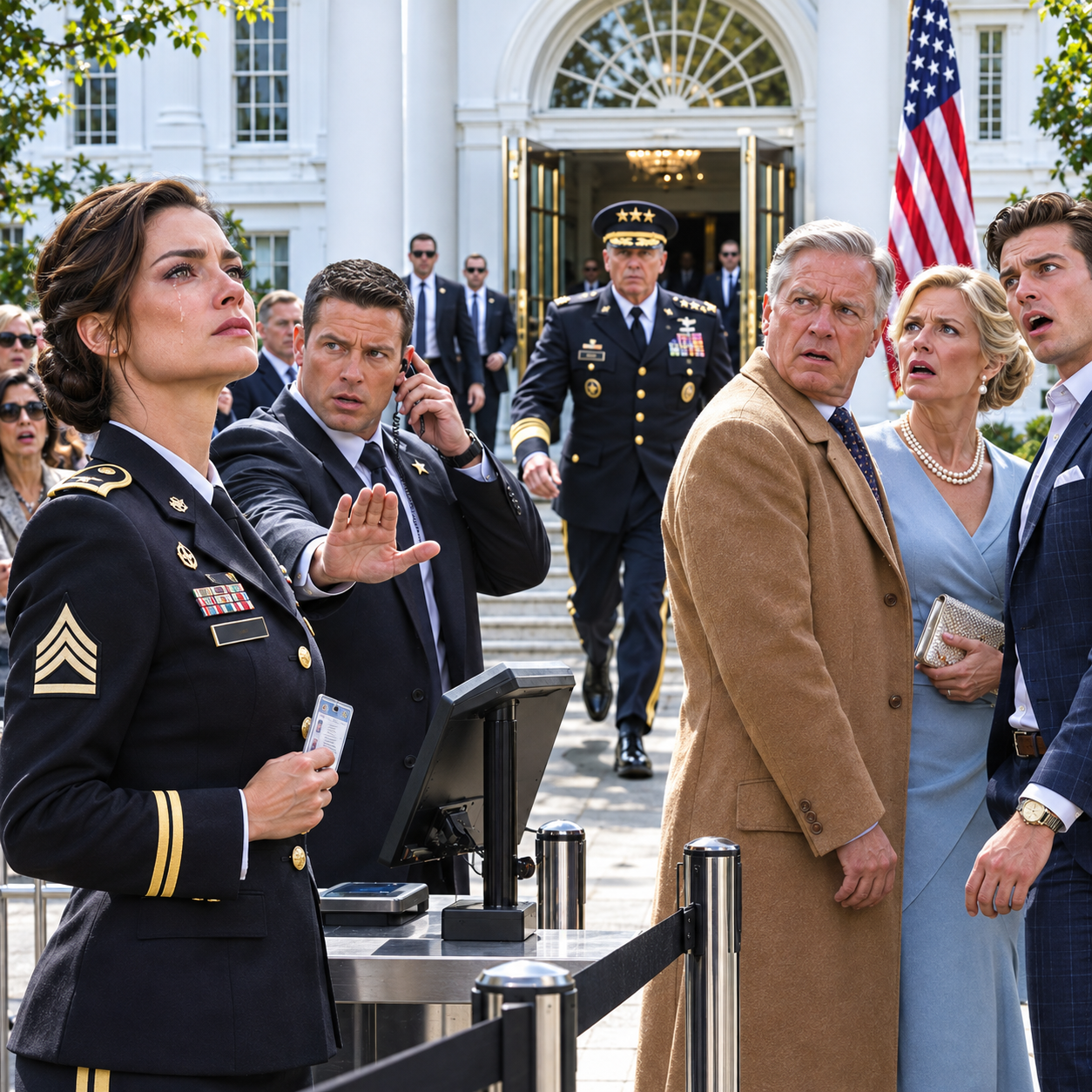
“Act like you don’t know us,” my father whispered when he saw me standing behind his wealthy new family outside the White House. He thought my Army uniform meant I had been assigned to guard people like him, and my stepbrother actually laughed about me scuffing the floors. I obeyed without arguing. Then a Secret Service officer scanned my credential, stopped the entire checkpoint, and called someone over the radio. Seconds later, a four-star general came through the doors looking for me.
### Part 1
By the time my father noticed me outside the White House East Wing, he had already spent twenty-six years pretending I did not exist. I was standing beneath a pale Washington morning sky in my Army service uniform, listening to the low murmur of diplomats, defense executives, congressional staffers, and uniformed officers funneling toward the security checkpoint. The air smelled faintly of wet pavement and clipped hedges after an early shower, and every few seconds a black government SUV rolled through the outer barricade with tires whispering against the damp street. I had arrived alone in a cab because I had never developed the habit of making an entrance.
My father had.
Grant Whitmore stood fifteen feet ahead of me in the donor line wearing a midnight-blue tuxedo that probably cost more than my first car. His silver hair had been trimmed so perfectly it looked carved, and his wife Celeste wore an ivory designer coat over a dress covered in tiny hand-sewn beads that caught the morning light whenever she moved. Beside them was Celeste’s son Nolan, thirty-six years old, unemployed in every meaningful sense of the word, examining his reflection in the black screen of his phone while adjusting diamond cuff links my father had undoubtedly paid for. Even before Grant turned around, I knew exactly what the three of them would see when they looked at me: an inconvenience from a chapter of his life he preferred to keep closed.
Nolan saw me first. His brows lifted, then his mouth curved into the same amused little smile I remembered from the last family event I had attended almost fourteen years earlier. “Well, this is unexpected,” he said, elbowing Celeste before looking deliberately at my uniform. “Claire finally made it to the White House.”
Grant turned.
For half a second, recognition stripped everything artificial from his face. I saw surprise, confusion, and something that might once have been guilt before contempt settled over all of it like a familiar mask. He stepped out of line, smoothing one hand over his tuxedo jacket while Celeste followed with visible reluctance. “What are you doing here?”
“Good morning, Dad.”
His jaw tightened at the word.
Nolan glanced at my shoulders but either did not understand the silver eagles there or did not care enough to ask. “Security detail?” he said. “Actually, that makes sense. Make sure none of the senators wander off with the silverware.”
Celeste covered a laugh with her gloved hand.
I looked at my father instead of them. At forty-eight, I had commanded soldiers in places where air-raid sirens interrupted dinner and where a five-minute satellite outage could turn a routine night into twelve hours of frantic work. Yet standing in front of Grant Whitmore, I could still smell the leather chairs in his old study and hear the same voice telling my twenty-one-year-old self that choosing the Army was an act of deliberate humiliation against him. Some injuries stop hurting without ever disappearing.
Grant leaned closer so the people around us could not easily hear. “Listen to me carefully, Claire. Today matters to my company.”
His eyes moved briefly toward two men wearing corporate lapel pins near the entrance.
“We have serious people here,” he continued. “People connected to procurement, appropriations, future contracts. Whatever assignment brought you here, do your job and keep your distance.”
I said nothing.
His voice dropped another degree. “Act like you don’t know us.”
For years, I had wondered what I would feel if he ever said those words plainly. Instead of anger, all I felt was an odd sense of completion. He had spent decades communicating the same message through missing birthday calls, returned Christmas cards, erased photographs, and introductions in which he described Nolan as “my son” while pretending his biological daughter had evaporated somewhere after college. Now, standing a few yards from the White House, he had finally given the arrangement a sentence.
“All right,” I said.
That seemed to disappoint him. He had probably expected tears, defensiveness, or a speech about everything I had accomplished without him. Grant had always understood conflict when it came in forms he could dominate. Silence made him restless.
I stepped around him and moved toward the credential checkpoint.
“Ma’am, this line is for invited principals,” one of the civilian event coordinators said, raising a hand before I reached the counter. She was polite rather than rude, and I could hardly fault her; several military support personnel had entered through a different lane.
I handed her my digital invitation.
She read the screen, looked at me again, then immediately lowered her hand. “Of course, Colonel. Please proceed.”
Behind me, Nolan made a quiet sound of surprise.
The Secret Service officer at the scanner was a woman around my age with dark hair pinned cleanly beneath her protective-service cap. “Good morning, Colonel. Credential and invitation, please.”
I placed both on the counter.
She scanned my identification card first. Green light. Then she aimed the reader at the encrypted square on my invitation.
The scanner chirped.
Her terminal changed.
I watched her expression become completely still.
The officer looked at the screen, then at me, then back at the screen as though she wanted to make sure the system had not produced the wrong record. She pressed one finger to her earpiece and spoke quietly into the microphone clipped near her collar. “Command, hold inner traffic at East reception.”
The murmur behind me faded.
Grant laughed softly.
Of course he did.
“I knew it,” I heard him tell Celeste. “Some credential problem.”
The officer pressed another key. “General Keene’s office, confirm arrival notification.”
A voice answered through her earpiece, too faint for me to hear.
Her posture changed instantly.
“Copy,” she said. Then she looked directly at me. “Colonel Whitmore, General Keene is on his way to receive you personally.”
Behind me, nobody laughed.
The double doors at the far end of the corridor opened.
I had known General Daniel Keene for six years, but I had never seen my father in the same room with someone he could not impress, purchase, intimidate, or charm. As the four-star general started walking toward me and every uniformed person in that corridor straightened at once, I realized I was about to find out what Grant Whitmore looked like when money stopped working.
### Part 2
General Keene did not hurry, but people moved out of his way as though he carried his own current through the building. He was sixty-two, broad-shouldered, close-cropped gray hair, four silver stars catching the white ceiling lights on each shoulder. Two aides followed several paces behind him, and a military assistant carrying a leather portfolio paused near the security barrier while the general continued alone. My father immediately stepped forward.
That was the most revealing part.
Grant’s shock lasted perhaps two seconds before instinct took over. He straightened his jacket, arranged his features into the gracious smile he used at defense conferences, and extended one hand. “General Keene. Grant Whitmore, Whitmore Defense Systems. We’ve corresponded with—”
General Keene walked past him.
He stopped two paces in front of me.
I came to attention automatically.
His eyes held mine for one brief moment, and I saw something there I had spent my entire adult life earning from people whose opinions mattered to me: respect. Then, in front of my father, Celeste, Nolan, the Secret Service detail, several foreign attachés, and half a dozen corporate executives, the four-star general raised his right hand in a sharp salute.
“Colonel Whitmore,” he said. “Welcome. It’s good to finally have you here.”
My hand rose in return. “Thank you, sir.”
“The Secretary has asked twice whether you’ve arrived.”
“I apologize for keeping him waiting.”
General Keene almost smiled. “You’re seven minutes early.”
A few people nearby chuckled.
Then he lowered his voice slightly. “You earned today, Claire. Don’t let anyone make you forget that.”
I knew he had noticed my father. General Keene noticed everything.
“Understood, sir.”
He turned toward the inner doors. “Walk with me.”
I fell into step beside him.
I did not look back.
That required more discipline than returning the salute.
The last thing I heard before the doors closed was Nolan saying, much too loudly, “Why did he salute her?”
Inside, the atmosphere changed from crowded confusion to controlled ceremony. White-gloved military ushers directed guests along carpeted corridors beneath portraits and tall windows, while the Marine Band rehearsed somewhere deeper in the building, brass notes arriving through the walls in short, polished bursts. General Keene asked about my flight from Virginia, my team at Fort Belvoir, and whether Lieutenant Colonel Ramirez had finally stopped arguing with headquarters about staffing numbers. We talked like professionals because that was what we were.
Still, an old memory kept pushing at me.
I was twenty-one again, standing in my father’s study with an ROTC scholarship letter folded inside my purse. Grant had poured himself a drink and listened while I explained that I wanted to commission after graduation. He had stared at me as if I had confessed to deliberately setting fire to the family business.
“You have a place waiting for you at Whitmore,” he had said.
“I know.”
“You’d start in strategic operations. Two years, maybe three, and you’d be on the board.”
“I don’t want the board.”
He had laughed once, sharply. “Everybody wants the board.”
“I don’t.”
That had been the moment our relationship truly ended. Not because I joined the military, I understood later, but because I had rejected a future he had designed without asking me. Grant could forgive mistakes if they remained under his authority. Independent choices were another matter.
He removed me from his estate plan that afternoon.
My mother had been dead six years by then, and there were no siblings to stand between us. Just me, him, and the terrible silence that forms when two people discover they no longer recognize one another. Two years later he married Celeste Harrington, whose son Nolan quickly learned that agreeing with Grant was the easiest occupation he would ever have.
I took the opposite route.
My twenties smelled of diesel fuel, canvas, instant coffee, and dust. I learned how to sleep for ninety minutes on a folding cot and wake up ready to make decisions affecting hundreds of people. I learned that supply routes were only boring to people who had never watched a unit run short of what it needed, and that logistics was not trucks and warehouses but time, distance, risk, mathematics, and human lives compressed into schedules that could not fail.
By thirty-four, I was commanding.
By forty, I was planning at levels I had never imagined as a cadet.
And somewhere along the way, my father’s disapproval stopped being fuel and became background noise.
That was why the envelope three weeks earlier had unsettled me more than I wanted to admit.
It arrived at my quarters at Fort Belvoir on a rainy Tuesday evening by official courier. The paper was heavier than ordinary correspondence, cream-colored, with a raised government seal on the front. I expected some formal invitation connected to an upcoming briefing.
Instead, I found a citation notice.
The language was deliberately vague because portions of the work remained classified. It referenced “extraordinary service in the development, protection, and implementation of strategic defense logistics architecture during a period of critical operational risk.” Beneath it was notification that I would receive the Defense Distinguished Service Medal during a White House ceremony attended by senior civilian and military leadership.
I read the letter twice.
Then I set it on my kitchen counter and made tea because I did not know what else to do.
There had been no one to call.
That was the part I had not expected to hurt.
General Keene and I reached another set of doors, where an usher checked a list and immediately stepped aside. Beyond him, I glimpsed the East Room filling beneath chandeliers, rows of chairs facing a raised platform and lectern. Names printed on reserved cards included cabinet officials, legislators, senior commanders, ambassadors, and service chiefs.
My card sat in the front row.
General Keene pointed toward it. “You’re with us.”
I exhaled slowly.
Then I heard an argument behind us.
Grant’s voice carried remarkably well when he was angry.
“She’s my daughter,” he was telling the security officer at the outer doors. “Colonel Claire Whitmore. You just watched me speak to her.”
The officer answered calmly. “Your pass provides mezzanine access, sir.”
“My company supplies the Department of Defense.”
“Mezzanine access.”
“I need to be on the main floor.”
“No, sir.”
General Keene glanced at me.
I kept my face neutral.
He studied me for a second longer, then said, “Family?”
“Technically.”
He nodded as if that answer explained everything.
I sat in the front row while my father was directed toward the stairs.
For the first time in my life, I did not feel abandoned when Grant Whitmore walked away from me.
I felt relieved.
What I did not yet know was that the medal ceremony was only the first thing he was about to discover.
### Part 3
The East Room looked different from television. It was warmer, more human, full of tiny sounds that cameras never captured: chair legs brushing carpet, programs rustling, quiet laughter between generals who had known one another for decades, the soft clink of a service member adjusting medals before sitting. Tall windows admitted clean daylight across the room, turning the gold trim pale rather than gaudy. I sat between a Navy vice admiral and a civilian intelligence official who greeted me by name before I introduced myself.
That still felt strange.
Recognition had never been part of the reason I stayed.
The Marine Band began the opening selection, and conversation dissolved. From the mezzanine above, I could feel rather than see my father’s attention fixed on me. I resisted the childish urge to look up.
Instead, I studied my hands.
There was a faint white scar across my left thumb from a shipping container latch that had split my skin during my first overseas assignment. Another scar hid beneath my watch where a field antenna bracket had caught me years later. None of them was impressive, but they reminded me of something important: careers are built mostly from days nobody applauds.
The ceremony began with several recognitions from different branches. A cyber officer from the Air Force received an award for protecting a critical network. A Marine colonel was honored for disaster-response coordination overseas. The audience stood, applauded, sat again.
Then the master of ceremonies changed pages.
“Ladies and gentlemen, please remain seated during the reading of the next citation.”
My stomach tightened.
Above me, somewhere behind the balcony rail, I imagined Grant leaning forward.
“Colonel Claire Elizabeth Whitmore, United States Army.”
Hearing my full name through those speakers created an almost physical sensation. It was the name my mother had chosen, the name my father had stopped saying in public, the name printed on every set of orders that had taken me farther away from the life he had planned. I rose.
The citation began.
Most of it was language I had already read, but then the master of ceremonies reached the portion that had been omitted from my advance copy.
“For exceptionally distinguished service while serving as director of the Sentinel Sustainment Integration Group…”
A small shift moved through the defense officials around the room.
Sentinel.
That name meant something here.
For five years, my team had developed a redundant logistics-and-communications architecture designed to keep military sustainment networks functioning when primary digital systems were disrupted. It was complicated work that involved software specialists, transportation planners, allied commands, cyber teams, contracting officers, and hundreds of people whose names would never appear in a newspaper. My job had been to make all of those pieces behave like one organism under pressure.
The master of ceremonies continued.
“During a major communications failure affecting coalition forces overseas, Colonel Whitmore’s planning framework enabled restoration of essential routing, tracking, and operational sustainment capability in under one hour, preserving mission continuity for more than eight hundred personnel.”
Nobody mentioned exactly where.
Nobody mentioned how close things had come to unraveling.
They did not need to.
People in that room understood.
I walked toward the stage.
The applause began before I reached the steps.
Then everyone stood.
I had received promotions, commendations, coins, letters, and handshakes throughout my career, but there was something different about looking across a room and seeing four-star officers, enlisted leaders, civilian officials, and representatives of allied nations standing because of work my team had done in silence. My throat tightened once.
I swallowed it.
The Secretary of Defense placed the medal around my neck and spoke quietly enough that only I could hear. “Your people did extraordinary work.”
“They did, sir.”
“And you kept them together.”
“That was my job.”
He smiled. “Exactly.”
When I turned toward the audience, I finally looked up.
Grant had binoculars.
Actual opera glasses.
Even from that distance, I recognized the expression on his face.
Not pride.
Calculation.
That disappointed me more than I expected.
Beside him, Nolan was staring down at his phone, likely searching the program name. Celeste had one hand pressed to her chest, though whether from astonishment or anxiety I could not tell. My father simply sat motionless, holding the binoculars halfway between his lap and his eyes.
I knew why.
Whitmore Defense Systems had tried repeatedly to obtain subcontracts connected to Sentinel.
I had recused myself from every matter involving his company. That firewall had been established years earlier, long before my father knew I worked anywhere near the program. I had never reviewed his proposals, influenced his bids, or discussed him with the selection teams.
But I had seen the company’s name in conflict-of-interest disclosures.
Their proposals had failed technical review.
Twice.
The irony was almost cruel.
Grant had spent years trying to gain access to a program his forgotten daughter happened to direct.
After the ceremony, guests moved toward a reception area where servers carried sparkling water, coffee, and small plates beneath bright chandeliers. General Keene intercepted me immediately and introduced me to a defense minister from an allied country who thanked my team for solving a problem I could not discuss in public. Then came a senator from the Armed Services Committee, two senior Pentagon civilians, and an Army lieutenant general I had once worked for in Germany.
For fifteen minutes, I forgot my father was in the building.
Then I heard him.
“Claire!”
The voice cut through the room.
Several heads turned.
Grant was pushing through the reception crowd with Celeste and Nolan behind him. His face had transformed completely. Gone was the disgust from the checkpoint.
He looked radiant.
Proud.
Almost emotional.
It was an extraordinary performance.
“Claire, sweetheart,” he called again. “There you are.”
General Keene’s eyes moved to mine.
I sighed.
My father had spent twenty-six years asking me to disappear.
Now that a room full of important people knew my name, he was running toward me like he had been searching for me all along.
### Part 4
Two Secret Service agents intercepted Grant before he reached our group. They did not touch him or make a scene; they simply stepped into his path with the quiet synchronization of people accustomed to stopping determined individuals without raising their voices. Grant halted so abruptly Celeste nearly walked into his back. Nolan, apparently forgetting where he was, muttered something unpleasant before noticing one of the agents looking directly at him.
“It’s all right,” Grant said with a laugh meant for the audience around him. “That’s my daughter.”
Neither agent moved.
“Sir, please remain outside the restricted reception circle.”
“Oh, there’s been a misunderstanding.” Grant pointed toward me with an affectionate expression I had not seen since childhood. “Colonel Whitmore is my daughter.”
The words sounded bizarre coming from him.
General Keene remained beside me.
That mattered.
Grant noticed him too and changed strategies immediately. “General, I apologize for the confusion. Grant Whitmore. Claire’s father.”
This time General Keene acknowledged him.
“Mr. Whitmore.”
Grant smiled broadly. “I can’t tell you how proud our whole family is. We always knew Claire would do exceptional things.”
My medal suddenly felt very heavy against my uniform.
I remembered Christmas when I was twenty-seven and home from an overseas assignment. Grant had hosted forty people at his house and introduced Nolan to a retired senator as “the son I’m grooming to take over the company.” When the senator asked whether he had other children, Grant had glanced directly at me across the room and said, “No.”
I had left before dessert.
Now he reached toward me. “Claire, darling, tell them it’s fine.”
The room around us had grown quieter.
I could have humiliated him.
For one dangerous second, I wanted to.
I could have listed the birthdays he ignored, the calls he never returned, the year he sent my Christmas package back unopened because he said receiving mail from an APO address “created unnecessary questions.” I could have told General Keene and every contractor standing nearby that Grant Whitmore had once said military service was where ambitious people went when they lacked the talent for private industry.
Instead, I gave my father exactly what he had requested.
“Mr. Whitmore,” I said.
His smile faltered.
I kept my voice calm. “At the security gate this morning, you instructed me to act like I didn’t know you.”
Nobody moved.
Nolan’s face changed first.
I continued, “I agreed.”
Grant stared at me.
“Claire, come on.”
“I intend to honor your request.”
The silence that followed was not dramatic. It was worse than dramatic. It was professional.
The senator standing near General Keene looked down into his coffee. A Navy officer turned slightly away. Celeste’s cheeks went scarlet beneath her makeup.
Grant lowered his voice. “This is neither the time nor the place.”
“You’re right.”
Relief flickered across his face.
Then I added, “Which is why you should return to your assigned reception area.”
General Keene did not smile.
He did something more devastating.
He turned his back on my father and resumed our interrupted conversation.
“Colonel, as I was saying, the integration review next month will need your recommendations.”
The others turned with him.
Just like that, Grant ceased to be the center of the room.
I thought he would leave.
Instead, he stayed close enough to wait for another opening.
That told me everything.
Twenty minutes later, while I was speaking with an Army acquisition executive, Nolan approached from the side. He had abandoned Celeste and my father near the donor tables.
“Can we talk?”
“No.”
His eyebrows rose. “Seriously?”
“Yes.”
“Claire, this is ridiculous.”
I looked at him.
Up close, he still had the polished confidence of someone who had rarely heard a door close in his face. His suit probably cost more than a junior soldier earned in a month, yet he wore it with the nervous energy of a boy playing an adult at a wedding.
“Dad was surprised,” Nolan said. “That’s all.”
“He seemed very clear.”
“He didn’t know why you were here.”
“That is also clear.”
Nolan sighed. “You have to understand how things looked.”
I almost laughed.
“How did they look?”
“You show up alone in uniform behind the donor line.”
“I am in the Army.”
“You know what I mean.”
“No, I actually don’t.”
He lowered his voice. “He thought you were assigned to event security or something.”
“And that would justify being ashamed of me?”
Nolan looked away.
For a moment, neither of us spoke.
Then his expression shifted.
“Look, there’s something you could probably help with.”
There it was.
Not an apology.
A request.
He glanced around to make sure my father was not listening. “Whitmore’s been trying to get into Sentinel-adjacent work for years. Dad had no idea you were running that portfolio.”
“I don’t discuss procurement matters with family.”
“It’s not like that.”
“It sounds exactly like that.”
“He just wants a meeting.”
“He has normal contracting channels.”
“Claire.”
“No.”
His friendliness vanished.
“You know, you always do this.”
“Do what?”
“Act like you’re morally superior because you wore a uniform while the rest of us built something.”
That sentence landed differently than he intended.
I smiled slightly. “Nolan, what did you build?”
His face tightened.
Before he could answer, a woman in civilian business attire appeared beside me. Dr. Melissa Shaw, a senior Pentagon technology official I had worked with for nearly three years.
“Colonel, sorry to interrupt,” she said. “We need you for the closed briefing.”
“Of course.”
Nolan stepped backward.
Dr. Shaw looked at him. “And you are?”
He opened his mouth.
I answered first.
“Someone from the donor reception.”
Then I walked away.
The closed briefing should have ended the family drama for the day.
It did not.
Because when I came out forty minutes later, my phone contained seven missed calls from Grant Whitmore—and one message that proved he had already begun trying to turn my career into a business opportunity.
### Part 5
The message was only two sentences long.
We need to discuss Sentinel before you leave Washington. There are family matters and corporate matters that require discretion.
I read it twice in the corridor outside the briefing room.
Then I deleted it.
Not because I wanted to destroy evidence or make some symbolic gesture. I deleted it because I did not need the temptation to answer while angry.
Dr. Shaw emerged behind me carrying a binder against her chest. “Everything okay?”
“Yes.”
She gave me the look senior officials develop after years of being lied to politely.
“Family?”
I slipped my phone into my pocket. “Something like that.”
She nodded. “Those are usually harder than cyber failures.”
That made me laugh.
We walked toward the reception together.
The briefing had concerned future phases of the resilience architecture my team helped develop. Nothing discussed would ever make a dramatic movie scene; there were no glowing maps or frantic countdown clocks. Mostly we talked about interoperability, staffing, institutional bottlenecks, cybersecurity standards, allied integration, and budgets.
Real national-security work often looked like intelligent people arguing over tables.
I preferred it that way.
When we returned to the public area, the crowd had thinned. Grant stood near one of the tall windows with a senior vice president from a major aerospace firm, laughing as if the morning had gone exactly according to plan. The instant he saw me, he excused himself.
He moved fast.
“Claire.”
I kept walking.
“Claire, please.”
The word please stopped me more effectively than anger would have.
I turned.
Grant’s face had lost some of its polish. A small line of perspiration had dried near his temple, and his perfect bow tie sat slightly crooked. For the first time that day, he looked his age.
“We need five minutes.”
“We really don’t.”
“I owe you an apology.”
I studied him.
That was new.
“All right,” I said. “Apologize.”
He glanced around. “Not here.”
“Then it can wait.”
His jaw moved.
“Fine. I was wrong this morning.”
“That is true.”
“I misunderstood the situation.”
“That is not what happened.”
His eyes sharpened.
“You saw your daughter in an Army uniform,” I said. “You assumed whatever job I had must be embarrassing to you. Then you told me to pretend I didn’t know you.”
“Claire, I didn’t know you were being decorated by the Secretary of Defense.”
Exactly.
The answer emerged so cleanly that even Grant seemed to hear what he had admitted.
I let the silence sit between us.
He tried again.
“What I mean is that I was under enormous pressure.”
“You were nicer to me once you learned important people respected me.”
“That’s unfair.”
“Is it?”
“We haven’t spoken properly in years.”
“Whose decision was that?”
His expression hardened, and for a second the old Grant returned. “You chose your path.”
“Yes.”
“You knew what it would cost.”
“No. You told me what you would make it cost.”
His eyes narrowed.
Around us, servers collected empty glasses from white-clothed tables. Somewhere near the foyer, a string quartet had begun playing softly, the notes almost absurdly elegant against the conversation we were having.
Grant looked down at my medal.
Then he surprised me.
“I was afraid.”
I said nothing.
“When your mother died, I had one thing left I thought I could control.”
The sentence hurt because it contained enough truth to be dangerous.
My mother, Rebecca, had died after a fast illness when I was fifteen. Grant had reacted to grief by expanding everything he could manage: the company, the house, my schedule, my college plans, my future. I had spent years telling myself his control was simply arrogance.
Maybe grief had helped build it.
That did not excuse what came after.
“I wanted you safe,” he continued. “I wanted you in the company.”
“You wanted me obedient.”
“I wanted a life for you I understood.”
“That is not the same thing.”
He rubbed one hand over his mouth.
For a moment, I saw the father who used to take me for pancakes on Saturday mornings and let me sit in his office drawing pictures while he worked. The memory nearly broke through my defenses.
Then he said, “And now we have an opportunity to fix this.”
I knew immediately he was not talking about us.
“What opportunity?”
He lowered his voice.
“Whitmore Defense Systems has spent three years trying to enter the next Sentinel support phase.”
I almost closed my eyes.
“Grant.”
“I’m not asking for classified information.”
“You should not be asking me for anything related to that program.”
“Don’t be dramatic.”
The warmth disappeared from his voice.
“You could simply make introductions.”
“No.”
“You know the decision-makers.”
“No.”
“I am your father.”
“You told your associates you had no daughter.”
His nostrils flared.
“I was angry.”
“For twenty-six years?”
He stepped closer.
“Do you understand what this contract could mean to the company?”
There it was again.
Company.
Contract.
Access.
He had managed barely four minutes between apology and transaction.
“I understand exactly what you’re asking,” I said. “That is why the answer is no.”
Grant stared at me.
Then his expression changed in a way I had not seen since I was young.
Coldness replaced persuasion.
“You always were vindictive.”
I felt something inside me finally settle.
Not break.
Settle.
“Goodbye, Grant.”
I walked away.
He did not follow.
That evening, I returned to my hotel overlooking the Potomac, removed my uniform jacket, and placed the medal carefully on the desk beside the window. Washington glowed beyond the glass, headlights threading along the roads in quiet streams. I should have felt victorious.
Instead, I felt tired.
At 9:17 p.m., my phone rang.
It was Colonel Aaron Blake from Army legal.
“Claire,” he said, “I need to ask you something unusual.”
I sat up.
“What happened?”
“There was an inquiry this afternoon from someone claiming to be acting with your authorization.”
My hand tightened around the phone.
“About what?”
“Whitmore Defense Systems.”
### Part 6
I did not sleep much that night.
Colonel Blake explained that someone associated with Whitmore Defense Systems had contacted an intermediary in the contracting community and suggested the company now had “senior internal sponsorship” for future work connected to Sentinel. No classified material had been shared, and no procurement process had been compromised, but my name had apparently been mentioned indirectly. Blake called me because my existing conflict-of-interest disclosure made the connection obvious.
“I gave nobody authorization,” I said.
“I assumed that.”
“I have never discussed procurement decisions with Grant Whitmore.”
“I know.”
“Who made the call?”
“We’re still sorting that out.”
I looked across the hotel room at the medal on the desk.
The ribbon caught a thin strip of city light.
“What do you need from me?”
“Document today’s contact with him. Every conversation involving the program.”
“I can do that.”
“And Claire?”
“Yes?”
“Don’t call your father tonight.”
I almost smiled.
“That won’t be difficult.”
By midnight, I had written a factual memorandum describing every relevant interaction with Grant and Nolan. I included Nolan’s request for help arranging a meeting and Grant’s direct statement that Whitmore Defense Systems wanted access to the next support phase. I removed emotion and speculation.
Facts were enough.
The next morning, I received an invitation to breakfast from Grant.
Then another.
Then a message from Celeste.
Your father is devastated. Please don’t punish him for being proud of you.
I stared at that one for a while.
Pride was an interesting word.
Pride would have existed before the medal.
Pride would have survived believing I was working security.
Pride would not require a government contract.
I blocked the number.
My official schedule kept me busy through midday. There were follow-up meetings at the Pentagon, a recognition lunch with several other honorees, and a session with members of my team who had driven in from Virginia. That lunch mattered more to me than the White House ceremony.
Major Elena Ruiz brought a bakery box containing a crooked sheet cake with CONGRATULATIONS MA’AM written in green icing. Someone had accidentally smeared one corner against the lid.
It was perfect.
“You know the medal belongs to all of you,” I told them.
Elena shook her head. “Absolutely not. I don’t own a uniform fancy enough to hold that thing.”
The table laughed.
For an hour, I was exactly where I wanted to be.
These were people who had seen me exhausted, wrong, irritated, afraid, and stubborn. They knew which meetings made me impatient, which coffee I hated, and why I always carried two pens. They did not need a four-star general to tell them whether my work mattered.
That realization changed something in me.
For years, a small part of my ambition had probably remained aimed at an invisible audience of one.
Maybe Grant would hear.
Maybe he would see.
Maybe one promotion or one command would force him to admit he had been wrong.
The White House ceremony should have been the ultimate version of that fantasy.
Instead, when he finally saw me, he immediately looked for something he could use.
The disappointment hurt.
The freedom felt better.
At three that afternoon, Colonel Blake called again.
“We identified the source of the representation.”
I closed my office door.
“Nolan?”
“Not directly.”
I waited.
“A consultant representing Whitmore Defense contacted a subcontracting liaison. The consultant said Grant Whitmore had recently reestablished a close relationship with a senior Army officer associated with Sentinel.”
My stomach turned.
“Did he use my name?”
“Not initially.”
“Initially?”
“After being pressed, yes.”
I sat very still.
Blake continued. “We’re treating this as an ethics and contracting-integrity issue, not something you’ve done wrong. Your documentation helps.”
“Does Grant know you’re looking into it?”
“Not yet.”
That answer lasted less than three hours.
At 6:40 p.m., Grant appeared at Fort Belvoir.
He did not get past the visitor center.
I was leaving headquarters when a young captain from the front desk called my office phone.
“Ma’am, there’s a Mr. Grant Whitmore asking to see you.”
“No.”
“He says it’s urgent.”
“No.”
A pause.
“He says he’s your father.”
“That’s accurate.”
Another pause.
“Still no?”
“Still no.”
I took the long route toward the parking lot.
Through the distant glass of the visitor center, I could see him speaking rapidly to the desk personnel, hands moving with controlled frustration. He had changed out of his tuxedo and now wore a charcoal business suit. Celeste waited behind him.
I could have walked another direction.
Instead, I went inside.
Grant saw me immediately.
“Claire.”
“Why are you here?”
“We need to talk before this gets out of hand.”
“That sounds like a conversation you should have with your attorney.”
His face went pale.
“So you did this.”
“No.”
“You reported me.”
“I documented my conversations with you after someone used my career to imply corporate access.”
“I was trying to save the company.”
“From what?”
That question stopped him.
Celeste looked away.
I noticed.
“From what, Grant?”
He said nothing.
Then I saw something I had completely missed.
He was afraid.
Not embarrassed.
Not angry.
Afraid.
I thought about the failed Sentinel bids, the relentless networking, the expensive donor access, and Nolan’s sudden desperation the day before.
“What’s wrong with Whitmore Defense?”
Grant’s mouth tightened.
“Nothing.”
Celeste closed her eyes.
I looked at her.
She whispered, “Grant.”
He turned sharply. “Don’t.”
That single word told me more than any confession could have.
The company my father had spent a lifetime building was in trouble, and whatever was happening had frightened him enough to gamble on the daughter he had erased.
### Part 7
Grant finally agreed to meet me in the visitor center’s small conference room. I chose it because cameras covered the common areas and because I wanted the conversation on government property with other people nearby. Celeste came with him but said almost nothing.
For the first time in my life, my father looked smaller sitting across a table from me.
Not physically.
The mythology around him had shrunk.
Whitmore Defense Systems, he explained reluctantly, had overexpanded during a period of aggressive growth. Two commercial programs had failed, a major subcontract had not been renewed, and several investors were becoming impatient. Grant had personally guaranteed debt because he believed a future defense award would stabilize the company.
“Sentinel,” I said.
He looked at the tabletop.
“Yes.”
“How much depends on it?”
“Enough.”
“That is not a number.”
“It doesn’t matter.”
“It mattered yesterday when you asked me to make introductions.”
He exhaled through his nose.
Celeste finally spoke. “Nearly everything.”
Grant glared at her.
She ignored him.
“The house isn’t at risk,” she added quickly, though the uncertainty in her voice suggested otherwise. “But there are loans, investment commitments, facilities…”
“Celeste.”
“What?” she snapped. “She already knows something is wrong.”
I looked at my father.
“So yesterday morning, when you told me to pretend I didn’t know you, your company was already in trouble.”
He did not answer.
“A few hours later, you discovered I was connected to the program you believed could rescue you.”
“Claire, don’t reduce this to something ugly.”
“I don’t have to.”
His palms flattened against the table.
“I built a company that employs eleven hundred people.”
That was the first thing he said that gave me pause.
Eleven hundred people.
Engineers, machinists, accountants, administrative staff, warehouse workers.
People who had nothing to do with my father’s treatment of me.
“What happens to them?” I asked.
“We’re not shutting down.”
“You didn’t answer.”
Grant’s expression softened slightly, sensing what he believed was an opening.
“If we secure the next contract cycle, none of this matters.”
I knew exactly where the conversation was going.
“No.”
“I haven’t asked anything yet.”
“You don’t need to.”
“Claire, these are people’s livelihoods.”
“Then you should not have tied their livelihoods to a contract you had no guarantee of winning.”
His face darkened.
“You think leadership is that simple?”
“No. I know it isn’t.”
That silenced him.
I leaned forward.
“I have made decisions knowing hundreds of people would live with the consequences. The difference is that I don’t get to change the rules afterward because I dislike the outcome.”
“This is business.”
“And my career isn’t.”
He looked away.
I stood.
“Your company has normal avenues to compete. Use them. If it is technically qualified, it can win. If it isn’t, my last name will not change that.”
Grant rose too.
“So that’s it?”
“For the contracting issue, yes.”
“I mean us.”
The question surprised me.
Celeste looked between us.
Grant’s voice dropped.
“Is there really nothing left?”
For twenty-six years, I had imagined hearing something like that.
In those fantasies, I usually delivered a perfect speech. Sometimes I forgave him magnanimously. Sometimes he apologized in tears.
Reality was quieter.
“There was plenty left,” I said. “For years.”
His eyes lowered.
“I called you after my first deployment. I sent letters after you stopped answering. I invited you to my promotion to major, lieutenant colonel, and colonel. Every time you chose pride.”
“I made mistakes.”
“Yes.”
“People change.”
“Sometimes.”
“I’m trying now.”
I looked at him for a long moment.
“No, Dad. You’re trying because you found out what I can do for you.”
His face tightened.
“You don’t know that.”
“I know you.”
The words hurt us both.
I walked toward the door.
Behind me, he said, “If Whitmore fails, will that make you happy?”
I turned.
“No.”
That was the truth.
“I don’t want your company to fail. I don’t want your employees hurt. I don’t want you ruined.”
Hope flickered across his face.
“But I will not sacrifice my integrity to save you from decisions you made.”
The hope disappeared.
I opened the door.
“And whatever happens next, do not use my name again.”
The contracting investigation moved quickly after that. No criminal conspiracy emerged, but the consultant’s representations triggered formal scrutiny and Whitmore Defense was temporarily removed from consideration for one upcoming opportunity while its communications were reviewed. Grant blamed the consultant publicly.
Privately, I suspected he had encouraged exactly enough ambiguity to create access without leaving clear instructions.
I never tried to prove more than the evidence supported.
Three months passed.
Then six.
Sentinel entered its next phase.
Whitmore Defense competed through ordinary channels.
It did not win the lead contract.
A smaller portion of work was awarded later through a separate competition to one of its divisions after technical review, entirely without my involvement. That outcome probably saved several hundred jobs, though Grant was forced to sell assets and step down from direct management after investors demanded restructuring.
One autumn afternoon, nine months after the White House ceremony, an envelope arrived at my office.
The return address was his home.
Inside was a handwritten letter.
For the first time in decades, my father did not ask me for anything.
I read all four pages.
Then I had to decide whether an apology that came twenty-six years late deserved an answer.
### Part 8
Grant’s letter began with my mother.
That almost made me stop reading.
He wrote about Rebecca laughing at him because he had once tried to assemble my childhood bicycle without instructions and put the handlebars on backward. He wrote about the hospital room where she died and how he had walked out believing his only remaining job was to prevent anything else from being taken from him. Somewhere inside that fear, he admitted, he began treating me less like a daughter and more like another part of his life he could manage.
I sat alone in my office while afternoon light stretched across the floor.
His handwriting had changed with age.
The letters leaned harder to the right than I remembered.
He apologized for the scholarship argument.
For removing me from his will.
For the years of silence.
For telling people he had no daughter.
For the checkpoint.
He even admitted the ugliest part.
When General Keene saluted you, my first thought was not that I had been wrong about you. My first thought was that I had underestimated your usefulness to me. I have been ashamed of that thought every day since.
I reread that sentence several times.
It was the closest Grant Whitmore had ever come to complete honesty.
The letter ended simply.
I do not expect forgiveness. If the only decent thing I can do now is leave you alone, tell me once and I will.
I folded the pages.
Then I placed them back in the envelope.
I did not cry.
Maybe I had used up those tears years earlier.
That evening, I drove home instead of staying late. My townhouse was quiet except for the refrigerator humming and traffic passing beyond the windows. I changed into jeans, made pasta, and ate at the kitchen island beside a stack of reports I deliberately refused to open.
At nine, I called Grant.
He answered before the first full ring.
“Claire?”
His voice sounded older.
“I got your letter.”
Silence.
“Thank you for reading it.”
“I believe you’re sorry.”
He exhaled.
I continued before he could mistake that sentence for something else.
“But I’m not coming back.”
Another silence.
“I understand.”
“No, I need you to understand exactly what I mean.”
“All right.”
“I don’t hate you. I don’t want revenge. I hope the restructuring works, and I hope you figure out what you want your life to be without controlling everybody around you.”
My hand tightened around the phone.
“But I’m not rebuilding a father-daughter relationship because you finally recognized my value.”
“I understand.”
“Do you?”
His answer took several seconds.
“I think I’m beginning to.”
That was enough.
Not for reconciliation.
For closure.
I told him he could send a Christmas card if he wanted. I would probably read it. If there were a genuine emergency, he could contact me.
But there would be no Sunday dinners.
No pretending the lost decades had been a misunderstanding.
No photographs staged to make us look like a family again.
Some damage can be forgiven without being reversed.
When I ended the call, I felt lighter than I had after the medal ceremony.
A year later, I was promoted.
The ceremony took place at Fort Belvoir on a bright spring morning, smaller and far less glamorous than the event at the White House. Soldiers and civilians from my team crowded into the hall, talking too loudly before the ceremony started. Major Ruiz had become Lieutenant Colonel Ruiz by then and complained that somebody had once again ordered too much cake.
General Keene attended.
So did people from nearly every chapter of my career.
Grant did not.
I had not invited him.
That decision had not been made from spite. I simply wanted the room filled with people who had actually participated in the life being recognized.
When the new insignia was pinned on my uniform, I thought briefly about my twenty-one-year-old self standing in Grant’s study while he told me I was throwing away my future.
I wished I could speak to that young woman.
I would not tell her everything worked out perfectly.
It hadn’t.
She would spend birthdays alone.
She would watch other officers’ parents attend promotions while an empty chair waited in her imagination.
She would lose friends, make mistakes, command badly some days and better the next, and learn the uncomfortable difference between being admired and being known.
But I would tell her something important.
Keep walking.
The life waiting beyond that study door is bigger than the approval you’re leaving behind.
After the ceremony, we gathered outside beneath clean white sunlight. Someone handed me coffee. Someone else complained that my speech had been too short.
Then Lieutenant Colonel Ruiz nudged my shoulder.
“Ma’am.”
“What?”
She pointed toward the gate.
A young second lieutenant stood there with her parents. Her father was straightening her uniform collar while her mother took photographs and cried openly.
I smiled.
“Looks familiar?” Ruiz asked.
“Not really.”
She immediately regretted the question.
I laughed.
“It’s okay.”
And it was.
My childhood family had taught me something valuable, though not in the way Grant intended. Blood can give you history, but it does not automatically give you loyalty, respect, or a permanent claim on someone’s future.
Those things are built.
So is dignity.
So is trust.
So is a life.
Several months later, I returned to Washington for another defense meeting. The driver dropped me near the same White House perimeter where Grant had once told me to pretend I did not know him.
I had time before my appointment, so I stood for a moment near the outer gate.
The day was bright.
Tourists clustered along the sidewalk.
Security officers checked credentials.
Nobody knew what had happened there.
That felt right.
I thought about Grant’s face when General Keene walked past his extended hand.
For a long time, I had considered that the moment everything changed.
I no longer did.
Nothing truly changed when a four-star general saluted me.
My rank had existed before Grant saw it.
My service had mattered before the room applauded.
My integrity had been mine before anyone important confirmed it.
The real change happened when my father finally offered me the recognition I had wanted for twenty-six years—and I discovered I no longer needed it.
I showed my credential to the officer at the gate.
She scanned it and handed it back.
“Have a good afternoon, General Whitmore.”
I smiled.
“Thank you.”
Then I walked through the gate without looking behind me.
THE END!
Disclaimer: Our stories are inspired by real-life events but are carefully rewritten for entertainment. Any resemblance to actual people or situations is purely coincidental.


