
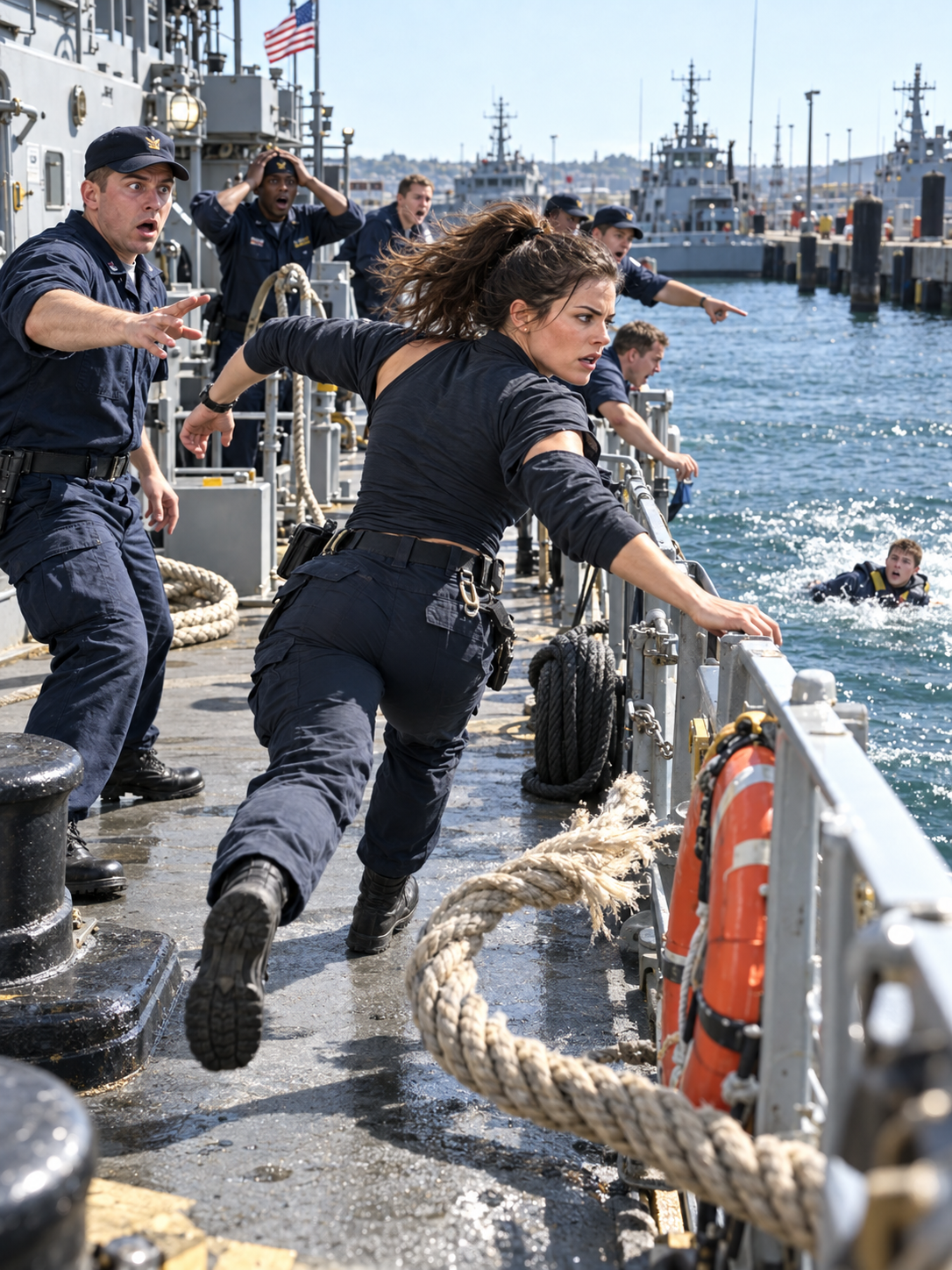
A petty officer grabbed my arm, shoved me off the boat, and told me the detail was for “real crew” while everyone watched. I said nothing, even though one sentence could have exposed who I was. Then a mooring line snapped like a gunshot, a nineteen-year-old sailor vanished into the harbor, and the same man who had dismissed me froze in panic. Seconds later, someone screamed for me to jump—and I ran toward the water he’d ordered me away from.
### Part 1
The pier was almost peaceful before sunrise, which was one of the reasons I had always liked waterfronts before the working parties arrived. Gray harbor water pressed softly against the timber camels, gulls argued somewhere beyond the fuel pier, and the smell of salt, diesel, wet rope, and old wood sat heavy in the cold air. I stood there with a paper cup of coffee cooling between my palms and a canvas seabag over one shoulder, enjoying what I thought would be my final morning of anonymity. Officially, I did not belong to that command until the following day.
I had come down early because twenty years in the Navy had taught me something briefings never could: if you want to know a waterfront, visit before everyone knows you are watching. The way lines are dressed tells you whether sailors respect stored energy, the condition of fenders tells you whether supervisors actually inspect their equipment, and the way junior sailors move tells you whether they have been taught or merely yelled at. I wore faded jeans, a soft canvas work jacket, and my hair loose instead of pulled into regulation. Nothing about me advertised rank, and for one more morning, I wanted it that way.
At the north end of the pier, eight sailors were working around a utility boat under the direction of a boatswain’s mate second class named Trevor Mercer. I did not know his name yet, only that he was maybe twenty-seven, broad through the shoulders, carrying a clipboard like it had been issued with command authority, and speaking loudly enough for the entire pier to hear him. He noticed me near the boat and immediately walked over. His eyes swept across my jacket, seabag, and loose hair, and I watched him decide exactly who I was without asking a single question.
“You’re in the wrong place,” he said. “Family day isn’t until Saturday.”
“I’m not here for family day.”
I said it without attitude because I had no interest in starting my relationship with a new command by humiliating one of its petty officers. Mercer could have asked who I was, checked my identification, or simply told me where visitors were permitted to stand. Instead his face tightened, and he stepped between me and the boat as though I had challenged him in front of his sailors. “Off the working area,” he said. “This detail is for real crew.”
Then he put his hand on me.
His fingers closed around my upper arm, and he shoved me backward two steps toward the bollards where visitors waited. It was not violent enough to injure me, but it was hard enough to make the point he wanted his sailors to see. A few heads turned, then quickly turned away, and one female diver near the equipment locker stared at Mercer with the expression of someone watching an equation produce an answer she did not trust. I could have ended the moment with four words, but the moment stopped mattering when I looked past him.
The boat was rigged wrong.
A spring line was taking too much of the boat’s load at an ugly diagonal instead of sharing it cleanly with the other mooring lines. Two fenders were riding too high, leaving the hull free to grind against the timber below them whenever a wake came through. Worse, a heavy line lay across the deck in a loose loop, and a young sailor was standing with his right boot inside it while bending over a shackle. He looked nineteen at most, narrow shoulders still filling out his Navy uniform, moving with that combination of eagerness and inexperience that makes young sailors both wonderful and terrifying.
I set my seabag beside the bollard and stayed.
Mercer glanced back at me. “Ma’am, I told you to move away from the detail.”
“I heard you.”
“Then why are you still here?”
“I’m not interfering.”
That answer irritated him more than an argument would have, but another sailor called his name and pulled his attention back toward the boat. I moved only a few feet, pretending to study the harbor while keeping the bad line in the corner of my vision. The female diver leaned toward another sailor and murmured, “Who is that woman?” but neither of them knew.
Standing there, I felt an old memory wake up in my hands.
Thirteen years earlier, I had been twenty-five and diving inside the brown zero-visibility water of a river mouth with my partner, Daniel Vega. Daniel had been the best waterman I ever knew, the kind of diver who could read tension through a line as if it were a language spoken directly into his fingers. He had a wife, a toddler daughter, a laugh that filled every locker room he entered, and an irritating habit of being right five minutes before everyone else caught up. During a recovery operation on a sunken vessel, the distance line connecting us went slack.
People who have never worked blind underwater do not understand what a slack line means.
A taut line is information. It tells you your partner is moving, working, alive somewhere beyond the darkness. A slack line gives you nothing but a question, and almost every answer is bad. I followed Daniel’s line through mud-thick water, found where it had fouled against torn metal, freed it, and reached him as fast as a human body could move.
I reached him.
I was not in time.
The investigation later cleared me of wrongdoing, and every official finding said the same thing: my actions had been appropriate, the response had been immediate, the loss was not attributable to negligence. The language was accurate and useless. Paper could say I had done everything right, but paper could not describe what it felt like to know exactly where your partner was and still arrive seconds after those seconds mattered.
Since that river, I had never been able to see a dangerous rig and simply walk away.
I watched the young sailor standing in the loop. His name, I would soon learn, was Noah Price, nineteen years old and eight months into his first enlistment. He shifted his weight while the line beside his ankle tightened and relaxed with the movement of the boat. Mercer was studying his clipboard, calling instructions without looking closely enough at what his sailors’ feet were doing. I moved closer, slow enough not to draw attention, and watched the water beyond the harbor entrance.
Then I saw the wake.
A larger vessel had passed through the channel at normal speed, leaving a broad rolling swell behind it. Nothing dramatic, nothing anyone had done wrong, just ordinary moving water traveling toward an improperly rigged boat. The first rise reached the hull, lifted it, and pulled the overloaded spring line tight enough to hum. Noah still had one boot inside the loop.
My coffee hit the pier.
I stepped forward.
The second swell was already coming.
And somewhere inside me, a clock I had been carrying since that river thirteen years earlier began counting down.
### Part 2
The first thing I heard was the line.
A loaded mooring line does not politely announce that it is failing. It stores thousands of pounds of energy until the fibers can hold no more, and then the whole argument ends at once. The crack that split the morning sounded like a rifle shot fired inside a metal room, and every sailor on the pier flinched before their minds caught up with what their bodies had already heard. I was moving before the broken line finished snapping backward.
Noah never had a chance to step clear.
The loop around his boot jerked tight as the line parted, ripping his leg sideways and taking the deck out from under him. The broken section struck across his shoulder as he fell, spinning him over the rail and into the narrow stretch of water between the utility boat and the timber camel. One second he was on deck; the next he was gone. His head surfaced once, his eyes wide and confused, before the hull rolled toward the pier again.
Someone screamed, “Man overboard!”
Everyone rushed to the edge, which was the most natural response and almost completely useless.
Mercer grabbed the orange life ring from its bracket and threw it toward Noah, but panic ruined his aim and it splashed several feet short. “Price! Grab the ring!” he shouted, leaning over the rail. Noah could not grab anything; he was half stunned, choking, and being pulled deeper into the narrow gap by the motion of the boat. The hull moved toward the timber with every swell, reducing several feet of black water to almost nothing.
That gap was a machine.
Tons of boat surged toward solid timber and then withdrew again, over and over, with Noah trapped inside the moving space. If he remained there for another cycle, we were not talking about a broken arm or cracked ribs. I shrugged out of my jacket, kicked off my shoes, and ran. Behind me, Mercer’s voice rose in pitch as control disappeared from it.
“Somebody call harbor patrol!”
“I need a line!”
“Price, stay with us!”
Then another voice cut through the panic.
“Let her through!”
A chief had come running from the barge, a weathered man named Dean Holloway who had spent enough years on waterfronts to recognize trained movement when he saw it. He did not know me, but he saw the way I approached the edge, watched me strip unnecessary weight without breaking stride, and understood that I was not a frightened civilian preparing to become a second casualty. He shoved two sailors aside. “Clear the edge! Give her room!”
I stepped off feet first.
Cold harbor water hit my body like a wall, squeezing the air from my chest and turning every nerve white for one brutal second. I let the cold be cold and nothing more, surfaced outside Noah’s reach, and moved behind him before his panicked arms could lock around my neck. He was coughing, fighting, and thrashing hard enough to make the water boil around us. I had never been happier to have someone fight me.
“Easy,” I said near his ear. “I’ve got you.”
He probably did not hear the words, but his body felt the support.
I slid one arm across his chest and under his forearm, keeping his face above water while positioning myself on the outboard side. That put my body between Noah and the closing gap, which was exactly where I needed to be and exactly where no sensible person would voluntarily stay. Above us, Chief Holloway had taken over the pier. His voice was suddenly the only calm thing in the entire harbor.
“Ease the boat off!”
“Get a ladder down!”
“Take tension slowly! Nobody gets inside that line!”
Mercer stood behind him, pale and frozen, staring at me.
The hull surged toward us.
I kicked backward and held Noah away from it until the movement stopped, then felt the boat retreat on the swell. One cycle. I watched the waterline, the angle of the hull, the rhythm of the wake reflecting from the pier. The second surge came, and this time I knew roughly how long the gap would remain open when the hull drew back.
Two cycles.
That was enough.
A pilot ladder dropped over the pier twenty feet forward of us. Two sailors climbed halfway down, extending their arms but staying clear of the dangerous water. Noah shuddered against me, coughed, and tried to turn toward the ladder. “Don’t fight me,” I told him. “You’re going home today.”
The sentence came out before I knew I was going to say it.
For one impossible instant, Noah’s soaked uniform became Daniel Vega’s dive gear in brown river water, and the teenager’s frightened breathing became the silence at the far end of that old line. I saw Daniel’s daughter as a toddler in the photograph he kept taped inside his locker. Then the harbor returned, sharp and cold, and the third swell began lifting the boat.
Not this time.
The gap opened.
I waited.
Every frightened instinct says to move the instant you see space, but almost open is not open, and almost safe has killed more sailors than fear ever has. I let the boat move another fraction away from the pier. The window widened.
“Now!”
I drove forward with Noah held against me.
We crossed the gap in two hard kicks, and hands caught his uniform at the bottom of the ladder. Chief Holloway’s sailors hauled him upward while Noah coughed water over the rungs. A roar went through the pier when his body cleared the surface completely.
Then the boat came back.
The ladder was crowded with Noah and the sailors lifting him. I had no clean route upward, and I was still on the wrong side of the hull’s movement. I saw the steel coming toward me and made the only decision the water left available.
I took one breath and went down.
Black harbor water closed over my head as the hull rolled above me. The underwater vibration passed through my chest like distant thunder, and my hands found timber beneath the surface. I flattened myself, let the moving boat pass, counted three slow beats, and pushed away when the pressure changed.
When I surfaced on the open side, Chief Holloway was staring down at me.
“You good?”
“Fine.”
“Ladder’s clear.”
I climbed out under my own power.
The pier had become strangely quiet. Noah lay on his side coughing while medical personnel came running from the shore. Mercer’s clipboard was face down on the wet planking several feet away, forgotten. I ignored everyone staring and knelt beside Noah, helping keep him positioned while he dragged air back into his lungs.
“Stay on your side,” I told him. “Good. Cough it out.”
His hand suddenly closed around my wrist.
He held me with surprising strength.
That was when Lieutenant Commander Aaron Kessler arrived.
He came fast, followed by two duty personnel, taking in the broken line, soaked deck, emergency crews, and nineteen-year-old sailor clinging to the wrist of an unknown woman. His eyes moved from me to the canvas jacket beside the bollard, then to the seabag I had brought down before sunrise. Something changed in his expression.
He knew.
Kessler straightened.
“Senior Chief Ellison?”
Mercer’s face went completely still.
I looked up from Noah.
“Yes, sir.”
“You’re not supposed to report until tomorrow.”
“I know.”
The commander glanced at the water and then back at me. “What are you doing here?”
I wiped harbor water from my face.
“I came down early to look at the pier.”
Behind him, Mercer stared at the same arm he had grabbed twenty minutes earlier.
And I watched the exact second he finally understood who he had shoved away.
### Part 3
My name is Mara Ellison, and at the time I stepped out of that harbor I had been a Navy diver for twenty years. I had completed more dives than I bothered counting anymore, supervised recovery operations, trained rescue teams, and spent enough hours in black water to understand that experience becomes useful only after pride has been burned out of it. The orders inside my seabag named me the incoming senior enlisted leader of that waterfront detachment. Mercer had not shoved some lost visitor from his boat detail.
He had put his hands on the senior chief who would become part of his chain of leadership the next morning.
That fact spread across the pier without anyone needing to repeat it.
Mercer opened his mouth. “Senior Chief, I—”
“Later.”
I held up one hand, not angry, because Noah was still shivering hard enough that his teeth clicked. A corpsman was wrapping him in warming blankets while another checked his breathing, and all I cared about was hearing the cough improve instead of worsen. Mercer’s apology could wait until nobody’s airway was in danger.
Lieutenant Commander Kessler crouched beside us. “Ambulance is coming through the gate.”
“Good,” I said. “He took a hit across the shoulder before he went in.”
Kessler nodded and looked toward the boat. “Anything else immediate?”
“Get that boat stabilized before another wake comes through. Nobody touches the parted line until safety documents it.”
Chief Holloway was already doing exactly that.
He caught my eye while giving orders and gave me a small nod. Later he walked over while Noah was being transferred to the ambulance and stopped beside me. The two of us were dripping harbor water onto the same deck, although he had never gone in. He looked at my soaked clothes, then toward the boat, then back at me.
“Senior Chief,” he said quietly.
Just two words.
Yet there was more respect in the way he said them than in half the ceremonies I had attended during my career. Holloway had recognized what I was before he recognized who I was. He had trusted technique instead of insignia, and on a bad waterfront morning that mattered more to me than anyone snapping to attention.
Mercer remained ten feet away.
The anger I expected to feel toward him never really arrived.
I remembered his hand on my arm, certainly, and I remembered “real crew,” but those things had become small beside the sight of Noah disappearing between the hull and the pier. Mercer’s contempt had embarrassed me for perhaps thirty seconds. His failure to inspect that rig had nearly created a death his conscience would carry for fifty years.
That was the mistake that mattered.
The mishap investigation began before lunchtime.
Photographs were taken, measurements recorded, witness statements collected, and the boat’s rig reconstructed as closely as possible. Investigators found the same things I had seen within seconds: overloaded spring line, poor lead angle, fenders too high, unsafe line management, and a sailor permitted to work with his boot inside a loaded loop. None of it was complicated.
That made it worse.
Catastrophes built from exotic failures can be difficult to prevent. This one had been assembled from ordinary mistakes every sailor on that detail had supposedly been taught to recognize. When the board asked for my statement, I gave them times, positions, observations, and actions without drama. Then one officer leaned forward.
“Senior Chief Ellison, we also have reports that Petty Officer Mercer physically removed you from the work area shortly before the mishap.”
“Yes.”
“Did he know your identity?”
“No.”
“Would you characterize his conduct?”
I knew what the room expected.
I could have ended Mercer’s career without exaggerating anything. He had grabbed and shoved a woman he thought was a civilian. He had failed to supervise a hazardous evolution. A nineteen-year-old nearly died. Every sentence necessary to bury him was already sitting in front of me.
Instead I said, “His supervision was inadequate to the hazard. His judgment toward me was unprofessional, but those are separate failures, and the first one is the reason we’re sitting here.”
The investigating officer studied me. “You don’t consider the physical contact relevant?”
“I consider it wrong. I don’t consider my bruised pride more important than Noah Price going into the water.”
That ended my statement.
Two days later I found Mercer standing alone near the north end of the pier after the working parties had secured for the afternoon. The damaged line was gone and a new rig was in place, but he stared at the same cleat as though the broken one were still attached. He heard me approach and straightened immediately.
“Senior Chief, I owe you an apology.”
“You do.”
His face tightened.
“But not the apology you’ve been rehearsing.”
He looked confused.
I stopped beside him and pointed at the water. “Putting your hands on me was arrogant. Deciding who I was before asking a question was stupid. I’ve been underestimated by better sailors than you, Mercer, and I’m still here.”
“Yes, Senior Chief.”
“The rig is different.”
He swallowed.
“If Price had died in that gap, you would hear that line snap every quiet night for the rest of your life. You would remember exactly where his boot was, exactly where you were standing, and exactly what you should have seen. I know that because I’ve carried a different line for thirteen years.”
Mercer finally looked directly at me. The defensive sharpness I had seen the first morning was gone.
“What happened?”
“Not important for this lesson.”
He waited.
Then he asked something I did not expect.
“Why are you helping me?”
That question saved him with me.
Not because I had forgiven him, and not because one humble sentence erased what he had done. It saved him because it told me he had stopped thinking about how to protect himself and had finally started wondering what came next.
“Because the next sailor on your line won’t care how guilty you feel,” I said. “And because regret is useless if it doesn’t improve your hands.”
I made him rerig the boat.
We stayed until the sun dropped lower over the harbor, dressing three proper lines so the load was shared, lowering fenders where they could actually protect the hull, and removing every careless loop from the deck. I made Mercer show me every bite before I pointed to it. I made him explain where a broken line would travel and where no human body should ever stand.
He did not complain once.
When we finished, the rig was clean.
Mercer looked at it for a long moment, then asked, “Senior Chief, the man you mentioned…the line you still carry. Did you lose someone?”
I stared across the gray water.
“Yes.”
“Was it your fault?”
For thirteen years, I had known the Navy’s official answer.
That evening, for the first time, I realized I no longer knew mine.
### Part 4
Daniel Vega died in 2013, and no amount of paperwork ever changed the way that sentence felt inside my chest.
The official investigation found no negligence. Our equipment had met standards, the visibility was effectively zero, and the fouling that trapped his line could not reasonably have been predicted. I had reached him as quickly as conditions allowed. For years, people repeated those facts as though enough correct facts might eventually rearrange what happened.
They never did.
I built my career around the difference between being close and being in time.
I checked lines twice when once should have been enough. I watched young divers until they probably thought I had eyes in the back of my head. I became patient with frightened sailors and merciless with sloppy equipment, and every time someone told me I was unusually attentive, I accepted the compliment without explaining that attention purchased with a friend’s life never feels like a gift.
The night after Mercer and I rerigged the boat, I sat alone in the dive locker.
Wet neoprene hung from metal racks, tanks stood in rows against the wall, and the room smelled of salt, rubber, canvas, and old water. I leaned forward with my forearms on my knees and stared at my hands. Those hands had reached for Daniel thirteen years earlier and grabbed Noah Price three days ago.
For most of those thirteen years, I had secretly kept an account.
I had never admitted it aloud, because saying it would have exposed how irrational it was. Somewhere beneath all the professional language I had told myself that enough rescues might eventually compensate for Daniel. Save enough people, train enough divers, prevent enough accidents, and perhaps one day the numbers would balance.
Noah destroyed that idea.
Saving him did not bring Daniel back.
Daniel dying did not make Noah’s survival smaller.
The two truths simply existed beside each other, and for the first time I understood that they did not have to cancel. Noah was not payment. Daniel was not a debt.
I sat in that locker until my hands stopped shaking.
Then I cried for Daniel Vega without turning the tears into an investigation, a lesson, a responsibility, or a promise to perform better tomorrow. I grieved my friend because he had been my friend. The simplicity of it hurt more than guilt and healed more than guilt ever had.
The next morning I reported aboard officially.
I wore a clean uniform, carried my orders into Lieutenant Commander Kessler’s office, and stood in front of his desk exactly as planned before a bad rig changed everyone’s introduction to me. Kessler read the orders he already knew, looked at me over the page, and shook his head with a tired smile.
“Most incoming senior enlisted leaders bring coffee on their first day.”
“I did bring coffee, sir.”
“You threw it on the pier.”
“I had a scheduling conflict.”
He laughed once, then became serious. “Half this waterfront watched you go into that gap for a sailor after one of our petty officers shoved you aside. You’re not going to have difficulty earning credibility here.”
“With respect, sir, I don’t want them following the story.”
Kessler raised an eyebrow.
“I want them following the standard. The story happened because the standard failed.”
He leaned back and considered that.
Then he nodded.
At quarters, I did not mention Noah’s rescue.
I did not mention Mercer’s hand on my arm, the line snapping, Daniel, or what anyone owed me. I told the sailors what I expected: clean load paths, correct fender placement, no feet inside bites, no guessing around stored energy, and no fear of speaking when a rig looked wrong. I promised them that anyone willing to learn would find me patient and anyone willing to gamble with another sailor’s life would find me much less patient.
Then I put them to work.
Mercer’s boat was the first one I inspected.
I walked the pier slowly, checking each line the same way I would for every crew from that day forward. When I reached his detail, I looked at the spring, breast lines, fenders, deck, and sailors’ positions. Everything was right.
“Clean rig, Mercer.”
His head came up.
“Thank you, Senior Chief.”
That was all.
Publicly acknowledging a corrected mistake matters. If you only remember a sailor when he fails, you are not training him; you are collecting evidence against him. Mercer had done something dangerous, then done the work necessary not to repeat it, and I intended to make both facts real.
The female diver who had watched our first confrontation was named Elena Navarro.
She was a first class petty officer in her early thirties, strong underwater, careful with equipment, and observant enough to notice tension before people announced it. I watched her for a few weeks and realized she was approaching the stage of her career when she would either become the kind of leader who protected standards or the kind who protected comfort. So one afternoon I called her to a work barge where a line was taking a lead I disliked.
“Tell me what’s wrong.”
Navarro studied it. “Angle’s too sharp.”
“What else?”
She crouched, followed the line with her eyes, and pointed. “There’s a bite behind that cleat.”
“Good.”
I had her put one gloved hand lightly against the line, not where it could trap her, but close enough to feel vibration. “Feel that?”
She nodded.
“That’s a line being asked to do too much.”
Navarro looked toward me. “Like Price’s line.”
The rescue had become waterfront folklore despite everything I did to keep it from becoming a legend.
“Yes,” I said. “Like Price’s line.”
We redressed it together.
Before leaving, I told her, “Someday you’re going to see something wrong on somebody else’s detail. You’ll tell yourself it isn’t your deck, and staying quiet will feel respectful.”
Navarro waited.
“Don’t stay quiet. Find a way to preserve the leader’s authority, but say something.”
She nodded slowly.
“How do you know when to push?”
I thought about Daniel.
“When the cost of politeness is higher than the cost of being uncomfortable.”
A week later I saw Navarro stop a junior sailor before he stepped into a loaded loop. She did not yell or embarrass him. She tapped his shoulder, moved him two feet, and showed him why.
The sailor corrected himself.
Nobody applauded.
Nobody wrote an award citation.
And I realized that might have been the most important thing to happen on that pier all month.
Then, one Friday afternoon, the quarterdeck called me.
“Senior Chief, there’s a civilian asking for you.”
I expected paperwork.
Instead I found a woman in her fifties standing beside the gate with a folded letter held tightly between both hands.
“My name is Laura Price,” she said.
And immediately I knew whose mother she was.
### Part 5
Noah’s mother did not run toward me, hug me, or make the kind of emotional scene people imagine after a rescue.
I was grateful for that because I would not have known what to do with it.
Laura Price simply stood under the weak afternoon sun in a blue cardigan, holding a folded piece of paper and trying not to cry. She looked tired in the particular way parents look after spending several nights waking up to check whether a child in the next room is still breathing.
“He’s home,” she said.
“I heard.”
“He keeps saying he’s fine.”
“He’s nineteen. That’s what nineteen-year-olds say.”
For a second she laughed, and the laugh broke halfway through.
Then she held out the letter.
“I tried to write something because I knew if I came here, I wouldn’t be able to say it.”
“You don’t owe me anything, ma’am.”
“I know.”
She placed the paper in my hand anyway.
“But I need you to have it.”
There were six lines.
She wrote that Noah was alive, sleeping in his own bed, eating too much cereal, complaining about being restricted from duty, and driving his younger sister crazy exactly the way he had before the accident. She wrote that ordinary annoyance had become beautiful to her. The final line thanked me for returning ordinary life to their house.
I folded the paper along the same creases and put it in my cargo pocket.
Laura touched my wrist lightly, exactly where Noah had gripped it after coming out of the water. “Thank you.”
Then she left before either of us had to figure out what came after that sentence.
I still carry the note.
Three weeks after the accident, I stood on the pier before sunrise with cold coffee in one hand and Laura’s letter in my pocket. The harbor was flat again, innocent-looking in the way dangerous things often are when nobody is asking anything of them. Mercer’s crew would arrive soon.
He had changed.
Not magically, and not because shame had transformed him into some perfect sailor overnight. Mercer still had an ego, still occasionally spoke before thinking, and still liked having the loudest voice on a working party. What changed was what he looked at.
His eyes went to feet now.
To lines.
To load paths.
To the water.
One morning I watched him stop a detail because a junior sailor had thrown a loop carelessly across the deck. Six weeks earlier he might have barked at the sailor for being sloppy and kept moving. Instead he crouched beside him.
“You see where your boot is?”
The sailor looked down.
“Yes, Petty Officer.”
“Tell me what happens if that line loads.”
The sailor answered.
Mercer nodded. “Good. Move your feet, then fix the line.”
No humiliation.
No performance.
Just correction.
When he noticed me watching from farther down the pier, his expression changed slightly. I gave him a single nod and kept walking.
That was all he needed from me.
I never forgot what he had done on my first morning.
I did not forgive it in the sentimental sense either. People treat forgiveness like an obligation placed on the person who was wronged, as though refusing to pretend something did not matter makes you bitter. I was not bitter. I simply did not need to turn Mercer’s behavior into something harmless before I could continue working with him.
He had been arrogant.
He had been unsafe.
He had nearly paid for both with another sailor’s life.
Then he learned.
That was enough for us to move forward professionally, and no more was required.
Noah returned to limited duty several weeks later.
The first time I saw him back on the pier, he stood several feet away from any working line and looked at the water like it had personally insulted him. I walked over beside him.
“You planning on staring it into submission?”
He smiled nervously. “Working on it.”
“How’s the shoulder?”
“Fine.”
“Your mother says you say that too much.”
His head snapped toward me. “You met my mom?”
“She found me.”
“Oh, no.”
I laughed.
“She was very polite.”
Noah rubbed the back of his neck. “Senior Chief… I don’t remember much after the line hit me.”
“That’s probably fine.”
“I remember being underwater. Then I remember your voice.”
I looked out across the harbor.
“What did I say?”
“You said I was going home that day.”
I had forgotten.
Noah had not.
“I’m glad you listened.”
“I didn’t exactly have a choice.”
“Best kind of sailor.”
He laughed, and the sound released something small inside my chest.
Over the next months, the waterfront became what I had hoped it could be.
Navarro earned more responsibility and became relentless about line safety without becoming cruel about it. Mercer turned into one of my most dependable supervisors, precisely because he had learned how thin the distance was between an ordinary morning and a funeral. Chief Holloway became the person I drank coffee with when neither of us wanted to talk, which is one of the better kinds of friendship after a certain age.
And the dramatic story everyone had told for the first few weeks gradually became less interesting.
That pleased me.
Because the real victory was not the rescue.
The real victory was that there was no second rescue.
No more sailors went into the gap because the rigging improved. No one lost fingers to snapback because supervisors started watching where sailors stood. Junior personnel corrected one another before small mistakes became stored energy.
Most mornings became boring.
Boring is beautiful on a waterfront.
Boring means everyone goes home.
Sometimes, usually before sunrise, I still thought about Daniel Vega.
Not as debt anymore.
Just Daniel.
I remembered his laugh, his habit of stealing the good coffee, the ridiculous fishing cap he wore whenever regulations allowed it, and the photograph of his daughter taped inside his locker. I remembered the river too, because healing did not erase anything.
But when that old memory came, Noah stood beside it now.
Not replacing Daniel.
Not balancing him.
Just existing beside him.
One man gone.
One boy alive.
Both true.
That was enough.
One morning Mercer approached while I was inspecting the north-end lines.
“Senior Chief?”
“What?”
He hesitated. “I’ve always wondered something.”
“That usually means I’m about to regret listening.”
He smiled carefully. “That first morning. Before Price went over. Why didn’t you tell me who you were?”
I checked the fender nearest my boot before answering.
“Would it have changed the rig?”
Mercer looked at the boat.
“No.”
“Would knowing my rank have moved Price’s foot out of that bite?”
“No.”
“Then my rank wasn’t the important information.”
He stood quietly for several seconds.
Finally he said, “I would’ve treated you differently.”
“I know.”
“I hate that.”
I looked at him.
“Good.”
He blinked.
“You should hate it enough that the next stranger gets treated correctly before you know whether she outranks you.”
Mercer nodded.
“Yes, Senior Chief.”
He walked away.
I finished checking the lines.
The sun was coming up by then, turning the gray harbor brighter without making it warmer. Sailors were arriving in groups, boots striking the pier, radios crackling, diesel engines starting, the waterfront slowly remembering how to make noise. I touched the folded letter inside my cargo pocket.
People sometimes ask what I learned from the morning Mercer shoved me away and Noah went into the water.
They expect me to say something satisfying about respect.
Maybe that you should never underestimate anyone.
That is true, but it is not the lesson I carried away.
The harder lesson is that you do not have to spend your life correcting everyone who misjudges you.
Sometimes proving who you are is simply pride wearing formal clothes.
Mercer had looked at me and decided I was nobody important. I could have corrected him immediately. I could have given him my name, rank, position, qualifications, and history until the whole working party snapped straight.
None of it would have fixed the line.
Competence did.
Attention did.
Training did.
A chief who recognized calm movement did.
A frightened nineteen-year-old who kept breathing did.
And afterward, what mattered was not making Mercer feel as small as he had tried to make me.
What mattered was making sure the next sailor never went into the water.
So I still arrive early.
I still carry cold coffee.
I still walk every line myself whenever I can.
I inspect the leads, loads, fenders, knots, working areas, and every loose loop that might someday find a boot. Because a properly dressed line at dawn is a sailor who probably gets to complain about dinner that night.
And after twenty years around unforgiving water, I cannot think of anything more worthwhile than that.
If someone decides you are nobody before learning a single thing about you, let them be wrong.
You do not always owe them a speech.
You do not always owe them your résumé.
You do not even owe them the satisfaction of watching you become angry.
Save your energy for the moment that matters.
Because someday the line may part.
The gap may open.
Somebody may be in the water.
And when that happens, everything people assumed about you becomes worthless.
Only what you can actually do remains.
Get the sailor out.
Then check your lines.
THE END!
Disclaimer: Our stories are inspired by real-life events but are carefully rewritten for entertainment. Any resemblance to actual people or situations is purely coincidental.

