
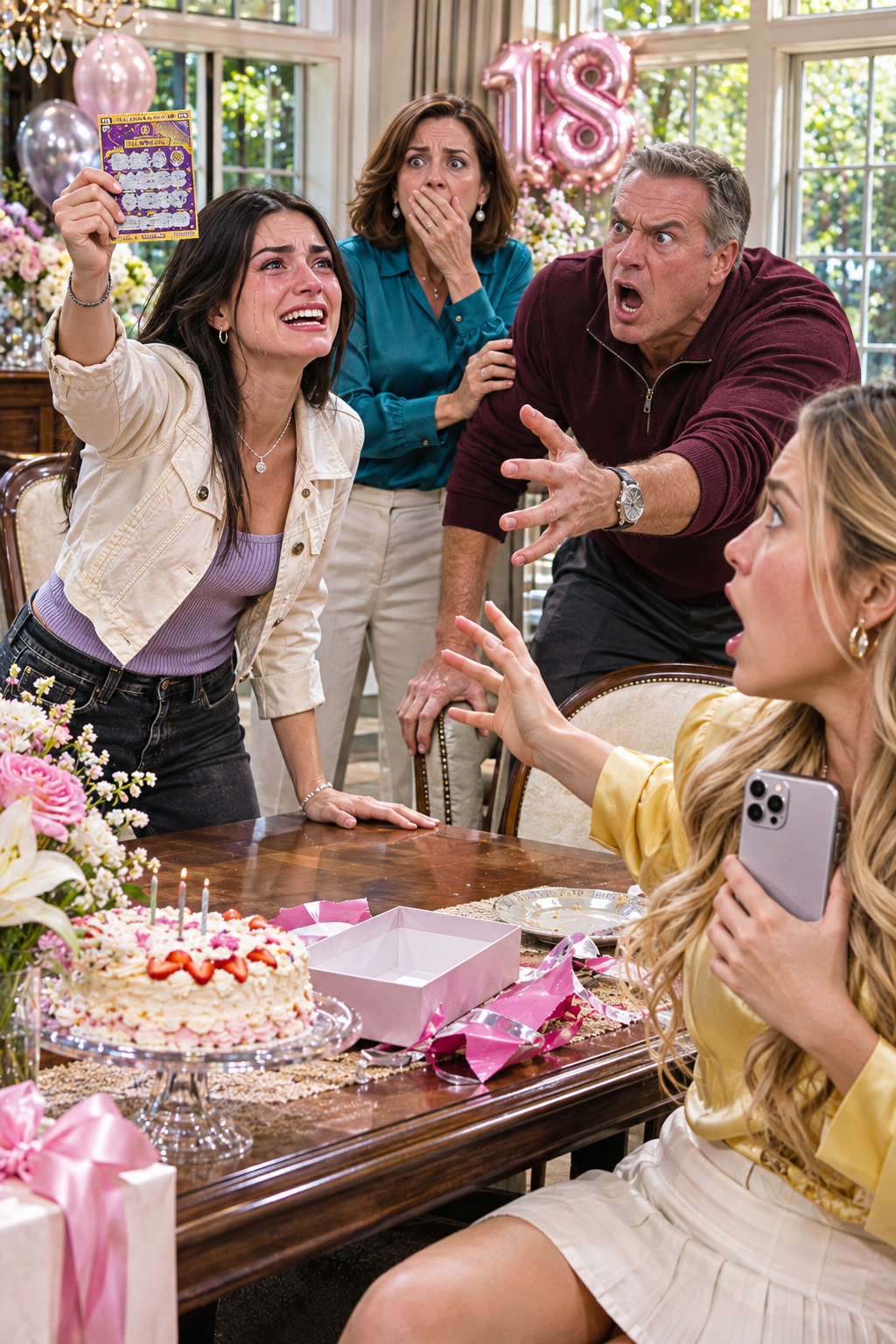
For My 18th, My Parents Got Me A New Phone. My Sister, 20, Burst Into Tears. Dad Took It Out Of My Hands And Gave It To Her, Then Tossed Me A $2 Scratch-Off. “I’ve Scratched 10,000 Of These. Maybe You’ll Get Lucky.” That Night, I Texted Him: “You Were Right, Dad.” 3 Days Later, Dad Found Out His $2 Joke Won $200,000. He Wanted Half…
On my eighteenth birthday, my father took the brand-new phone he’d just given me and handed it to my older sister because she started crying. To replace it, he tossed a two-dollar lottery ticket beside my cake and laughed about my chances. My mother watched without saying a word. I thanked him, walked out, and made a decision I wouldn’t take back. Three days later, Dad demanded half of my $200,000 winnings, but a bank statement revealed something even worse than his birthday joke.
## Part 1/5
My name is Laurel Keene, and the summer I turned eighteen, I learned that the difference between being loved and being useful can fit inside a two-dollar lottery ticket. We lived outside Parkersburg, West Virginia, in a white ranch house with an uneven front porch and a driveway my father had promised to repave since I was eleven. My dad, Curtis, operated a forklift at a distribution warehouse, and my mother, Diane, worked in the cafeteria at a public elementary school. My older sister, Whitney, was twenty, took community college classes when she felt like it, and had never been expected to solve a problem that someone else could solve for her.
The rules of our family were never written down, but I could have recited them from memory. Whitney needed reliable transportation, so she received the used Honda that was supposedly intended for both of us, while I walked to my part-time job even after earning my driver’s license. Whitney needed expensive dental work, so Dad arranged a payment plan, while my own crooked front tooth became something he described as giving me character. When she wanted money for a weekend trip, Mom quietly found it somewhere, but when I mentioned tuition for welding school, Dad suggested I consider working full-time instead because college wasn’t for everybody.
I stopped asking for things around my fifteenth birthday, not because I wanted to make a statement, but because disappointment had become exhausting. My high school shop teacher, Ms. Porter, introduced me to Leonard Hensley, a sixty-eight-year-old welder who owned a fabrication shop on the outskirts of town. Len smelled permanently of machine oil and cinnamon toothpicks, had a gray beard trimmed close to his chin, and considered three consecutive compliments a sign of poor judgment. He hired me to sweep floors, sort metal scraps, and organize tools, promising I could eventually learn the equipment if I proved capable of respecting it.
For the first year, I spent more time cleaning than welding, but Len gradually let me practice on discarded steel plates after school. By graduation, I could repair farm gates, fabricate simple brackets, and lay down a respectable weld without anyone standing over my shoulder. I bought my boots, gloves, protective hood, and most of my clothes with money I’d earned, saving every dollar possible for a welding certificate program scheduled to begin in August. I had $3,100 in a credit union account my mother had helped open when I was fourteen, and although her name remained on it, I thought of that money as the first thing in my life that belonged entirely to me.
Then came my eighteenth birthday, a Tuesday in June when the air was so humid that even the kitchen windows seemed to sweat. Mom made tacos, my favorite dinner, followed by chocolate cake with thick peanut butter frosting, and for a while I let myself enjoy being the center of attention. After we finished eating, she brought out a wrapped box, while Dad leaned back in his chair with a smile I hadn’t seen directed at me in months. I opened it and found a beautiful new smartphone, still sealed in its packaging, several generations newer than the cracked hand-me-down I’d been carrying since sophomore year.
For perhaps thirty seconds, I believed something had changed. Dad said I’d worked hard and deserved something nice, and Mom looked genuinely happy as I turned the box over in my hands. Across the table, Whitney stopped scrolling through her own phone and stared at mine, her expression moving from curiosity to disbelief before her eyes filled with tears. “Mine’s almost two years old,” she complained, her voice rising, “and you told me we couldn’t afford another one, but apparently Laurel gets whatever she wants.”
Mom reached toward her, but Dad moved faster, taking the unopened phone directly out of my hands and setting it in front of Whitney. “She’s your sister,” he told me, as though that explained everything, “and you’re eighteen now, old enough to understand that sometimes family comes first.” Whitney began peeling away the plastic before I could respond, while Mom lowered her eyes toward the cake and pretended to search for the correct knife. I looked at Dad and said, “It was my birthday present,” but he merely waved his hand and reached into his shirt pocket.
He dropped a two-dollar scratch-off ticket beside my plate, its bright mountain illustration looking ridiculous against the chocolate frosting. “I’ve bought thousands of these things and never won more than twenty bucks,” he said, laughing, “but maybe you’ll get lucky.” Whitney was already asking where the phone charger was, and Mom started cutting the cake into unusually small squares as though keeping her hands occupied could make the conversation disappear. I slipped the ticket into my pocket, pushed my chair underneath the table, and told Mom not to save me a slice.
Outside, the sun was still hanging over the trees, turning the road pale silver beneath the summer haze. I walked past the neighboring farms until I reached Rudd’s Corner Market, a gas station with two pumps, a refrigerated bait cabinet, and a wooden bench that had been repaired so many times it barely resembled the original. Dad bought his morning coffee and lottery tickets there before work, occasionally letting me scratch one with his house key when I was little. I sat on that bench with my damaged phone in my lap, wondering why I could stand being treated unfairly for years but couldn’t stop thinking about those thirty seconds of happiness.
Eventually, I remembered the ticket and pulled my house key from my pocket. The game was called Mountain Match, and its instructions promised the corresponding prize if three matching amounts appeared, although I expected nothing more than a little gray dust on my jeans. The first amount was $200,000, the next was $10, and the third was $50, but when another $200,000 appeared, I stopped breathing for a moment. I scratched the remaining spaces carefully, watched a third $200,000 emerge, and stared at the cardboard until the numbers blurred.
Inside the market, the cashier, Mavis Rudd, scanned the ticket twice before looking at me over her reading glasses. “Laurel, sweetheart,” she whispered, “you need to sign the back of this immediately, because this isn’t something I can pay out here.” I signed it while she explained that a prize this large had to be verified and claimed through the state lottery office in Charleston, then photographed both sides with my battered phone. When she asked where I’d bought it, I told her Dad had given it to me instead of my birthday present, and her expression changed in a way I didn’t understand until much later.
I asked her not to tell anyone, and she promised it wasn’t her news to share. Outside, I sat on the bench again and sent Dad a message that said, “You were right, Dad,” which earned a reply reminding me to mow the lawn the next morning. I looked at the ticket once more, folded it carefully behind my driver’s license, and started walking toward Len’s welding shop instead of home. I had just turned eighteen, I was holding a possible fortune, and for the first time in my life, the person I trusted least to know about my good luck was my own father.
## Part 2/5
Len was sitting outside his shop when I arrived, drinking iced tea beneath a porch light surrounded by moths. He studied my face, set his glass down, and asked whether my birthday had been as bad as he suspected, so I told him about the phone, Whitney’s tears, Dad’s joke, and the ticket. He listened without interrupting, except when I mentioned the scanner, at which point he removed the toothpick from his mouth and asked to see what I’d brought. He held the ticket beneath the porch light, examined my signature, and said, “Before you do anything else, we’re putting this somewhere your father can’t reach it.”
We locked the ticket inside the steel safe bolted to Len’s office floor, and he offered me the small apartment above the shop for the night. It had a narrow bed, a refrigerator that rattled every twenty minutes, and one window overlooking the gravel parking lot, but I felt safer there than I had in my childhood bedroom for years. Len made two things clear before turning out the lights: he would drive me to Charleston the following morning, and I would still be expected at work when my regular schedule resumed. “Money can give you choices,” he said, “but it can’t tell you which choices are worth making.”
The next morning, we left before sunrise in his battered work van, passing empty gas stations and mist-covered fields on the way south. At the lottery office, I filled out several pages of paperwork, presented my identification, and watched an employee carefully inspect the ticket before accepting it for verification. She explained that taxes would reduce the final amount and that processing could take several weeks, information that made the prize seem simultaneously enormous and strangely distant. I walked out holding a stamped claim receipt instead of two hundred thousand dollars, but Len smiled when I showed it to him and said, “That’s what a legitimate beginning looks like.”
On the way home, I asked him to stop at a credit union branch where nobody knew my parents. I wanted an account in my name alone, and the representative helped me open one before asking whether I needed to transfer funds from my existing savings. When she pulled up my old account, I noticed a number that made me lean forward because the balance showed only $914. I explained that I should have approximately $3,100, and she printed a transaction history showing a withdrawal of $2,186 made nine days earlier through a transfer authorized by the other account holder.
For several seconds, I couldn’t speak. My mother’s name was listed as the person who had initiated the transfer, and although the bank representative couldn’t explain why she’d done it, she confirmed the money had gone into another account belonging to Mom. I asked for copies of the transaction records, declined to move the remaining balance until I understood what had happened, and left with a folder that suddenly felt more important than my lottery receipt. Len didn’t ask questions until we reached the van, where I handed him the statement and watched his jaw tighten.
“Did you know about this?” he asked. I shook my head, explaining that I’d deposited most of my paychecks and only checked the balance occasionally because I had no reason to believe anyone was touching it. He tapped the withdrawal date with one thick finger and reminded me that I’d been working overtime that week to help pay for my welding program. Then he said something that stayed with me long after the drive ended: “People who take from someone they think won’t complain usually get comfortable doing it.”
Mom was home when I returned that afternoon, standing at the kitchen counter with a dish towel over her shoulder. She greeted me like nothing had happened, offered leftover birthday cake, and said Dad expected me to apologize for walking out during dinner. I set the bank statement on the counter and asked where my money had gone, watching the color drain from her face before she even looked at the paper. She began to say she’d been meaning to explain, but I interrupted and asked her to tell me what possible explanation justified taking more than two thousand dollars from money I’d earned myself.
She sat down slowly and admitted Whitney had fallen behind on her car payments because she’d been spending too much at the boutique where she worked. Dad had cosigned the car loan, and the lender had warned that further missed payments could create serious problems for both of them. “We were only borrowing it until things settled down,” Mom whispered, adding that she had planned to replace the money before my classes started. I asked whether Dad knew, and when she answered that he’d been the one who suggested it, I realized the stolen birthday present hadn’t been a momentary lapse in judgment.
I went upstairs, packed my work clothes, welding gear, school documents, and the few personal things I cared about, while Mom stood in my doorway asking me not to make a permanent decision over a temporary problem. I told her she had nine days to tell me she’d taken my money and had chosen not to, just as she’d chosen to remain silent when Dad gave away my phone. She reached for my arm, but I stepped aside and told her I would be living above the welding shop until I could make other arrangements. Before leaving, I asked her to tell Dad that I wanted the missing money returned, without mentioning the lottery ticket.
That evening, Whitney posted a picture of herself holding her new phone, enclosed in a pink case, with a caption about having the world’s best father. A few minutes later, Mom texted that Dad thought I was being selfish and should appreciate everything they’d done for me, which I read twice before putting my phone face down. I had spent years believing Whitney received more because my parents thought she needed more, but now I knew they’d been using what I earned to maintain her comfortable life. What I didn’t know was that Dad had already begun counting on my lottery winnings to cover a problem much larger than one overdue car payment.
## Part 3/5
Friday morning began with the smell of hot steel, grinding dust, and Len’s terrible coffee. I was repairing a trailer hinge when my phone started vibrating across the workbench, first with calls from Dad, then Mom, then Whitney, until I finally turned it over and saw fifteen missed calls. I hadn’t told anyone about the ticket except Len and Mavis, but the messages arriving every few seconds made it obvious that my secret was no longer safe. Dad’s latest message said, “That ticket belongs to me, and you’d better answer before I come down there.”
I learned what happened at Rudd’s Corner Market from Len’s friend, a retired truck driver named Harold who witnessed the entire exchange. Dad had arrived for his regular coffee and two scratch-offs, then entertained the usual morning crowd by explaining how he’d replaced his daughter’s expensive birthday present with a two-dollar ticket. He laughed about my dramatic departure, claiming I was probably hiding at the welding shop until I ran out of money, and Harold said several customers joined in before Mavis finally spoke. “She did get lucky, Curtis,” Mavis told him, then quietly explained that the ticket had won the top prize.
Dad reportedly spilled his coffee onto his boots and demanded to know whether she was joking. When Mavis repeated the amount, he announced that he’d bought the ticket himself and therefore owned it, apparently forgetting that he’d just told everyone he’d given it to me. Harold said the market went silent while Dad argued, and Mavis finally reminded him that a present didn’t become a loan simply because it turned out to be valuable. He left his coffee and two fresh tickets untouched on the counter, drove straight home, and started calling everyone who might know where I was.
Around noon, Dad’s pickup came tearing into the shop parking lot, followed by a spray of gravel against the open bay door. He marched inside with Mom and Whitney behind him, stopped beside my worktable, and demanded that I tell him where I’d hidden his money. I removed my welding hood, set it carefully on the bench, and explained that the ticket had already been submitted at the lottery office in Charleston. His expression changed when I mentioned signing the back, and he turned toward Len as though my employer had personally arranged the entire situation to humiliate him.
“You know perfectly well that was my ticket,” Dad said, pointing at me, “and I paid for it with money I earned.” I reminded him that he’d handed it to me at my birthday dinner, immediately after taking away the phone, and asked whether he’d also intended to reclaim the cake after I’d eaten it. Whitney made a small choking sound before covering her mouth, while Mom stared at the floor and Len stood beside the workbench with his arms folded. Dad insisted he hadn’t known the ticket would win, so I answered, “Neither did I, which is why you thought it was an acceptable gift.”
When he couldn’t convince me, Dad demanded that Mom explain how families were supposed to share their good fortune. She looked between us, visibly frightened, before admitting that she’d watched him hand me the ticket and had understood it as a birthday present. Whitney reluctantly confirmed the same thing, adding that she remembered Dad laughing about my chances while she opened the phone. Dad fell silent for several seconds, then lowered his voice and proposed what he apparently considered a reasonable compromise: I could keep half the winnings, provided I transferred the remaining half to him after receiving the money.
I asked why he needed one hundred thousand dollars, and he responded with a list of household expenses, mortgage payments, and sacrifices he’d supposedly made raising two daughters. When I mentioned the $2,186 he’d already taken from my savings, he shot Mom a furious look and accused her of discussing private family finances. I held up the transaction statement and explained that the bank had shown me exactly what happened, including the date and the account holder who authorized it. Dad didn’t apologize; instead, he said Whitney’s situation was an emergency and that I would’ve helped willingly if I’d understood how serious things were.
“Then why didn’t anybody ask me?” I said, but his only answer was that I was being difficult because I’d never had real responsibilities. Whitney suddenly announced that her car wasn’t a luxury because she needed transportation to work, even though I’d spent three years walking to my own job. I turned toward her and told her to keep the birthday phone because I intended to buy my own, then reached into my pocket and took out a fresh two-dollar scratch-off I’d purchased the previous evening. I placed it in Dad’s palm and said, “Maybe you’ll get lucky.”
For a moment, he simply stared at the ticket. Then he looked toward Len, apparently expecting someone older to correct my behavior, but Len stepped forward and told him our conversation was finished because we had paying customers waiting. Dad shoved the ticket into his pocket, promised I would regret turning my back on family, and stormed toward the truck with Whitney close behind him. Mom lingered long enough to whisper that things had gotten out of control, but when I asked whether she’d return the money from my savings, she said nothing and followed them outside.
That afternoon, Dad removed me from the family phone plan, leaving my old phone without cellular service just as I was trying to arrange transportation for school. Len drove me to a phone store, where I bought an inexpensive replacement and signed up for my own plan, using money I’d earned rather than money I hadn’t received yet. I thought the confrontation was over until Monday morning, when a message arrived from the lottery claims department requesting additional documentation because another person had contacted them disputing ownership of the winning ticket. Attached was a statement from my father claiming he’d never intended to give it away permanently.
## Part 4/5
The letter arrived on a Wednesday, exactly eight days after I’d submitted the winning ticket. I sat in Len’s office reading it while the big ventilation fan hummed outside, trying to understand why the lottery needed proof that something handed to me at my own birthday party belonged to me. Dad’s statement claimed he’d temporarily given me the ticket to cheer me up and had expected it returned, an explanation so different from what happened that I wondered whether he’d convinced himself it was true. Len read the letter, called a local attorney named Ada Mercer, and arranged an appointment before I could talk myself into handling it alone.
Ada was a practical woman in her early forties who worked from a small office above a pharmacy downtown. She explained that Dad’s complaint didn’t automatically establish ownership or entitle him to the winnings, but it could delay payment while the lottery reviewed the conflicting information. She asked me to describe the birthday dinner without leaving anything out, then collected my photographs, claim receipt, text messages, and the names of everyone who’d witnessed Dad giving me the ticket. When I finished, she studied the paperwork and asked, “Does your father understand that his own witnesses contradict his statement?”
I told her I didn’t know what Dad understood anymore. Ada contacted Mavis, who agreed to provide a written account of what I’d told her on my birthday and what Dad had publicly said at the market three days later. Harold and another customer confirmed hearing him describe the ticket as a gift before learning about the prize, while Whitney initially refused to become involved because Dad had warned her against taking sides. The following afternoon, Mom called and asked whether it was true I’d hired an attorney, but instead of answering, I asked if she’d be willing to tell the lottery what happened at dinner.
She remained silent long enough for me to hear dishes clattering in the background. Finally, she admitted Dad had instructed her to say the ticket was never meant to replace the phone, despite the fact that she’d watched him take my present away. I told her I wasn’t asking her to choose between her husband and her daughter; I was asking her to describe something she’d personally witnessed. She began crying and said Dad had been frightened about money for months, which made me think of the missing savings and ask why nobody had mentioned those problems before.
Two days later, Mom came to the shop without Dad. She carried a manila envelope containing bank statements, old receipts, and a handwritten list of household expenses, then asked Len whether we could speak privately in his office. She admitted the $2,186 transfer hadn’t been the first time she’d used my savings to help Whitney, and the records showed four additional withdrawals over the previous eighteen months totaling $3,420. Some had covered vehicle expenses, one had paid for a community college course Whitney dropped, and another had funded part of a beach trip Dad had told me Whitney purchased herself.
I stared at those statements for a long time, adding the withdrawals until the total reached $5,606. Mom explained that Dad had always considered me responsible enough to manage without assistance, while Whitney supposedly needed extra support to become independent. When I asked whether either of them had intended to reimburse the earlier withdrawals, Mom admitted they’d never agreed on a schedule because every time they had extra money, something else seemed more urgent. It wasn’t one emergency or one poor decision; my parents had treated my wages as a backup fund for a sister who earned money but rarely faced the consequences of spending it.
“That’s why he wants half,” I said, looking up from the statements, and Mom nodded without meeting my eyes. Dad had cosigned Whitney’s increasingly expensive car loan, carried balances on several credit cards, and borrowed against the house to cover other family spending, all while insisting there was never enough money for my education. He viewed the lottery prize as a way to erase years of decisions he didn’t want to acknowledge, and he genuinely believed that because he’d raised me, he deserved control over the solution. Mom finally looked at me and whispered, “I should have stopped this long before your birthday.”
I told her an apology wouldn’t restore the money or give back the years I’d spent believing I simply deserved less. She signed a statement describing the birthday dinner, agreed to provide the financial records to Ada, and acknowledged in writing the amount she’d taken from my savings, promising to repay it through regular payments. I didn’t hug her when she left, although I thanked her for telling the truth, because doing one decent thing after years of silence didn’t erase everything that came before. That evening, Ada called to say she’d received Mom’s statement and was submitting our response to the lottery, but Dad had been warned of the conflicting evidence and was refusing to withdraw his complaint.
The situation changed the following week when Dad’s own attorney contacted Ada after reviewing the witness statements. He explained that Dad had been advised there was no credible basis for claiming the ticket had only been loaned to me, particularly after publicly describing it as my birthday gift. Continuing to dispute the claim would require Dad to defend an account contradicted by several witnesses, including his wife, and his attorney recommended ending the matter. Dad eventually withdrew his objection, but before Ada could finish explaining the next steps, she added one more detail: he’d asked whether I might voluntarily give him money if he agreed never to contact me again.
## Part 5/5
I told Ada that Dad didn’t need to negotiate permission to stay out of my life. If he wanted no contact, he could stop calling, and I wasn’t going to purchase peace from someone who’d already taken enough from me. Ada relayed that I wouldn’t discuss a payment, confirmed the lottery had received the withdrawal of his objection, and helped me review the remaining paperwork. The entire process had cost me time, attorney fees, and several nights of sleep, but it had also given me something I’d never had before: a clear record of what my family had done and the freedom to decide how much contact I wanted with them.
The winnings arrived several weeks later, after the required taxes and processing. I won’t pretend the amount left in my account didn’t make my heart race, because I’d never imagined possessing that much money while barely old enough to vote. But I didn’t buy a sports car, book a vacation, or announce anything online, and the first payment I made was directly to the technical college for my welding certificate program. Then I purchased a reliable used car, professional tools, and a welding machine comparable to the equipment Len had taught me to use.
I asked Len whether I could keep renting the apartment above his shop, offering to pay for repairs and the roof he’d been complaining about for years. He refused to let me replace the roof as a gift and insisted that if I lived there, I would pay ordinary rent like anyone else. We settled on a reasonable monthly amount, and he made me write it on a calendar so I’d never become careless about obligations simply because I could afford them. Most of the remaining money went into savings and conservative investments after I met with an independent financial adviser, someone Ada recommended because he had no relationship with my parents.
Dad never apologized for filing the ownership complaint. Instead, he sent messages insisting that he’d raised me for eighteen years and deserved something in return, occasionally attaching amounts he claimed to have spent on my childhood as though feeding and clothing me had been optional services. Eventually, he wrote that I would understand his perspective when I had children of my own, which was the last message I read before blocking his number. I wasn’t interested in debating whether a parent should be reimbursed for raising a daughter, and I refused to let his disappointment become another bill I was expected to pay.
Whitney contacted me about a month later, after Mom stopped covering the car payments and Dad told her she’d need to contribute more of her own earnings. Her first message included an apology for taking the phone, followed almost immediately by a question about whether I’d truly keep all the lottery money. I answered that she could keep the phone, but she needed to stop treating my income as a family resource, and she responded that I was acting superior because I’d gotten lucky. I didn’t argue because a conversation with someone who considered my boundaries an insult was unlikely to change either of us.
Mom began repaying the money she’d taken, sending monthly transfers accompanied by brief messages describing how much remained. I had Ada retain the signed acknowledgment and transaction records, not because I wanted to punish her, but because I no longer considered verbal promises sufficient protection. Mom also arranged to remove herself from our old joint account and helped transfer the remaining balance into my personal account. When she asked whether she could visit me at the shop, I agreed occasionally, provided Dad and Whitney weren’t invited and our time together didn’t become another conversation about what I owed the family.
By August, I was attending classes four days a week and working at Len’s shop whenever my schedule allowed. My instructors expected precision, patience, and an ability to correct mistakes without pretending they hadn’t happened, which suited me better than anything I’d experienced at home. In October, Len increased my wages and officially listed me as an apprentice, handing me a paycheck with my name printed across the top. I pinned the pay stub beside the framed copy of my lottery claim receipt, and when he asked which one meant more, I pointed to the paycheck because it represented something no one could claim they’d given me by accident.
The following spring, Mom came by one Wednesday afternoon carrying a chocolate cake with peanut butter frosting. She’d been picking up additional hours through the school district, and her repayments were continuing, although I knew it would take time for her to return everything. We ate at the small table upstairs while she told me about her work and asked about my classes, and for once she didn’t mention Dad or try to convince me to come home. Before leaving, she admitted she was attending counseling to understand why she’d spent so many years avoiding conflict at her daughters’ expense.
I told her I hoped it helped, and I meant it, but when she asked whether I could ever forgive what happened, I couldn’t give her the answer she wanted. “I don’t hate you, Mom,” I said, “but I can’t go back to trusting you just because you’re finally doing the right thing.” She nodded, wiped her eyes, and left without asking me to reconsider. I watched her car disappear down the gravel road, feeling sad about what we’d lost but relieved that I no longer had to pretend everything was fine to keep someone else comfortable.
I finished my welding certificate program with strong evaluations and accepted a permanent position at Len’s shop, where I began taking responsibility for more complicated fabrication projects. We also started planning how I might gradually purchase a share of the business after gaining more experience, an arrangement Len insisted would be based on proper contracts rather than promises. I wasn’t ready to own a shop yet, but I liked having something to work toward that couldn’t be taken away by somebody else’s tears. My winnings gave me security, while the work gave me a reason to get out of bed every morning.
I heard through Mom that Dad still kept the unused scratch-off I’d placed in his hand during our confrontation. He’d never scratched it, and sometimes she saw him take it from the visor of his truck, stare at it, and put it back. Maybe he was waiting for the right moment, or maybe he couldn’t bring himself to discover that the ticket was worth nothing. I didn’t ask her to find out, because whatever he hoped to discover inside that piece of cardboard had stopped being my concern.
On the anniversary of my eighteenth birthday, I bought one two-dollar ticket from Mavis and took it outside to the old wooden bench. I scratched it with my house key, just as Dad had taught me when I was little, and uncovered a complete loser. Mavis laughed when I showed her, and I laughed too, because the money had never been the most important thing that happened on that bench. What mattered was that I’d finally stopped measuring my worth by what my family was willing to give me, and I walked back to the shop knowing I had built a life they could no longer take away.
THE END!
Disclaimer: Our stories are inspired by real-life events but are carefully rewritten for entertainment. Any resemblance to actual people or situations is purely coincidental.


