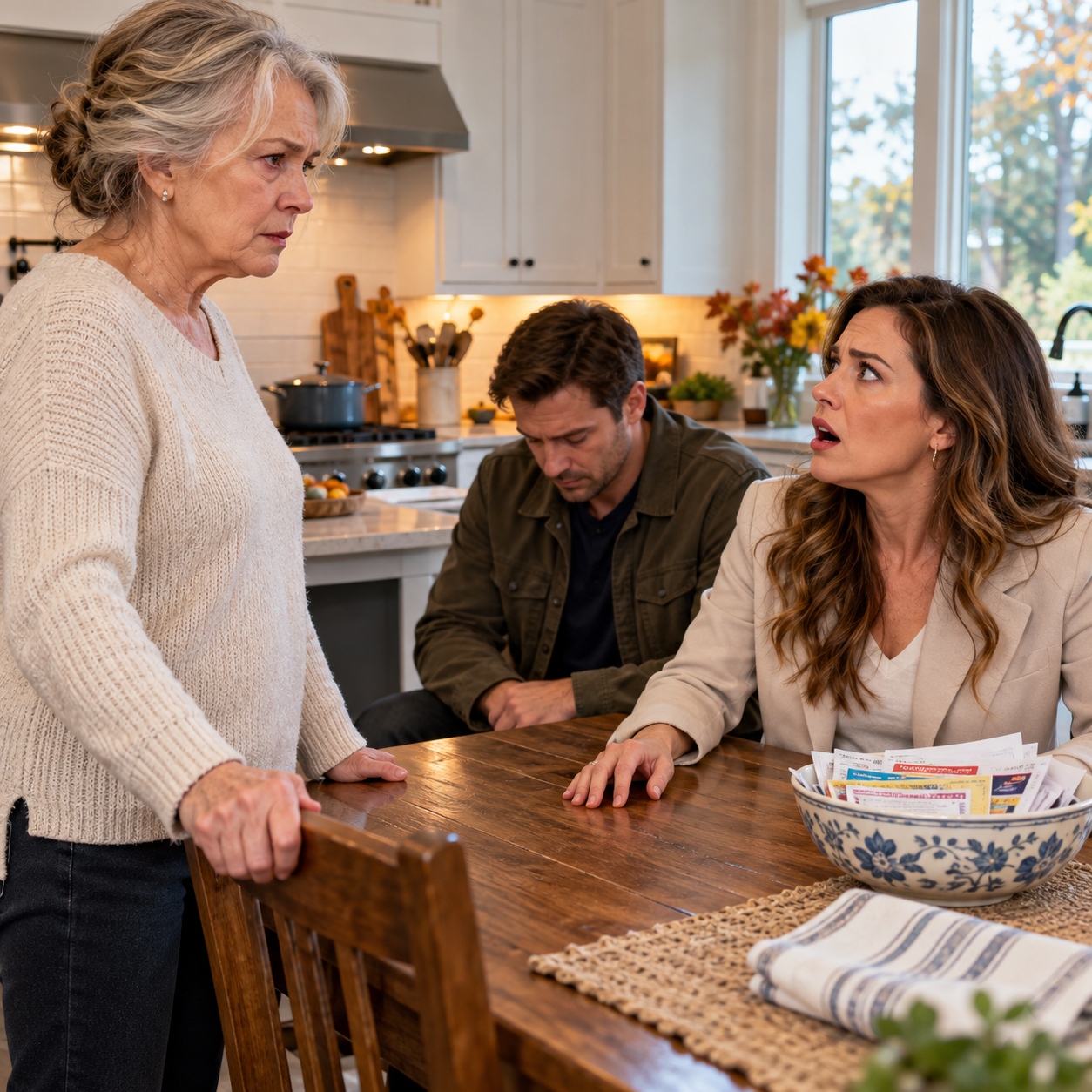
Part 2: An old contractor estimate revealed the lie behind everything
The date bothered me enough that I called the contractor the next morning. I introduced myself as a family member reviewing the proposal and asked whether the project was active. A man named Carl remembered Evan’s address immediately. “We priced that last winter,” he said. “They decided not to move forward. Haven’t heard from them since.”
After hanging up, I spread the papers across my desk. Rebecca had presented that folder as if a crew were waiting for a deposit and their kitchen might collapse without my check. There had been no urgency. Whatever they needed thirty-eight thousand dollars for, it was not countertops.
I scanned the estimate and sent Evan one message: I spoke with the contractor. I know the project was shelved months ago. When you’re ready to tell me what the money was actually for, I’ll listen.
He called twice without leaving a message. Rebecca said nothing.
Three days later, Evan arrived alone.
I had seen my son embarrassed as a boy, but adult shame sat differently on him. He remained standing in my living room until I pointed toward the couch. “The kitchen wasn’t completely fake,” he said. “We really do want to renovate.”
“That isn’t what I asked.”
He pressed his palms together. “We have debt.”
“How much?”
His eyes moved toward the photograph on my mantel of Mark holding newborn Lucy. “A little over twenty-six thousand. Credit cards mostly. Some medical bills from Ben’s surgery, things from when I was unemployed, then balance transfers. It got away from us.”
“And the renovation?”
“Rebecca thought asking for money to pay debt would make us look irresponsible.”
I stared at him. “So asking me to finance a luxury kitchen seemed responsible?”
“When you say it like that—”
“How would you say it?”
He rubbed both hands over his face. Rebecca had suggested the story, he admitted, but he had agreed because he was frightened by the interest charges. They had also built my monthly six hundred dollars into their normal household budget, which meant canceling it had already caused trouble.
Then he said something I knew had cost him effort.
“We thought you’d call after Rebecca said no contact.”
“Why?”
He looked down. “She thought you’d panic about the kids. That you’d want to fix things.”
“And fixing things meant giving you the money?”
“I didn’t think of it that way.”
“You should.”
His shoulders dropped. “Yeah.”
The urge to rescue him was still there. He was my son; that fact did not disappear because he had behaved badly. But loving him no longer meant protecting him from every consequence.
“I’m not paying the debt,” I said. “The monthly transfers are finished too. Permanently.”
He swallowed and nodded.
“If you want help making a budget, I’ll sit down with you. I’ll pay for one session with a qualified financial counselor. But I will not hand over money to erase choices you hid from me, and I will not pay for access to my grandchildren.”
“That isn’t what I want.”
“It became what you allowed.”
He left that evening without asking me to reconsider. Oddly, that was the first hopeful thing that had happened between us in months.
A few weeks later, Evan emailed me a spreadsheet. Every card was listed with its balance, interest rate, and minimum payment. Some charges made me angry—restaurants, electronics, a vacation they clearly could not afford—but others came from unemployment and Ben’s medical care. The numbers told a more complicated story than I wanted: not two villains plotting against me, but two frightened adults who had let pride and bad decisions turn into manipulation.
We met at a library conference room the following Saturday. Evan brought statements, canceled subscriptions on his phone, and agreed to sell their newer SUV. I never touched his accounts and never wrote a check. For the first time in years, helping my son meant helping him carry something instead of carrying it for him.
Rebecca contacted me six weeks after the no-contact declaration.
I think we should talk, her text said.
We met at a coffee shop where neither of us had home-field advantage. Rebecca was already there, both hands wrapped around a paper cup. “I handled this badly,” she said.
“That’s true.”
Her mouth tightened, but she continued. “I was embarrassed about the debt. When you wanted to pay the contractor directly, I felt like you were treating me like a child.”
“I was asking for accountability.”
“I know.” She looked down at her coffee. “At the time, it felt like you were saying I couldn’t be trusted.”
I waited.
After several seconds she said, “And when you wouldn’t give us the money, I wanted you to understand what it felt like for us to say no to you.”
There it was. Not cruelty for cruelty’s sake, but pride wounded badly enough to become punishment.
“You used Lucy and Ben to teach me a lesson.”
Rebecca’s fingers tightened around the cup.
“Yes,” she said.
It was the quietest word she had ever spoken to me.
Part 3: We rebuilt our family after ending the old arrangement
I did not forgive Rebecca at that coffee shop. I told her I appreciated the honesty, but honesty did not erase the weeks when two children had wondered where their grandmother had gone. She said they had told Lucy and Ben the adults needed space, and I told her adult conflicts should never turn children into bargaining chips.
We agreed on new rules. If Rebecca or Evan had a problem with me, they would speak to me directly. I would not be automatic childcare, and declining a request would not become evidence that I did not love them. Most importantly, nobody would threaten a relationship between the children and a grandparent to gain money, cooperation, or an apology.
I saw Lucy and Ben the following Saturday at a park. Lucy ran into me so hard I nearly lost my balance, while Ben immediately asked whether we could still plant tomatoes in spring. I hugged them both, said absolutely, and refused to turn our reunion into a speech about their parents.
The debt took longer to repair than the relationships. Evan and Rebecca sold their SUV and bought a used sedan, canceled a vacation, stopped using two credit cards, and met with the counselor I had offered to pay for. Their kitchen stayed exactly as it was, including the chipped tile beside the dishwasher and the cabinets Rebecca had once described as unbearable.
Four months after the ultimatum, they invited me for Sunday dinner. I arrived half-expecting another uncomfortable conversation and instead found pot roast on the table, Lucy doing homework at the counter, and Rebecca carrying mismatched plates from the cabinets she had wanted replaced.
After the children went upstairs, Evan cleared his throat. “We paid off the smallest card.”
“How much?”
“Thirty-two hundred.”
Rebecca gave a tired smile. “It seems silly to celebrate when there’s still so much left.”
“It isn’t silly,” I said. “It’s progress.”
No one asked me for money.
That mattered more than a dramatic apology would have.
Rebecca and I remained careful with each other. Sometimes I heard irritation in her voice when I could not babysit, and sometimes I caught myself volunteering before she even asked. We both had habits to unlearn. The difference was that now we noticed them.
Evan began calling on Sundays again, often with no request attached. The first time he asked about my watercolor class and actually remembered the painting I had mentioned the week before, I laughed. “You remembered that?”
“I’m trying, Mom.”
“I know.”
My own life had changed during the separation. Tuesday evenings belonged to watercolor. I joined a morning walking group, took another trip with Diane, and learned to eat dinner with friends without keeping my phone beside my plate. A quiet house no longer felt like evidence that someone had forgotten me.
In early spring, Lucy and Ben came over to plant tomatoes. Rebecca dropped them off at ten and asked, “Would two o’clock be all right for pickup?” The old arrangement was contained inside that simple question: she was asking instead of assuming, and I was free to answer.
“Make it three,” I said. “We’re baking bread too.”
When Rebecca returned, she stood for a moment in the kitchen where our fight had begun. Then she placed a small envelope beside my purse.
“This isn’t repayment for everything,” she said. “Evan said not to make it weird.”
I waited until they left before opening it.
Inside was a six-hundred-dollar check and a handwritten card.
First month we didn’t need yours.
I called Evan that evening. “I’m tearing up the check.”
“I figured you would.”
“But I’m keeping the card.”
He was quiet for a moment. “Good.”
By summer, we were not the family we had been before, and I finally understood that this was a good thing. The old family had depended on me saying yes, swallowing irritation, providing money, and mistaking exhaustion for devotion. What replaced it was less convenient and more honest.
Rebecca eventually apologized plainly. It happened while we were washing dishes after Lucy’s birthday dinner, without an audience or carefully chosen speech. She handed me a wet plate and said, “I’m sorry I used the kids to scare you. I kept telling myself I was protecting my family, but mostly I was protecting my pride.”
I dried the plate before answering. “Thank you for saying that.”
“I don’t expect you to forget.”
“I won’t.”
She nodded, and strangely, that was the moment I trusted her most.
Almost a year after the night she declared no contact, I sat at my kitchen table with coffee and the newspaper when Evan sent me a message.
Just checking in. Hope your class went well last night.
There had been a time when I would have answered instantly, grateful simply to have been remembered. Instead, I finished the article, carried my cup to the sink, and replied when I was ready.
Stopping the money had not destroyed our family. Neither had boundaries, separate plans, unanswered phones, or the word no. What nearly destroyed us was pretending that love could be measured by how much one person was willing to surrender.
Once we stopped doing that, we finally had something worth rebuilding.
The End .
All characters and events in this story are fictional, created for storytelling and entertainment purposes. Thank you sincerely for reading. Your feedback and support are invaluable and motivate me to continue sharing more stories with you.