
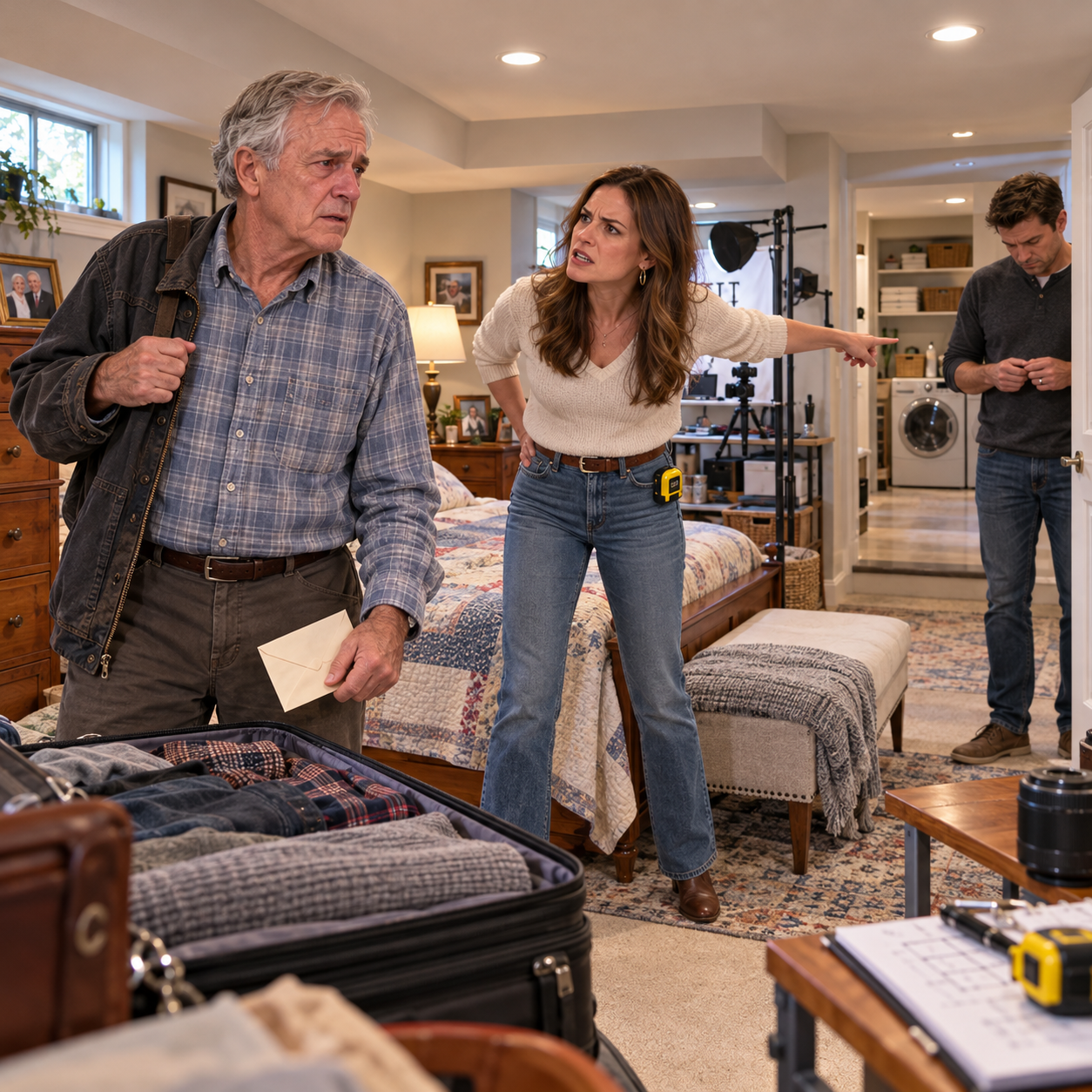
Part 2: A Newspaper Reveals My Fortune And Changes Their Plans
The first person from my old household to see my new truck was Caroline. We crossed paths outside a farmers’ market, where she was pushing Miles in his stroller and carrying a shopping bag full of decorative candles. Her gaze traveled from the keys in my hand to the clean silver pickup parked behind me. “You bought a truck?” she asked, before quickly adding, “I hope you’re being careful with your savings.”
I smiled at Miles, who reached toward me with both hands, and lifted him from the stroller. Caroline watched while he grabbed my collar and pressed his cheek against mine, just as he’d done during those long evenings in the basement. “I’m managing,” I told her when she asked about my living arrangements. She waited for me to elaborate, but I simply kissed Miles and handed him back.
Three days later, the local business newspaper published a report about the technology company’s land purchase. The article mentioned forty-six acres near Schoolcraft, a $7.9 million transaction, and the name of the retired machinist who had owned the property. By lunchtime, my phone held five missed calls from Ben and three messages from Caroline. The last one asked whether I could come to their house for a private family conversation.
I didn’t answer immediately. That Saturday, June helped me prepare dinner for a few friends at my newly purchased house, including Elena and Marcus. We were finishing dessert when Ben’s car pulled into the driveway, and moments later he and Caroline stood on my porch without the children. I invited them inside, although something about the way Caroline studied the furniture told me why they’d come.
“Is that article accurate?” Ben asked after a few uncomfortable minutes. I confirmed the sale and explained that the land had belonged to my father long before either of them was born. Caroline lowered herself onto the edge of the couch. “So you had all that money when you left?” I nodded and said, “Four days before. I was planning to tell you on Sunday.”
I went to the bedroom and returned with the envelope I’d intended to give them. Instead of handing it over, I unfolded my original notes and explained the mortgage payment, the children’s education funds, and the investment I’d considered making in Ben’s business. He stared at the paper for a long time. “You were going to do all that for us?” he asked, and I answered that I had been considering it because I thought we were building a family together.
Caroline looked toward June, then back at me. “We couldn’t have known, Harold. You never told us about the land.” I agreed that she couldn’t have known, but reminded her that she’d known I was her husband’s father and her children’s grandfather. Ben asked whether the plans could still be discussed, and I folded the paper carefully before returning it to its envelope. “Not tonight,” I said.
After they left, the calls became frequent. Caroline sent pictures of the children, asked about my meals, and offered to bring groceries. Ben began mentioning increased mortgage payments and the expensive loan Caroline had taken out to launch her studio. I answered kindly but avoided discussing money, though I attended Sophie’s school concert and promised her she could visit my new workshop.
Then my longtime friend Frank Miller called with something that disturbed me. Ben had approached him at the veterans’ club and asked whether I’d seemed confused or forgetful recently. He’d mentioned the possibility of someone needing authority over my financial affairs. Frank had told him I was perfectly capable of managing my own life, but the conversation left him uneasy enough to warn me.
I made an appointment with my attorney, Rebecca Sloan, the following morning. She arranged an independent cognitive evaluation with a qualified physician, reviewed my financial documents, and prepared an estate plan naming June as my financial agent if I ever became unable to act for myself. The doctor’s written assessment confirmed I was competent to make my own decisions. Rebecca also began establishing independently managed education trusts for the grandchildren.
Two weeks later, Ben invited me to dinner for my birthday. He sounded nervous, although he said he and Caroline wanted to repair our relationship. I accepted because I missed the children and still hoped my son might acknowledge what had happened. When Caroline called that afternoon asking me to arrive early to soothe Miles, I agreed to help for the evening.
The nursery was warm, with a small nightlight illuminating the stuffed animals along the shelf. Miles settled against my shoulder while I walked slowly beside his crib, listening to the soft hum of the furnace. Then I heard Caroline’s voice coming from the two-way baby monitor on the dresser. Someone downstairs had left the kitchen unit transmitting.
“Daniel will bring the paperwork,” she said, sounding impatient. “The doctor is only there to make it look like we’re being responsible.” Ben answered something I couldn’t hear, and she continued, “Your father has millions sitting in an account while we’re worrying about losing this house. If he signs the authorization, you can manage it before somebody else convinces him to waste it.”
Ben replied more clearly this time. “Dad isn’t confused, Caroline. He knows exactly what he’s doing.” She sighed, and I heard a cupboard close. “Then tell Daniel he’s been acting strangely since your mother died. People will believe he’s vulnerable. Once we have control, everything will be easier.”
I placed Miles in his crib, checked that he was sleeping comfortably, and looked down at the gray monitor. I hadn’t expected tenderness from Caroline that evening, but I hadn’t expected to hear them preparing to misrepresent my mental condition, either. Downstairs, the doorbell rang, and through the nursery speaker I heard her tell Ben to put on a welcoming face.
When I returned to the dining room, two extra guests were waiting. One introduced himself as Caroline’s cousin Daniel, an attorney, and the other was a retired physician she described as an old family acquaintance. After dessert, Daniel opened a leather folder and placed a document in front of me. The heading read DURABLE POWER OF ATTORNEY, and my son’s name was already filled in as the proposed agent.
Part 3: The Papers On Their Table Finally Showed Me The Truth
Daniel spoke pleasantly, explaining that sudden wealth could be overwhelming for someone my age. Caroline nodded throughout his presentation, while Ben sat beside her with his fingers pressed tightly together. When Daniel suggested that allowing Ben to manage my accounts would offer protection and peace of mind, I asked whether he had prepared the document based on an independent assessment of my abilities. He glanced toward Caroline before admitting he had not.
I opened the folder I’d brought from home and placed my doctor’s evaluation beside his paperwork. Then I added the signed estate documents Rebecca had prepared, explaining that my legal and financial arrangements were already established. Daniel read the first page slowly, his expression becoming increasingly uncomfortable. “I wasn’t informed these measures were in place,” he said, directing the statement toward Caroline.
The retired physician adjusted his glasses and asked whether I had recently experienced problems with memory or judgment. I told him I hadn’t, then explained that my decision to sell inherited farmland had taken almost a year of negotiations and extensive legal review. Finally, I mentioned the nursery monitor. “You may want to know that the conversation in your kitchen carried upstairs while I was putting my grandson to bed.”
Caroline’s face tightened, and Ben pushed his chair away from the table. I repeated what I’d heard about my money, the proposed authorization, and the suggestion that they should describe me as confused. Daniel closed his folder and said he would not participate in obtaining any signature under those circumstances. The retired physician also excused himself, explaining that any legitimate concerns about capacity would require appropriate independent medical evaluation.
After the front door closed, Caroline began crying. She said their debts had become unmanageable and that she genuinely feared Ben’s business ambitions would disappear if they couldn’t find financial stability. The studio had cost more than expected, their mortgage payments were behind, and she believed my new fortune could solve everything. “We weren’t trying to hurt you,” she said. “We were desperate.”
I believed they were desperate. I’d seen the bills piled beside their microwave and heard Ben arguing with lenders while he thought I was asleep downstairs. But desperation hadn’t forced them to remove me from their home or invent concerns about my mental health. Those were decisions they’d made while believing I had little power to refuse them.
“Ben,” I said, turning toward my son, “when your mother was sick, she worried about leaving me alone. She asked you to check on me after she was gone.” His eyes filled, and he looked toward the hallway where family photographs hung above the staircase. “I know, Dad,” he whispered. I asked whether he’d been thinking about her when he told me to leave, or when he agreed to sign papers that could have put my finances under someone else’s control.
He covered his mouth with one hand before answering. “I kept telling myself Caroline understood the situation better than I did.” I waited while he searched for something else to say. Eventually he admitted he’d enjoyed having me handle the children and household responsibilities, even while knowing I was unhappy. He hadn’t wanted to confront his wife, and after learning about the inheritance, he’d allowed himself to think her plan might be justified.
I told them both that I would always love my grandchildren, but I would not sign their document, pay their debts, or surrender control of the life I’d spent decades building. Caroline asked whether that meant I intended to cut them off completely. I answered that I wasn’t making decisions about the children at their dinner table, but any future relationship with them would require honesty and respect. Then I collected my papers and went home.
The following week, Rebecca finalized two protected education trusts for Sophie and Miles, with an independent professional trustee overseeing the funds. Their parents would have no authority to withdraw money for mortgages, loans, or personal expenses. I also arranged to contribute to the elementary school library where Ruth had volunteered for years. The principal agreed to establish a children’s reading room in her memory, with a quiet corner overlooking the playground.
I spent time with people who had shown me kindness without expecting anything in return. June had been postponing important repairs to her roof, so I arranged for a contractor and persuaded her to let me cover the bill. After learning Elena was only two semesters from finishing nursing school, I offered to pay the remaining tuition through the school. Marcus accepted my help purchasing essential equipment for the small repair shop he’d been hoping to open.
None of those arrangements made the situation with Ben easier. He came to my house one afternoon in December, looking exhausted, and admitted that the mortgage company had sent another warning. Caroline’s business was struggling, and she’d lost several clients after falling behind on their work. He asked whether I might help them catch up, promising to repay everything when circumstances improved.
I poured him coffee and listened without interrupting. When he finished, I told him I wouldn’t lend money, although I was willing to help him review his finances or find a reputable debt counselor. “You can afford it,” he said quietly, staring at the coffee cup. “Yes,” I answered. “But being able to pay doesn’t mean I should pretend nothing happened.”
His face reddened, and for a moment I thought he might leave without speaking again. Instead, he asked whether I believed he had ever loved me. I told him I did, but that love was not an excuse for refusing responsibility when someone needed him to do what was right. We talked for another hour, longer than we’d spoken honestly in years, and when he left he thanked me for hearing him out.
On the morning after Christmas, June and I packed for a long-planned train journey west. Ruth had always wanted to see the Rocky Mountains from a sleeper car, and I’d decided to make the trip with June and two longtime friends. At the station, just before boarding, I noticed Ben approaching along the platform. He was alone, carrying a folded piece of construction paper.
“Sophie wanted you to have this,” he said, handing me a drawing of a train with her grandfather smiling through one window. Underneath, she’d written that she hoped we could build another birdhouse when I came home. I folded it carefully and put it inside my coat, beside the old envelope I’d carried since the night I moved out. Ben watched me for a moment before saying, “Dad, I owe you an apology that has nothing to do with the money.”
He admitted he’d been afraid of losing his marriage, afraid of their debts, and too ashamed to admit how much they’d relied on me. None of those fears justified his choices, he said, and he didn’t expect me to forgive him immediately. I reached out and rested my hand on his shoulder. “Start by becoming someone your children can depend on when things are difficult,” I told him. “The rest of us can work from there.”
He promised Sophie could visit after my trip, provided I was comfortable with it. I said I’d like that, and we agreed to speak again when I returned. There was no dramatic embrace, no sudden repair of everything we’d damaged, only my son standing beside me long enough to say something true.
As the train pulled away, I watched the platform disappear behind us. June handed me a cup of coffee, and outside the window the winter fields stretched toward the horizon. For years I’d believed I needed to make myself useful to deserve a place in someone else’s home, but now I had a home of my own, friends who valued my company, and grandchildren I could love without surrendering my independence.
I took Ruth’s unfinished travel list from my pocket and unfolded it beside Sophie’s drawing. She had marked the mountain journey with a small blue star, and underneath she’d written a reminder to bring warm socks and a good book. I smiled, settled back into my seat, and turned toward the passing countryside.
For the first time in a long while, I wasn’t waiting for anybody to tell me where I belonged.
The End .
All characters and events in this story are fictional, created for storytelling and entertainment purposes. Thank you sincerely for reading. Your feedback and support are invaluable and motivate me to continue sharing more stories with you.


