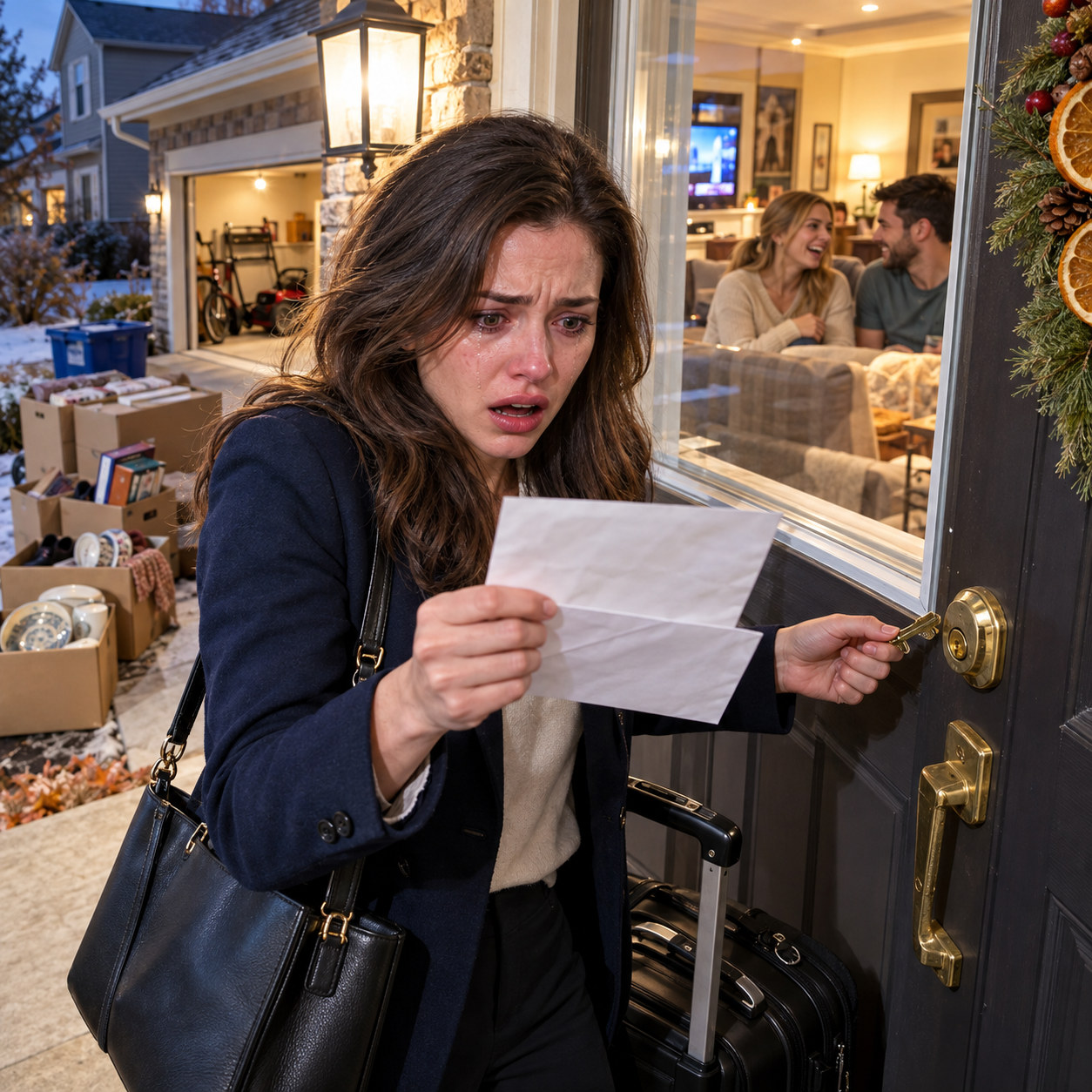
Part 2: A Hidden Agreement And A Costly Repair Exposed Everything
Mara spread the original agreement and my mother’s photograph across her conference table. Even with the coffee stain Dana had left near her signature, the complete document was perfectly readable. My sister hadn’t forged anything, but she’d presented a carefully selected portion as though it represented the whole arrangement.
“That won’t change the deed,” Mara said. “But it explains why your mother thinks you’ve broken a promise.”
“Can Dana claim I gave her the house?”
“She can claim whatever she likes. Ownership records tell a different story.”
Mara explained that Dana could still have occupancy protections, even without paying rent, and that I couldn’t simply replace the locks in return. She would arrange appropriate written notices and pursue court proceedings if necessary. I told her to proceed, although the prospect of treating my sister like a stranger made me feel almost as miserable as the night on the porch.
My mother called again that afternoon.
“Your father says perhaps everyone misunderstood.”
“Mom, she put my things beside the garbage cans.”
“She was upset.”
“She had time to pack three boxes and hire somebody to change the locks.”
There was a long pause, followed by the familiar sound of my mother rearranging objects on her kitchen counter.
“I just want my girls speaking again.”
“I’d like that too,” I said. “But speaking to someone doesn’t mean agreeing with everything they do.”
For the next two weeks, Dana ignored the letters from Mara’s office. She answered my one attempt to call by sending a message telling me to communicate through attorneys if I intended to make everything so formal.
Then the plumbing failed.
The old sewer lateral beneath the backyard had appeared in the inspection report when I purchased the property. A contractor had warned that the clay pipe would eventually need replacement, and I had been saving for the repair. I hadn’t expected the problem to accelerate during the coldest part of the year.
The first warning came from the neighbor, Mrs. Bennett, who called me because water was pooling near the shared fence.
She had lived next door since I was eight years old and still addressed Christmas cards to my parents.
“Honey, I don’t know what’s happening over there,” she said, “but there’s an awful smell behind the garage. Your sister says her husband will look at it.”
I contacted a licensed plumbing contractor immediately.
He inspected the accessible portion of the line and confirmed that a section had collapsed. The city also became involved after the neighbor reported the wastewater problem, and the repair couldn’t be postponed without risking additional damage.
Dana called me for the first time since locking me out.
“There’s something wrong with the sewer,” she said without greeting me.
“I know. I’ve arranged an inspection.”
“The contractor says it could cost ten thousand dollars.”
“Possibly more, depending on the excavation.”
Her breathing grew sharper. “You have to pay for it.”
“I understand my responsibilities as the owner.”
“Then why is everyone saying you’re trying to throw us out?”
I moved my coffee mug away from the paperwork. “Because you told everyone I gave you the house. You can’t insist it’s yours when you want control and mine when a bill arrives.”
“I never said you weren’t responsible for it.”
“That’s exactly the problem, Dana.”
She ended the call.
Kyle phoned two days later, sounding considerably less confident than usual. He wanted to know whether the lender holding my mortgage would allow them to borrow against the property’s equity.
“Not without being the owners,” I told him.
“We thought maybe there was some kind of family arrangement.”
“There was. Dana signed it.”
He cleared his throat. “She said the paperwork was mostly a formality.”
I asked whether he had seen the entire document.
He admitted he hadn’t.
The contractor repaired the damaged sewer section after Mara coordinated access with Dana. I paid the invoice from my maintenance savings, and the crew restored the excavated portion of the yard. I wouldn’t let a preventable problem threaten the house or the neighbors, no matter how angry I was.
What I could no longer justify was keeping the property indefinitely.
I met my mother at a diner near Colorado Springs the following weekend. She arrived carrying a shopping bag of homemade muffins, as if feeding me might make the conversation easier.
I placed the closing statement from my purchase, recent mortgage statements, and the complete occupancy agreement on the table.
“These are the documents,” I said. “I bought the house because Dad was going to lose it. Dana was allowed to stay, but she never became the owner.”
Mom examined the pages slowly.
“I knew you purchased it,” she said. “Dana made it sound as though you’d promised to transfer it eventually.”
“Did you ask me?”
She looked down at the muffins.
“No.”
That one word hurt more than I expected.
“Why didn’t you?”
“She was having such a difficult time, Natalie. Kyle’s business wasn’t bringing in much, and she felt like she hadn’t accomplished anything. When she told us you wanted them to have the house, I thought perhaps you’d decided to help.”
“I already was helping.”
“I know that now.”
I watched her trace the rim of her coffee cup. For years, she’d handled Dana’s disappointments by asking everyone else to make themselves smaller. A missed birthday became an unfortunate misunderstanding, a borrowed dress that never came back became something not worth arguing over, and each compromise made the next one easier to demand.
“Mom, I love her,” I said. “But I can’t keep financing a life she tells people she built herself.”
My mother reached across the table and held my wrist.
“I should have called you.”
It wasn’t a complete apology, but it was the first time she had acknowledged her part without changing the subject.
Two days later, I met with Beth Moreno, a real estate agent who had evaluated the property earlier that year when I’d considered renting it out.
We stood in her office reviewing recent sales and photographs of the house.
“You’ve maintained it well,” she said. “Even with the sewer expense, there’s a strong market for a home of this size.”
I looked at the picture of the backyard. My father had built the wooden swing beneath the maple tree when Dana was six. Selling the house meant losing more than an investment.
Beth studied my expression.
“You don’t have to make a decision today.”
“I’ve spent three years making decisions based on what everyone else needs,” I told her. “I think I’m ready to make one for myself.”
With Mara handling the required notices and Beth coordinating permitted showings, I listed the property. Dana complained, but eventually allowed scheduled visits after learning that refusing access wouldn’t settle the ownership dispute.
Within several weeks, a family relocating from Fort Collins submitted an offer close to our asking price.
Their financing was approved, and they agreed to handle the remaining landscaping after the sewer repair.
There was one important condition in the purchase agreement.
The house had to be vacant before closing.
Part 3: The Final Family Confrontation Ended With An Unexpected Goodbye
I told Dana about the offer on a Saturday morning.
She answered while someone was running a vacuum cleaner in the background.
“I’d like to meet at the house,” I said. “Mom and Dad are coming too.”
“Why?”
“Because I’ve accepted an offer, and we need to discuss moving arrangements.”
The vacuum stopped.
“You actually listed it?”
“Yes.”
“You didn’t even ask us.”
“Dana, I’ve been asking you to discuss the property for weeks.”
She said something to Kyle that I couldn’t hear. Then she told me they would be there at noon.
Driving back to the house felt different from every previous visit. The streets were familiar, the houses unchanged, but I wasn’t going there to sleep in my childhood bedroom or seek permission to use my own kitchen. I was going to finish a conversation our family had avoided for years.
Dad arrived first, wearing the brown work jacket he’d owned since I was in high school.
He hugged me beside the driveway.
“I’m sorry about this whole mess,” he murmured.
I wanted to tell him that a mess was what happened when somebody spilled paint. This was the result of choices people had made, repeatedly, while assuming I would handle the consequences.
Instead, I squeezed his arm and followed him inside.
Dana sat at the kitchen table with Kyle beside her. My mother stood near the sink, rubbing her thumb over the handle of an untouched coffee mug. Nobody had moved the old pine table Dad built when we were children, and its familiar scratches seemed strangely out of place beneath the tension.
I placed the purchase agreement on the table.
“The buyers want to close in late February,” I said. “Mara has explained the legal process to both of us. I’d rather agree on a move-out date than go through a hearing.”
Kyle leaned forward.
“We’ve been looking. Rent’s expensive everywhere.”
“I know.”
Dana gave a small, bitter laugh.
“Of course you know. You have plenty of money.”
I looked at her across the table.
“I have a mortgage. I have travel expenses and repairs and insurance. You see my salary, Dana, but you never ask what it costs me to keep everything going.”
“You got the house for less than it was worth.”
“Because Mom and Dad needed a sale they could complete quickly, and I took on the debt. Everyone knew the terms.”
She looked toward our father.
“Dad, tell her this isn’t right.”
He stood with both hands resting on the back of a chair.
“Your sister kept us from losing the place,” he said quietly. “That doesn’t mean we can tell her what to do with it forever.”
Dana’s face reddened. I could see that she had expected him to rescue her from the conversation, the way he had rescued her from parking tickets and overdue bills when we were younger.
Kyle pushed his chair back a few inches.
“We weren’t trying to steal anything,” he said. “We thought if we stayed and improved the place, maybe Natalie would eventually let us buy it.”
“Improvements don’t transfer ownership,” I said. “But we could have discussed a purchase when your financing was ready.”
Dana stared at the table.
“Every time you came home,” she said, “you walked in like you were checking our work. You noticed the grass, the gutters, whether we’d cleaned the kitchen. I felt like I was fifteen again.”
Her words made me remember the afternoons I’d arrived after long flights, exhausted and impatient, asking questions before I’d even put down my bag.
“Maybe I did sound critical sometimes,” I admitted. “I should have talked to you about that.”
She looked up, surprised.
“But you could have said something. You could have asked me to arrange my visits differently. You didn’t have to remove my belongings and change the locks.”
“I thought you’d get angry, and then you’d get over it.”
There it was, spoken without calculation.
She had expected an argument, perhaps a few weeks of awkwardness, followed by the same arrangement continuing under terms she’d chosen.
My mother set down her mug.
“Dana, you told us Natalie agreed the house would become yours.”
Dana swallowed.
“I said she was thinking about it.”
“You showed me half the agreement.”
“I didn’t think the rest mattered.”
“It mattered,” my mother said. “And you let me accuse your sister of breaking a promise she never made.”
Dana looked at me, then away.
“I wanted you to believe we had something,” she whispered.
Kyle stared at his hands. I wondered how many conversations in their marriage had been built around a future neither of them could actually afford.
Nobody raised their voice after that.
I told them I would pay for a moving truck and contribute toward their security deposit, provided we documented the arrangement properly and agreed on a reasonable departure date. I made it clear that this was a one-time offer, not another open-ended financial commitment.
Kyle nodded immediately. Dana took longer.
Finally, she asked, “And after that?”
“After that, you and Kyle decide where you want to live.”
She pressed her lips together.
“So that’s it?”
“For the house, yes.”
Mara prepared a written move-out agreement, and Dana and Kyle signed it after reviewing the terms. They found a two-bedroom apartment near Kyle’s work, smaller than the house but within their budget. The sale remained contingent on their departure, and I arranged for the moving company to be paid directly.
On moving day, I went over to collect my remaining belongings.
Dana was standing in the empty dining room, holding a framed photograph of the four of us at a Fourth of July barbecue. She’d taken it down from the wall and was wiping dust from the glass with the sleeve of her sweatshirt.
“Do you want this?” she asked.
I shook my head.
“Keep it.”
She studied the photograph for another moment.
“I really thought we were going to buy this place someday.”
“You might have,” I said. “If you’d waited until you could, and treated me like someone you needed to make an agreement with.”
She didn’t answer immediately.
“I hated asking you for things,” she said. “I hated that you could always be the one who helped.”
I understood that feeling better than she knew. Being the dependable daughter had never been entirely comfortable; people thanked me for being strong while quietly deciding I didn’t need much from them.
“I never wanted you to feel less than me,” I said.
Dana tucked the photograph into a box.
“Maybe I made that part up myself.”
It was the closest we came to an apology.
She handed me the new house keys before leaving. I held them in my palm while she carried the last box to the moving truck, and for a moment, I considered telling her we could pretend none of this had happened.
But the garage, the letter, and the cropped agreement had happened. Pretending otherwise wouldn’t make us close again.
The closing took place without further trouble.
The buyers were a couple with two school-age daughters. During their final visit, the younger girl ran straight to the backyard and asked whether the maple tree was strong enough for a swing.
I told her father where the old swing hooks were still fastened beneath the branch.
He smiled and said he’d take a look.
After paying the remaining mortgage, transaction expenses, and repair costs, I had enough from the sale to make a substantial down payment on a modest townhouse. It had a small patio, two bedrooms, and a kitchen window overlooking a row of flowering shrubs.
I moved in during April.
My parents visited a few weeks later. Dad helped assemble a bookcase, while Mom arranged the dishes I’d rescued from the garage in my new cupboards.
At one point, she found the ceramic mixing bowls that had belonged to her mother.
“These used to be in your grandmother’s kitchen,” she said, running her hand over a chipped rim.
“I remember.”
“I wish I’d known Dana put them outside.”
I looked at her.
“You could have asked me what happened.”
She nodded, and this time she didn’t make an excuse.
“I know. I’m trying to do better.”
Later, after Dad had carried the empty boxes to his truck, Mom stood beside me on the patio.
“Have you spoken to Dana?”
“Not recently.”
“She’s working more hours. Kyle’s business seems steadier.”
“I’m glad.”
Mom rested her hands on the railing.
“I hope you’ll find your way back to each other.”
“Maybe we will.”
She accepted that answer, which was something new for both of us.
Dana sent me a birthday card that summer. There was no request for money, no explanation of why I’d supposedly misunderstood her, and no attempt to recruit our parents into another argument. She’d written only that she hoped I liked my new place and that she was sorry things had become so ugly.
I kept the card in my desk drawer.
I haven’t decided what our relationship will look like. I miss the girl who used to crawl into my bed during thunderstorms, and I still remember the woman who put my belongings outside a locked door. Both are my sister, and neither memory cancels out the other.
On quiet Sunday mornings, I sit on my patio with coffee and listen to the neighbors opening their windows. Sometimes I think of my parents’ old house, the maple tree, and the family now making its own memories there. I hope the girls love that yard as much as Dana and I once did.
Then I go inside, turn the key in my own front door, and feel the uncomplicated relief of knowing that the home I’ve made is finally mine to keep.
The End .
All characters and events in this story are fictional, created for storytelling and entertainment purposes. Thank you sincerely for reading. Your feedback and support are invaluable and motivate me to continue sharing more stories with you.