
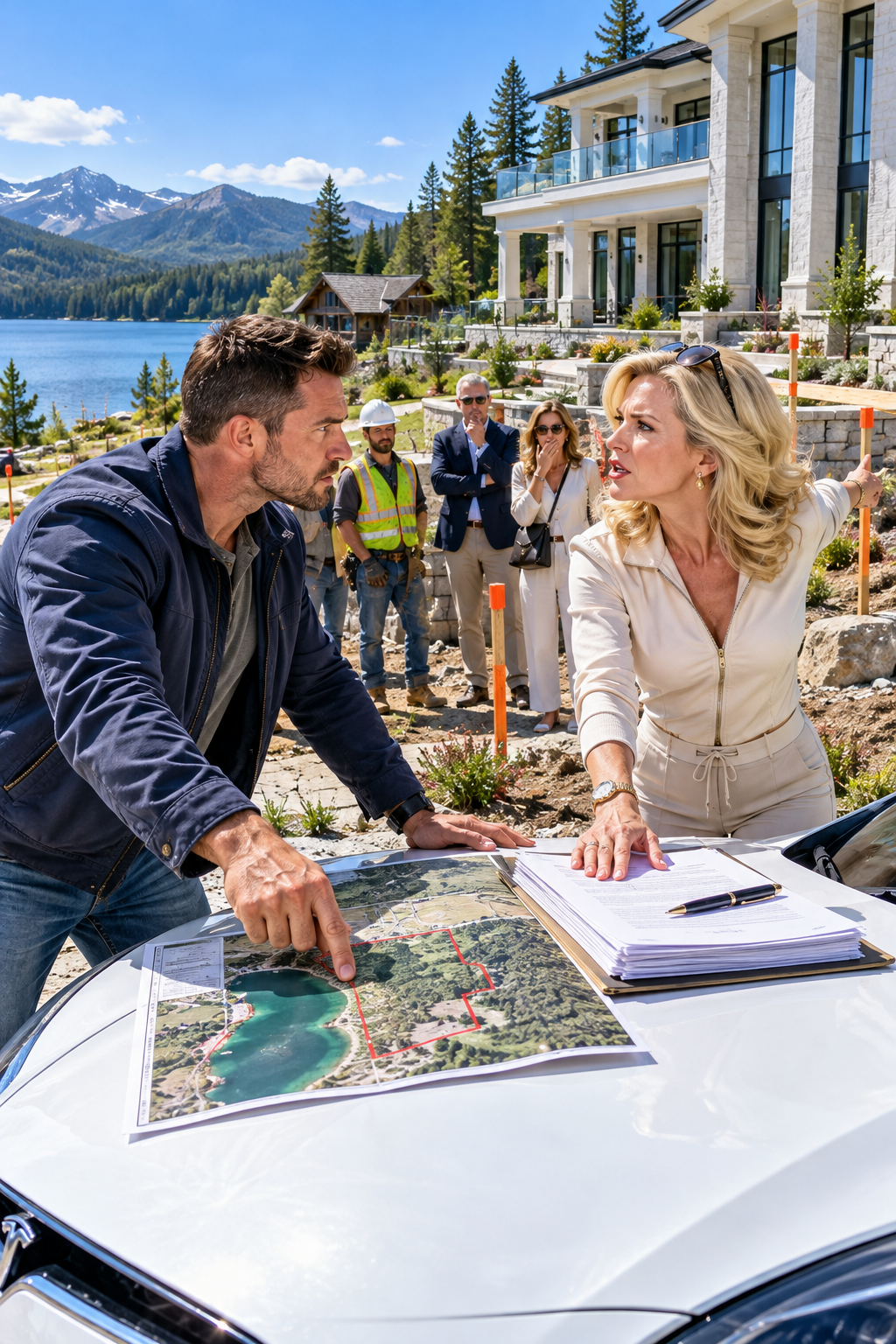
### Part 2: Poisoned lake water exposed the conspiracy beneath Vivian’s mansion
I photographed the forged signature and called Hank Caulfield, a retired attorney who’d known my grandfather for forty years. He listened while I explained the HOA documents, the threats, and the money Vivian wanted me to pay. “Don’t sign anything,” he said. “We’ll get an independent survey and challenge her ownership claim properly. And Dex, keep every piece of paper she sends you.” His voice became unusually serious when I mentioned the dead man’s signature.
Jake met me at the shoreline later that morning, carrying photographs, protective gloves, and sealed sampling containers. Near Vivian’s mansion, a gray discharge pipe disappeared beneath the decorative stone wall and emptied into water so cloudy I could barely see my boots. Jake showed me construction photographs revealing that the approved septic tanks had never been installed. “She saved a fortune by running waste straight into the lake,” he said. “And every time somebody complained about the smell, her husband made the complaint disappear.”
I remembered standing in that exact spot beside Grandpa when I was ten, watching trout flicker between the rocks. Now the reeds were coated with residue, and the sharp smell of cleaning chemicals drifted above the surface. “We need certified testing,” I told Jake, photographing the pipe’s location. He nodded and began documenting everything without touching the discharge. Then an ATV rattled through the trees, and Vivian appeared with two attorneys.
“You’re trespassing,” she announced, climbing off the vehicle. I showed her the survey coordinates on my phone, placing us well inside the original Morrison boundary. Her lawyer, James Hartwell, suggested we discuss the dispute privately, but Vivian stepped between us. “I’ve spent $2.3 million bringing value to this miserable wilderness,” she snapped. “You think your grandfather’s ancient paperwork gives you the right to destroy everything I’ve built?” Jake glanced toward my phone, where the recording indicator glowed red.
“Does progress include dumping sewage into Copper Lake?” I asked. Vivian’s face tightened, and she turned toward her attorneys instead of answering. “My husband runs county planning,” she said, pointing toward the road. “We have approvals for everything, and you people aren’t going to ruin this development.” One attorney caught her elbow, but she shook him away. I ended the recording only after they’d driven off, knowing her own words would matter more than any argument I could make.
At 2:47 the next morning, my cabin went dark. Through the window, I saw flashlights moving along the shoreline, and by sunrise I discovered severed power lines, missing survey stakes, and TRESPASSER painted across the front door. Someone had also disabled the communications repeater near my driveway. Jake arrived with a generator and coffee, while I retrieved footage from the trail cameras I’d installed after receiving an anonymous warning to leave town.
The recordings showed Vivian, Fletcher, and two other men walking the property after midnight. I recognized Fletcher’s county vehicle, the movement of their flashlights, and Vivian directing one man toward the shoreline markers. I copied everything and turned it over to Hank and the authorities. The next threatening message warned that my cabin might burn if I refused to destroy the footage.
Federal investigators arrived soon afterward. Agent Elena Martinez from the Environmental Protection Agency’s criminal investigations team explained that authorities had already received months of complaints about Copper Lake. Her colleague, Agent Arden, collected samples and documented the discharge equipment while Martinez studied Jake’s construction photographs. Preliminary testing revealed severe bacterial contamination and evidence of chemical cleaning agents entering the water. “This doesn’t look like a malfunctioning system,” Martinez told me. “It looks like a system designed to bypass treatment entirely.”
Three days later, I discovered why Vivian had been so determined to force me off the property.
Tucked inside a faded Christmas card in Grandpa’s trunk was the original 1963 mineral rights lease with Montana Aggregate Company. The agreement was approaching expiration, and the attached geological map identified valuable gravel deposits beneath the exact section where Vivian’s mansion stood. I searched the company’s corporate filings and found that Fletcher Ashworth owned a thirty-percent interest in Rocky Mountain Extraction, a related business positioned to benefit from future extraction rights.
I carried the documents to Hank, who spread them across his desk beneath a green-shaded lamp. The geological estimates suggested roughly five hundred thousand tons of recoverable gravel, potentially worth $7.5 million in gross material value. Fletcher’s company had quietly positioned itself to profit from a resource his wife was attempting to control through a fraudulent land claim. Hank followed the ownership records with his finger, then looked up at me. “Dex, this was never just about a mansion.”
Suddenly, the expensive house, the fabricated HOA, the pressure to sell, and Fletcher’s involvement all made terrible sense. They weren’t simply trying to take a beautiful piece of shoreline.
They were trying to steal the fortune buried beneath it.
### Part 3: A community celebration destroyed the Ashworths’ carefully constructed empire
By Thursday morning, six of us had gathered around a folding table inside the volunteer fire station. Hank brought legal filings, Jake brought construction records, and Sheriff Tommy Clearwater arrived carrying copies of the vandalism reports. Marge, the local historian, had assembled decades of county photographs, while Sarah Blackhorse, representing the tribal council, laid out maps showing how the contaminated watershed affected longstanding fishing traditions. When I finished explaining the mineral lease, nobody spoke for several seconds.
Hank broke the silence. “We file the property action and record a notice of pending litigation,” he said, setting down his pen. “That puts potential buyers and lenders on notice that ownership is disputed.” Jake arranged for an independent professional survey, and Sarah coordinated additional water testing and legal review of treaty-related environmental concerns. Marge proposed holding Copper Lake Heritage Day on the Morrison property, with historical displays, local businesses, and community volunteers. “Your grandfather believed this lake belonged in people’s hearts,” she said. “Let’s remind everyone why.”
The following evening, someone smashed a bottle containing gasoline through my cabin window. It landed in the metal kitchen sink, where the small flame died before spreading, but the attached note promised another attempt. Tommy collected the evidence while I showed him camera footage of Vivian’s Tesla arriving near the property shortly before the incident. He looked at the screen, then at the scorched curtain beside my sink. “We’re treating this seriously, Dex,” he said. “You need somewhere safe to stay tonight.”
On Friday, Vivian held a press conference outside the courthouse, declaring herself the victim of a campaign against legitimate development. Amanda Arden, an environmental reporter, asked whether Vivian knew that investigators had identified untreated sewage entering Copper Lake from her property. Vivian dismissed the findings as technical issues, then insisted that modernization required sacrifices. “We brought jobs and investment,” she declared, glaring into the camera. “People can’t expect every stretch of wilderness to remain untouched forever.”
By afternoon, her comments were spreading across regional news broadcasts. Federal investigators executed search warrants at the Ashworth residence and related offices, removing financial records, computers, and permit files. Fletcher arrived demanding to know why his department was being investigated, only to learn that his official approvals were among the records under examination. The mansion had already received a safety closure notice after inspectors documented serious electrical and sanitation defects. For once, neither his position nor Vivian’s expensive attorneys could make the paperwork disappear.
Saturday morning, I heard heavy engines before I finished my coffee. Vivian had brought a demolition crew to the ranch, claiming my grandfather’s cabin presented an emergency structural hazard. Jake inspected the permit she’d produced and discovered that it identified an entirely different parcel. Tommy instructed the crew to stop while the documents were checked, and Vivian stood beside her Tesla, furiously calling people who no longer seemed eager to answer.
By ten o’clock, nearly three hundred residents had gathered for Heritage Day. Volunteers unfolded tables of historical photographs, food trucks lined the access road, and tribal musicians prepared to perform near the shoreline. Sarah introduced elders who spoke about fishing traditions and the generations who had depended on the lake. Watching families examine Grandpa’s photographs, I felt something I’d almost forgotten since returning home: belonging.
Fletcher arrived at noon with county vehicles and demanded that the gathering disperse. Tommy showed him the event permits, while Sarah explained that her legal team had secured a federal order protecting relevant environmental and treaty interests from interference. The commissioner read the documents twice, his jaw tightening with each page. “This isn’t over,” he muttered. Sarah held his gaze. “No. It isn’t.”
Then a shout rose from the far side of Vivian’s mansion.
Her demolition contractors had struck an improperly installed waste line, sending foul water spilling across the lawn toward the lake. The workers backed away while federal environmental personnel cordoned off the contaminated area and documented the damage. Vivian shouted that someone had sabotaged her house, but Agent Martinez pointed toward the exposed plumbing and explained that investigators had already identified the unapproved discharge system. Even through the gathering crowd, I could see Vivian’s expression change from fury to fear.
At four o’clock, she stormed toward the festival’s microphone. “Everybody listen!” she shouted, her voice cracking through the speakers. “You’re standing on private property, and I want you gone.” I stepped beside her with Grandpa’s original deed and the independent survey, which had confirmed the boundary crossing her mansion. “This is Morrison land,” I said. “And you’ve spent three years pretending it belongs to you.”
Vivian tried to push past me, but Agent Martinez approached with officers and informed her that she was being arrested on federal charges arising from the ongoing investigation. Nearby, Fletcher was taken into custody in connection with the alleged fraud, permit abuses, and obstruction. Neither resisted, but Vivian kept insisting that her money and connections would prove her innocent. Sarah watched the vehicles pull away, then turned toward the darkened water. “Arresting them doesn’t heal the lake,” she said softly.
She was right.
And for the first time, I knew keeping Grandpa’s promise would require more than winning back his land.
### Part 4: One courtroom revelation cost Vivian her mansion and fortune
Six months later, I sat in a packed Montana courtroom, holding Grandpa’s original deed while Vivian Ashworth stared at me from the opposite table. Her designer clothes were gone, replaced by a plain dark suit, and Fletcher sat beside his attorney without looking at her. Their lawyers argued that years of investment and development supported the HOA’s claim to the disputed property. Hank rose slowly, placed the independent survey before the judge, and said, “Your Honor, investment does not create ownership when the underlying documents are fraudulent.”
The evidence unfolded one piece at a time. The 1952 deed established Grandpa’s ownership, the tax records contradicted Vivian’s abandonment claim, and the HOA incorporation documents exposed a timeline that could not possibly be true. Then Marge took the witness stand and produced canceled checks showing she’d helped pay the ranch’s property taxes during Grandpa’s declining health and after his death. “Russell asked me to make certain the land was never lost,” she said, looking directly at me. I lowered my head, realizing my grandfather had been protecting our home even when he could no longer protect it himself.
Hank saved the most devastating evidence for last. He presented the mineral lease, corporate ownership records, and correspondence linking Fletcher’s extraction company to the valuable gravel deposits beneath Vivian’s mansion. The records showed that the Ashworths had pursued control of land containing millions of dollars in potential mineral resources while concealing Fletcher’s financial interest. Vivian’s attorney searched through his papers, but Fletcher remained motionless. When the judge asked whether the disputed HOA authorization carried Russell Morrison’s genuine signature, their side could offer no credible explanation.
The court ruled in my favor, confirming Morrison ownership, rejecting the HOA’s claim, and barring further collection of its fabricated charges. Subsequent orders required the unlawful encroachments to be resolved, and Vivian’s mansion was eventually demolished after its serious construction violations made preservation impractical. Separate federal proceedings ended with Vivian receiving eighteen months in prison, substantial restitution obligations, and five years of supervised release. Fletcher received twelve months, while the exposure of his misconduct ended his public career. Their luxury development empire collapsed beneath legal judgments, criminal penalties, and the costs of repairing what they’d damaged.
I didn’t celebrate when the mansion came down. I stood beside Jake and watched workers carefully remove the final sections overlooking Copper Lake, knowing the homeowners Vivian had deceived would need fair settlements rather than more suffering. The land was legally mine again, but Grandpa’s voice kept returning to me: Keep it wild, keep it free, keep it in the family. I finally understood that he had never meant the shoreline should belong to one person alone.
With Hank, Sarah, and the community, I established the Morrison Conservation Trust to protect all nine hundred acres permanently. Environmental restitution helped fund restoration, while a university partnership brought researchers to study the recovering lake. The trust created three annual scholarships for local students pursuing environmental science and skilled trades, and Heritage Day became a lasting community tradition. Jake built a business helping homeowners identify dishonest contractors, while Amanda’s reporting helped bring wider attention to rural property fraud and environmental protection.
One morning, a letter arrived from Vivian asking for forgiveness and a favorable character reference. I read it on Grandpa’s rebuilt porch, watching sunlight move across water where fish had finally begun returning. I placed the letter beneath his old fishing photographs and decided that protecting what she’d tried to destroy was answer enough.
For the first time since inheriting the ranch, I could hear loons calling across the lake without the noise of construction equipment.
Grandpa had wanted his land to remain in the family.
Now I knew how to keep that promise.
THE END.
All characters and events in this story are fictional, created for storytelling and entertainment purposes. Thank you sincerely for reading. Your feedback and support are invaluable and motivate me to continue sharing more stories with you.

