
### Part 2: Two paid parties reveal how Karen sold my private shoreline
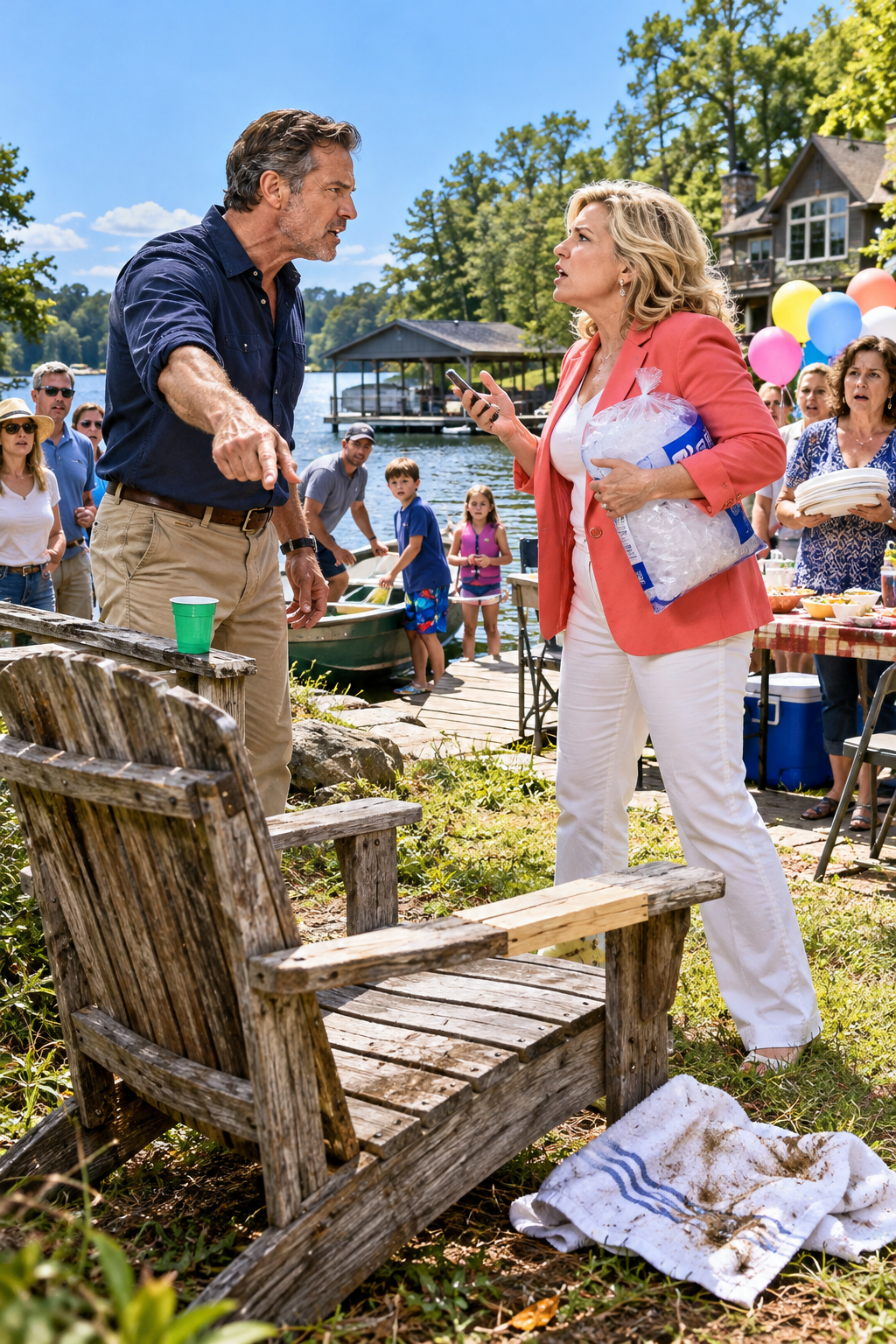
Her name was Natalie, and her mother was turning seventy-five on Saturday. Family members were traveling from several states, and Karen had assured her that my lakeside property was an approved private venue. “She said you preferred not to be disturbed during events,” Natalie explained, her voice growing uncertain. I asked her to send the arrival instructions, and seconds later my phone displayed a photograph of my dock, my address, and the old gate code.
Beneath the directions, a sentence instructed guests not to knock at my house because the owner already knew about the arrangement. Even worse, the document contained two reservations: Natalie’s birthday lunch and a private lakeside reception beginning before the birthday guests were scheduled to leave. Both groups had been promised exclusive use of my shoreline. I stared at the screen, realizing Karen had not merely shared my code; she had built an entire event business around my property.
Natalie called again after confronting Karen. “She says I can’t cancel this close to Saturday,” she told me. I asked how much she had paid, and her answer stopped me cold: “$1,200 for the venue, setup, and cleanup.” The receipt showed payment to Briar Cove Community Events, accompanied by a claim that proceeds supported neighborhood improvements and that I was donating the rental income.
For a moment, I considered allowing the birthday because Natalie and her family were innocent. Then I remembered Karen standing beside my mother’s chair, insisting that my refusal was embarrassing her. If I surrendered now, every future customer would be told the same story. “I can’t host your party,” I explained gently, “but I’ll help you find somewhere that actually agreed to have you.”
I called a community hall I knew had an accessible entrance, kitchen, and enough space for her relatives. Fortunately, another booking had been moved, leaving Saturday afternoon available, and Natalie reserved it while I stayed on the telephone. She paid another deposit without knowing when she would recover her original money. Before hanging up, she thanked me and promised to notify every guest, although two relatives were already traveling without reliable phone service.
The HOA treasurer, Stewart, called that evening after I forwarded the receipts, security footage, and written refusals. He confirmed that Natalie’s payment had entered the association’s event account and that a second payment covered a reception for approximately forty guests. When I demanded refunds, he initially mentioned expenses already charged against the events. “Stewart, these people didn’t cancel a venue they rented,” I said. “They paid for a venue that was never available.”
There was a long silence before he agreed to investigate and contact the customers. I asked him to preserve every reservation, message, and payment record rather than quietly erase the evidence. On Friday, the association formally canceled both bookings and informed Karen that no guests or vendors could enter my property. Her entire response was one word: “Received.”
I printed a sign for the entrance explaining that the lake was a private residence with no event access, and I placed directions to Natalie’s replacement venue beside the intercom. Then I moved my truck away from the turnaround so confused drivers could leave safely. Mom watched me from the porch as I photographed everything for the record. “I don’t want you spending every morning guarding the gate,” she said, and I promised I was working toward exactly that.
Friday evening, Natalie sent me a photograph of the decorated community hall. Family pictures lined one wall, the tables were arranged beautifully, and her mother’s birthday banner hung above the windows. I smiled at the picture until Natalie mentioned her cousin Beth, who was carrying the cake and might still have the original arrival sheet. I promised to redirect anyone who appeared at my entrance.
Saturday morning, however, Mrs. Harris forwarded me a post Karen had published late the previous night. It declared that the conflicting information about the lake events had been resolved and instructed guests to follow their original arrival directions. Underneath, residents thanked her for clearing up the confusion. I called Stewart, who confirmed that nothing had changed and that Karen’s announcement was unauthorized.
At 10:40, I saw her SUV pull into the gravel turnout. She stepped outside carrying a clipboard, a box of paper wristbands, and a sign announcing event check-in. I walked down the driveway while she positioned the sign beside my keypad. Before I could speak, another car arrived, and a woman carefully lifted a large birthday cake from its passenger seat.
Karen smiled through the gate. “See, Tom? Everyone’s already coming. You might as well open up.”
### Part 3: A locked gate exposes the lies behind Karen’s community fundraiser
The woman carrying the cake introduced herself as Beth, Natalie’s cousin. Her phone had died during the drive, so she hadn’t received the revised address, and Karen immediately instructed her to enter the original gate code. The keypad flashed red again and again while Karen insisted the system was malfunctioning. By the fifth attempt, Beth’s husband had placed the cake on their car hood, and Karen was glaring at me through the bars.
“Open it, Tom. People are waiting.” I reminded her that both events had been canceled and that Natalie was celebrating at the community hall. Karen leaned toward the gate and hissed, “You’re making a scene.” Then Beth produced the printed receipt from her purse, showing the $1,200 payment and my property’s name, and asked whether I had truly donated the rental income.
Karen reached for the paper, claiming it contained private information, but Beth pulled her hand away. “He can read it,” she said firmly. I explained that Karen had never received permission to rent my land and that the money had gone into the HOA account, not mine. Beth stared at Karen before asking, “Then why did you tell us to keep trying that code?”
Karen offered no answer. A catering van arrived moments later, and its driver asked where to unload the birthday food. I handed him the hall address and asked him to confirm the change with Natalie, which he did before turning around. Beth carefully lifted the cake back into the car, thanked me, and told Karen she should remove the misleading check-in sign.
Instead, Karen accused me of damaging a community fundraiser. “People contribute different things,” she argued. “Some give money, some give space.” I looked toward my house, where Mom had started down the path carrying her swimming bag, then turned back inside after seeing the growing crowd. “People can only contribute what they actually agree to give,” I answered.
Two more families arrived before Stewart reached the property, each convinced by Karen’s latest announcement that the cancellations had been reversed. I gave them the proper directions without shouting or blaming them. When Stewart confronted Karen, he asked why she had told guests the bookings were resolved after receiving written confirmation they were canceled. “I thought Tom would eventually understand what this meant to the neighborhood,” she replied.
Stewart examined the arrival sheet, particularly the instruction telling guests not to knock at my house. “Who wrote this?” he asked, and Karen admitted that she had. When he demanded why, she answered, “To protect Tom’s privacy.” I almost laughed, because keeping strangers from asking the homeowner was precisely how she had kept her lie alive.
While Stewart contacted the remaining reception guests, I returned home and found Mom sitting at the kitchen table with her swimming bag untouched. “You can still go down,” I told her. She rubbed the little card holding her new gate code and whispered, “I know, but I don’t want to walk past all those people.” I sat beside her, understanding that Karen had already taken something no receipt could measure.
“Finish this without becoming like her,” Mom said softly. I understood immediately: no humiliating innocent families, no public spectacle, and no turning frightened guests into weapons against Karen. I carried drinking water outside for a couple who had driven an hour for the reception, while Stewart helped them contact the organizer. By midafternoon, the guests had been redirected to the restaurant where Roger, the reception organizer, had arranged an alternative gathering.
Karen finally loaded her belongings into the SUV, but Stewart stopped her from taking the wristbands because their printing had been charged to the association. After she drove away, he handed me one printed with my lake’s name. The invoice underneath showed an order for five hundred wristbands, far more than the day’s expected guests. I refused to assume all five hundred represented trespassers, but I asked Stewart to investigate every booking associated with my address.
Sunday morning, he called while I was pouring coffee for Mom. “Tom, we’ve found twelve paid reservations involving your property,” he said. Three were earlier gatherings, two were Saturday’s canceled events, and seven were scheduled for future dates. Security recordings of unfamiliar visitors now made sense: they had been tours and delivery inspections, not additional parties.
Then Stewart mentioned one reservation that had already gone disastrously wrong. A young couple had booked my dock for their wedding the following Saturday, sent invitations, and made arrangements for twenty-eight guests. They believed I had personally granted permission, and they were furious that the lake owner was supposedly canceling their ceremony. I asked Stewart to give them my telephone number, then opened the original text conversation in which Karen had requested access for the rubbish trailer.
### Part 4: One cropped message unmasks Karen and returns our lake to peace
Rachel and Ben called together, their voices exhausted from trying to rescue their wedding plans. Rachel explained that they had chosen my dock because her father had difficulty walking long distances and Karen had promised an easy, peaceful ceremony beside the water. When I said I’d never approved the wedding, Ben sounded stunned. “But she sent us your permission in writing,” he insisted.
The screenshot arrived seconds later, showing part of my old text message to Karen: “Sure, you can bring the trailer through. I’ll be out, but the code is…” Beneath that were the four numbers I’d disabled. Karen had cropped away her original question about collecting roadside rubbish and my following instruction, “Just for the pickup.” She had presented permission for a cleanup trailer as permission for a wedding rental.
I sent Rachel and Ben the complete conversation. Neither spoke for several seconds before Rachel whispered, “We thought you took our money and changed your mind.” I told her I hadn’t received a dollar and couldn’t host the wedding, but I would help them reach the people responsible for fixing the situation. Ben finally answered, “Now that we know what happened, we’re not asking you to.”
I forwarded the cropped and original messages to Stewart, who brought them before the full board. A lawyer I consulted helped me prepare a written demand requiring the association to stop advertising my property, remove my gate code from every event material, notify its customers, and acknowledge that it possessed no rights to my lake. Meanwhile, Paula from the HOA office preserved the reservation records and their change history before removing the lake listing. Those records showed that Karen herself had added my property to the booking system.
The board suspended Karen’s access to association events while Stewart and another director began arranging refunds. A clubhouse was available for Rachel and Ben’s wedding, but its lawn had an entrance step that Rachel’s father might struggle to manage. I remembered Dale, the rental supplier, had previously provided portable ramps for community gatherings. After assessing the site, his company identified an accessible side entrance and supplied a suitable ramp, allowing the couple to keep their original wedding date without using my dock.
Karen emailed me one final proposal: allow the wedding at my lake, and she would announce that every remaining booking had been moved through a friendly agreement. I read it twice before replying with Stewart copied. “There is no agreement to host the wedding. Please correct the information you gave the couple.” Her proposal proved that even after everything, she still expected me to surrender my home to repair the damage she had caused.
At Wednesday’s board meeting, Karen sat across from me with her hands folded neatly on the conference table. She began by reminding everyone that I had supported neighborhood activities, but I placed the complete cleanup conversation beside the version she had sent Rachel and Ben. “Then explain why their copy ends before the words ‘just for the pickup,'” I said. One director examined the pages and asked why Karen had removed the only sentence defining what I’d permitted.
She claimed she had shortened the message for convenience. Stewart then presented my written refusals, her acknowledgment of those refusals, the unauthorized event announcement, and the arrival sheet instructing paying guests not to approach my house. As each record passed around the table, Karen’s explanations grew shorter. Finally, she admitted, “I thought once Tom saw how much this could help the neighborhood, he’d cooperate.”
I leaned forward and looked directly at her. “You didn’t misunderstand my answer, Karen. You made promises using my property because you thought I’d be too embarrassed to refuse once people had paid.” She stared at the table, and for the first time since finding strangers beside Mom’s chair, I had nothing more I needed to say.
Two days later, Stewart confirmed the board had removed Karen as HOA president under its governing rules and that she had resigned her board seat. The association signed a written acknowledgment that it had no permission to use my road, gate, dock, or shoreline and adopted a requirement for written owner approval before advertising any outside venue. The board refunded both canceled Saturday events and all seven future bookings, handled complaints from the three earlier events, and reimbursed my documented legal-letter and paddle expenses.
Money intended for the clubhouse patio project went toward the losses instead, upsetting some residents. I knew that wouldn’t make me popular with everyone, but those neighbors had also been misled by Karen’s promises. The association’s first public correction described the incident as a misunderstanding, so I insisted on clearer wording. The final notice stated that I had never approved the rentals, received event payments, or offered my lake as a donation.
A week after Rachel and Ben married at the clubhouse, she sent me a photograph. Her father sat comfortably near the windows, with Ben beside him holding a plate of wedding cake while Rachel laughed in the background. Beneath the picture she had written, “Dad stayed for the whole reception. Thank you for helping us find the ramp.” I showed Mom, who smiled at the image before ordering me to put my phone away and enjoy the morning.
For weeks, I still caught myself listening whenever tires rolled along the county road. Eventually that habit faded, although I kept separate gate codes, limited visitor access, and the private-property sign. Mom learned her own code and even invited two friends to swim one Saturday. She called them herself, set the time, and asked me to arrange temporary access without the slightest worry that someone else might invite another crowd.
That afternoon, I watched from the kitchen as her friends came through the gate and walked laughing toward the dock. There were no wristbands, check-in signs, or strangers claiming my home belonged to the neighborhood. Mom returned later with her empty coffee mug and announced, as she always did, “Your coffee is still weak.”
“I thought you came up to thank me,” I teased. She glanced toward the lake, where her friends were arranging clean towels beside Dad’s old wooden chair, and gently squeezed my arm. “I think you already know what I’m thankful for,” she said.
After she went inside, I stood by the window listening to the distant laughter and the soft movement of water against the dock. My mother’s chair sat exactly where it belonged, the pale wood of Dad’s repair catching the afternoon sunlight. The gate remained closed to everyone we hadn’t invited, and for the first time in weeks, I didn’t feel the need to check it.
THE END.
All characters and events in this story are fictional, created for storytelling and entertainment purposes. Thank you sincerely for reading. Your feedback and support are invaluable and motivate me to continue sharing more stories with you.


