
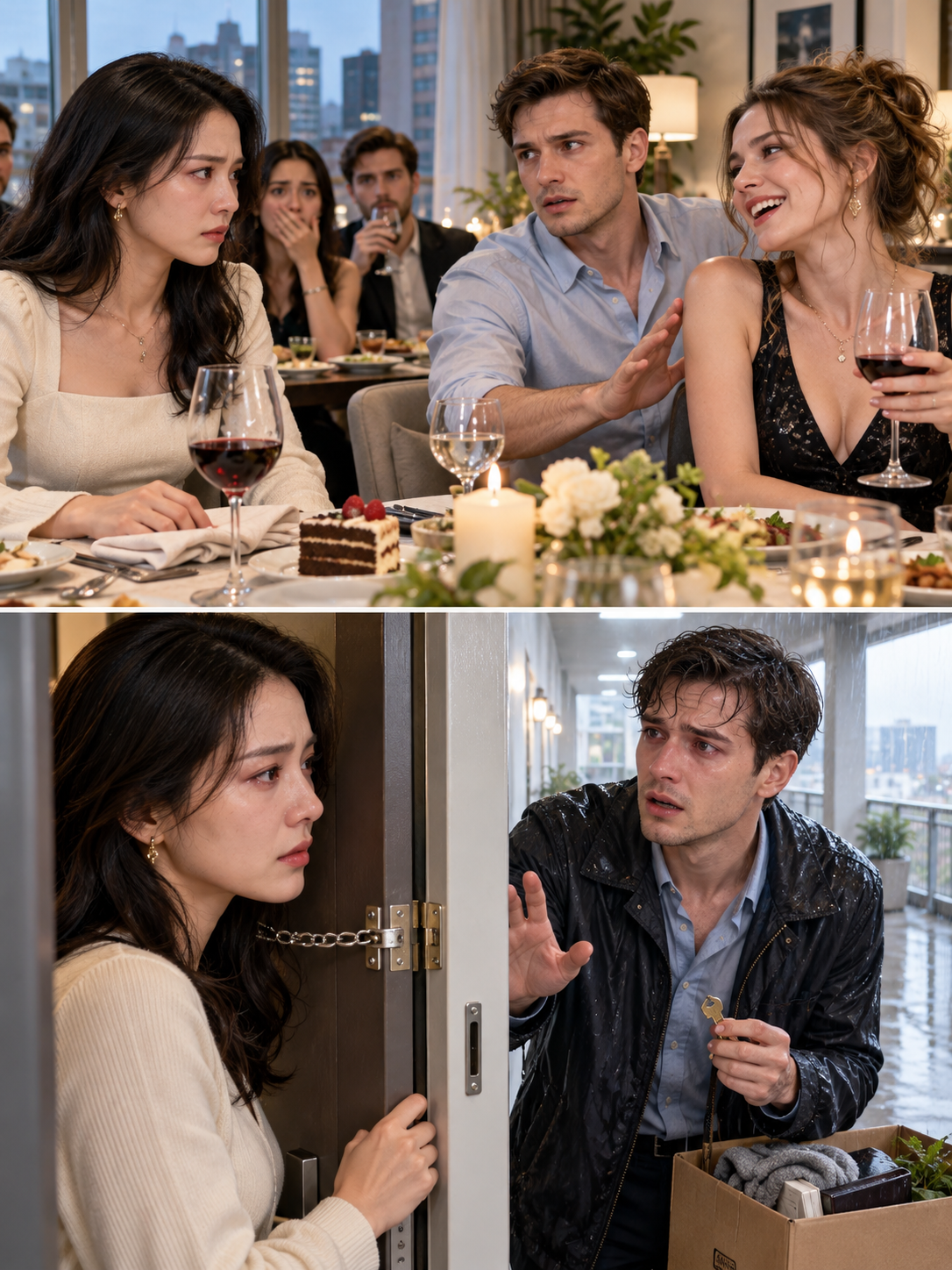
Part 2: One cruel joke forces Noah to reveal his loyalty
Lena’s smile flickered. “Camille, come on. I’m joking.”
“No, I’m curious.”
Noah shifted beside her. “Cam.”
I kept my eyes on Lena. “You’ve clearly formed an opinion. What would ‘better’ look like?”
She glanced around the table, suddenly aware that everyone was watching. “Someone less intense, maybe. Someone who doesn’t make everything feel like a board meeting. Noah used to be lighter.”
“Someone more like you?”
“That’s not what I said.”
“It’s what you’ve been saying for three years without using the words.”
Her face reddened. Noah murmured my name again, but I had spent too long pretending not to understand subtext. I folded my napkin and placed it neatly beside my plate. “Since we’re discussing what Noah deserves, maybe we should be honest about what you believe you offer him. You borrowed money from him three times this year. The repairs on your convertible came from our joint account. You still have a key to our apartment, despite the fact that I never agreed to give you one.”
Lena stared at Noah. “You told her about the car?”
“He didn’t have to,” I said. “Joint accounts come with statements.”
The color drained from Noah’s face. Until that moment, I don’t think he realized I knew the exact amounts. Nine hundred for the mechanic. Six hundred forty for rent. Three smaller transfers labeled with harmless words like supplies and emergency. I hadn’t objected because I trusted him, and because I understood that friends sometimes need help. What I could no longer understand was being judged by the person whose emergencies I had quietly helped finance.
Lena pushed back from the table. “So you’ve been keeping a file on me?”
“No. I’ve been paying attention.”
“You make everything sound ugly.”
“I didn’t bring your finances into dinner. You brought my worth into it.”
For the first time all evening, her confidence broke. She looked at Noah, not me. “This is what I mean. You’re different around her. You measure every word. You ask permission for everything.”
Noah’s jaw tightened. “Lena.”
“What? You know it’s true.”
There it was: not simple jealousy, but a story Lena had apparently been telling herself for years. I hadn’t stolen Noah from her; I had transformed him into someone cautious and dull. In her version, she wasn’t interfering in our relationship. She was trying to rescue the person he used to be.
I turned to Noah. “Do you believe that?”
He looked from me to Lena. “I think this has gotten completely out of control.”
“That isn’t an answer.”
“You’re interrogating everybody at a dinner that was supposed to celebrate you.”
Lena wiped at the corner of one eye. “I shouldn’t have said anything.”
I waited for Noah to say, No, you shouldn’t have.
Instead, he reached over and touched her shoulder.
Something inside me became very quiet.
“She’s drunk,” he said to me. “She said something stupid, and now you’re humiliating her.”
“She insulted me in my home.”
“And you responded by listing her financial problems in front of everyone.”
“Because those financial problems involve our money.”
Lena stood. “I’ll go.”
“No,” Noah said quickly. “You don’t have to.”
I looked at him then, really looked at him. The man who hated confrontation had finally chosen one. He had simply chosen it with me.
“Camille,” he said, his voice low and strained, “you need to apologize.”
One of our friends whispered, “Noah…”
He ignored her. “Apologize to Lena, and we can move past this.”
“And if I don’t?”
His face tightened. For perhaps five seconds, he had a chance to reconsider. I watched him wrestle with pride, alcohol, embarrassment, and the instinct to protect the person who appeared most fragile. Then he said, “If you can’t apologize, maybe this is over.”
Lena stared at him.
So did I.
I rose, picked up my glass, and carried it to the kitchen sink. Behind me, chairs creaked, someone cleared his throat, and Noah said my name as though he expected another round of argument. I rinsed the wine from the glass, set it upside down on a towel, and turned.
“You gave me two options,” I said. “I heard you.”
Part 3: I stop protecting the future he chose to risk
Noah slept at a friend’s apartment that night. By Monday, his messages had moved from defensive to wounded: You embarrassed me. Lena was drunk. We both said things. Can we please act like adults? I answered none of them. There was nothing adult about repeating the same argument until one person became too exhausted to maintain a boundary.
I packed his clothes, books, drafting tools, and the old gray sweatshirt I used to steal on winter mornings. I boxed our photographs separately because destroying them would have felt theatrical, and I had no appetite for theater. Three years of shared life fit into six cardboard boxes and one narrow plastic container labeled KITCHEN. That fact hurt more than I expected.
Then I dealt with the arrangements Noah had never fully understood.
A year earlier, when he decided to leave a corporate design job and enter a graduate architecture program, I had helped him apply for a privately funded scholarship administered through my firm’s charitable foundation. I had disclosed our relationship and stayed out of the selection process, but my professional sponsorship had made the application possible. Around the same time, I had recommended him for an extern placement with an architecture practice that regularly worked with our firm. Both opportunities had been tied to my ongoing professional involvement.
After the dinner, that involvement was no longer appropriate.
I called the foundation director first. “I need to withdraw as private sponsor on the Bennett grant,” I said. “There’s been a personal conflict, and I can’t remain attached to it.”
She paused. “You understand the grant may be reviewed without your sponsorship.”
“I do.”
The second conversation was with my managing partner. I told him I could no longer supervise or facilitate any placement involving Noah. I didn’t ask anyone to punish him. I didn’t invent misconduct. I simply removed my name, my recommendation, and my continuing support from doors I had helped open.
The consequences arrived quickly.
His placement disappeared first. Then the scholarship board suspended his remaining private funding pending review. When I saw the email confirming my withdrawal, I sat at my desk for a long time with my hands resting on the keyboard. There was no thrill in it. For years, I had told myself that helping Noah succeed was part of loving him. Now I had to learn the difference between supporting someone and quietly constructing the floor beneath his feet.
I changed the apartment locks after he collected most of his things. The missing spare key made that decision easy.
Fourteen days after the dinner, rain streaked the windows when my doorbell rang. Noah stood on the security monitor with wet hair and his shoulders folded forward. Before ringing again, he tried his old key. I watched him turn it once, then twice, before staring at it in disbelief.
I opened the door with the chain still fastened.
“Camille.”
“Noah.”
“We need to talk.”
“I don’t think we do.”
He rubbed rain from his face. “You can’t erase three years because of one dinner.”
“I didn’t.”
“You know what I mean.”
“Yes,” I said. “That’s the problem.”
His mouth tightened. “Things are bad.”
I waited.
“Lena and I have been staying together,” he said. “Not like—” He stopped. “It doesn’t matter. She’s struggling. She thinks I ruined everything. My program funding is gone. The placement is gone. I’m behind on rent.”
“And?”
His eyes sharpened. “You did that.”
“I withdrew my support.”
“That’s the same thing.”
“No. It only feels like the same thing because you thought my support belonged to you permanently.”
He stared at me through the narrow opening. “I wasn’t thinking clearly that night.”
“You were clear enough to give me an ultimatum.”
“She was crying.”
“So you protected her.”
“I was trying to calm things down.”
“You asked the person who was insulted to apologize because she was easier to pressure than the person who caused the problem.”
His gaze dropped.
After a moment he said, “She isn’t who I thought she was.”
I almost smiled, but there was nothing satisfying about hearing it. “Neither were you.”
He looked up sharply.
Then I repeated the sentence he had given me at the table, not cruelly, not loudly.
“You said apologize or we’re over. I chose over.”
I closed the door before either of us could turn it into another negotiation.
Part 4: A year later, the truth no longer needs revenge
The first few months were less dramatic than people imagine heartbreak should be. I repainted one wall in the living room a deep blue Noah had always thought was too dark. I bought dishes that didn’t match anything we had owned together. I started running before work again, not because I had discovered some new philosophy, but because mornings were easier when my body was tired before my mind had time to wander.
Mutual friends occasionally brought me news I hadn’t requested. Noah and Lena tried living together for a while. Without me as the common enemy, they had to face each other directly. Lena resented him for losing his funding and stability; Noah resented her for expecting him to keep rescuing her when he could barely rescue himself. Their relationship, whatever name they gave it, lasted only a few months.
One friend once sent me a photograph taken outside a coffee shop. Lena stood near the curb with smeared mascara and a cigarette between two fingers while Noah stared at the pavement several feet away. I deleted it. There had been a time when seeing them suffer might have felt like proof that I had been right, but being right had become less important than being finished.
A year after the dinner, I made partner.
That evening, I hosted another meal in the same apartment. The table was smaller, the food simpler, and nobody performed intimacy for an audience. My friends raised their glasses, teased me about my terrible habit of checking email during dessert, and stayed late helping with dishes. When someone asked whether I was dating, I shook my head.
“Not yet.”
For once, those words didn’t feel like a defense.
A few weeks later, I saw Noah in a grocery store.
He was standing near the produce section holding a paper bag of apples. He looked thinner, older around the eyes, but steadier than the man who had stood dripping outside my door. We both considered pretending not to see each other. Then he gave a small nod.
“Camille.”
“Hi, Noah.”
We spoke about work. He was freelancing and had returned to school part-time. He had moved into a small studio and was taking whatever design work he could find. There was no mention of Lena until the end.
“We don’t talk anymore,” he said.
I nodded.
He turned one of the apples slowly in his hand. “I blamed you for a long time.”
“I assumed you did.”
“I thought you destroyed my life because you were angry.”
“And now?”
He gave a tired smile. “Now I think I didn’t understand how much of my life depended on things you were quietly doing for me.”
I said nothing.
“I also didn’t understand what I was asking you to tolerate.” He looked toward the automatic doors, then back at me. “Lena needed me to keep proving I would choose her. You needed me to prove there was never a choice.”
That was the closest he had ever come to saying it correctly.
“I’m sorry,” he said. “Not because things went badly afterward. I’m sorry for what I did before they went badly.”
For the first time, I believed him.
“Thank you,” I said.
His eyes softened. “Is that it?”
I thought about our Sunday coffees, the bookstore below our old window, the missing key, the dinner table, the rain outside my door. I thought about how desperately I had once wanted him to understand me, and how strange it was to finally have that understanding after I no longer needed it.
“That’s it.”
He nodded, accepting the answer.
I walked toward the checkout without looking back.
That evening, I opened the apartment window and let the city noise drift through the room. For years, I had believed peace was Noah sitting quietly beside me. Then I believed peace was getting away from him. Eventually I understood it wasn’t either of those things.
Peace was no longer arranging my life around someone else’s unwillingness to choose me openly.
Lena had been wrong at dinner, but not in the way she thought.
Noah could have done better.
So could I.
And finally, we both did.
The End .
All characters and events in this story are fictional, created for storytelling and entertainment purposes. Thank you sincerely for reading. Your feedback and support are invaluable and motivate me to continue sharing more stories with you.

