
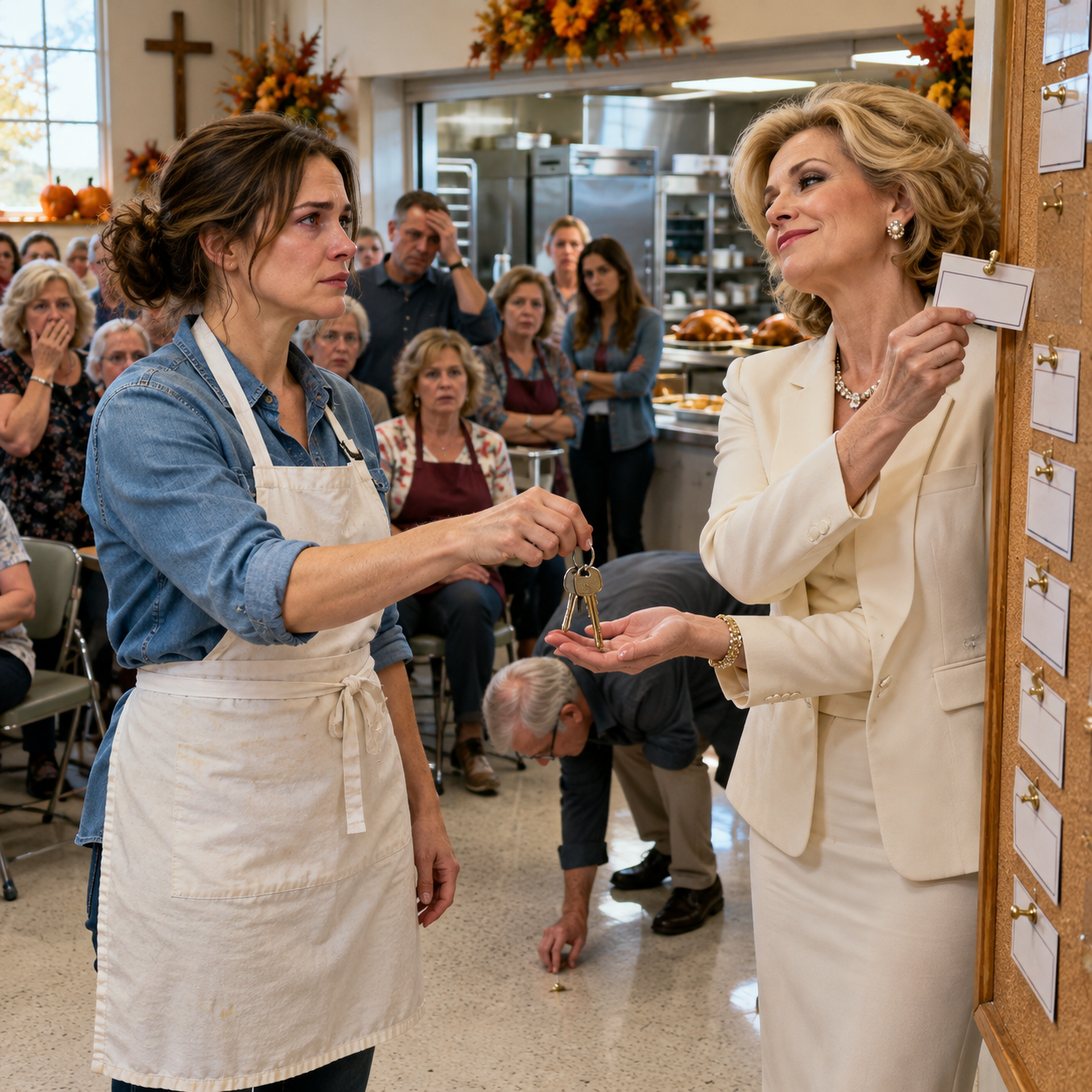
## Part 2: A School Cafeteria Becomes Our Kitchen as Betrayal Deepens
Northside Elementary had two commercial ovens, a massive tilt skillet, industrial refrigeration, and enough tables to seat 300 children. Because the building was available for approved community functions during holidays, Mr. Purvis agreed to sponsor our nonprofit’s request. By 10:15 Wednesday morning, the principal had signed the authorization.
“Just make sure somebody saves me a plate,” she said.
At 10:30, I called Josette. “Deliver everything to Northside Elementary. The cafeteria entrance is across from Bethel.”
She laughed when she realized the delivery truck would have to pass directly in front of the church.
That afternoon, Remy arrived home holding his phone. A local television station had posted a Thanksgiving preview titled “Bethel’s First Lady Feeds 300.” Beneath it was a photograph from the previous year’s dinner, showing steam rising above our serving line.
I recognized the picture immediately because Remy had taken it. In the original, I stood in the center, laughing with a ladle in my hand. Someone had cropped the picture just far enough to remove my face.
“She cut you out, Mama,” Remy whispered.
Below the image, Charlene described the Thanksgiving dinner as a cherished tradition of her church family. She had never actually attended one.
I might have ignored the photograph. I couldn’t ignore what I learned an hour later.
When I called Bethel’s office about our sixty home-delivered meals, the secretary hesitated before explaining that Charlene had hired a caterer from Broussard. The new arrangement was strictly sit-down dining, with no deliveries to elderly residents or people unable to leave home.
“She said the volunteers’ cars create liability concerns,” the secretary admitted. “And people who can’t attend wouldn’t be part of the television coverage anyway.”
Sixty people would receive nothing.
I thought about the elderly man living off Breaux Bridge Highway, who needed oxygen and always requested extra cranberry sauce. I pictured his empty kitchen table.
“Remy,” I said, reaching for my apron, “tell the youth group anybody who can peel potatoes should be at Northside by six.”
By half past six, thirty-one people had arrived. Nine of the fourteen original volunteers came, along with eleven young people accompanied by parents, three school bus drivers, and neighbors carrying knives, mixing bowls, and grocery bags. Mr. Purvis stood in the center, assigning duties with the authority of a man who had fed six hundred children daily for thirty-two years.
The pantry truck had already unloaded forty-two turkeys, sixty cases of canned goods, 360 rolls, and stacks of paper plates. I had watched it pass Bethel’s front windows. For one brief moment, the curtain in the pastor’s office moved.
At eight that evening, butter sizzled beneath onions, celery, and bell peppers. The air smelled like Miss Odile’s kitchen, and the children were washing sweet potatoes under their parents’ supervision. I was stirring the dressing base when the cafeteria door swung open.
Charlene entered wearing a tailored coat. Her heels clicked against the tile as she surveyed the room.
“This is rather sad, Miss Yvette,” she said. “People come to Bethel for Thanksgiving. They won’t come to an elementary school cafeteria.”
I kept stirring.
“We have professional caterers, tablecloths, and a television crew,” she continued. “I’d hate for you to be embarrassed when nobody shows up.”
“Then we’ll deliver the meals to the people who can’t come.”
Her expression barely changed.
“We’ll pray for your little dinner.”
She walked out without offering to help.
Ten minutes later, Reverend Alcide called. His voice sounded weary, and he asked why I had organized another dinner instead of discussing matters with him.
“Your wife removed my name in front of fourteen people,” I answered. “You were down the hall, Reverend.”
He said Charlene wanted to attract younger families and feared two competing dinners would divide the congregation.
“I didn’t take anything from the church,” I told him. “Miss Odile made me responsible for the Fontenot Table in 2015. The food pantry called me because the donations are legally assigned to that organization.”
After a long pause, he admitted he hadn’t known.
“Nobody asked,” I said.
We worked until eleven. The turkeys were prepared, greens washed, and cornbread dressing assembled. I reached home near midnight and set my alarm for four.
Thanksgiving morning arrived cold and brilliant. By six, steam fogged the cafeteria windows while Mr. Purvis softly sang “Amazing Grace” near the dishwashing machine.
At nine, our bus drivers collected sixty packed meals. Each contained turkey, dressing, greens, sweet potatoes, a roll, and pie. I handed one driver the address on Breaux Bridge Highway and reminded her about the extra cranberry sauce.
By ten-thirty, the ovens held enough food for hundreds. Paper turkeys decorated the tables, and Remy had taped a handmade sign on the entrance: THANKSGIVING DINNER — EVERYBODY WELCOME — FREE.
At 10:45, I stepped outside and looked across Johnston Street.
A tremendous line stretched from Bethel’s doors along the sidewalk. Families, elderly couples, mothers carrying babies, and men from the local shelter were waiting beneath the church’s Thanksgiving decorations.
Charlene stood at the entrance in a cream-colored suit, smiling toward the television camera.
Nobody stood outside our cafeteria.
Mr. Purvis joined me on the steps. Neither of us spoke.
Then an old brown Buick stopped beside the church. Remy climbed out and opened the rear passenger door.
A tiny woman emerged wearing a purple hat.
Miss Odile had arrived.
And instead of crossing toward me, she walked directly toward Charlene.
## Part 3: An Eighty-Eight-Year-Old Woman Changes Thanksgiving Before the Television Cameras
I watched Miss Odile climb Bethel’s front steps with Remy’s arm supporting her. People recognized her immediately, stepping aside and applauding the woman who had fed their families for decades. Charlene hurried forward with an enormous smile, opening her arms as the cameraman adjusted his position.
“Miss Odile! What a blessing! We’ve reserved a special table for you.”
Miss Odile stopped.
“Where is Yvette?”
Charlene’s smile tightened. “Miss Yvette is holding her own little dinner across the street. We thought the church deserved a family woman representing this year’s event.”
Miss Odile turned toward the camera, then looked back at the people waiting behind her.
“My husband and I started this dinner in our living room in 1971,” she said. “In 2015, I transferred the Fontenot Table to Yvette Boudreaux. The permit is hers. The donations are hers. The responsibility is hers.”
She lifted her cane and pointed toward me.
“That woman has been feeding you while other people worried about appearances. If you’re hungry, follow me.”
Then she turned around and descended the steps.
Remy guided her to the marked crossing on Johnston Street, where traffic stopped to allow them through. The people waiting outside Bethel began following, first a few elderly men, then families, then almost everyone. The line became a long procession moving across the street toward Northside Elementary.
The television cameraman followed with his equipment, recording every moment.
I stood motionless until Mr. Purvis rested a hand on my shoulder.
“Yvette, somebody needs to serve these folks.”
I hurried inside, wiped my eyes, and took my position behind the steam table.
Miss Odile arrived breathing hard, her purple hat tilted sideways.
“How’s the dressing?” she demanded.
“Not too much sage, ma’am.”
“We’ll see about that.”
She marched toward the nearest table.
That Thanksgiving, we served 309 people inside the elementary school cafeteria. Every chair was occupied, conversations echoed against the tiled walls, and children admired the construction-paper turkeys. The bus drivers returned from their deliveries carrying empty crates and stories of grateful neighbors.
Twenty minutes after serving began, Charlene appeared.
She walked straight toward me, gripping her purse so tightly her knuckles had whitened.
“You stole our Thanksgiving,” she hissed. “You and Odile arranged this to humiliate me on television.”
“I handed you my keys, Charlene. You tried to collect food that belonged to the Fontenot Table. When the pantry refused, I found another kitchen.”
Her eyes flashed. “You made me look ridiculous.”
“I didn’t do anything because I wanted you embarrassed. I did it because three hundred people needed dinner and sixty more needed meals delivered.”
She glanced around, then lowered her voice.
“We can still fix the story. Tell the reporter it’s a partnership between the church and the school. You handle the cooking, and I’ll handle the interview.”
I thought about Remy’s photograph, with my face carefully erased.
“I’m not pretending you invited me to my own table.”
Before she could reply, Reverend Alcide entered. He had followed the congregation across the street, and he stopped beside his wife.
“I told you the dinner was important to Bethel,” he said quietly. “I never told you that you owned it.”
Charlene turned on him. “You could have stopped me!”
“Yes,” he answered. “I should have. But I wasn’t the person who removed Yvette’s name.”
For a moment, neither spoke.
Then Reverend Alcide removed his suit jacket, rolled up his sleeves, and looked at me.
“Could you use another pair of hands?”
“Mr. Purvis needs somebody carving turkey.”
The reverend nodded and went to work. Charlene remained beside the serving line a few moments longer before leaving alone.
Across the street, the caterer sat with nearly three hundred untouched dinners. Rather than let the food spoil, I sent Remy to ask whether some could be shared. Soon we were serving his macaroni and cheese and green bean casserole alongside our own dishes.
By four o’clock, everyone had eaten. We packed the remaining food, and the bus drivers carried extra meals to a women’s shelter and a nearby fire station.
That evening, I drove Miss Odile home. She dozed in the passenger seat, her purple hat resting in her lap, until we reached her porch.
“Clovis always said the table belongs to the person who sets it,” she murmured.
I thought that was the end of our trouble.
Two weeks later, a white envelope from the school district arrived.
Inside was a formal complaint accusing me of improperly using school property for a religious event and diverting charitable donations from a church. I had been summoned to a meeting with district human resources on December ninth.
I sank onto the kitchen floor.
My bus driver’s salary paid our rent, insurance, groceries, and Remy’s orthodontist. Sixteen years of employment could disappear because someone had decided Thanksgiving wasn’t humiliation enough.
When Remy came home, he found me sitting against the cabinets, clutching the letter.
“Mama,” he whispered, “are they going to take your job, too?”
For the first time since Charlene removed my name, I didn’t know how to answer.
## Part 4: The Truth Protects My Job and Restores the Table’s Legacy
Mr. Purvis arrived that evening carrying a shoebox filled with documents. He placed everything on my kitchen table: the principal’s signed authorization, our current food-service permit, the pantry’s donation records, the Fontenot Table’s nonprofit registration, and the school district’s policy allowing approved community organizations to use school facilities during holidays.
“Thirty-two years working for that district,” he said, tapping the papers. “I know where they keep their rules.”
On December ninth, he accompanied me to the central office wearing a necktie I had never seen before.
The human resources officer, Ms. Delahoussaye, read the complaint carefully. She asked whether I had conducted a church service in the cafeteria.
“No, ma’am. I served Thanksgiving dinner. Anybody could eat, and nobody had to attend a sermon.”
She studied the documents Mr. Purvis placed before her.
“The principal approved the building use,” she said. “Your nonprofit is registered. The donations were made to that organization, not to Bethel Fellowship. The permit was valid.”
She closed the folder.
“Mrs. Boudreaux, this complaint is unsupported. The matter is closed.”
My shoulders sagged. Mr. Purvis pressed his hand over mine beneath the table.
Then Ms. Delahoussaye removed her glasses.
“My mother was one of the people who followed Miss Odile across the street,” she told me. “She’s eighty-one. She said your dressing reminded her of Thanksgiving in 1971.”
For a moment, I couldn’t speak.
Mr. Purvis smiled. “Bring her next year. We’ll save her a good seat.”
The following Sunday, I almost stayed home. Remy persuaded me to attend because Miss Odile would be waiting in our usual pew.
Reverend Alcide stood at the pulpit, his reading glasses resting against his forehead. Instead of beginning his sermon, he looked directly toward me.
“Three weeks ago, a faithful member of this congregation was told she wasn’t the right kind of woman to represent our Thanksgiving table.”
The sanctuary became still.
“Those were my wife’s words. But I was in my office when they were spoken, and I did nothing. Silence can make a man responsible for cruelty he didn’t personally commit.”
He paused.
“Someone connected to this church also made allegations against that woman’s employer. I have since learned those allegations were unfounded. That behavior will not be tolerated.”
Charlene sat rigidly in the front pew.
Then the reverend said my name.
“Yvette Boudreaux, I’m sorry. This church owes you an apology.”
He looked around the sanctuary.
“Faith isn’t measured by whether someone’s family looks perfect. It is measured by how we treat one another. Jesus fed thousands without asking whether they were married.”
Beside me, Miss Odile thundered, “Amen!”
The congregation echoed her.
I pressed a hand to my mouth, thinking about all the Sundays I had wondered whether Remy and I belonged in that room.
Afterward, Charlene stood by the church doors greeting people. When I approached, she offered her hand. She didn’t apologize or attempt an explanation, but when she spoke, she simply called me Yvette, without that cold, pointed “Miss.”
It wasn’t forgiveness. It wasn’t friendship. But I shook her hand and walked outside beside my son.
On Christmas Eve, Miss Odile invited me to her house.
At her kitchen table, where I had signed those mysterious papers ten years earlier, she pushed a small wooden box toward me. Inside were dozens of handwritten recipe cards: gumbo, pralines, preserves, bread pudding, and the cornbread dressing she had spent years teaching me to perfect.
On the dressing card, beneath her careful handwriting, someone else had written a tiny note.
Odile, less sage. Love, C.
“Clovis wrote that after our second Thanksgiving,” she explained. “He was right, but I never admitted it.”
I laughed until tears blurred the faded ink.
Then she took my hand.
“I never had a daughter, Yvette. But I have you.”
I tried to protest when she told me to keep the box.
“You fed three hundred people without a church kitchen and with two days to prepare,” she said. “Surely you can carry some recipes home.”
I placed that box above my stove, where I could see it every morning.
The following September, Reverend Alcide asked whether the Fontenot Table could return to Bethel for Thanksgiving. He explained that the church would provide the fellowship hall while the nonprofit and its volunteers retained responsibility for the dinner.
I agreed on one condition: Northside Elementary’s cafeteria would remain our second kitchen.
We needed the ovens. Attendance had climbed to 340 people.
Josette delivered fifty turkeys that November with a handwritten message attached to the paperwork: For the woman whose name is on the form.
The television station returned, too. Its footage of Miss Odile leading the Thanksgiving crowd across Johnston Street had reached thousands of viewers. This time, the reporters interviewed her about the dinner’s history, and she spent eleven minutes telling them everything before informing one young reporter that his tie was crooked.
Ms. Delahoussaye brought her mother. Mr. Purvis reserved their promised seats.
And Charlene volunteered at the welcome table.
She sat there for five hours in a cream-colored sweater, writing names on adhesive tags and handing paper turkeys to families. She greeted people warmly, remembered their children, and never asked anyone about their marital status.
After the final meal, she entered the kitchen and watched me packing the remaining dressing.
“Is that Odile’s recipe?” she asked.
“With Clovis’s correction.”
She nodded, picked up a dish towel, and spent an hour drying pots beside Mr. Purvis.
We didn’t exchange another word.
Some wounds don’t disappear because someone finally learns to behave differently. I didn’t forget what Charlene had done, and we never became friends. But I learned that protecting a table doesn’t always mean refusing someone a place beside it.
A month earlier, Remy and the youth group had repainted Bethel’s kitchen door. I hadn’t seen their work until Thanksgiving morning, when I arrived before sunrise to switch on the ovens.
Across the white door, in uneven blue letters, were three words:
Yvette’s Kitchen.
Beneath them, in smaller handwriting, Remy had painted:
Founded by Odile and Clovis Fontenot, 1971.
My son had spent three afternoons working on those letters. He told me later that the curved Y took him three tries.
I sat on an overturned bucket and cried while the ovens warmed behind me.
For eleven years, I had thought belonging meant someone allowed me to stay. Charlene believed removing my name from a corkboard could erase everything I’d given that church. But the people who mattered hadn’t followed a name card, a photograph, or a woman standing in front of a television camera.
They had followed Miss Odile across a street because they knew where love was being served.
Now, every Thanksgiving, she still comes into the kitchen wearing her purple hat. She tastes my dressing, closes her eyes, and makes me stand there waiting for her judgment.
“Too much sage, chère,” she always says.
Then she winks and asks for another helping.
I lost three keys that November. I nearly lost my job. I learned exactly how much damage one person’s pride could cause.
But I gained something no one could ever remove from a wall.
I learned that my son and I had always been a family, that service doesn’t need anyone’s permission, and that a table is built by the hands willing to feed whoever comes through the door.
Every Thanksgiving morning, before the first turkey goes into the oven, I look at the words Remy painted.
Then I tie my apron, turn on the lights, and start cooking.
Because there is always room for one more plate.
THE END.
All characters and events in this story are fictional, created for storytelling and entertainment purposes. Thank you sincerely for reading. Your feedback and support are invaluable and motivate me to continue sharing more stories with you.


