
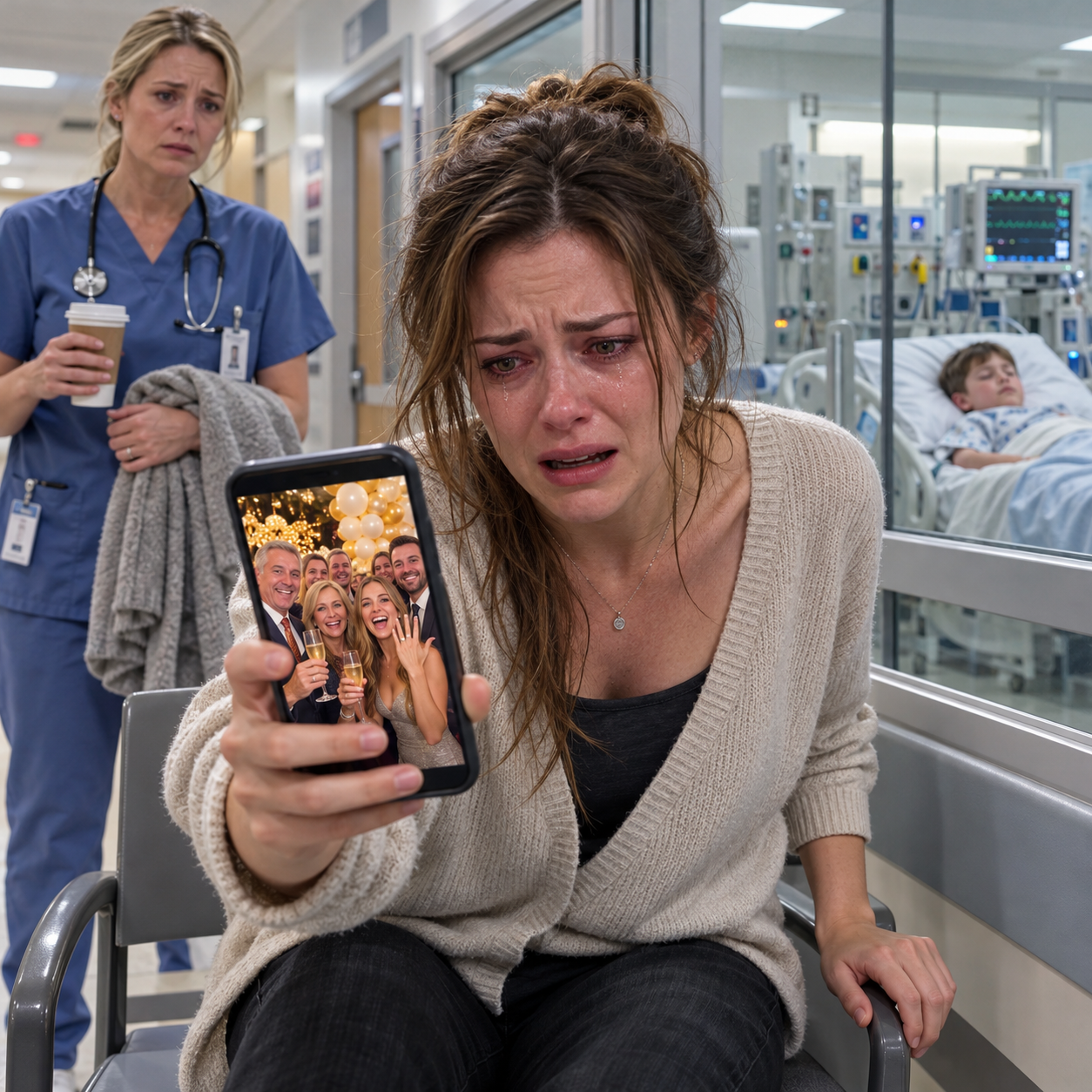
Part 2: Eleven Days Later, My Mother Asked for Money
Noah stayed in the hospital four days.
Madison never visited.
Dad sent a text on the third afternoon.
How’s our little man doing?
I replied:
Better. Still on IV antibiotics.
He sent a thumbs-up.
Mom sent a red heart.
That was the entire conversation.
When we finally came home, Noah moved carefully, holding a small pillow against his stomach whenever he coughed. I made a bed for him on the living room couch and slept nearby for several nights.
I told myself not to make permanent decisions while I was angry.
That was an old habit.
I had spent most of my adult life translating my family’s behavior into softer language.
Mom wasn’t dismissive; she was overwhelmed.
Dad wasn’t passive; he hated conflict.
Madison wasn’t spoiled; she needed more reassurance.
And I wasn’t neglected.
I was independent.
Eleven days after Noah’s surgery, my mother called while I was making grilled cheese.
Her voice was bright.
“You sound tired.”
“I am.”
“How’s Noah?”
“He’s improving.”
“That’s good. Listen, I have some exciting news.”
I turned the sandwich.
“What?”
“We toured Ashford Estate today.”
I knew the place. White columns, gardens, a ballroom Madison had probably saved on Pinterest five years before meeting Daniel.
“She fell in love with it,” Mom continued. “The date she wants is still open.”
“That’s nice.”
“The only issue is the deposit.”
I lowered the stove flame.
“Okay.”
“They need five thousand by Friday.”
Still I didn’t understand why she was telling me.
Then she laughed lightly.
“Your father and I are stretched this month. Daniel’s family already committed to their portion, so we thought you could handle the deposit.”
The spatula remained in my hand.
“You thought I could what?”
“Cover it. Just temporarily.”
“How temporarily?”
“Well, you know how weddings are. We’ll work it out.”
I looked toward Noah.
He sat at the kitchen table arranging LEGO pieces by color, his hospital bracelet still looped around one wrist because he had asked me not to cut it off yet.
“Mom, you want me to pay five thousand dollars toward Madison’s wedding.”
“It’s the venue deposit, Claire.”
“Eleven days ago, I asked you to come to the hospital.”
She sighed.
“We already discussed this.”
“No. You ended the discussion.”
“Must we turn every conversation into a trial?”
“My child was having emergency surgery.”
“And he’s okay.”
The words came quickly, as if his survival had retroactively erased the danger.
I set the spatula down.
“You didn’t know he would be okay.”
Mom became quiet.
Then she said, “I’m sorry you felt unsupported.”
There it was.
Not I’m sorry we weren’t there.
I’m sorry you felt.
I rubbed my forehead.
“Why are you asking me instead of Madison?”
“Because she’s starting her married life. She needs to save.”
“And I don’t?”
“You earn more.”
“That’s not an answer.”
“Claire.” Her voice changed, acquiring the patient tone she used when she believed I was being difficult. “Families help one another. You know that better than anyone.”
I almost laughed.
Instead, I said, “I’ll think about it.”
After we hung up, I stood at the counter staring at the burned side of the sandwich.
“Mom?”
I turned.
Noah was holding up a tiny LEGO spaceship.
“Does this need another wing?”
“Probably.”
He considered it.
“Yeah. Me too.”
That night, after he went to bed, I opened my laptop.
I wasn’t looking at wedding venues.
I opened my bank account.
Three years earlier, Dad’s employer had reduced his hours. My parents fell behind on the second mortgage, and Mom called me crying because a notice had arrived.
I covered the payment.
Then another.
Eventually I put the $1,100 monthly payment on automatic withdrawal.
Mom’s car insurance came later.
Two hundred ten dollars each month because her credit history had sent her premiums soaring.
The family phone plan was mine too.
Streaming accounts.
A winter heating bill.
Property taxes one year.
A replacement water heater.
Small transfers with descriptions like groceries, just until Friday, and Dad short this month.
I opened a spreadsheet.
One by one, I entered the payments.
The rows multiplied.
1,100.
210.
389.
750.
1,600.
I went back through three years of statements, comparing dates and transfer confirmations.
Shortly after midnight, I reached the final figure.
$52,340.
I leaned back and stared at it.
Fifty-two thousand, three hundred forty dollars.
I had never asked them to repay it.
I had barely allowed myself to think of it as money I had given them.
It was simply what Claire did.
Then my phone lit up.
A text from Mom.
Ashford can only hold the date until Friday. Please don’t leave your sister hanging.
I looked from the message to the spreadsheet.
And began canceling payments.
Part 3: I Stopped Financing People Who Wouldn’t Show Up
I didn’t do anything dramatic.
That mattered to me.
I didn’t empty accounts that belonged to anyone else. I didn’t threaten them. I didn’t post family business online.
I simply stopped paying bills that had never been mine.
The bank confirmed the mortgage autopay cancellation.
I called the insurance company and learned my name could be removed as the payer without affecting Mom’s coverage until the next bill.
The phone carrier explained how to separate my parents’ and Madison’s lines.
“They’ll receive thirty days to transfer their numbers,” the representative said.
“Perfect.”
When everything was documented, I wrote an email.
I rewrote it three times.
The first version was furious.
The second sounded like a legal notice.
The third finally sounded like me.
Mom, Dad, Madison,
When Noah was taken into emergency surgery, I asked for help. None of you came.
I’m not writing this to argue about the engagement party. You made your choice that night, and I understand it more clearly now than I did then.
Yesterday Mom asked me for $5,000 for the Ashford Estate deposit and reminded me that family helps family.
Attached is a spreadsheet showing $52,340 I have paid on behalf of this family during the past three years.
I never expected repayment. I did expect that when I truly needed you, being family would mean more than money.
Effective today, I am no longer paying the second mortgage, Mom’s car insurance, or the shared phone plan. You have thirty days to transfer your numbers.
I will not contribute to the wedding.
Please do not contact me to discuss money.
If you want a relationship with Noah and me, start with acknowledging what happened at the hospital.
Claire
I attached the spreadsheet.
Then the bank records.
Then I pressed Send.
The first call came from Mom nineteen minutes later.
I let it ring.
Dad called next.
Then Madison.
By the time I put Noah to bed, I had fourteen missed calls.
Mom’s voicemail began in anger.
“You cannot make financial decisions like this without talking to us.”
I almost smiled at the wording.
Financial decisions about my money apparently required family approval.
Dad’s message was shorter.
Please call. The mortgage comes out next week. We need time.
I texted him:
You have time. I’m not paying it anymore.
Madison called again.
This time I answered.
For several seconds, neither of us spoke.
Then she said, “Fifty-two thousand dollars?”
“Yes.”
“Mom said you helped sometimes.”
“I helped every month.”
“I didn’t know.”
“I believe you.”
She started crying.
“I swear, Claire, I didn’t know about the mortgage.”
I sat at the edge of my bed.
“You knew Noah was in surgery.”
Her crying quieted.
“That part you knew.”
“I thought Mom said it wasn’t serious.”
“I texted you from the emergency room.”
“I was hosting Daniel’s family. There were forty people there.”
“You could have called.”
“I should have.”
“Yes.”
A long silence followed.
Then Madison asked, almost too softly, “Does this mean you won’t help with Ashford?”
That question told me more than the tears had.
“No, Madison.”
“We’re going to lose the date.”
“I know.”
“You know how much this wedding means to me.”
“And you know how much Noah means to me.”
She didn’t answer.
We ended the call without yelling.
That almost made it sadder.
Over the next two weeks, the consequences arrived quietly.
Dad picked up weekend work doing inventory at a warehouse.
Mom sold several pieces of jewelry.
Madison and Daniel gave up Ashford Estate and began talking about a ceremony in Daniel’s aunt’s backyard.
Mom left messages saying I was punishing everyone for one bad evening.
I stopped listening after the fourth.
Then, one Saturday morning, Dad came to my house alone.
I saw him through the front window but didn’t open the door immediately.
He held an envelope.
No flowers.
No speech prepared on his phone.
Just an envelope.
When I finally stepped onto the porch, he held it out.
“What’s this?”
“Something I should’ve written before I came.”
I opened it after he left.
The handwriting wandered downhill across the page.
Claire,
I kept telling myself your mother knew what she was doing, and that Noah was probably fine because she said he was.
That was cowardly.
The truth is I wanted to stay at the party. I didn’t want to embarrass Madison in front of Daniel’s family, and I knew you would manage because you always manage.
I have been using that as an excuse for years.
You are my daughter. You were scared. Your son was sick.
I should have been sitting beside you.
I am ashamed that it took losing your financial help to make me understand how much else I had been taking from you.
I am not asking for money.
I would like to apologize to Noah, if you ever allow it.
Dad
I read the letter twice.
Then I folded it along the crease he had already made.
Part 4: My Father Finally Understood What Family Actually Cost
I didn’t call Dad that day.
Or the next.
An apology can be sincere and still arrive after damage has been done.
For most of my life, I had confused forgiveness with restoring everything exactly as it was. If somebody apologized, I rushed to make them comfortable. I reassured them. I minimized what happened.
This time, I let discomfort exist.
Dad didn’t pressure me.
That helped.
Five weeks passed.
Then Noah found the letter on my desk.
“Is that Grandpa’s writing?”
“Yes.”
“Is he mad?”
“No.”
Noah climbed onto the chair beside me.
“He hasn’t visited.”
I looked at him.
“Do you want him to?”
He shrugged in the solemn way children do when they’re trying not to admit they care.
“He makes the best pancakes.”
That Saturday, I called Dad.
He answered on the first ring.
“Claire?”
“You can come by tomorrow.”
His breathing changed.
“Okay.”
“For an hour.”
“Okay.”
“And Dad?”
“Yes?”
“This is not everything being fixed.”
“I know.”
He arrived ten minutes early and waited in his truck until exactly two o’clock.
When I opened the door, he was holding a small LEGO box.
Noah spotted it immediately.
“Grandpa!”
Dad bent down, and Noah wrapped both arms around his neck.
My father’s face crumpled.
He held Noah carefully.
“I missed you, buddy.”
“Mom says I can run again now.”
“That’s good.”
“But not jump off the couch.”
Dad looked at me over Noah’s shoulder.
“Sounds like a reasonable rule.”
He stayed fifty-eight minutes.
He didn’t mention the mortgage.
He didn’t mention Mom.
He didn’t ask when things would go back to normal.
Before leaving, he stopped beside my car.
“I started paying down some things,” he said.
“That’s good.”
“I should’ve done it years ago.”
I nodded.
He rubbed his hands together.
“Your mother thinks you’re trying to humiliate her.”
“I haven’t told anyone outside the family.”
“I know.”
“Then whatever humiliation she feels is coming from knowing what happened.”
Dad looked toward the house.
“I told her that.”
I studied him.
“That must have gone well.”
A faint smile appeared.
“No.”
Madison married Daniel three months later in his aunt’s backyard.
I did not attend.
Neither did Noah.
I sent a card because I wanted my final decision to come from clarity rather than spite.
I wished them a good marriage.
I sent no check.
Mom and I remained apart.
She sent occasional messages at first.
Some were angry. Others were nostalgic photographs from childhood or reminders of birthdays and holidays.
But the apology I needed never came.
She could say she hated the distance.
She could say she missed Noah.
She could say families shouldn’t stay angry forever.
She could not say: I chose a party when you begged me to come to the hospital, and I was wrong.
Madison came closer once.
Months after the wedding, she left a voicemail saying she had been selfish and embarrassed by how much attention she had expected during her engagement.
I listened.
I appreciated it.
I wasn’t ready to call back.
Maybe someday I will be.
Dad, however, kept showing up.
He came to Noah’s school program and sat quietly in the second row.
He brought pancakes one Sunday morning.
When I caught the flu, he left groceries on my porch without coming inside or asking for praise.
Small things.
Ordinary things.
Things I once would have overlooked because they didn’t involve money or grand declarations.
Noah is eight now.
He is healthy, noisy, and almost impossible to get into bed before nine.
The scar from his surgery has faded.
Mine, in its own way, has too.
I still have the spreadsheet.
Not because I intend to collect the $52,340.
I keep it because sometimes evidence protects you from rewriting your own history.
For years, I believed being dependable meant never letting anyone fall.
Now I understand that sometimes people have to feel the weight of their own lives before they learn to carry them.
My parents did not lose their house.
Dad’s extra work helped. Mom cut expenses. They refinanced eventually.
Madison still got married.
The world did not collapse because I stopped rescuing everyone.
What collapsed was the role my family had assigned me.
The reliable daughter.
The emergency fund.
The person who could always manage.
I’m still dependable.
But now I know the difference between helping someone and teaching them that they never have to show up for me.
The night Noah was rushed into surgery, I thought I was finding out how alone I was.
Years later, I see it differently.
I found out who would come when there was nothing to celebrate, no photographs to take, and no applause waiting.
And I finally learned to give my time, money, and love accordingly.
The End .
All characters and events in this story are fictional, created for storytelling and entertainment purposes. Thank you sincerely for reading. Your feedback and support are invaluable and motivate me to continue sharing more stories with you.

