
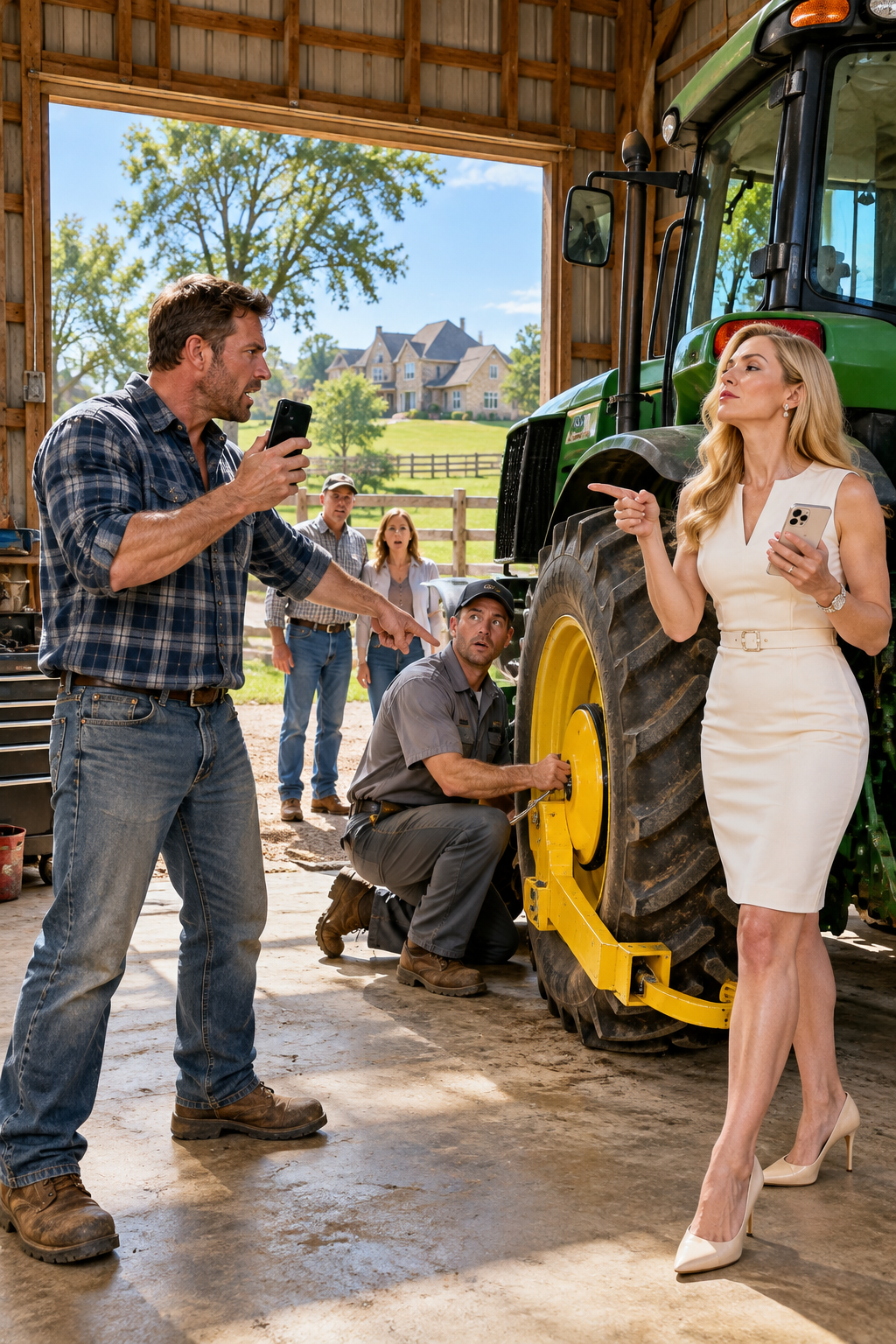
### Part 2: My Father’s Forgotten Road Agreement Threatens a Million-Dollar Disaster
I carried the folder to the kitchen table and spread its contents beneath the morning light. Two easement agreements, a letter from the developer’s attorney, and an original subdivision plat lay before me. Both agreements contained the same condition: anyone benefiting from the roads was forbidden from interfering with agricultural activities on the surrounding property. If interference continued for thirty days after written notice, the landowner could begin revoking the easements with an additional ninety days’ notice.
I read the language again, remembering my father standing beside a fence post years earlier. “Cole, people can share our roads as long as they respect our land.” He’d said it without anger, as though explaining something as ordinary as repairing a gate. Now I understood why he’d insisted on writing the agreements himself.
In 2004, Ridgewood Development had purchased 110 acres beside our farm and planned thirty-four expensive homes. The subdivision had one serious problem: reaching FM 812 required crossing our property. The alternative meant constructing a bridge over Tanner’s Branch, cutting through a limestone bluff, and building more than a mile of engineered roadway. Rather than force a costly solution, my father had granted two conditional easements for Ridgewood Drive and Tanner’s Lane.
Those roads were never public property. They were a privilege granted under written conditions, and Shelby had mistaken that privilege for ownership.
Maggie returned from Austin and found me surrounded by documents. I showed her the photographs, then read the highlighted paragraph aloud. She pulled out a chair without speaking. When I finished, she touched my father’s signature with one fingertip. “He protected this place even after he was gone,” she said.
That Monday, I drove to Austin to meet attorney Naen Garza, whom Dennis Maldonado had recommended. Her office overlooked Congress Avenue, but she barely glanced outside as she examined the documents. She checked the recorded plat, compared the descriptions, and studied the photographs from my barn. “Your father understood exactly what he was signing,” she finally said. “And the developer acknowledged these conditions in writing.”
I asked whether dissolving the original development company in 2009 changed anything. Naen shook her head. The obligations had been written to bind successors and beneficiaries, including the homeowners now using the roads. She cautioned that any revocation could still face legal challenges, but the recorded language gave us a powerful position.
Then she called a civil engineer.
The preliminary estimate came back at $2.1 million for a replacement road, bridge, and bluff excavation. Naen turned her computer toward me. “Thirty-four households. That’s roughly sixty-two thousand dollars each if they share the cost equally.” I pictured the families driving to work, taking children to school, bringing groceries home. Most of them had never spoken to me, and I had no desire to punish them for Shelby’s behavior.
“I don’t want their money,” I said.
“Then give them a chance to fix this,” Naen answered. “But make the consequences unmistakable.”
My friend Ray Cantu inspected the tractor after the immobilizer was removed. He found a damaged hydraulic seal and axle components requiring repair. His written estimate totaled $3,812, and he signed a statement explaining how the clamp had caused the damage. Jackson watched Ray inspect the machine, his hands buried in his jeans pockets. “Grandpa helped you choose this tractor, didn’t he?” he asked. I nodded. Jackson stared at the damaged wheel. “She didn’t even know what she was touching.”
Naen prepared formal notices for the homeowners, identifying the HOA’s interference with our farming activities. The demands were straightforward: compensate me for the tractor damage, stop all attempts to regulate our farm, and acknowledge in writing that Ridgewood Crossing had no authority over our property. We also filed civil claims against Shelby personally over the unauthorized entry and equipment damage.
The notices allowed thirty days to remedy the violations before we pursued the additional ninety-day revocation process. Naen attached photographs, county inspection records, copies of Shelby’s letters, and the original easement language.
Shelby called that Thursday evening.
“Mr. Harden, you cannot seriously believe you can take away thirty-four families’ roads.”
“I’m not taking anything away today,” I replied. “I’m giving your association thirty days to honor an agreement.”
“Those roads belong to our community.”
“They cross my property, Shelby. Your own subdivision map says they’re conditional private easements.”
For several seconds, neither of us spoke. Then she disconnected.
By Friday morning, every homeowner had received an email from Shelby claiming that an unreasonable farmer was threatening the neighborhood’s access. She described Ridgewood Drive and Tanner’s Lane as public roads, although the recorded documents said otherwise.
Three days later, her attorney filed an emergency request for a restraining order to prevent us from exercising the revocation provisions. Naen called as I was repairing a fence along the southern pasture. “She wants a judge to make your father’s agreement unenforceable,” she said. “The hearing is Tuesday.”
I set my pliers on a fence post and looked toward the distant roofs of Ridgewood Crossing.
For twenty years, those houses had stood behind roads my father allowed them to use. Now a woman who hadn’t bothered to read the deed was asking a court to erase the conditions that made their neighborhood possible.
### Part 3: A Judge Rejects Her Demands Before Pride Destroys Everything
Shelby arrived at the courthouse in a cream-colored designer dress, holding a leather handbag against her side. Her attorney carried a thick stack of papers. I wore clean khakis and a blue shirt Maggie had ironed that morning. Naen placed our evidence on the table, arranged by date, while Judge Carmen Reyes studied the dispute from behind her reading glasses.
Shelby’s attorney argued that the subdivision had relied on the roads for years and that closing them would harm innocent residents. He described my threatened revocation as unreasonable and emphasized the community’s dependence on continuous access. Naen waited until he finished before standing with the two original agreements in her hands.
“Your Honor, reliance does not erase recorded conditions,” she said. She read the paragraph protecting agricultural operations, then displayed Shelby’s notices, the county’s rejected complaints, and photographs of the boot attached to my tractor. Finally, she submitted Ray Cantu’s statement documenting the damage.
Judge Reyes studied the evidence before announcing her decision. She denied the emergency restraining order, finding that Shelby’s attorney had not established grounds to prevent enforcement of the recorded agreement. The judge emphasized that the subdivision had been given a specific remedy: correct the interference within the required period.
Shelby remained motionless as Naen gathered her papers. Outside, Maggie took my hand. “Your dad would have been proud,” she said. I wanted to believe her, but I couldn’t stop thinking about the families who might face a terrible financial burden. Winning a court hearing wasn’t the same as finding a way to live beside one another afterward.
Three days before the cure deadline, Shelby drove up our gravel driveway. She stepped out of her Mercedes wearing white sneakers instead of her usual heels. I was replacing an air filter on the back porch when she approached, gripping a folded sheet of paper. “Mr. Harden, I’d like to resolve this privately.”
I set the filter down. “You had fourteen months to leave my farm alone.”
Her expression tightened. “Perhaps the board was too aggressive. We were trying to protect property values.”
“You entered my barn and disabled equipment I need to feed my cattle.”
She looked away. “That was regrettable.”
I told her there were three conditions. The tractor repairs had to be paid in full, she had to apologize publicly at an HOA meeting, and the board had to sign a permanent recorded agreement recognizing that my farm was outside its jurisdiction. Shelby listened without interrupting until I mentioned the apology.
“A public admission would damage my credibility,” she said.
“Then maybe your credibility needs to change.”
She pressed her lips together. “I’m prepared to discuss compensation. But I will not stand in front of my neighbors and humiliate myself.”
“You humiliated a seventy-three-year-old widow over her front door. You tried to close my family’s farm. All I’m asking is for you to tell the truth.”
Her eyes narrowed. “I don’t apologize to farmers.”
The words settled between us. Behind her, the cattle moved quietly through the pasture, and the same barn she despised stood beneath the oak trees.
“Then we’re finished,” I said.
Shelby took one step toward her car before turning around. “You would destroy an entire neighborhood because I won’t apologize?”
“No, Shelby. Your choices brought us here. I’m still offering a way out.”
She drove away without answering.
When I told Maggie what happened, she shut her book and looked at me for a long moment. “File the next notice,” she said. “And make sure those families know they still have a choice.”
The thirty-day deadline passed without the required remedy. Naen recorded our notice of intent to revoke the two easements, triggering the additional ninety-day period. We had not physically closed either road, and we would not endanger residents or obstruct emergency access while the dispute remained unresolved. But the legal countdown had begun, and the $2.1 million alternative was suddenly more than an abstract engineering estimate.
Shelby attempted to organize an emergency special assessment of approximately $62,000 per household. The homeowners rejected it twenty-nine to five. When they discovered that she had described conditional easements as public roads, angry questions filled the community message boards.
Then Dan Weber, a retired civil engineer who lived on Tanner’s Lane, telephoned me.
“Mr. Harden, we’ve only heard Shelby’s version,” he said. “Will you come to our emergency meeting Saturday? I think everyone deserves to see the evidence.”
I looked toward my father’s filing cabinet.
“Yes,” I answered. “And I’m bringing the original map.”
### Part 4: Thirty-Four Families Discover the Truth and Reclaim Their Neighborhood
The Ridgewood Crossing clubhouse was full when I arrived Saturday evening. Thirty-four homeowners sat beneath decorative chandeliers, some with spouses beside them, others holding folded notices from Naen’s office. Shelby occupied the front table in a navy blazer, her leather folder perfectly aligned with the edge. She watched me enter without changing her expression.
She opened the meeting with a prepared statement about maintaining community standards and managing an unfortunate disagreement with an adjacent landowner. Not once did she mention the tractor, the barn, or the damage. Dan Weber finally stood and interrupted her. “Shelby, we’ve heard enough descriptions of the problem. I’d like Mr. Harden to explain what actually happened.”
I walked to the front carrying my father’s folder.
“My grandfather bought our farm in 1961,” I began. “My father worked that land for decades. When this subdivision was built, he could have refused to let the developer cross our property. Instead, he agreed because he understood that families needed roads.”
I opened the original plat and laid it on the table. “He asked for one thing in return. Leave our agricultural operation alone.”
Then I presented the evidence. The paint demands. The seven county complaints. The petition based on misleading feedlot research. The commissioners’ unanimous rejection. Finally, I displayed the photograph of the yellow boot fastened to my tractor inside my barn.
A woman in the third row covered her mouth.
“That machine costs forty thousand dollars,” I continued. “The clamp caused $3,812 in repairs. But the worst part wasn’t the money. Someone entered a building my father constructed and decided that thirty-four homeowners’ preferences mattered more than my right to work on my own property.”
I played the recording of Shelby instructing the technician to immobilize the tractor. Her voice filled the clubhouse speakers. When it stopped, I placed the engineering estimate beside the subdivision map.
“$2.1 million,” I said. “That’s what building an alternative route could cost. I have never wanted to take away your roads. But my family cannot keep providing access while your association tries to shut down our farm.”
Patricia Hall, a nurse raising two children alone, stood slowly. “You told us he was damaging our property values,” she said, looking directly at Shelby. “You never told us you entered his barn.”
Shelby leaned toward her microphone. “The board was acting on behalf of the community.”
“No,” Dan answered. “You were acting for yourself.”
Then Gil Ochoa, the former HOA president, rose from the back row holding an old binder. Inside was a copy of the subdivision plat and the easement conditions. He explained that the association had possessed the documents for years and that he had included them in the records when Shelby became president.
“I told her the roads were private easements,” Gil said. “I specifically warned her that the HOA had no authority over Cole’s farm.”
Every head turned toward Shelby.
She had not merely misunderstood where her power ended. She had been warned, and she’d chosen to ignore it.
Shelby opened her mouth, then closed it. The woman who had filled neighborhood meetings with charts, warnings, and lengthy speeches suddenly had nothing to say.
A retired contractor named Bill Parish stood next. “I signed your petition because you showed me those property-value numbers. My house doesn’t even face this farm. You made me afraid of a man I’d never met.”
The vote to remove Shelby as president passed thirty-one to three. A second motion accepted my three settlement conditions unanimously, thirty-four to zero. The homeowners also voted to censure the former board for allowing the dispute to continue.
Shelby remained seated throughout the voting, her hands flat against the table. When Dan announced the final result, she looked at the closed folder in front of her. For the first time, she seemed to understand that authority wasn’t something she could manufacture with stationery and threats.
Two weeks later, Shelby stood before the same homeowners and read a formal apology. Her voice was stiff, and her eyes stayed on the note card. She acknowledged entering my barn without permission, interfering with my tractor, and exceeding the HOA’s jurisdiction. It lasted less than a minute.
I didn’t need her to cry. I needed the truth spoken where everyone could hear it.
The $3,812 repair payment arrived and cleared. Dan, now the elected HOA president, signed a permanent agreement recognizing our farm’s independence from association rules. The agreement was recorded with the county, and a new annual payment of $4,800 was established to help cover maintenance and wear on the roads crossing our land.
With the violations remedied and the new protections in place, Naen and I withdrew the pending revocation. The subdivision kept its access, and thirty-four families avoided a construction project none of them could reasonably afford.
Shelby listed her house three weeks later for $585,000, roughly forty thousand less than she had paid. The listing described Ridgewood Crossing as a peaceful community surrounded by natural beauty. Maggie laughed when she read it. “Funny how your pasture suddenly became a selling point.”
Her home sold to a young family with two children and a golden retriever. One Saturday, the new owners stopped by our mailbox and asked whether their children could see the tractors. Maggie smiled and invited them over.
That summer, Jackson began hosting Saturday morning barn visits for neighborhood families. He showed children the baler, explained how hay was harvested, and introduced them to Hank, our border collie. One little girl asked whether the cows had names, and Jackson spent fifteen minutes helping her identify the friendliest ones.
I watched from the barn doorway as people who once hurried past our property gathered beneath the oaks, laughing with my son. For years, Shelby had convinced them that our farm was something to fear. Now they were discovering that the people working beside their neighborhood were simply neighbors too.
One afternoon, Dan brought over a pecan pie his wife had baked. We sat on the porch as the sun dropped behind the western pasture.
“I still can’t believe we nearly lost our roads,” he said.
“You didn’t lose them,” I answered. “You just learned who was responsible for keeping them open.”
Dan nodded toward the barn. “Your father must have been quite a man.”
I looked at the weathered boards, the doors he’d hung, and the tools I’d inherited. “He knew how to build things that lasted.”
After Dan left, I returned the original agreements to my father’s filing cabinet. I paused over his signature, remembering the calluses on his hands and the evenings he’d spent checking property surveys beneath the kitchen light. He had protected our family without knowing that one day I’d need that protection against someone who thought a fancy neighborhood sign carried more authority than a recorded deed.
I closed the drawer and stepped outside.
The Ridgewood Crossing entrance still carried its gold-lettered promise of a premier living experience. The thirty-four families still drove along Ridgewood Drive and Tanner’s Lane. My tractor still worked the hayfields, and my father’s barn still stood exactly where he’d built it.
The difference was that nobody looked at those roads quite the same way anymore.
Every family knew they crossed land belonging to someone else, and every driver understood that the agreement depended on mutual respect.
Shelby had tried to erase my farm from her neighborhood’s picture of perfection. Instead, she’d reminded an entire community why the farm deserved to remain.
And every time I drove my tractor out of that barn, I could almost hear my father’s voice reminding me that protecting what belongs to you doesn’t mean refusing to share it.
It means making sure everyone remembers what sharing requires.
THE END.
All characters and events in this story are fictional, created for storytelling and entertainment purposes. Thank you sincerely for reading. Your feedback and support are invaluable and motivate me to continue sharing more stories with you.


