
Part 2: A Gallery Owner Helped Me Reclaim My Buried Dream
Megan arrived carrying a notebook and a canvas tote bag. She didn’t ask intrusive questions about the newspaper or offer exaggerated sympathy, which immediately made me more comfortable. Instead, she requested permission to look at the paintings and moved slowly around my small studio. I watched her expression as she studied work I’d never intended to show another person.
She spent several minutes examining the dining-table painting before turning toward the girl behind frosted glass. When she reached Ashes, she asked what had inspired the red lines running through the gray surface. I explained that they represented the parts of an old experience that remained visible no matter how many times I tried painting over them. Megan listened carefully, then stood before the family portrait.
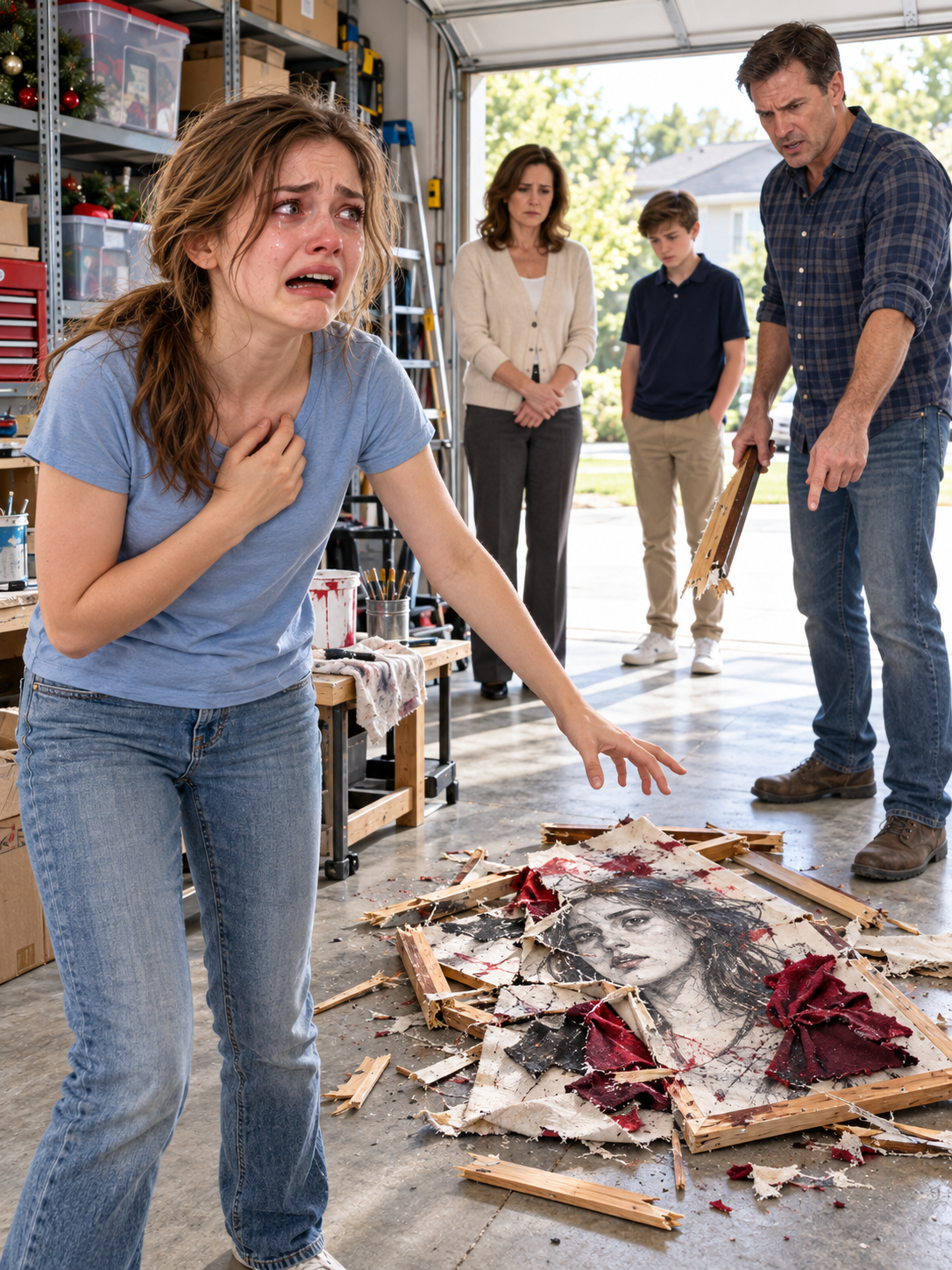
“This story didn’t begin with the newspaper, did it?” she asked. I told her about the garage, Mrs. Cooper, and the summer program I’d abandoned after Dad destroyed my painting. Megan looked back at the canvases and said she believed they could form the beginning of a small exhibition. She warned me that a successful show would require more than an interesting personal history; the paintings themselves had to carry the meaning.
Over the next week, we planned seven pieces around the idea of belonging. Four were paintings I’d already completed, and three would be new works responding to the experience of seeing my private life turned into public entertainment. Megan encouraged me to create something that visitors could understand through their own experiences rather than treating the gallery as a place to settle arguments with my relatives. I liked the distinction because I wanted my work to matter beyond what my parents had done.
Before agreeing to display anything connected to the advertisement, I consulted an attorney who handled privacy and media disputes. She explained that we needed to preserve original records, avoid revealing unnecessary personal information, and distinguish verifiable facts from accusations. She also helped me contact the newspaper about the location details in its online edition. I wanted those details removed, not circulated further through an exhibition.
Megan suggested displaying a heavily redacted copy of the advertisement near the entrance, leaving only its central accusation visible. We covered my personal information, removed the family photograph, and concealed details that could identify where anyone lived. The single word Failure remained in the center. Looking at it beneath clear acrylic, I felt nervous but no longer ashamed.
The first new painting became The Letter, a portrait of a woman whose face seemed to disappear beneath layers of printed words. The second, The Good Child, showed two children beneath the same roof, one illuminated by warm light while the other blended into the wall. For the final piece, I painted an open doorway leading from a dim room toward a bright, unfinished space. I called it Outside the Frame.
I worked at my data job during the day and painted late into the evening. Some nights I hated everything I made, while other nights I forgot to check the clock until well after midnight. Megan visited twice to discuss composition, lighting, and the order in which visitors would encounter the paintings. She treated me like an artist preparing a real exhibition, not a woman whose family had become the subject of local gossip.
A week before the opening, I sent my parents and Ethan a brief message explaining that I wouldn’t discuss the advertisement by phone. I told them the show was about my experiences and that I wasn’t inviting public arguments. I included the gallery information because I wanted them to have the opportunity to see the work if they chose. Then I stopped answering messages demanding that I cancel the event.
On opening night, I arrived early and stood alone in the gallery while Megan adjusted the lighting. Seeing my paintings on clean white walls felt strangely different from seeing them stacked in my apartment. The dining-table piece looked larger and lonelier than I remembered. When the doors opened, visitors began moving through the room, reading the short descriptions beside each canvas.
Several people recognized me from the newspaper, but most were careful not to make the exhibition about the advertisement. A woman spent a long time studying The Good Child and told me she’d grown up constantly compared with an older sister. Another visitor said the dining-table painting reminded him of family gatherings where he never felt entirely welcome. Hearing those responses unsettled me because I’d believed my paintings described experiences nobody else would understand.
My parents arrived shortly before eight, with Ethan following behind them. Dad wore the navy suit he reserved for formal occasions, while Mom carried the expensive handbag she always brought to charity events. Ethan looked around the gallery, recognizing several people who had received newspapers from him. For a moment, I could see all three trying to decide how to behave in a room they hadn’t arranged.
Dad approached me near the entrance and asked to speak privately. I suggested we step toward a quiet seating area, away from the other visitors. He said the exhibition was unnecessary and that the newspaper advertisement had been intended to motivate me toward greater success. When I asked why encouragement required publishing my salary and directing strangers toward my neighborhood, he said I’d misunderstood their intentions.
“Did you approve the advertisement?” I asked him. Dad hesitated before admitting that he and Mom had discussed it and agreed to the wording. Mom said they’d believed public accountability might encourage me to change my priorities. I asked whether either of them had considered how it would feel to receive messages from strangers who now knew where to look for me. Neither offered an answer.
Ethan insisted mailing the newspapers had been his way of making sure people understood the family’s concerns. I asked why he’d sent them to coworkers who had never requested information about my personal life. He looked toward the gallery entrance and said he’d gone too far, though he still blamed me for making the disagreement more visible. I told him I hadn’t mailed a single copy to his workplace.
Dad wanted to know whether I planned to keep discussing the family in public. I explained that the artwork wasn’t a collection of accusations, but a way of describing experiences I’d spent years hiding. If he wanted to understand why the paintings existed, I suggested he look at them rather than argue about the opening. He followed me reluctantly toward Ashes, while Mom and Ethan walked behind us.
Standing before the gray canvas, I told them about being sixteen and watching my self-portrait burn behind our garage. Dad said it had happened a long time ago and he’d only been trying to keep me from chasing an uncertain career. I agreed that art could be financially difficult, but breaking my work hadn’t taught me responsibility. It had taught me to hide the things I loved.
Mom looked at the painting without speaking. I reminded her that I’d looked directly at her when Dad broke the frame because I hoped she would intervene. She whispered that she remembered, then turned toward the family portrait hanging nearby. I couldn’t tell whether she was beginning to understand or simply remembering an afternoon she’d preferred to forget.
The portrait showed four figures standing close together, with their shadows stretching behind them. Three shadows overlapped, but the fourth fell several feet away. Ethan studied it before asking whether I’d always believed he was responsible for how our parents treated me. I told him I had never wanted them to be less proud of him; I’d only wanted his achievements to stop being used as evidence that mine weren’t enough.
We stood there for a moment before Dad said he didn’t agree with how I’d presented our family. I told him he was entitled to his opinion, just as I was entitled to describe my experiences through my work. Mom asked whether I wanted everyone to think badly of them, and I answered that I couldn’t control what visitors believed. I wanted only to stop pretending that their choices hadn’t affected me.
They left before the exhibition ended. I watched them through the front windows, then returned to the room where visitors were discussing paintings and asking questions about color and texture. Megan approached with a small notebook containing several inquiries about future work. She asked how I felt, and I admitted I was frightened by how much had changed in a single evening. She nodded and reminded me that the exhibition was only a beginning.
Part 3: My First Exhibition Forced Our Family To Face The Truth
The week after the opening felt unfamiliar. My phone was quieter because I’d stopped responding to demands for explanations, but the gallery began receiving inquiries from people interested in purchasing paintings. Megan called to say someone wanted The Good Child, while another visitor had asked whether Ashes was available. I was surprised that people wanted to live with artwork containing emotions I’d spent years trying to hide.
I kept my data analyst job and continued painting in the evenings. Megan was careful to explain that one successful exhibition didn’t guarantee a permanent artistic career, and I appreciated her realism. We discussed pricing, commissions, and the cost of materials before accepting offers. Selling the first painting felt wonderful, but receiving thoughtful questions about the work mattered almost as much.
The exhibition attracted some local coverage, and several people asked my parents about the advertisement. I heard that Dad was uncomfortable discussing it with clients and that Mom had stopped attending certain community gatherings for a while. Ethan left an angry voicemail complaining that his colleagues now questioned his judgment. I didn’t contact anyone to encourage those conversations; the advertisement and its distribution were already matters of public record.
The newspaper eventually removed the identifying location details from its online version after my attorney’s request. It also published a clarification explaining that the personal information had appeared in a paid submission rather than an independently reported article. The physical copies couldn’t be recalled, but the correction gave me some relief. I filed the confirmation with my records and tried to stop checking whether the original advertisement was still circulating.
As the months passed, visitors began responding more to the paintings than to the story behind them. One older man stood before Ashes and told me his parents had discarded his musical instruments when he was young because they wanted him to study accounting. A woman said the empty chair in my dining-table painting reminded her of holidays spent feeling unwelcome among relatives. Their stories helped me understand that I’d made something larger than an argument with my parents.
Megan arranged a second, smaller showing with several local artists. I created new pieces about memory, distance, and the strange comfort of familiar places. After several months of consistent sales and careful budgeting, I reduced my hours at work and rented a modest studio downtown. It had tall windows, enough storage for canvases, and a sink large enough to wash my brushes without making a mess of the bathroom.
The first morning I unlocked the studio, I stood in the empty room with coffee in my hand and remembered Dad’s garage. I thought of the shelves where I’d hidden my supplies and the little space I’d claimed as my own when I was sixteen. Back then, I believed the destruction of one painting had ended any chance of becoming an artist. Standing in the sunlight, I realized the dream had continued quietly even when I was too afraid to name it.
I didn’t contact my family during those months. Dad sent occasional messages insisting that the exhibition had misrepresented him, and Ethan seemed primarily concerned with how others viewed his role. I saved the messages but didn’t respond because the conversations always returned to what I owed them. I wanted any future relationship to begin with a willingness to discuss what had happened, not another demand for silence.
Then Mom sent a message unlike the others. She wrote that she kept remembering the afternoon in the garage, especially the moment I’d looked at her while Dad held my painting. She admitted she’d known I wanted her to intervene and that she’d chosen not to. For the first time, she apologized without telling me I was too sensitive or explaining that everything had been done for my benefit.
I sat in my studio reading the message several times. I wasn’t ready to invite her back into my life as though nothing had happened, and I knew an apology couldn’t restore the painting or the years I’d spent hiding. But it mattered that she’d finally named something she’d done instead of asking me to forget it. I replied, “Thank you for acknowledging that,” and left the conversation there.
A few weeks later, Mrs. Cooper visited my studio after Megan contacted her with my permission. She was retired now, with silver hair and the same attentive expression I remembered from art class. We walked past the newer paintings, and she stopped before a small self-portrait I’d recently completed. She said she recognized the confidence in my brushwork, though she hoped I was finally allowing myself to enjoy the process.
I told her how frightened I’d been when she encouraged me to apply to that summer program. She said she remembered my enthusiasm more than my fear and had wondered over the years whether I’d continued painting. I admitted that I’d worked in secret for a long time because I couldn’t bear hearing that my work was pointless again. She looked around the room and said she was glad I’d continued.
I still keep a copy of the newspaper advertisement in the bottom drawer of my studio. It isn’t framed or displayed, and I don’t bring it out when visitors ask about my childhood. The page sits beneath sketches and receipts, gradually becoming just another piece of paper. I keep it to remember the day I stopped allowing someone else’s description of me to determine what I was willing to attempt.
My parents had wanted the town to see that I’d failed to become the person they imagined. Instead, their advertisement brought someone into my life who remembered paintings I’d almost forgotten sharing. That opportunity didn’t excuse what they’d done, and I would never call their humiliation a gift. But I had taken an experience intended to diminish me and used it to begin something I valued.
I don’t know whether Dad or Ethan will ever understand why their choices hurt. I hope Mom continues thinking about the things she once dismissed, though I haven’t promised her reconciliation. I no longer measure my success by whether the three of them approve of my decisions. My work, friendships, and the quiet satisfaction of building a life I choose have become enough.
One morning, I placed a fresh canvas on the easel beside my studio window. The street below was busy with people going to work, opening shops, and carrying coffee through the early sunlight. I picked up a brush and began sketching a figure standing in an open doorway, looking toward an unfinished landscape. For the first time since I was sixteen, I didn’t wonder whether my father would think the painting was worth making.
The End .
All characters and events in this story are fictional, created for storytelling and entertainment purposes. Thank you sincerely for reading. Your feedback and support are invaluable and motivate me to continue sharing more stories with you.


