
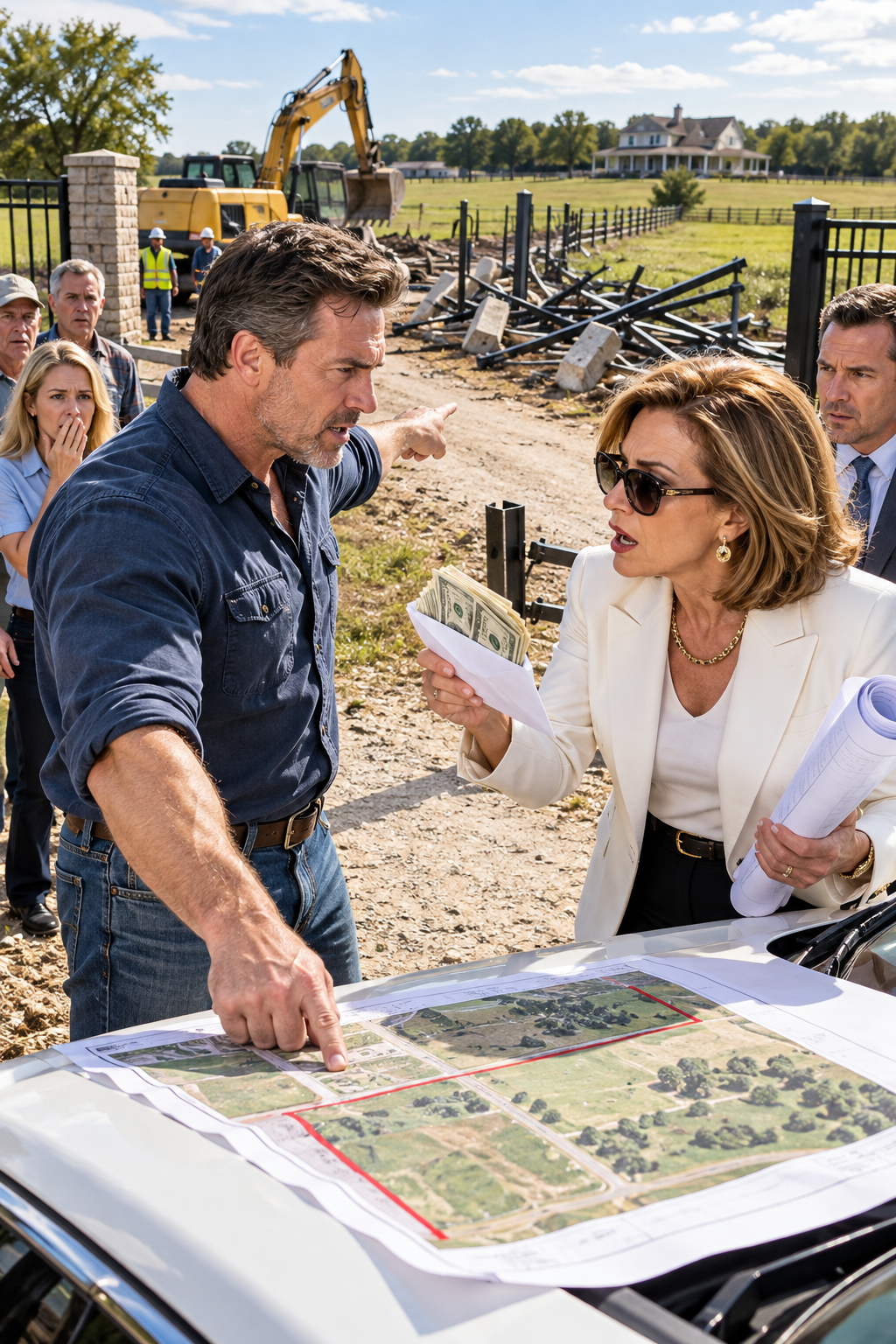
### Part 2: Rebuilding My Gate Exposed the Forged Permission Behind Everything
By sunrise Saturday, Piper was checking fresh survey stakes while my attorney, Norah Sheffield, spread legal documents across a folding table in my barn. She was preparing a demand for damages, a warning against further trespass, and instructions requiring everyone involved to preserve their records. I had called a professional fencing crew the night before and paid extra to get prefabricated steel sections delivered immediately. Every replacement post would stand exactly where the original had stood.
By afternoon, the steel panels stretched straight across my property again. The damaged gate was repaired and secured with a heavy chain, temporary security cameras covered the entrance, and a new sign warned that HOA access required my authorization. I was tightening the final hardware when Constance’s white SUV skidded into the driveway. She stared at the fence, grabbed her phone, and told the event company to keep every delivery on schedule.
“I’ll have the sheriff make you remove this,” she snapped. I took my phone from my pocket and called Sheriff Franklin Decker myself. He arrived, inspected Piper’s survey, and explained that an HOA resolution didn’t grant access to someone else’s land. Any disputed easement would have to be established legally, not enforced by threats.
The sheriff asked me to ensure that arriving trucks could turn around safely without blocking the public highway. I agreed, and Piper helped identify a suitable turnaround and a commercial staging lot a quarter mile away. I wanted every driver to leave safely, not become another victim of Constance’s promises. As the sheriff departed, Constance drove off without saying goodbye.
That evening, Elise Bramwell, director of the showcase’s event company, called with a question that made me grip the kitchen counter. “Mr. Brisco, why did you cancel your land-use agreement?” I told her I had never entered into one. After a long silence, she replied, “We have your signature authorizing access on all thirty-six delivery orders.”
At 5:47 Sunday morning, headlights appeared beyond the ranch gate. Ten tractor-trailers, fourteen box trucks, and twelve flatbeds carrying prefabricated model homes formed a convoy stretching along the road. Most proceeded to the staging lot when they saw my locked gate, leaving only the lead truck at my entrance. Its driver, forty-eight-year-old transport coordinator Hudson Bell, climbed down with a tablet and approached me.
“Unloading starts at six-thirty,” he explained. “We’ve got a signed agreement for this route.” I pointed to my private property sign and told him no such permission existed. Hudson brought up the agreement, displaying my full name, address, and what appeared to be my signature. “Did you sign this?” he asked.
“No.”
He studied my expression, then raised his radio. “All units, hold position. Engines off until I verify site access.”
The distant diesel engines fell silent one after another. Moments later, Constance arrived, marched toward the gate, and demanded that I open it. “You’re costing this community millions!” she shouted. I looked directly at her and answered, “You destroyed my fence, and somebody forged my permission. I’m not opening anything.”
Hudson examined the electronic agreement more carefully. It authorized heavy machinery to widen the access route between Friday and Sunday, the very clause Constance had shown Wade’s demolition crew. Its attached map contained the altered survey reference Piper had identified. Even worse, the authentication log showed that my signature had been verified through a business account controlled by Constance herself.
Constance reached for Hudson’s tablet, but he stepped away and called his company’s legal department. Norah arrived with Piper, examined the agreement, and requested preservation of the original electronic files, authentication records, and correspondence. The email address supposedly belonging to me wasn’t mine, and the electronic signature had never come from any account I controlled.
Sheriff Decker arrived soon afterward, took statements, and photographed the documents. Constance demanded that he arrest me for obstructing her event, but he asked whether she could produce a court order or valid recorded easement. She flipped through her folder without finding either. Hudson then informed her that his company’s contract required customers to guarantee lawful access, meaning failed deliveries could still leave her responsible for mobilization costs.
For the first time, Constance looked frightened.
Then Daphne pulled into the staging lot, carrying a thick folder against her chest. She walked directly past Constance and spread several bank records across Norah’s car. “Clayton,” she whispered, “there’s something you need to understand about those trucks.”
She pointed to the account that had received the HOA’s $196,000.
The name on it belonged to Constance’s own company.
### Part 3: The Hidden Development Turns Thirty-Six Trucks Into Unwilling Witnesses
Daphne’s hands trembled as she showed me the transfer records she had accessed through her lawful authority as HOA treasurer. Norah checked the state business registry and confirmed that Stonebrook Event Ventures LLC was controlled by Constance Ellery. The reserve money hadn’t been paid directly to independent contractors, as Constance had claimed. It had been transferred into a business she personally managed.
Elise arrived shortly after seven and confirmed the event’s true purpose. The Stonebrook Grand Showcase was the commercial launch of Stone Brook Reserve, a proposed residential development across fourteen acres of HOA common land. Twelve furnished model homes would form the centerpiece of an investor presentation, surrounded by temporary streets, advertising displays, and VIP reception areas. Constance had represented herself as having authority to develop the green space, although the homeowners had never granted the approvals their governing documents required.
“The subdivision entrance isn’t wide enough for these homes,” Hudson said, indicating the oversized flatbeds. “That’s why they routed everything through your ranch.” I looked toward the locked gate and finally understood the desperation behind Constance’s threats. Without my road, she couldn’t deliver the centerpiece of her investment presentation.
Norah uncovered another obstacle in the recorded property documents. A restrictive covenant protected the fourteen acres as open space, and Daphne produced a long-term development lease Constance had signed without the necessary homeowner approval. Norah instructed her to secure the financial evidence and share it properly with the uninvolved board members. “We’re not going to give her an excuse to bury this under more accusations,” she said.
By eight-thirty, several sponsors and board members had gathered near the staging lot. I handed them copies of the certified survey, the altered access map, the disputed signature agreement, and the electronic verification log. Daphne supplied the financial records. A silver-haired sponsor representative named Grant Whitfield read through the documents, then opened his own contract and pointed to a clause near the bottom.
“She personally guaranteed repayment under certain circumstances if the venue couldn’t lawfully be used,” he said. His eyes moved toward Constance. “She knew what she was promising.”
Constance overheard him and hurried toward the gate, shouting into her phone. She demanded that an equipment manager bring a backhoe and remove my newly restored fencing. When he refused, she announced she would take personal responsibility and ordered nearby workers to move the panels themselves. Nobody obeyed.
“I paid for this event!” she screamed. “I decide which gate opens!”
I stood inside my boundary and met her eyes. “You paid for an event. You didn’t buy my land.”
Constance tore the private property sign from its mounting and flung it into the gravel. Sheriff Decker and his deputy immediately ordered her away from the fence and documented the damage. She threatened to redirect the convoy through Stonebrook’s residential streets, but the roads were too narrow and sharply curved for several oversized loads. A county fire marshal also found that the proposed event configuration lacked the necessary access, safety clearances, and authorizations to admit the advertised crowd.
Constance offered to move the ceremony into the clubhouse, but it could neither accommodate the promised guests nor display twelve prefabricated homes. Elise suspended installation work, and Hudson received instructions to return the convoy to the freight yard. One by one, the thirty-six trucks started their engines and began leaving the commercial lot.
I watched the flatbeds turn onto the highway with their model homes still wrapped in white plastic. None crossed my gate. As the last truck prepared to leave, Constance received an email from the lead sponsor’s legal department demanding an explanation and giving notice of a claim for repayment.
By afternoon, investors arriving for the grand opening found an empty field, unfinished banners, and confused event staff. The showcase was officially canceled before sunset. Constance tried to blame me for everything, but the sponsors had already seen the documents.
Her event hadn’t been stopped by a man seeking revenge.
It had been stopped by the truth about a road she never owned.
### Part 4: The Final Investigation Restores My Boundary and Exposes Her Debts
Monday evening, Daphne convened an emergency HOA board meeting with an independent attorney present. I sat near the back while the preliminary financial figures appeared on a projector: $42,000 for my destroyed fence, $196,000 in unauthorized reserve transfers, $288,000 in contractor mobilization and cancellation demands, and $1.1 million in sponsorship funds and deposits subject to repayment claims. The total exposure reached approximately $1,626,000. Not every claim had been proven or resolved, but the room fell silent.
Constance sat rigidly at the front table, insisting that everything had been done for Stonebrook’s benefit. Daphne placed the bank statements beside the projector and asked why community reserves had been transferred into Constance’s private company. Constance opened her mouth, looked toward her attorney, and said nothing. The board suspended her independent transaction authority, froze the reserve account, and ordered an audit covering three years of HOA finances.
Two weeks later, the homeowners gathered for a removal vote conducted under the association’s bylaws. The independent attorney explained the procedure and confirmed the required threshold before the ballots were counted. Out of ninety-six eligible property owners, seventy-eight voted to remove Constance Ellery from office. When the result was announced, she gathered her papers with trembling hands and rose from her chair.
Daphne stopped her near the aisle and requested the association’s financial records, account credentials, and official files. Constance turned toward me, her eyes filled with bitterness. “You ruined everything I built,” she whispered. I stood without raising my voice. “I rebuilt what you destroyed, Constance. Everything else was your choice.”
Norah called me later that night with news that the original electronic agreements and authentication records had been preserved. Investigators were examining the disputed signature, the altered access documentation, and the unauthorized movement of association money. Six weeks after the trucks arrived, their findings established that the land-use agreement had been generated through Constance’s business system using an image of my signature without my authorization. Questions involving possible criminal wrongdoing continued separately from the civil claims.
Meanwhile, Norah negotiated compensation for the damage to my property. The agreement provided $42,000 for restoration and formally recognized that Stonebrook Estates held no easement or access right over my private ranch road. The court approved the terms within its authority, bringing my property dispute to a close. I deposited the compensation check without celebrating; it simply returned money I should never have been forced to spend.
The new HOA board recovered the $196,000 through supervised action involving assets held by Constance’s company. Her event business remained subject to financial oversight while contractors and sponsors pursued their respective claims. Several contracts contained personal guarantees that could expose her own assets to repayment obligations, although their final amounts remained unresolved. For once, she couldn’t simply declare that the homeowners should pay for her decisions.
Stonebrook’s residents also voted to protect the fourteen acres of common green space from development and establish stricter approval requirements for major contracts. A few days later, Daphne sent me a handwritten letter apologizing on behalf of the homeowners who had believed Constance’s accusations. I read it twice at my kitchen table, then placed it in the drawer beside my original property deed. I didn’t need another public apology, but knowing the neighborhood understood what happened meant more than I expected.
One afternoon that autumn, Hudson Bell stopped by to finish paperwork connected with his company’s canceled delivery operation. He stood beside my gate, studying the clean line of steel posts stretching across the pasture. “I’ve hauled freight into thousands of job sites,” he said, chuckling. “Never seen thirty-six trucks turned around because somebody forged one man’s signature.”
He leaned against his pickup and glanced toward the road. “Do you ever regret spending all that money to rebuild this before they arrived?”
“Not for a second,” I answered.
Hudson shook my hand and drove away, leaving a thin cloud of dust along the gravel. I walked the fence line as the afternoon sun lowered over the valley. Beyond my property, the fourteen acres remained open grassland instead of becoming the private development Constance had imagined.
I remembered her standing beside the excavator on that Friday morning, utterly certain that her position gave her the power to erase my boundaries. She had commanded contractors, sponsors, millions in proposed investments, and thirty-six trucks carrying enough equipment to transform an entire field. Yet she had never possessed the one thing her grand plan required: my permission.
I rested my hand on the cool steel gate and looked down the road those trucks had never crossed.
Constance believed that if she could tear down my fence, she could take whatever lay behind it.
But a boundary isn’t just something you build with steel and concrete. Sometimes it’s the quiet line you refuse to let another person cross, no matter how powerful they believe themselves to be.
And the most satisfying part wasn’t watching thirty-six trucks turn around.
It was knowing that when they were gone, my fence was still standing.
THE END.
All characters and events in this story are fictional, created for storytelling and entertainment purposes. Thank you sincerely for reading. Your feedback and support are invaluable and motivate me to continue sharing more stories with you.


