
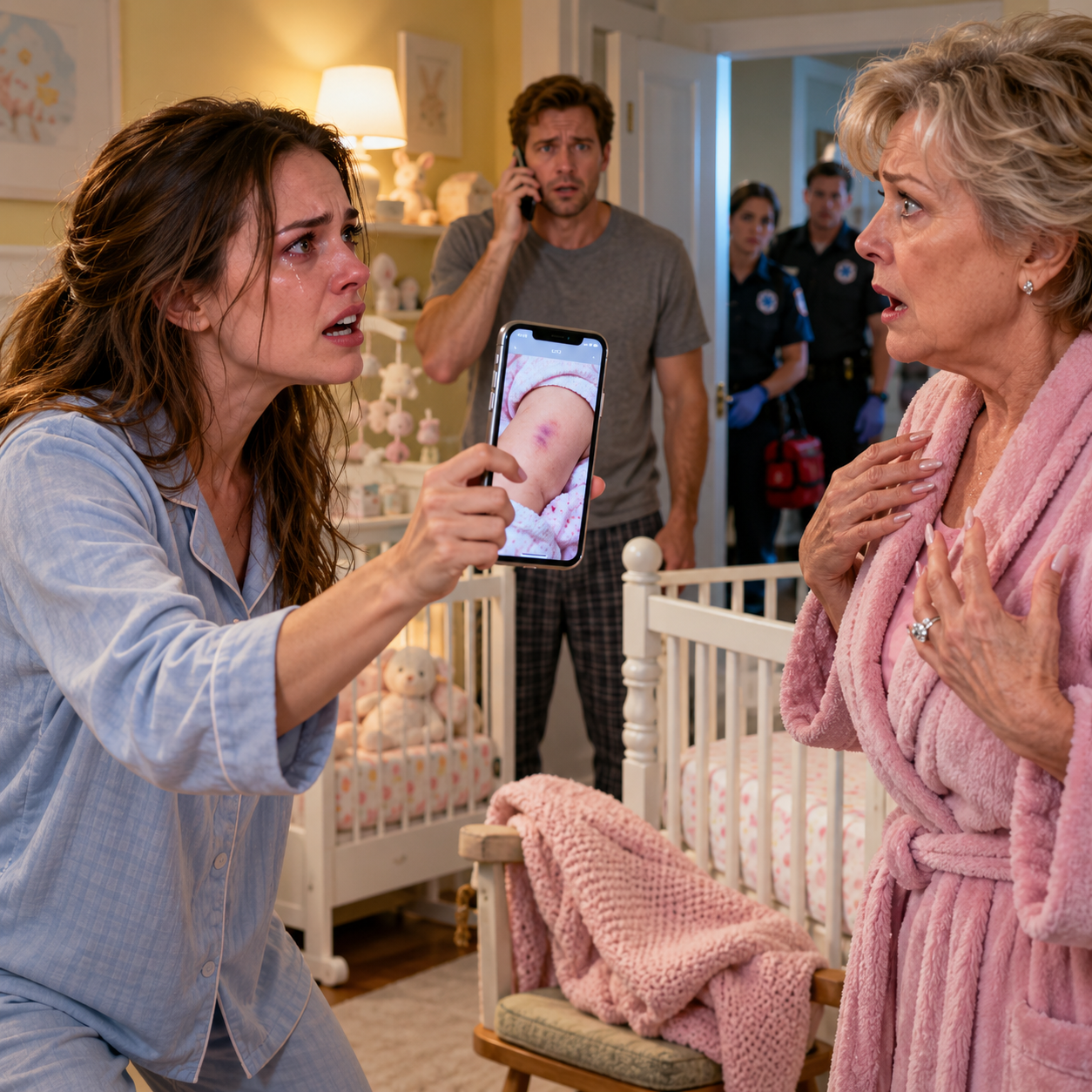
## Part 2: A grandmother’s performance persuaded everyone to call murder an accident.
Trevor’s voice cracked as he told the dispatcher our baby wasn’t breathing. I tried to help Ruby while Joyce stood against the wall, watching, until paramedics crowded into the yellow room and carried my daughter toward the ambulance. Only when a police officer asked what had happened did Joyce begin to sob. “I was trying to calm her,” she said, turning her confession into something softer with every sentence.
At the Tennessee hospital, I held a pink blanket so tightly the seams cut into my palms. Detective Corey Phillips sat opposite me in a cramped family room and asked me to repeat Joyce’s exact words. I did, without looking toward the door. Trevor told him he’d been asleep and insisted his mother must have panicked, because there was no other explanation he could bear.
Joyce came in wailing and almost fell into Trevor’s arms. She claimed Ruby had turned red, so she’d patted her back and perhaps done it too hard; Trevor wrapped her in his embrace as if she, not our child, needed rescuing. Detective Phillips watched without interrupting. Then the doctor entered, said Ruby hadn’t survived, and Joyce gasped theatrically while I stared at the floor, listening to the sound of my marriage changing.
At the funeral, Joyce stood near Ruby’s tiny coffin and accepted condolences from church friends who called her devoted. I wanted to tell them what she’d said in the nursery, but grief had left me almost voiceless. The medical examiner’s full findings arrived later, yet the most important pages were barely considered. A district attorney facing reelection accepted the picture of a respectable sixty-two-year-old volunteer who’d made a terrible mistake.
Joyce pleaded guilty to misdemeanor child endangerment. She received probation and one hundred hours of service at an animal shelter, and when she hugged her lawyer outside the courtroom, she caught my eye. That tiny glimmer of relief on her face told me more than her testimony had. Trevor called the outcome closure; I drove alone to the cemetery, where the fresh dirt above Ruby’s grave had not yet settled.
“I heard what you said,” I whispered into the grass. “I haven’t forgotten.” I stayed until the evening light disappeared, thinking about the bruises I’d explained away and the way I’d thanked Joyce for taking Ruby when I was exhausted. The guilt was unbearable, but it couldn’t bring my child back. What I could still change was whether the official story remained a lie.
Trevor wanted counseling, reconciliation, and someday forgiveness. “She’s my mother,” he pleaded one night, his hands wrapped around a cold cup of coffee. “She’s hurting, too.” I watched him struggle to defend her and understood that an open fight would close every door I needed to keep open.
So I told him I wanted to try healing. We mailed Joyce a birthday card with a pale flower on it, and I smiled faintly at a church woman who’d testified on her behalf when we met in the Kroger cereal aisle. Trevor mistook my composure for forgiveness. After he fell asleep, I opened a laptop I’d bought with cash, pulled Ruby’s photographs beside me, and started searching for the facts no one had wanted to see.
## Part 3: Hidden records and a kitchen confession broke the family’s lie.
The full medical examiner’s report changed everything. Ruby’s death wasn’t consistent with a well-meaning pat: it described asphyxia and injuries to her face and mouth. I spread the pages across the table and placed my photographs of her bruised arms beside them. A doctor I consulted privately said the spacing of the crescent marks could fit a forceful pinch; I pictured Joyce’s long acrylic nails and felt the last of my denial collapse.
Next I wrote down the times. I’d fed Ruby at 3:05 a.m., laid her down around 3:30, and awakened at 3:52; Trevor’s emergency call began at 3:54. Joyce had claimed she’d endured an hour of screaming, but those numbers gave her no such hour. There was one thing missing from my folder: her own unguarded voice.
“Invite your mother for coffee on Sunday,” I told Trevor. He looked so grateful that for a moment I couldn’t meet his eyes. When Joyce arrived in her nicest blouse, I sat across from her at the kitchen table with my phone recording in my pocket. I’d checked Tennessee’s rule for recording a conversation I participated in, and I asked her to help me understand Ruby’s last moments.
“Was she choking?” I asked. “You said you were patting her back.” Joyce took my hand as though nothing had happened and repeated the story about panic. I gently asked whether the crying had frightened her, whether she’d wanted to keep Trevor asleep. She glanced toward him and then said, “I might have put my hand over her face, just for a second. She was so loud. I had to make her stop.”
Trevor’s skin went pale. I thanked Joyce, excused myself to the bathroom, and saved the recording in three places while the faucet ran. The next day I brought it, the timeline, the photographs, and the examiner’s report to Danielle Ferguson, a Nashville attorney who had once prosecuted child homicides. She listened twice before looking up at me.
“The murder charge was never tried,” she said. “A misdemeanor plea doesn’t automatically settle what happened to Ruby. Let us take the evidence to investigators and a grand jury.” For the first time, someone saw the whole case rather than Joyce’s tearful explanation. Danielle contacted the state’s cold-case unit, and Detective Phillips came to our house to review what we’d gathered.
He asked whether we still had the nursery camera. I’d forgotten it saved recordings to the cloud, even though the lens pointed toward the doorway instead of directly into the crib. We opened the archive together and found seventeen minutes from Ruby’s last night. The recording held her crying, Joyce’s furious voice, a sudden sharp sound, and a silence that made the detective lower his head.
“I should have pushed harder,” he said. I wanted to hate him for that, but he was the first officer who had listened when I spoke. In October, a grand jury indicted Joyce for second-degree murder. Local television showed her being led from her house in the same pink robe she’d worn in Ruby’s nursery, while neighbors watched from their lawns.
Trevor confronted me that evening. “You lied when you said you forgave her,” he shouted, his eyes swollen and red. “You used me to get to my mother.” I put Ruby’s photograph between us on the kitchen table and answered, “I asked her what she did to our daughter. You heard her answer.” I filed for divorce the next morning; Trevor didn’t contest it.
## Part 4: The courtroom revealed Joyce’s lies and finally restored justice.
At Joyce’s trial, the courtroom filled with reporters, neighbors, and church members who had once described her as incapable of cruelty. I wore a plain dark dress and sat close enough to see the grandmother’s diamond ring flash under the fluorescent lights. When the prosecutor called me, I walked to the witness stand carrying no photographs, only the memory of that nursery door opening under my hand.
“What did the defendant say?” he asked. I looked directly at Joyce. “She said she smacked Ruby because she wanted the crying to stop.” My voice held steady even as a woman behind me began to cry. Then the jury heard the kitchen recording, including Joyce admitting she’d covered Ruby’s face.
Her attorney suggested I’d manipulated a distraught woman into saying things she didn’t mean. “Did you plan that conversation, Mrs. Hawkins?” he asked. “Yes,” I answered. “I planned to ask about my daughter. I couldn’t plan what Joyce would admit.” He looked down at his notes, and the prosecutor moved on to the evidence that no amount of acting could erase.
The nursery audio played through courtroom speakers. Ruby cried, Joyce spoke harshly, and then the sound stopped; a juror pressed a hand to her mouth. Trevor, seated in the back in the gray suit he’d worn to the funeral, stood and left before the recording ended. I didn’t turn to follow him.
Then the medical examiner explained the truth Joyce had concealed beneath the word pat. The injuries showed not only a strike to Ruby’s face but an obstruction of her breathing, consistent with a hand covering her nose and mouth. It was not the panicked attempt to help a choking baby she’d described at the hospital. When he finished, Joyce stared at her perfectly manicured hands as though she’d never seen them before.
The jury returned after two hours and fifty minutes. “Guilty of murder in the second degree,” the foreperson said. Joyce’s mouth opened, but no cry emerged. The judge sentenced her to life imprisonment, with parole eligibility after twenty-five years, and reminded her that Ruby had been utterly dependent on the adults entrusted with her care.
As deputies escorted her past my row, Joyce stopped. “After everything I did for you,” she whispered, “how could you do this?” I stood and met her eyes. “Because you counted on me staying silent.” For once, she had no answer; the deputies led her through the side door, and I let her go without taking another step.
Trevor eventually moved to Arizona. I sold our house, took the rocking chair Joyce had chosen to the dump, and boxed up Ruby’s tiny clothes to donate to a women’s shelter. I rented a white apartment across the county, where the mornings were quiet in a different way. No verdict could return my daughter, but at last the record said what had happened to her.
On the first Sunday after sentencing, I carried five pink roses to the cemetery, one for each week Ruby had lived. I’d changed the inscription on her headstone from a vague phrase about angels to the simple truth: Ruby Hawkins, Beloved Daughter. I placed the flowers in the wet grass and told her, “They know now, sweetheart.” The wind moved through the oak branches above me, and for the first time in nearly a year, I could breathe without feeling that I had to fight for the next breath.
THE END.
All characters and events in this story are fictional, created for storytelling and entertainment purposes. Thank you sincerely for reading. Your feedback and support are invaluable and motivate me to continue sharing more stories with you.


