
## Part 2: A forged signature revealed the conspiracy hiding inside my marriage
Six weeks earlier, I had been standing in our kitchen in Fayetteville, North Carolina, arguing with Sophie about whether peanut butter cookies counted as breakfast. Garrett was upstairs preparing for work, the dishwasher hummed beside me, and our biggest disagreement concerned a missing permission slip. At forty-three, I was a lieutenant colonel assigned to Fort Bragg, accustomed to complicated schedules and demanding responsibilities. What I wanted at home was simple: a peaceful marriage, an ordinary childhood for Sophie, and a husband who still respected me.
Garrett hadn’t always been cruel. Twelve years earlier, he was the funny, hardworking construction manager who brought me flowers without an occasion and carried our newborn daughter through sleepless nights. But his father, Warren, had transformed Whitmore Contracting into a successful regional business and seemed convinced that financial success entitled him to control everyone around him. At Sunday dinners, he routinely mocked my military career while Patricia questioned whether a working mother could properly raise a child. Garrett used to change the subject; lately, he laughed along.
At one dinner, Warren announced a major commercial development contract near Raeford Road before raising his glass toward me. “Maybe we’ll make enough money that Rebecca can stop playing soldier,” he declared. Garrett laughed while Sophie stared at her grandfather in disbelief. “My mommy’s job is important,” she protested, squeezing my hand beneath the table. I remember looking at my husband, waiting for him to defend me, and watching him reach for another dinner roll instead.
Three days later, a bank envelope arrived addressed to Rebecca Anne Whitmore. Inside was a notice concerning a commercial loan for Whitmore Contracting, with an outstanding balance of $286,400. According to the paperwork, I had personally guaranteed the debt. I called Garrett immediately, and he dismissed it as an administrative mistake involving his father’s equipment refinancing. “Please don’t turn this into a federal investigation,” he said before hanging up.
I contacted Piedmont Community Bank and requested copies of every document bearing my name. Eleven pages arrived, including a personal guarantee and a notarized signature that resembled mine until I examined the final stroke. The acknowledgment claimed I had personally appeared before a notary in Cumberland County on September eighteenth. That date was unforgettable because I had been attending an Army planning conference at Fort Leavenworth, Kansas. My travel orders, airline confirmation, hotel receipt, and attendance records proved I had been hundreds of miles away.
Attorney Helen Price examined the paperwork in her downtown Fayetteville office and removed her reading glasses. “Somebody is going to have difficulty explaining how you signed this in North Carolina,” she said. She helped me dispute the guarantee, place fraud alerts on my credit reports, and report suspected identity theft. We discovered additional financing inquiries, a fabricated financial statement claiming I owned investment property in Raleigh, and an income figure nearly twice my actual salary. I stored every legally obtained document in a blue accordion folder that Sophie affectionately called my “boring folder.”
Garrett stopped pretending the documents were meaningless when I confronted him after dinner. “Someone forged my signature,” I told him, placing the guarantee between us. He stared at it, rubbed his forehead, and suggested I might have signed something earlier and forgotten. “I was in Kansas, Garrett,” I reminded him. His expression changed for one unmistakable second, and then he grabbed his keys and walked out.
Another lender soon produced records connecting Whitmore Contracting to financing arrangements through a South Carolina company. Helen organized the evidence, and the investigation eventually reached Special Agent Brooks, who questioned me about everyone with access to my financial information. Garrett, his parents, and Caleb had all handled personal documents over the years. Brooks asked whether I had ever authorized business loans or received their proceeds. I answered no to both questions.
The Whitmores reacted by tightening their grip. Patricia demanded I stop embarrassing the family, Warren warned that attorneys were expensive, and Garrett announced he wanted a divorce. Three days later, he filed a criminal complaint accusing me of diverting company money into an account associated with my name. I had never opened that account, but the documents appeared convincing enough for a magistrate to issue a warrant.
Sheriff Keane met with Helen, Brooks, and me eleven days before my arrest. He explained that a valid warrant could still be executed while investigators pursued evidence contradicting Garrett’s accusations. When Martha later overheard Patricia boasting that I would be arrested before the weekend, I notified my attorney immediately. I prepared emergency school arrangements for Sophie, gave Martha a spare key, and informed my commanding officer that I faced a serious personal legal matter.
The night before the arrest, I saw Garrett carrying a brown envelope bearing the name of a financial institution Brooks had mentioned. He turned it facedown the instant he noticed me watching. I had no right to open his private documents, so I didn’t touch them. But I remembered the institution’s name, and at the detention facility, that detail became important.
The newly obtained bank records showed that the account supposedly receiving stolen company funds was controlled through credentials linked to Whitmore Contracting. The warrant still required formal resolution, but Garrett’s accusation was collapsing. Meanwhile, investigators were tracing another account connected to a separate chain of transactions involving Warren.
When Brooks received the alert about a new transfer request, I watched her exchange a serious look with Keane. Somewhere outside that building, my husband believed I was still locked away, unable to interfere. For the first time, I understood that the family had been using my name for more than borrowing money.
They had made me the person they intended to blame when everything fell apart.
## Part 3: The video spread, but one reluctant witness exposed everything
By eight that morning, Garrett had uploaded the footage of my arrest to Facebook. Beneath a photograph showing me handcuffed beside a patrol vehicle, he wrote, “Sometimes the truth finally catches up with people.” By lunchtime, the post had been shared forty-three times. I saw it while sitting in Helen Price’s office, waiting for confirmation that the prosecutor and court had completed the steps necessary to withdraw the accusation and authorize my release.
“Don’t answer him online,” Helen warned, watching my expression. “I wasn’t planning to,” I said, although my fingers had tightened around my phone. She reminded me that an angry comment could complicate an investigation already involving multiple financial institutions. I understood her reasoning, but all I could think about was Sophie seeing strangers call her mother a criminal.
The accusation against me was withdrawn that afternoon, and Brooks confirmed that investigators were working with financial institutions to examine the suspicious transfers. When I finally reached home, Sophie ran straight into my arms. She looked at the red marks on my wrists, disappeared upstairs, and returned carrying her favorite tube of hand lotion. “Will this make them stop hurting?” she asked, carefully rubbing the cream into my skin.
I held her against my chest and tried to explain that someone had given the authorities false information. Two days later, Colonel Marcus Bell called me into his office and explained that the allegations required administrative review. Certain financial approval duties would temporarily be assigned to another officer, although I was neither suspended nor found guilty of misconduct. I walked out of his office understanding how quickly a carefully built reputation could be shaken.
The consequences reached Sophie before I could protect her. After a birthday party, she told me that another child had repeated his mother’s claim that I had gone to jail for stealing. I contacted the school counselor and arranged professional support with a therapist experienced in helping military families. Meanwhile, Patricia continued posting messages about loyalty and truth, while Caleb removed boxes of company records and a subcontractor became reluctant to cooperate after Warren threatened his business. Every new development reminded me that the Whitmores still had influence.
Three weeks after my arrest, a woman named Linda Carver called while I was folding laundry. She identified herself as Whitmore Contracting’s former bookkeeper and said she had retained copies of financial records Warren instructed her to destroy. “There’s something else,” she whispered. “Your husband knew those signatures weren’t yours.” I sat down on the edge of the bed because suddenly I couldn’t trust my knees.
Helen and I met Linda at a Panera Bread near Cross Creek Mall. After seventeen years working for Warren, Linda had watched Caleb alter invoice dates, record payments under misleading accounts, and enter the same transactions more than once. When she questioned Warren, he dismissed her as too old to understand modern accounting. She had preserved copies of records she was authorized to handle during her employment, including emails directing those changes and notes documenting the conversations.
Then she placed a printed email on the table.
Garrett’s name appeared above a discussion of the loan documents and the unauthorized signature. Linda explained that the correspondence showed he knew my identity was being used, despite repeatedly claiming the problem was a bank mistake. I stared at the page until the restaurant noises seemed impossibly distant. The man who had held my hand when Sophie was born had watched me search for an innocent explanation while knowing there wasn’t one.
Helen arranged for Linda to speak directly with Brooks. Investigators authenticated financial records, reviewed bank transactions, interviewed witnesses, and pursued additional evidence through lawful channels. Weeks passed with little public movement, but by early summer, the investigation had progressed far enough that Brooks warned me charges against members of the Whitmore family might soon become public. She gave no date, and I had learned not to ask.
The confrontation occurred at a community fundraiser sponsored by Whitmore Contracting. I attended with Helen because the nonprofit’s board needed guidance about financial records connected to the company. Warren spotted me near the refreshment table and raised his voice so nearby donors could hear. “Well, look who’s here. I suppose some people don’t mind showing their faces after trying to destroy a family business.”
Garrett stood beside him, wearing the same smug expression I remembered from the morning of my arrest. Patricia watched from the entrance while Caleb remained near the back of the room. I placed my glass on the table, met Warren’s eyes, and said, “Mr. Whitmore, I think you should speak to your attorney.” Garrett laughed, but the laughter stopped when the doors opened.
Special Agent Brooks entered with two federal investigators and a county investigator. They approached Warren, Garrett, and Caleb calmly, explained the legal documents they were serving, and directed the men to accompany them as required. Patricia hurried forward, insisting there had been a mistake. Nobody shouted, and nobody touched me, but the silence spreading through that crowded room was more powerful than any argument I could have made.
Within days, federal allegations involving bank fraud, conspiracy, and related financial offenses became public. Court filings described the misuse of my identity, and neighbors who had circulated Garrett’s video suddenly began asking whether the story they’d believed had been false. I felt no satisfaction in their embarrassment. I wanted my daughter to stop being afraid when a vehicle slowed near our driveway.
That evening, while Sophie and I prepared grilled cheese sandwiches, Helen called with unexpected news. Garrett’s attorney wanted to arrange a meeting. He claimed he had something important to discuss concerning our daughter. I looked across the kitchen at Sophie carefully arranging pickle slices on her plate and felt a familiar ache return.
Even facing criminal charges, Garrett had found one more way to make me listen.
## Part 4: In court, the truth finally freed my daughter and me
Three days later, Garrett walked into Helen’s conference room wearing the pale blue shirt I’d bought him for Father’s Day. His attorney sat beside him, and the confident man who once dominated every conversation looked suddenly smaller. “Rebecca, I need your help,” he began, folding his hands on the table. I asked what this had to do with Sophie, and he avoided my eyes.
“Everything I do affects her,” he replied. Then he explained that Warren had controlled the business, Caleb had handled the financial records, and he had merely signed documents his family placed in front of him. If I could tell prosecutors how much pressure his father had exerted, he believed it might help his case. I watched him carefully, realizing that he hadn’t requested the meeting because he was worried about our daughter.
He wanted me to rescue him.
“You knew my signature was forged,” I said. “You watched me dispute those loans, and you told me I was imagining things.” Garrett shifted in his chair and blamed his father’s expectations. I leaned forward and asked the question I’d carried since that terrible morning. “Did you understand what Sophie would see when those deputies came into her bedroom?”
He lowered his gaze. “I didn’t think they’d arrive while she was awake.”
For several seconds, I couldn’t speak. He had considered the timing of my arrest, but apparently not enough to protect our daughter from witnessing it. “You were afraid of disappointing your father,” I told him. “But you weren’t afraid of destroying us.” When he tried to answer, I stood and said any genuine concern about Sophie could go through our attorneys.
The criminal proceedings continued for months. Garrett eventually pleaded guilty to charges related to the fraudulent financing scheme, and Caleb also admitted his role in manipulating the company’s accounts. Warren contested the allegations longer, forcing prosecutors to establish the evidence against him through further proceedings. The records ultimately supported serious findings of wrongdoing, and the resulting sentences, restitution obligations, and financial losses brought Whitmore Contracting to an end.
I attended Garrett’s sentencing because I needed to hear the court address what had happened to my identity. Among the evidence described during the proceedings was the account activity surrounding the morning of my arrest. Investigators had connected the supposed stolen-money account to Whitmore Contracting and traced the separate transfer activity that began while I was being taken into custody. The timing made clear that my arrest had served a financial purpose beyond public humiliation.
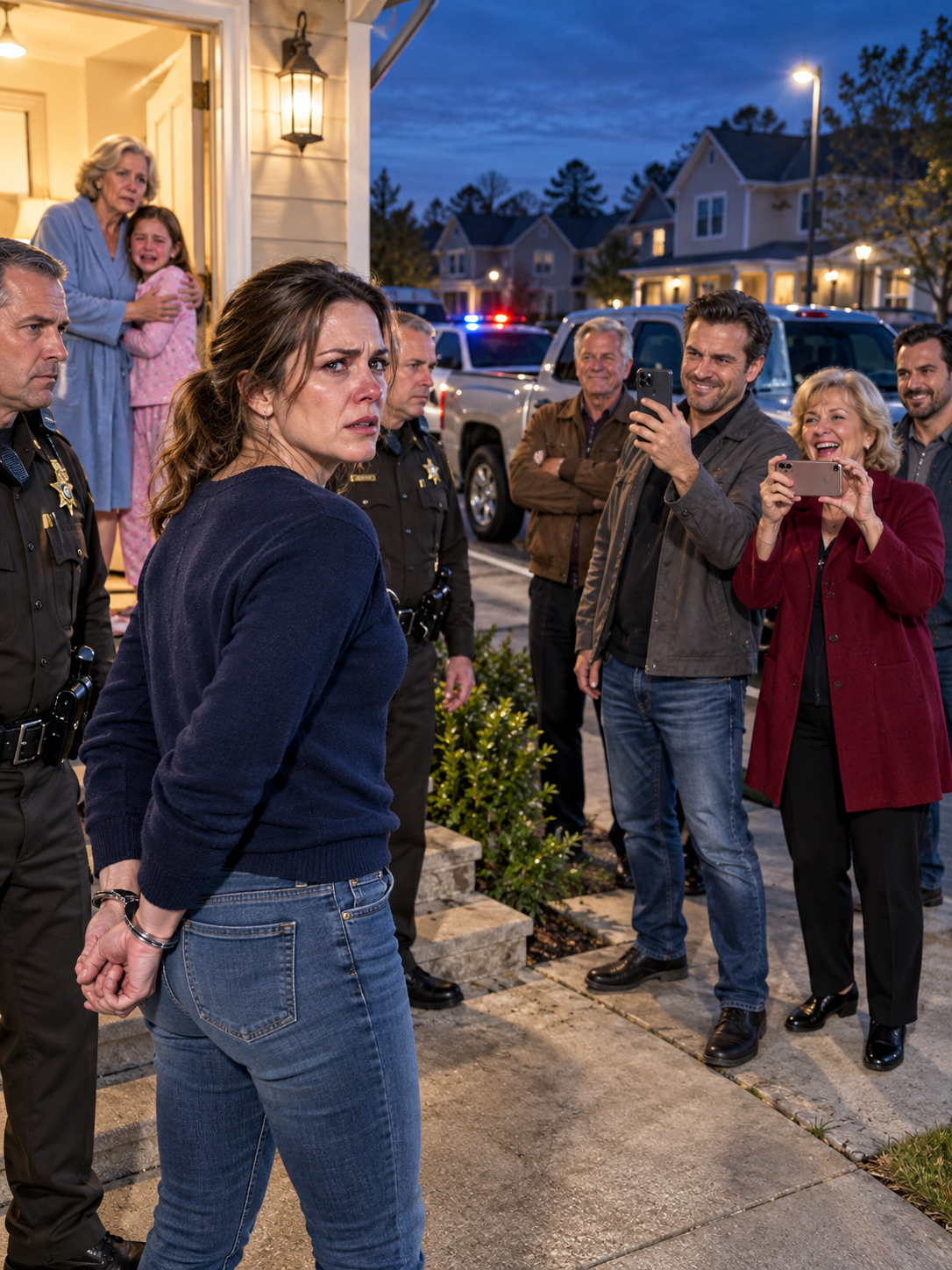
That was the final truth I had resisted accepting. Garrett hadn’t simply obeyed his father or failed to protect me when the business collapsed. He had knowingly participated in the scheme, helped turn suspicion toward me, and allowed our daughter to witness the consequences. The same morning Patricia was filming my handcuffs, investigators were uncovering the records that would expose the family.
When the judge addressed the fraudulent use of my identity, Garrett stared at the table without looking up. Patricia sat behind him clutching a tissue, while the expensive certainty that had surrounded the Whitmores for years seemed to disappear. I expected to feel vindicated watching them face the consequences. Instead, I thought about Sophie holding a tube of hand lotion and asking whether my wrists still hurt.
Our divorce was finalized several months later. The attorneys resolved the property and financial disputes, including debts created without my authorization, while the family court established parenting arrangements based on Sophie’s well-being. She continued seeing her counselor, and I learned that healing required more patience than any military assignment I’d ever completed. Some mornings she laughed freely; other mornings, an unfamiliar vehicle near our driveway still frightened her.
My military administrative review also reached its conclusion. Colonel Bell called me into his office, informed me that the allegations against me had been resolved, and restored my normal responsibilities. There was no ceremony, no unexpected promotion, and no audience waiting to applaud. The following Monday, I returned to answering emails, reviewing operational plans, and drinking coffee that had gone cold on my desk.
It felt like getting part of myself back.
By autumn, Sophie and I had created our own routines. Fridays were pizza nights, Saturdays belonged to pancakes, and we planted yellow marigolds beside the front porch. Sophie chose them because she said they looked cheerful even when nobody was paying attention. I found myself remembering those words whenever I passed the flowers on my way to work.
One evening, we sat together on the porch steps while a neighbor mowed his lawn beneath the fading sunlight. Sophie rested her head against my shoulder and asked, “Mom, were you scared when those officers came?” I looked down at the little girl who had spent months learning that adults could disappoint her. “Yes, sweetheart,” I admitted. “I was very scared.”
“But you didn’t look scared.”
“I was trying not to frighten you more.”
She thought for a moment, then asked, “What if they hadn’t let you come home?”
I took her hand and squeezed it. “Then I would have kept fighting to prove the truth, and the people who love us would have helped you until I could come back.” Sophie studied my face, searching for the certainty she had needed that morning. Then she whispered, “I think you’re the bravest person I know.”
I shook my head and kissed her hair. “Being brave doesn’t mean you aren’t afraid, honey. Sometimes it means doing what you have to do while you’re terrified.” She slipped her hand into mine, and we sat quietly until the porch light came on.
For months, I had believed justice would arrive when Garrett and his family lost the money, the reputation, and the power they had used against me. But their downfall wasn’t what finally made me feel free. Freedom was my daughter laughing at breakfast without looking over her shoulder. It was walking into work without wondering whether my colleagues believed a lie. It was understanding that I no longer had to defend myself to people determined to misunderstand me.
One Saturday morning, Sophie handed me a pancake shaped vaguely like a heart. “I made this one for you,” she announced proudly, pushing a plate across the kitchen counter. I laughed, asked whether she’d used every drop of syrup in the house, and watched her grin at me. Beyond the window, our yellow marigolds moved gently in the breeze.
At four in the morning, Garrett Whitmore had wanted the world to remember me as a woman being led away in handcuffs.
But my daughter remembered something different.
She remembered that I looked into her frightened eyes, told her I would find my way home, and kept my promise.
And when Sophie reached across the breakfast table to hold my hand, I knew the truth had given us something the Whitmores could never take away.
Our future.
THE END.
All characters and events in this story are fictional, created for storytelling and entertainment purposes. Thank you sincerely for reading. Your feedback and support are invaluable and motivate me to continue sharing more stories with you.


