
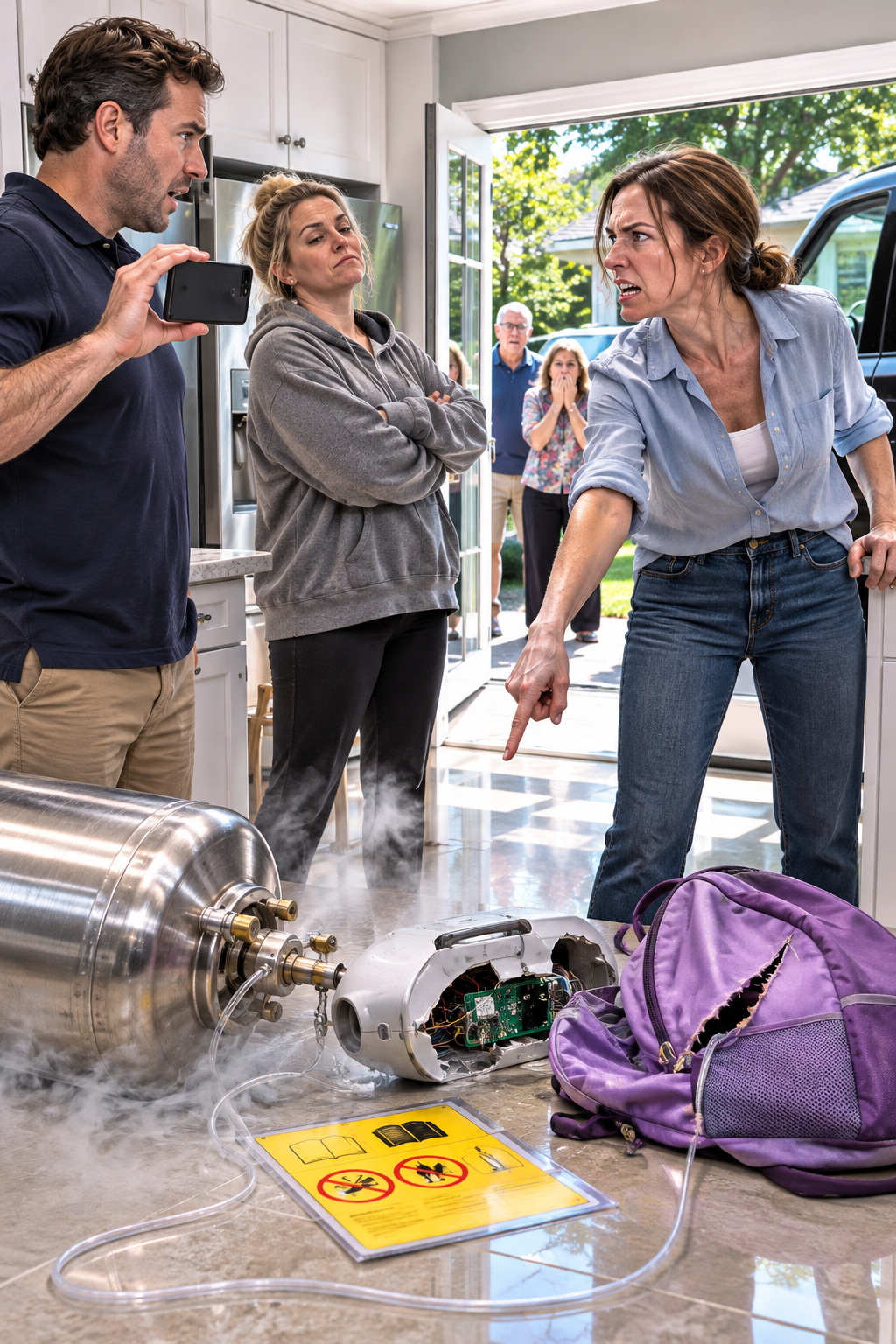
### Part 2: His Threats Continued While Our Daughter Fought to Recover
I pulled to the curb a block away because something in Darien’s voice told me he was still standing in that kitchen. “Where are you?” I asked, gripping the steering wheel. He snapped that he was cleaning up my mess, and I told him to stop immediately, evacuate the house, and keep Sheay away from cigarettes, flames, and electrical switches. The leaking reservoir was creating an oxygen-rich atmosphere, and one ignition source could turn an ordinary household fire into a catastrophe.
He laughed. “Everything with you is an emergency, Gina. It’s just air.” Behind him, I heard Sheay announce that she was going to light a cigarette at the counter to prove how ridiculous I was being. I begged him to get her outside, but he dismissed it as another joke and repeated his threat about keeping quiet.
When the call ended, I almost drove back. I imagined standing in the driveway, pressing the horn until both of them came outside, and demanding that they understand what they had done. But Pippa remained pale and unusually quiet, and the emergency cylinder in my SUV had a limited supply. I photographed the spare laminated safety card I kept behind my driver’s license and texted Darien the picture with one final warning to leave the kitchen.
At the children’s hospital, fourteen minutes away, a nurse took one look at Pippa’s mask and rushed her into treatment. Before we arrived, however, my daughter had managed to tell me what happened, lifting her mask for only a few seconds at a time. “Aunt Sheay picked up my backpack and threw it,” she whispered. “She said I was pretending, and Daddy said they should find out.”
I asked her what he meant. Pippa stared through the windshield before answering, “He told her to do it while he filmed, because it would be good for his lawyer.” The backpack had struck the reservoir, knocking it over and damaging the oxygen system, and when Pippa collapsed, Darien continued recording. What hurt most was her final sentence: “I tried really hard to stand up so they’d stop.”
The hospital team placed Pippa on high-flow oxygen, drew blood, and ordered chest imaging to check for complications. Her saturation recovered, although the doctor wanted to monitor her overnight because of her exposure to the extremely cold vapor and some concerning sounds in her left lung. When the physician finally assured me she was going to survive, my knees felt too weak to support me. Then I noticed the whiteboard above her bed, where somebody had written “Home O2 equipment failure” as the reason for her admission.
Those four words made me ashamed of myself. When the nurse asked what happened, I’d explained that the reservoir had fallen and the portable unit was destroyed, but I hadn’t told her who caused it. Even after our divorce, Darien’s threats still had the power to make me measure every word before speaking. His messages arrived while I stared at the board: Where are you taking her? Which hospital? Did you say anything?
I didn’t answer. Instead, I sat beside Pippa while a volunteer brought a deck of cartoon animal cards because the ward didn’t have checkers. Pippa invented a complicated game in which the rules changed whenever I started winning, and for twenty minutes I let her cheat as much as she wanted. Eventually, she set the cards facedown on her blanket, announced that she was going to keep playing with her eyes closed, and fell asleep halfway through another sentence.
In the bathroom, I finally noticed the damage to my own ankles from crossing the leaking oxygen. Angry red patches circled my skin, and a small pale area on my right foot looked like a cold injury. My shirt still had cereal crumbs on it, although I couldn’t remember ever opening the box. I stood before the mirror, studying a woman whose daughter had nearly died because two adults wanted proof that her medical condition wasn’t real.
At 2:10 that afternoon, Darien called again. I’d ignored his previous attempts, but this time I stepped into the corridor and answered beside a window overlooking the parking garage. Sirens overwhelmed his first words, followed by distant shouting and the unmistakable sound of him struggling to breathe. When he finally managed to say my name, I knew something terrible had happened.
### Part 3: One Cigarette Exposed the Lie They Refused to Admit
“Gina, it’s the kitchen,” Darien gasped. “Sheay was upset. She was crying, and she lit a cigarette.” I pressed my forehead against the hospital window while he described a sudden flash and flames spreading through her oxygen-enriched clothing. He’d dragged his sister outside, but emergency crews were treating her on the front lawn, and another ambulance was waiting for him. The rear of his house was burning, and firefighters were trying to control the rapidly spreading blaze.
I asked whether he was hurt, and he said his arms had been burned while helping Sheay escape. His voice kept breaking as he tried to explain how quickly everything happened, and I heard someone nearby ordering him to move away from the house. Then he told me the fire investigator had discovered the damaged oxygen reservoir. “He’s asking whose equipment it was,” Darien whispered. “He wants to know where the child is.”
Below me, a woman was maneuvering a minivan out of an awkward parking space, backing up and pulling forward repeatedly. I watched her because it was easier than picturing the kitchen where Pippa had been lying less than two hours earlier. Darien began begging me to tell him what to say, and I remembered the emergency card, my warning, and the message he’d refused to acknowledge. “I told you exactly what could happen,” I said. “You laughed at me.”
“I know,” he whispered. “Please, Gina. What do I tell them?”
For nine years, I’d been afraid of saying something that might provoke his anger. Now the same man who’d threatened me was asking me to rescue him from the consequences of his own choices. I thought about Pippa struggling to stand because she believed doing so might stop their laughter. “You told me not to tell anyone what happened,” I answered. “So I’m not going to tell them your story. You can tell them yourself.”
I ended the call and returned to my daughter’s bedside. She was awake, watching the doorway, and she asked whether her daddy had been on the phone. I explained that an accident had happened at his house, that both he and Aunt Sheay were alive, and that they were being taken to the hospital. Pippa listened without interrupting before asking one quiet question: “Did somebody light something?”
I didn’t answer immediately, but she could read my face. She turned toward the ceiling, her oxygen tubing resting beneath her nose, and whispered, “It’s on the card.” Then she closed her eyes again, and I held her foot through the blanket until her breathing settled.
The following morning, a fire investigator appeared at our hospital room. He was a tired-looking man carrying a notebook, and the oxygen supplier’s records had led him directly to Pippa. He explained that Darien had already given a statement claiming Sheay accidentally tripped while carrying the backpack, struck the reservoir, and later lit a cigarette without understanding the danger. The investigator didn’t need to raise his voice when he added that Sheay had given a different account to emergency responders.
I told him that Pippa could explain what happened, provided I remained in the room. Sitting upright in her hospital bed, my daughter described the argument, her aunt’s accusations, and the moment her backpack was deliberately thrown. She repeated her father’s instructions about filming the incident for his lawyer, while the investigator wrote everything down and asked gentle questions when she needed a moment. He already had physical evidence from the damaged equipment recovered after the fire, but Pippa’s testimony made the sequence clear.
When he finished, Pippa asked whether she had done something wrong by telling him. I sat beside her and explained that telling the truth about what somebody had done to her was never a betrayal. She nodded, looked at the oxygen equipment beside her bed, and asked whether the hospital had checkers. The investigator smiled sadly and promised to ask at the nurses’ station.
Darien’s version of events had depended on everybody believing the damage was accidental. But there was a problem he couldn’t solve with a lawyer, an edited video, or another threatening phone call. Someone else had already described what happened inside that kitchen, and her account had begun unraveling his story before the flames were even extinguished.
### Part 4: The Truth Survived the Fire and Freed My Daughter
Sheay spent seven weeks in a specialized burn unit, undergoing a series of surgeries for serious injuries to her face, neck, and hands. Darien remained hospitalized for eleven days while doctors treated the burns on his arms, and the rear portion of his house was destroyed. The kitchen where he’d stood laughing with his phone no longer existed. Neither did the refrigerator, the blue painter’s tape, or the yellow warning card somebody had marked with a smiley face.
The investigation moved forward without requiring me to become the furious ex-wife Darien had always accused me of being. Fire investigators examined the damaged reservoir and Pippa’s portable unit, emergency responders provided their accounts, and the hospital documented my daughter’s injuries and oxygen deprivation. Darien’s own recording, made to discredit his child, became impossible to reconcile with his claim that everybody had simply suffered an unfortunate accident. What he’d called evidence against me had helped establish the truth about him.
The family court suspended his visitation, and the decision eventually became permanent. When his injuries healed, Darien faced felony child endangerment charges, and Sheay was charged as well. Darien entered a plea and received a six-year prison sentence, while Sheay received felony probation after the judge considered the severe and lasting injuries she’d suffered in the fire. I wasn’t in the courtroom when her sentence was announced, and the news brought me no satisfaction.
People expected me to celebrate, as though watching someone else suffer could erase the sight of my daughter reaching toward me from that kitchen floor. But I wasn’t interested in revenge, and I didn’t want Pippa growing up believing justice meant taking pleasure in another person’s pain. I wanted her to understand that adults were responsible for protecting children, that medical conditions were not weaknesses, and that love never required someone to prove they deserved to breathe. Most of all, I wanted her to stop wondering whether she’d somehow caused what happened.
Pippa came home after two nights in the hospital, with a replacement portable unit, a new purple backpack, and a fresh oxygen reservoir installed in my kitchen. Her left lung needed several more weeks to recover fully from the incident, but her doctors were pleased with her progress. She returned to school, complained about homework, and began beating me at checkers again. Every Saturday, she asked for the same frosted cereal I had been buying when her monitor sounded, although I couldn’t bring myself to return to that particular grocery store.
I replaced the safety card on my refrigerator and checked the equipment more often than necessary. Sometimes, when Pippa was asleep, I stood in the kitchen listening to the quiet mechanical sounds that had become part of our lives. I thought about how ordinary that Saturday morning had seemed, with its checkers board, coffee mugs, and promises to be home by six. And I thought about how close I had come to losing her because two people had mistaken cruelty for proof of intelligence.
About a month after she came home, Pippa asked me something while doing math homework at the kitchen table. “Mom, did you tell on Daddy?” she said, never lifting her pencil. I answered that I hadn’t gone around telling people what he’d done, and she paused over a subtraction problem. “Then how come everybody knows?”
I pulled out the chair across from her. For a moment, I saw Darien in my memory, leaning against his refrigerator with that phone pointed at our daughter, so certain he could control what everybody believed. I remembered his final demand for a story that would protect him, and the fire investigator’s notebook, which had contained details I hadn’t provided. The truth had traveled from that front lawn to the investigators and into the courtroom without waiting for Darien’s permission.
“Because Aunt Sheay told the firefighters,” I said.
Pippa looked up, surprised. I explained that when the first emergency responder reached her aunt on the lawn, Sheay had been frightened and injured, and he had asked how the oxygen equipment came to be broken. She hadn’t repeated the carefully prepared story Darien later gave from the ambulance. Instead, she admitted what she’d done.
Pippa rested her pencil on the table. “Did she tell them it wasn’t my fault?”
“Yes, sweetheart,” I said. “She did.”
My daughter studied my face for a few seconds, then quietly returned to her homework. I watched her write another number, pick up her eraser, and correct herself without embarrassment. The afternoon sunlight fell across her purple oxygen backpack beside the chair, and for the first time since that terrible Saturday, its presence didn’t make me afraid.
It reminded me that she was still here.
Later, after Pippa had gone to bed, I thought about the final sentence Sheay had given the first firefighter. It was the sentence that destroyed Darien’s carefully rehearsed accident story and answered the question my daughter had been carrying since that afternoon.
Sheay had held out her injured hands and confessed, “I broke the little girl’s oxygen. I broke it on purpose.”
For months, Darien had wanted the world to believe that Pippa was pretending to be sick. In the end, the person who helped expose that lie was the woman who’d broken the equipment meant to keep her alive.
I couldn’t change what happened to my daughter, but I could change what happened next. Pippa would grow up knowing that her illness was real, her life was precious, and she never had to earn compassion from people who refused to offer it.
And every Saturday morning, when she beat me at checkers with her favorite cereal beside the board, I understood what winning truly looked like.
It looked like my little girl breathing, smiling, and knowing she was safe.
THE END.
All characters and events in this story are fictional, created for storytelling and entertainment purposes. Thank you sincerely for reading. Your feedback and support are invaluable and motivate me to continue sharing more stories with you.


