
## Part 2: Four Years of Financial Dependence Ended Behind My Locked Door
By the time Imran dropped me outside the house Terry and I had bought in 1991, I had received seventeen calls. I carried my suitcase inside, filled the kettle, and stood in our familiar kitchen while the water heated. The silence should have felt lonely. Instead, I noticed that I could hear the clock above the stove without anyone demanding something from me. I poured my tea, opened my laptop, and began examining four years of bank statements.
After Terry died suddenly of a heart attack in our garage, Derek and Haley had become frequent visitors. At first, I welcomed every dinner invitation and every unexpected knock on the door because grief had made our house unbearably quiet. Then Derek mentioned that he needed a replacement truck, and somehow I ended up co-signing the financing and covering his $689 monthly payment. Haley added their phones to my Telus account, followed by a $400 grocery transfer every month. Each arrangement was supposed to be temporary, but temporary had quietly become permanent.
I stared at the payment history until the numbers blurred. For four years, I had been supporting two employed adults while convincing myself I was keeping our family close. I canceled the automatic grocery transfers and the truck-payment debit, knowing that co-signing still left me financially responsible if Derek defaulted. Then I called the phone company about the account in my name and suspended their two lines. I wasn’t trying to make anyone suffer; I was ending arrangements I could no longer justify.
Derek left a voicemail that evening. “Mom, this isn’t funny. Haley’s really upset, and we need to talk about what you’ve done.” He sounded offended, almost bewildered, as though my refusal to finance his vacation was a betrayal of some sacred agreement. I placed the phone in a drawer, carried my suitcase upstairs, and slept for eleven uninterrupted hours.
At eight the following morning, a locksmith named Ralph arrived with a gray ponytail and a van full of tools. I watched him replace the locks on my front, side, and garage doors while the smell of fresh coffee drifted through the hallway. Derek and Haley had carried keys to my home for six years, and somewhere along the way they had stopped treating the place as mine. Haley stored fifty-two cartons from her failed candle business in my basement, her holiday decorations filled the garage, and Derek’s hockey equipment occupied my front closet. When Ralph handed me three new brass keys, I closed my fingers around them and felt something I hadn’t expected: relief.
Meanwhile, Derek and Haley had arrived in Maui to discover that the villa reservation no longer existed. The rental counter had no vehicle waiting for them, and the expensive Wailea hotels were either fully booked for the long weekend or far beyond their budget. They spent their first night in a small Kahului motel beside a laundromat, then purchased two one-way tickets back to Canada for $4,100. By the time they returned through Vancouver, their phones had stopped working, their luggage was a mess, and the vacation they had expected me to finance had become a very expensive lesson.
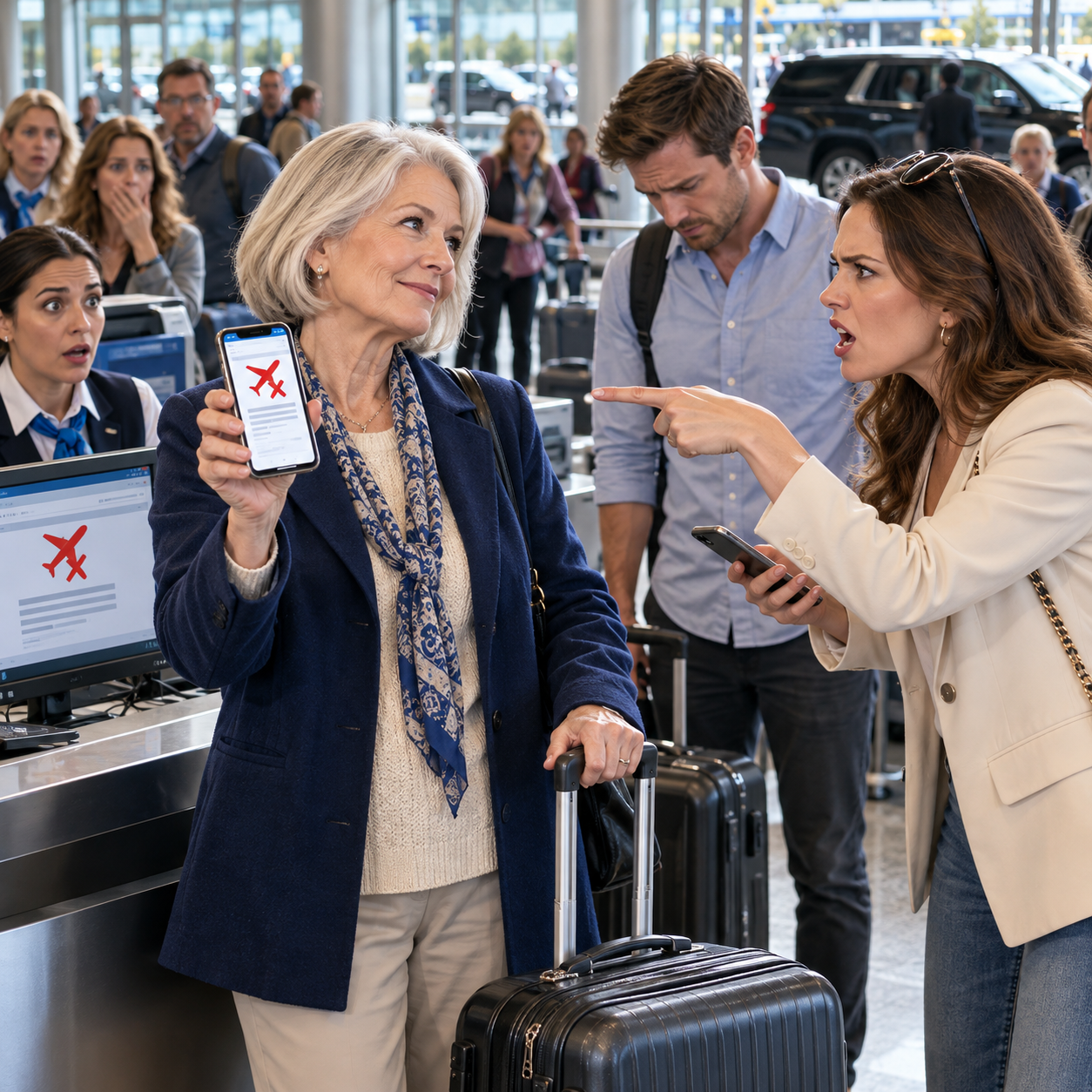
Sunday afternoon, I heard Derek’s key scrape uselessly against my new front-door lock. He tried again, rattled the handle, and finally called, “Mom?” I opened the wooden door but kept the security screen locked. Haley stood behind him in wrinkled travel clothes, her face twisted with fury. “You canceled everything!” she shouted. “We slept in a motel, Marilyn! Do you have any idea what you’ve cost us?”
“You told me to walk home,” I replied, keeping my voice level. “So I went home.” Haley threw up her hands. “It was a joke! We were trying to teach you something about family.” I looked directly at her. “You canceled a sixty-five-year-old woman’s flight because she wouldn’t give you $38,000. That’s not a joke, Haley.”
Derek pressed his palms against the screen. “Mom, our phones don’t work, and the truck payment hasn’t gone through. You can’t just leave us like this.” His voice cracked on the last sentence, and for a moment I saw the little boy who used to run toward me after school. But the man standing outside was thirty-four years old, with a steady job and a wife who also worked. “I’m not abandoning you, Derek,” I said. “I’m simply not paying your bills anymore.”
Haley grabbed the screen-door handle and demanded that I let them inside. I watched her fingers tighten around the metal, then gently closed the wooden door. My hands shook so badly afterward that I spilled tea on the kitchen counter. But I did not open it again.
For the first time since Terry’s funeral, my home belonged entirely to me.
And there was still a great deal of their property inside it.
## Part 3: My Son Faced Financial Reality as His Wife Turned Against Me
Monday morning, I paid two neighborhood high-school seniors, Leo and Beckett, twenty dollars an hour to help me clear the garage and basement. We carried Haley’s holiday decorations, fifty-two candle cartons, Derek’s hockey bag, a battered futon, and a broken treadmill onto the driveway. I arranged everything neatly, photographed the belongings, and sent Derek a message asking him to collect them by five the following afternoon. Anything unclaimed would be donated to the Mustard Seed.
They arrived the next day in a rented van, with Haley stepping out before Derek had even turned off the engine. “You have no right to do this!” she snapped, raising her phone as though recording me would make my driveway legally hers. I pointed toward the carefully stacked boxes. “I’m returning your property, Haley. You’re welcome to take every single thing.” Derek surveyed the enormous pile, rubbed his forehead, and asked whether I could store it for one more month.
“No,” I said, and the word surprised even me with its simplicity. Haley attempted to walk past me into the house, but I remained in the doorway without touching her. Eventually, they began loading the van, arguing in urgent whispers while I sat in a lawn chair with a glass of iced tea. Fifty-three minutes later, Derek slammed the rear doors and drove away. I went inside and discovered that my basement had windows I hadn’t seen in years.
Two weeks passed without a call. I volunteered at the library, weeded my flower beds, and visited my sister Connie for afternoon tea. Then, during the third week of June, Derek called from an unfamiliar number. “The pickup’s gone, Mom,” he said quietly. “They repossessed it. I missed two payments, and I couldn’t catch up.” I stood beside the kitchen sink, watching a robin hop across the grass.
“I’m sorry, Derek. I received the notice, too.” He breathed heavily into the phone before admitting that their mortgage renewal was approaching in August and the payments would increase. Haley wanted to sell the house, but she insisted I had deliberately ruined their lives. “Are you really going to let us lose everything over one stupid mistake?” he asked. I closed my eyes. “It wasn’t a mistake. Your wife made a decision, and you stood beside her.”
For several seconds, neither of us spoke. Then I offered him the number of a free credit-counseling service and suggested asking his manager about overtime. He sounded disappointed, but I didn’t reach for my bank card. When the conversation ended, I remained beside the sink, grieving the easy relationship I had always imagined we shared. The difference was that this time, I allowed myself to grieve without paying to make the feeling disappear.
In August, Connie hosted our annual family barbecue at her home in Okotoks. I arrived carrying potato salad, expecting grilled salmon, familiar stories, and a peaceful afternoon beneath the patio umbrella. Derek and Haley arrived later, having traveled by bus and walked from the nearest stop. Haley greeted everyone with exhausted smiles and immediately began explaining how difficult their lives had become since Derek’s mother had suddenly withdrawn her support.
By dinner, I could feel relatives glancing toward me across the folding tables. Haley pushed a piece of salmon around her plate and sighed loudly. “It’s just heartbreaking when someone you love abandons you without warning,” she said, dabbing at her eyes. Connie lowered her fork. “Marilyn, she says you stopped paying their truck and phone bills overnight. Is that true?”
I set down my glass, opened my purse, and removed a folded sheet of paper. Without raising my voice, I slid it across the table toward my sister. At the top was the date and time of Haley’s airport message. Beneath it were the words she had sent after canceling my flight: “Walk home. Maybe the long walk will give you time to think about how you treat this family.”
Connie read it silently before handing it to her husband, Dale. His expression hardened, and my niece covered her mouth when the paper reached her. “She canceled my flight twenty minutes before departure,” I explained. “She wanted to punish me because I refused to pay $38,000 for an addition to their house. Every other vacation reservation was mine, and I canceled those after she made it clear I wasn’t welcome.”
Haley’s face flushed. “That’s completely out of context!” she protested. “I was stressed, and she knows it was a joke.” Dale placed the paper flat on the table. “There’s no joke that makes leaving your mother-in-law stranded at an airport acceptable,” he said quietly. Derek stared at his plate, unable to defend either of us.
I looked at my son, then at the family members who had known me for decades. “I didn’t abandon them. I stopped paying for the privilege of being included.” Haley pushed back her chair so abruptly that it toppled onto the grass. She grabbed her purse and stormed through the garden gate, leaving Derek to mumble an apology before following her.
Connie reached across the table and squeezed my hand. “Why didn’t you tell us what was happening?” she whispered. My throat tightened as I finally admitted the truth. “Because I was ashamed, Connie. I thought if I stopped helping them, I’d lose my son.”
My sister held my hand a little tighter.
And for once, nobody asked me to write a check.
## Part 4: One Final Confession Revealed the Truth and Set Me Free
We finished the barbecue with strawberry shortcake, ordinary conversation, and the comforting sound of someone laughing in the kitchen. Dale refilled my iced tea, and Connie complained about the tomatoes that refused to ripen in her garden. Nobody demanded that I forgive Haley, rescue Derek, or put the family back together at my own expense. Driving home that evening, I realized how much of my life I had spent trying to prevent other people from being disappointed in me. I had mistaken their satisfaction for peace.
In September, I sent Haley one final email requesting repayment of the $1,812 I had transferred for my canceled ticket. I included the original transfer confirmation and explained that the airline had refunded the purchaser’s card. A week later, the full amount appeared in my account without an apology or even a message. I recorded the payment in my notebook, closed it, and put the matter away.
By January, Derek and Haley had sold their house in Cranston and moved into a small one-bedroom apartment across Calgary. Connie occasionally passed along news: Haley had started working evenings and weekends at a call center, while Derek rode the CTrain to work through temperatures that fell to twenty-five degrees below zero. Their beautiful sunroom remained nothing more than pictures on a forgotten Pinterest board. I felt sorry that their lives had become difficult, but I no longer believed their discomfort was something I had to purchase my way out of.
One cold afternoon the following February, someone knocked on my front door. Through the window, I saw Derek standing on the porch alone, wearing an old parka with a fraying cuff. He wasn’t carrying flowers, and there was no embarrassed request waiting behind his smile. He simply stood there until I opened the wooden door. “I’m not here for money, Mom,” he said before I could speak.
I studied his face through the locked security screen. “Then why are you here?” Derek swallowed, looked at the porch boards, and slowly raised his eyes to mine. “Because I’ve been lying to myself about what happened at the airport.” I felt the familiar weight settle beneath my ribs. “What do you mean?”
He rubbed both hands together against the cold. “I knew what Haley was going to do,” he admitted. “I was sitting right beside her when she canceled your ticket on her phone. I watched her do it, and I didn’t say anything because I thought you’d eventually give in.” For a moment, the winter wind was the only sound between us.
I had suspected that Derek knew more than he admitted, but hearing him confess still hurt. The cruelty hadn’t come from a daughter-in-law acting alone; my own son had helped create the silence that allowed it. “And when I was standing at that airport,” I asked, “did you think about what I might feel?” His eyes filled with tears. “I did. That’s the worst part, Mom. I knew you’d be hurt, and I let it happen anyway.”
I looked at the boy I had raised and the man he had become, understanding that loving him did not require me to pretend his choices were harmless. “You should have protected our relationship,” I said quietly. “Not because I’m your mother and you owe me obedience, but because I trusted you.” Derek nodded, wiping his face with his sleeve. “I know. I’m sorry. I don’t expect you to fix anything.”
That was when I unlocked the screen.
We sat at the kitchen table with two cups of tea, and for the first time in years, Derek asked questions that had nothing to do with money. We talked about Terry, the afternoon he died while changing a garage light bulb, and the fishing trip Derek had taken with him when he was eleven. Derek remembered his father patiently untangling a fishing line while pretending not to notice that his son had already eaten all the sandwiches. We laughed at that memory, and then we sat quietly, sharing the kind of sadness that didn’t need to be repaired.
When Derek stood to leave, he hesitated beside the kitchen door. “Do you think things can ever be normal again?” he asked. I considered the question carefully before answering. “I don’t want what we called normal, Derek. I want something better, something honest.”
He nodded and hugged me on the porch. I held him tightly because he was still my son, and I loved him. But when he walked away, I didn’t hand him a house key or offer to cover his transportation. He had come to apologize, not to collect, and that distinction meant more to me than any expensive gift.
I haven’t spoken to Haley since Connie’s barbecue. Perhaps one day we’ll manage a civil conversation, but I’m no longer willing to sacrifice my security to make that happen. I don’t celebrate their financial struggles, and I don’t pretend that watching my son rebuild his life has been painless. What I have learned is that helping someone and carrying them are two different things, especially when the weight eventually threatens to bury you.
This past March, I finally took the Hawaiian vacation I had once dreamed of sharing with my family. Not Maui this time, but Kauai, where I rented a quiet oceanfront apartment with a balcony overlooking the water. I booked every reservation myself, paid with money I had deliberately saved, and spent my mornings watching the sunlight move across the waves. There were no arguments about restaurants, no unexpected bills, and nobody reminding me how lucky I was to be included.
One morning, the woman on the neighboring balcony leaned over the railing and smiled. “Are you here with family?” she asked. I glanced at the empty chair beside me, where my coffee sat cooling in the breeze. For years, an empty chair had represented everything I feared about growing old alone. Now it was simply a chair beside a beautiful ocean, waiting for whoever I might someday choose to invite.
“Just me,” I answered, returning her smile. “And I’m in excellent company.”
Later, I took out my phone and found the old message Haley had sent from Calgary International Airport. I read her command one last time, remembering the woman who had stood beside a canceled boarding pass, frightened of losing the last family connection she believed she had. Then I deleted the message and returned my attention to the water.
Haley had told me to walk home because she thought home was where I would learn how helpless I was without them.
She never imagined that home was where I would finally remember who I was.
And when I eventually returned from Kauai, I opened my own front door with my own key, stepped into the peaceful house Terry and I had built together, and knew that I had not lost my family by refusing to be their bank.
I had simply stopped losing myself.
THE END.
All characters and events in this story are fictional, created for storytelling and entertainment purposes. Thank you sincerely for reading. Your feedback and support are invaluable and motivate me to continue sharing more stories with you.


