
Part 2: A Missing Masterpiece Exposes The Lie Behind Our Thanksgiving Dinner
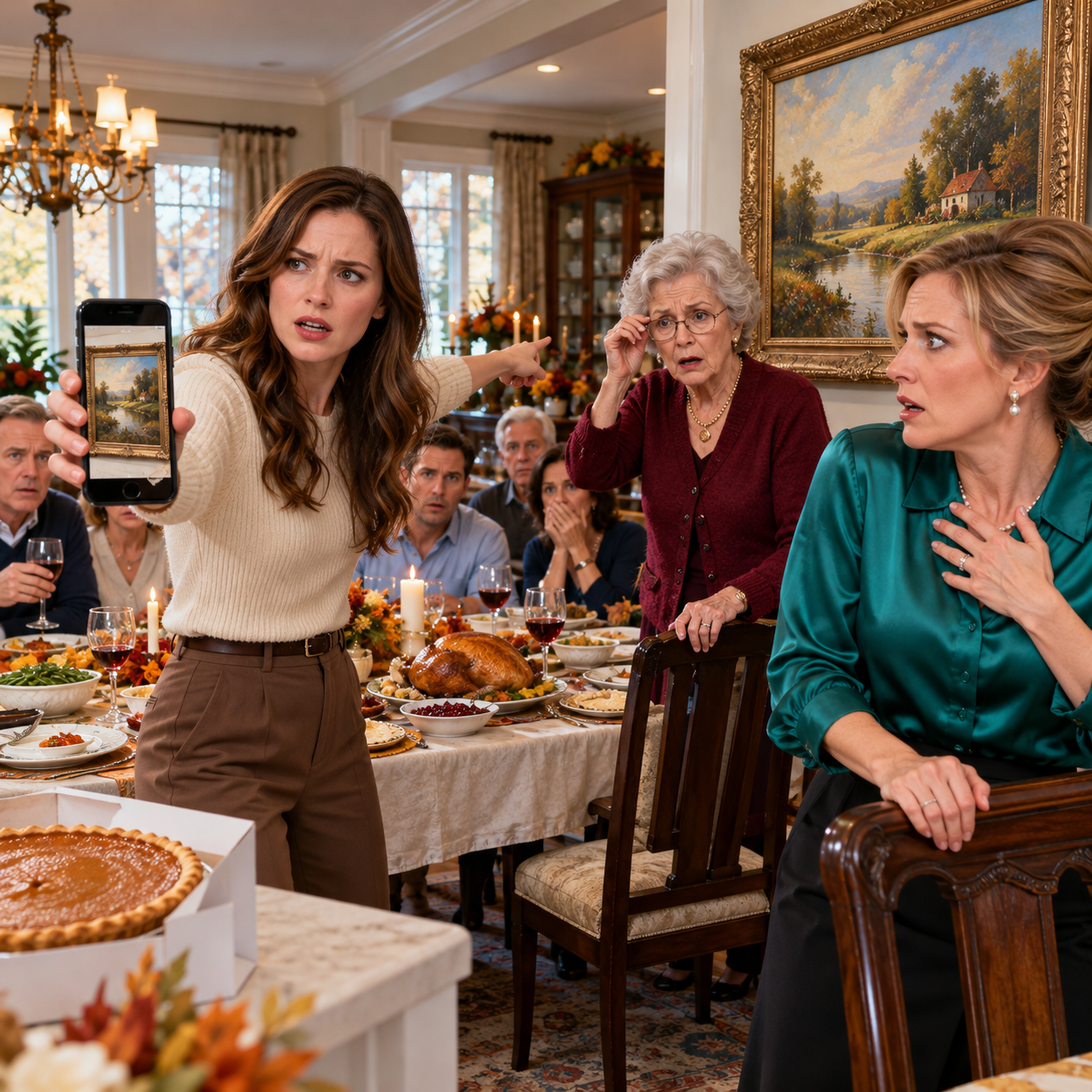
My father slowly lowered his wineglass. Grandma came to stand beside me, squinting at the landscape through her reading glasses, while Cindy pushed back her chair so abruptly that its legs scraped across the hardwood floor. “That’s ridiculous,” she said. “I took everything down to paint the walls, then put it all back. You’re making something out of nothing.”
“I’m not accusing anyone yet,” I told her. “But the original was appraised two years ago, and the photographs should make it easy to compare. We need an independent conservator to examine this one.” I took out my phone and opened the folder where I’d saved copies of the appraisal photographs. Grandma leaned closer, comparing the familiar repaired frame corner on my screen with the one hanging in front of us.
“That’s not the same,” she said quietly.
Cindy’s husband, Mark, stopped cutting his turkey. My mother asked whether perhaps the lighting had changed when the walls were repainted, but Grandma shook her head and pointed at a small detail beside the painted river. “Harper showed me that mark years ago. It isn’t there anymore.” When I explained that a professional would need to confirm the discrepancy and that we might have to contact the insurer and police if the original was missing, Cindy suddenly sat down and covered her face.
For nearly a minute, she couldn’t speak clearly enough for anyone to understand her. Mark reached toward her shoulder, but she brushed his hand away. Finally, between uneven breaths, she said, “I was going to fix it. I swear I wasn’t going to let Grandma lose anything.”
Nobody interrupted her this time.
Cindy explained that her clothing boutique had accumulated almost $100,000 in debt. Sales had been declining for months, the landlord was demanding overdue payments, and her suppliers had stopped extending credit. When she’d helped repaint Grandma’s living room, she’d taken photographs of Grandma’s identification and copied the painting’s appraisal and provenance documents. Then she’d forged Grandma’s signature on ownership and sale paperwork, arranged a private sale to a collector, and commissioned a reproduction to hang in its place.
“You sold my painting?” Grandma asked.
Cindy nodded without looking up. She admitted she’d rearranged several other pictures to make the wall seem different enough that nobody would trust their memory. “I needed breathing room,” she whispered. “Once the boutique recovered, I thought I could buy it back.” Grandma stared at her for a long moment before asking how she intended to find a buyer willing to return a painting he’d already purchased.
Cindy had no answer.
Mark’s father set down his napkin and turned toward his son. “Did you know about this?” Mark rubbed his forehead and admitted Cindy had told him Grandma had agreed to sell a painting to help the business. When I asked whether he knew the painting on the wall was a copy, he looked at Cindy instead of answering. Whatever he’d believed when the sale happened, he had known enough by Thanksgiving to help keep me away.
My mother began pleading for everyone to calm down. She reminded us that Cindy had worked hard building the boutique, that economic conditions had been difficult, and that nobody should condemn her over one desperate decision. “We don’t need to involve police,” she insisted. “This is family. We can find another solution.”
Grandma walked back to the table and placed both hands flat against the white tablecloth. “My daughter has sold something that belonged to me, forged my name, and lied about it in my own home,” she said, looking directly at my mother. “And your first concern is keeping her out of trouble?”
My father tried to intervene, but Grandma lifted a hand to stop him. Then she turned toward Cindy and gave her seven days to return the original painting in its original condition. If it wasn’t back, Grandma would authorize a police report and pursue the forgery and theft through her attorney. Cindy began explaining that she’d already spent the money, but Grandma simply repeated the deadline.
“Seven days, Cindy. Not eight.”
Dinner ended with coats pulled hastily from the hallway closet and a procession of embarrassed relatives leaving through the front door. Mark’s parents were still questioning him as they reached their car, and my parents left without looking at me. When everyone had gone, Grandma and I stood beside the half-cleared table, listening to the dishwasher humming in the kitchen.
Eventually, I warmed two plates of turkey and potatoes while Grandma made tea. We sat together at the small kitchen table, eating the Thanksgiving meal Cindy had tried to keep me from attending. Halfway through dinner, Grandma glanced toward the living room and asked, “If you hadn’t come today, how long do you think she would’ve let me look at that thing?”
I didn’t pretend to know. Grandma put down her fork and said she wanted me beside her when she called an attorney the following morning.
Part 3: Seven Days To Recover What Her Granddaughter Had Stolen
The attorney’s office smelled faintly of coffee and old paper. Grandma arrived carrying the original appraisal, her insurance schedule, photographs of the painting hanging in her living room, and a folder documenting how it had come into her possession. I helped the attorney photograph the reproduction, including its backing, dimensions, and visible differences. Grandma answered every question carefully, even when he asked her to repeat details she’d already explained.
The attorney contacted the collector through legal counsel and explained that the sale involved disputed ownership and an allegedly forged signature. The collector maintained that he’d purchased the painting in good faith, but the documents Grandma provided made his position considerably more complicated. The attorney warned us that recovering valuable artwork could involve months of litigation, especially if the current holder refused to cooperate. He prepared the necessary paperwork for further action while giving Cindy the opportunity to meet Grandma’s deadline.
During that week, Grandma kept her regular routine, though I noticed she checked the telephone whenever it rang. On Wednesday, she asked whether I remembered the afternoon we’d examined the landscape’s tiny farmhouse together. “You were eleven,” she said, turning a page in her gardening magazine. “You told me the little smoke coming from the chimney meant somebody inside was making supper.” She smiled briefly, then returned to her reading.
On the seventh evening, Cindy and Mark arrived with their attorneys and a professional art handler. The painting came inside wrapped in protective materials, while the lawyers reviewed documents confirming the return and unwinding of the disputed sale. Cindy explained that she and Mark had borrowed against their house to satisfy the collector’s financial demands and related expenses. The entire arrangement had cost them approximately $135,000, about $15,000 more than Cindy had received from the sale.
Grandma didn’t ask where they’d found the money. She directed the art handler to place the painting somewhere safe until her trusted appraiser could examine it. Later, the expert compared the canvas, backing, labels, frame repairs, and documentation, confirming that it was the original and had suffered no new damage. Grandma rested her fingertips against the familiar corner of the frame, then turned toward Cindy, who stood near the doorway twisting her wedding ring.
“I’m sorry,” Cindy said. “I was scared, Grandma. I thought I was going to lose everything.”
Grandma looked at the painting rather than at her granddaughter. “So you decided I should lose something instead.”
After consulting her attorney, Grandma chose not to pursue a police complaint once her property had been returned. She was clear, however, that retrieving the painting did not make the forged documents or the deception acceptable. Cindy seemed relieved enough to mistake that decision for forgiveness, and my parents apparently believed everything could gradually return to normal.
Two weeks later, Grandma asked all of us to come back to her house. When we arrived, the authentic landscape was hanging in its familiar place, and a neatly arranged stack of documents rested on the coffee table. Grandma waited until everyone was seated, then handed each person a copy.
“I’ve changed my will,” she said. “And there are a few other things you need to understand.”
Part 4: Grandma Changes Her Will And Makes One Final Choice
Cindy unfolded her copy first, scanning the pages until her expression changed. Grandma explained that her estate attorney had prepared and properly witnessed the new will, leaving Cindy no inheritance. My parents would receive $100,000 between them, while the house would go to me and the art collection would go to the local museum. She had also updated her medical authorization and emergency contact documents, naming me as her sole designated family contact.
“You can’t cut me out over one mistake,” Cindy protested, holding up the papers. Grandma looked at her steadily and reminded her that stealing a painting, forging a signature, and deceiving a buyer had required several deliberate decisions. My father argued that leaving me the house was excessive, particularly when Cindy was facing financial problems. Grandma folded her hands and asked him when he’d last worried as much about my circumstances as he worried about Cindy’s.
He didn’t answer.
Grandma reminded my parents of the school events they’d missed because Cindy needed attention, the money they’d repeatedly given her, and the arguments they’d settled by expecting me to be the mature one. She had financed Cindy’s boutique when it opened and helped cover its debts more than once. “I helped her build that business,” Grandma said. “And when it began failing, she decided she was entitled to take something else from me.” My mother stared at the paperwork while Cindy gathered her purse and walked out crying.
Over the following weeks, my parents repeatedly called, asking me to persuade Grandma to reconsider. I refused because I knew the will was Grandma’s decision, not mine to negotiate. Eventually, the calls dwindled to short messages on birthdays and holidays. I wasn’t invited to Christmas that year, so I spent it with Grandma, eating pot roast at her kitchen table and talking about ordinary things that had nothing to do with Cindy.
The boutique eventually closed anyway. Borrowing against their house had returned Grandma’s painting, but it couldn’t rescue a business whose debts kept growing, and Cindy lost the commercial property after the unpaid obligations caught up with her. I heard through relatives that she was selling the remaining inventory online. I never contacted her, though occasionally I wondered whether she understood that the theft had cost her far more than the money she’d been trying to save.
Grandma decided not to wait until her death to give away the art collection. Working with her attorney and museum staff, she arranged a formal donation, and I helped prepare inventories, photographs, condition reports, and the paperwork needed for a proper transfer. At the museum ceremony, she spoke about preserving art so that future generations could discover the same beauty she’d found in those paintings. She didn’t mention Cindy, and the museum’s acknowledgement said nothing about our family’s troubles.
The original landscape went to the museum with the rest of the collection. Grandma kept only the reproduction Cindy had commissioned, leaving it hanging above the console table where the authentic painting had once been. One Sunday, while we were drinking tea in her living room, I finally asked why she’d chosen to keep something that reminded her of such an awful Thanksgiving.
“Because sometimes I start feeling sorry for your sister,” Grandma answered, setting down her cup. “Then I look at that painting and remember what she was willing to do when she thought nobody would notice.”
I visit Grandma most weekends now. Sometimes we talk for hours, and sometimes we sit together while she reads and I finish paperwork from the office. The reproduction still hangs across from her favorite chair, its colors too bright and its surface too smooth, pretending to carry a history that doesn’t belong to it. And whenever I notice it, I remember Cindy standing in Grandma’s doorway, telling me there wasn’t room for me at Thanksgiving dinner.
In one sense, she’d been telling the truth. There wasn’t room at that table for both me and the secret she’d brought into our grandmother’s home.
The End .
All characters and events in this story are fictional, created for storytelling and entertainment purposes. Thank you sincerely for reading. Your feedback and support are invaluable and motivate me to continue sharing more stories with you.


