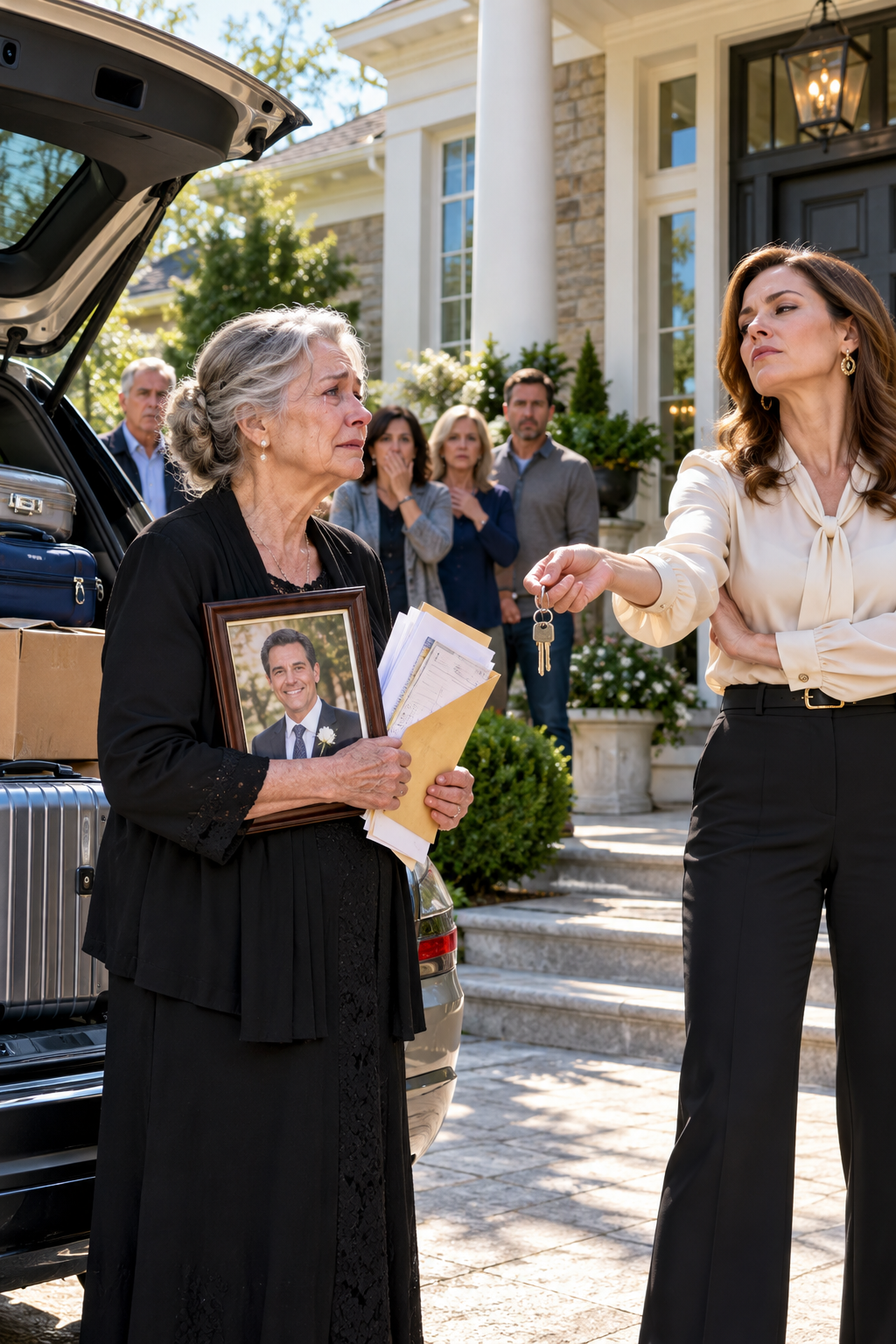
### Part 2: A secret inheritance exposes the truth David carefully concealed.
At 1:45 the following Tuesday, I pulled into the parking lot of Morrison and Associates and spotted Stephanie climbing out of a silver BMW. She wore an expensive black dress, and her brother Marcus, a lawyer himself, followed carrying a leather briefcase. The moment she saw me in the reception area, her expression hardened. “What’s she doing here?” she demanded, but the receptionist simply replied, “Both Mrs. Fairfields were invited.”
Mr. Morrison welcomed us into his wood-paneled office precisely at two o’clock. He was a silver-haired gentleman with wire-rimmed glasses, and he spoke with the quiet authority of someone who had spent decades handling difficult family matters. Stephanie settled into her chair with a satisfied smile while Marcus opened his legal pad. I folded my hands in my lap, expecting nothing more than a photograph or perhaps my late husband’s old watch.
The attorney began reading, and everything seemed to unfold exactly as Stephanie anticipated. David had left her the house, their vehicles, his retirement accounts, and the benefits of his $200,000 life insurance policy. She nodded approvingly as each asset was mentioned, occasionally glancing toward me with barely concealed triumph. Then Mr. Morrison stopped, removed a sealed envelope from his desk drawer, and announced, “There is one additional provision David personally added three months before his death.”
Stephanie leaned forward so suddenly that her chair creaked. Mr. Morrison broke the envelope’s seal and continued, “To my mother, Eleanor Fairfield, who provided the down payment for our home and never demanded repayment, I leave the contents of Safe Deposit Box 337 at First National Bank, including all associated financial documentation.” Marcus stopped writing, and Stephanie’s fingers tightened around the arms of her chair. “What safety deposit box?” she snapped, staring at the attorney as though he’d made a terrible mistake.
Mr. Morrison explained that David had maintained the box privately and had specifically designated me as its recipient. When Stephanie demanded that its contents be included in her inheritance, he calmly reminded her that David’s instructions were clear and properly documented. “When did he make this change?” I asked, and the attorney checked his notes before answering, “February fifteenth.” I remembered that evening because David had seemed unusually quiet at dinner, barely responding while Stephanie complained about the neighbors and the expense of maintaining their home.
Before we left, Mr. Morrison handed me a second envelope containing David’s bank key and the paperwork necessary to claim the box. Stephanie immediately announced that she would accompany me, but the attorney informed her that access was restricted to me alone. Outside, she cornered me beside my car and suggested that whatever David had hidden should be shared between us. “You need my goodwill, Eleanor,” she warned, “because you don’t even have a home,” and I looked directly at her before replying, “I think I’ve already learned what your goodwill is worth.”
Three business days later, a bank manager named Mrs. Peterson escorted me through the security doors at First National Bank. She explained that David had rented Box 337 five years earlier and had visited regularly, a detail that made my heart ache with questions. The box was surprisingly heavy, and when she left me alone in a private viewing room, I lifted its lid with shaking fingers. On top of several thick folders lay an envelope bearing my name in David’s unmistakable handwriting.
Mom, if you’re reading this, then I’m gone, and I’m afraid Stephanie may have treated you exactly as I feared she would.
I pressed the letter against my chest before forcing myself to continue. David explained that he’d never forgotten the $40,000 I’d contributed toward their home, even though I’d stopped asking about repayment. Instead, he had spent five years investing money for my future, adding his own savings whenever possible and arranging the accounts in my name. Beneath the letter were statements showing a combined balance of $185,000, enough to buy me the freedom I had quietly believed was gone forever.
But the money wasn’t the greatest shock. David had also preserved years of emails, text messages, and financial records documenting Stephanie’s attempts to convince him that I was an unbearable financial burden. He explained that the mortgage had always been paid directly from his salary and that money I’d contributed to household expenses had been carefully set aside for my benefit. At the bottom of his letter, he’d written, Take what I’ve saved, Mom, and build a life where nobody can ever make you feel unwanted again. Please don’t tell Stephanie what you’ve discovered until you’re somewhere safe.
I cried until the ink blurred, not because of the money, but because my son had understood far more than I’d ever realized. Before leaving, Mrs. Peterson explained how to complete the account verification and helped me secure the documents. As I reached my car, my phone rang, and Stephanie’s suddenly affectionate voice invited me to lunch. “We should talk about what David left you,” she said sweetly, and I looked down at the envelope in my hands before answering, “Noon sounds lovely.”
### Part 3: A seemingly friendly lunch reveals years of calculated family betrayal.
Stephanie answered the door wearing a flowing white dress, her face glowing with a friendliness I hadn’t seen in years. “Eleanor, I’m so glad you came,” she exclaimed, guiding me toward a dining table decorated with fresh roses and her finest wedding china. She had prepared my favorite chicken salad and poured iced tea into crystal glasses, acting as though she’d never ordered me out of the house. I placed a small gift bag beside my chair and watched her carefully as she searched for the right moment to ask about David’s secret.
After several minutes of meaningless conversation, she leaned forward and said, “I’ve been thinking about us, Eleanor, and I truly believe David would want his family to stick together.” I nodded politely, remembering how she’d refused to let me stay even one more night after his funeral. She continued, explaining that perhaps we could combine our resources and allow her financial advisers to manage whatever David had left me. “That’s generous,” I replied, setting down my fork, “but why are you suddenly so interested in helping someone you considered a burden?”
Her smile faltered, and I reached into the gift bag before she could answer. Inside was a framed photograph of David at his college graduation, taken on a bright May afternoon when he’d wrapped his arm around my shoulders and told me everything good in his life had begun with my sacrifices. Stephanie studied the photograph, visibly confused by the gift. “I thought you might appreciate having this,” I told her, “especially since David kept such careful records of the people he loved.”
“Records?” she repeated, her eyes narrowing. I opened my phone and displayed a screenshot of a conversation between Stephanie and her sister from six months earlier. In it, Stephanie complained that she couldn’t wait for me to leave so she could convert my bedroom into the home gym she’d always wanted. When I showed her another exchange with Marcus discussing ways to pressure David into demanding more money from me, she pushed her chair backward so violently that it scraped the hardwood floor.
“Where did you get those?” she demanded, reaching toward my phone. I moved it out of her grasp and calmly explained that David had preserved the messages, along with emails describing me as gullible and laughing about how easily she could make me feel unwanted. Her face turned pale when I mentioned the conversations in which she’d called David weak for defending me. “He shouldn’t have kept private conversations,” she whispered, but I shook my head and answered, “You made my son choose between the two women he loved. He simply wanted to understand why.”
Then I opened a folder containing bank statements showing David’s regular mortgage payments and Stephanie’s luxury purchases. She had repeatedly told me the family was struggling financially, persuading me to contribute from my teaching pension even while charging expensive clothes and weekend trips to credit cards. I showed her the records, one page at a time, watching the practiced confidence drain from her expression. “You told David I was costing you thousands,” I said, “while you were spending money you claimed the household didn’t have.”
Stephanie stared at the papers before demanding, “What exactly do you want from me?” I considered her question, remembering the loneliness of that first night at the hotel and the humiliation of being treated like an unwanted stranger. “I don’t want revenge,” I answered quietly. “I want you to understand that the woman you threw away was loved by the same man whose money you’re so determined to control.”
Her expression shifted from anger to fear when I opened another email thread. This one contained messages between Stephanie and Marcus discussing whether they could eventually portray me as mentally incompetent and gain authority over my Social Security and pension income. They hadn’t taken those steps, but the casual way they discussed my independence made my skin crawl. “We never actually did anything,” Stephanie protested, and I looked at her steadily before saying, “David knew that, which is why he made certain you never would.”
For several seconds, she couldn’t speak. Then her eyes dropped to the investment folder beside my purse, and I saw the familiar calculations returning behind them. “How much did he leave you?” she asked, suddenly abandoning every other argument. I closed the folder and rose from my chair, but Stephanie caught my sleeve and whispered, “Please, Eleanor. I need to know.”
I looked at the hand gripping my arm, then gently pulled away. David had warned me about exactly this moment, when Stephanie would realize that I possessed something she couldn’t control. I had come prepared to show her the truth, but I hadn’t expected her concern about my supposed helplessness to disappear quite so quickly. When I finally opened the account summary, she leaned across the table so eagerly that her wedding necklace brushed the papers.
### Part 4: David’s final gift restores my freedom and exposes Stephanie’s greed.
I turned the statement toward Stephanie and watched her eyes settle on the balance: $185,000. Her lips parted, and for a moment she seemed incapable of understanding what she was seeing. “That’s impossible,” she whispered, gripping the table with both hands, but I explained how David had invested the money from my original contribution and added to it over five years. Instead of celebrating her husband’s thoughtfulness, she demanded, “That’s almost as much as the life insurance. Why should you get that?”
“Because David wanted me to have it,” I answered, surprised by how steady my voice sounded. Stephanie insisted that the money should belong to his estate, then suggested dividing it between us as though she were offering some remarkable compromise. I reminded her that she’d already inherited the house, cars, retirement accounts, and insurance benefits, yet she slapped her palm against the table and shouted, “I was his wife! You’re just his mother!” Those four words hurt more than anything she’d said since David died.
I looked at the graduation photograph resting beside her plate and remembered holding David’s tiny hand as he learned to walk. I’d worked extra hours teaching summer classes to help him through college, sat beside him during childhood illnesses, and given him my savings when he needed a home. “Yes, Stephanie,” I said softly, “I’m his mother, and apparently that meant enough to him that he spent years making sure I’d be protected.” Her eyes filled with angry tears, but I felt no need to apologize for being loved by my own son.
Then I placed the final set of financial records in front of her. They showed approximately $15,000 in credit card charges during the month before David died, including spa treatments, designer clothing, and a weekend in New York with her sister. Throughout that same month, she’d complained to David that their grocery expenses were becoming unmanageable. “You weren’t afraid of poverty,” I told her. “You were afraid of losing the lifestyle you expected someone else to provide.”
Stephanie sank into her chair, staring at the statements. “Do you know how much pressure I was under?” she whispered, tears streaking her carefully applied makeup. She described the exhausting need to impress neighbors, entertain David’s colleagues, and maintain the image of a perfect marriage. When she admitted that she’d been counting on the insurance money to continue living that way, I finally understood why she had spoken about financial decisions within hours of David’s death.
“You inherited a house worth roughly half a million dollars, a $200,000 insurance policy, and your husband’s retirement savings,” I reminded her. “You have more than enough to build a secure life if you’re careful.” Stephanie covered her face and sobbed, “But it isn’t enough for the life I planned.” I stood beside my chair, letting the silence settle before answering, “Then perhaps the life you planned was never the life you needed.”
She begged me to stay, promising that we could rebuild our relationship and perhaps even live together again. But every promise came with another suggestion about combining accounts, consulting her advisers, or sharing the money David had protected for me. When she offered a hurried apology for throwing me out, I asked whether she would have made the same offer if the safety deposit box had contained nothing but photographs. She lowered her eyes, and that silence told me more than any apology ever could.
I gathered my papers, picked up my purse, and walked toward the front door. Behind me, Stephanie slumped forward, her shoulders shaking as she repeated, “I can’t lose everything.” I stopped and looked back at the woman who had once stood beside my son at the altar, promising to love him through good fortune and hardship. “You’re not losing everything, Stephanie,” I said. “You’re simply discovering that some things were never yours to take.”
Outside, sunlight spilled across the driveway where she’d watched me leave with four suitcases only weeks earlier. I sat in my car for several minutes, holding David’s final letter against my heart, and cried for the future he would never experience. I wished he’d told me what was happening while he was alive, because no mother wants her child to carry such worries alone. Yet even through my grief, I understood that he’d been trying to give me something greater than financial security: the dignity of making my own choices.
Over the following weeks, with the bank’s verification completed and Mr. Morrison’s assistance, I finished arranging the accounts David had established for me. I moved out of the Hampton Inn and found a lovely two-bedroom cottage with a small garden, a sunny kitchen, and a porch overlooking a quiet street. My sister visited from Phoenix to help me unpack, and we placed David’s graduation photograph on the mantel beside a picture of my late husband. For the first time since the funeral, I slept through the night without waking in fear of what tomorrow might bring.
One afternoon, while sorting the last box of belongings, I discovered a birthday card David had given me years earlier. Inside, beneath his familiar signature, he’d written, You spent your whole life making sure I had a home, Mom. Someday, I hope I can do the same for you. I sat beside the window, watching sunlight move across the garden, and realized that his final gift hadn’t been the $185,000, the documents, or even the truth about Stephanie. It was the promise he’d kept, quietly and faithfully, without ever asking for recognition.
I never took Stephanie to court or tried to strip away what David had left her. She kept the property and inheritance he’d intended her to receive, while I kept the future he’d prepared for me, and eventually our lives went in separate directions. I still missed my son every morning, especially when I brewed coffee and instinctively reached for my phone to call him. No amount of money could fill that silence, but the security he left me meant I could grieve without the added fear of becoming dependent on someone who resented my existence.
That spring, I planted white roses beneath the cottage windows because they’d always been David’s favorite flowers. As I pressed the last handful of soil around the roots, I remembered Stephanie’s words: “You’re just his mother.” I looked toward the little house that was finally mine, then up at the clear blue sky, and smiled through my tears. I had lost my beloved son, but his love had followed me home, and no one could ever take that away.
THE END.
All characters and events in this story are fictional, created for storytelling and entertainment purposes. Thank you sincerely for reading. Your feedback and support are invaluable and motivate me to continue sharing more stories with you.