
## Part 2: Hidden Financial Records Reveal a Fraudulent Luxury Retreat Scheme
I began collecting evidence. I saved the rental website, every review, Britney’s receipt, and the camera footage. Deputy Kowalski warned that much of the dispute still appeared civil, but encouraged me to document everything. Britney successfully disputed her credit card charge, and the website vanished four days after I archived it.
November brought the first snow and another attack. Sloan complained to Valley County and the Idaho Department of Water Resources that my bridge was dangerous and illegally constructed. When I arrived for the inspection, I found her spraying brown paint over my orange trespass markings.
“I’m restoring the natural appearance,” she said, still holding the spray can.
I photographed her and called Kowalski.
County inspector Lyle Dorsey examined every bearing plate and weld. Stream-channel officer Tess Branigan reviewed my permit and the dated photographs documenting fifteen years of compliance.
“Condition four,” Tess read aloud. “The bridge must be completely removed before May first and remain out until reinstallation is approved.”
She shut the binder. “Complaint unfounded.”
Sloan was twenty feet away discussing table linens on her phone. She missed every word.
Kowalski arrived moments later and cited her for damaging my trespass markings. Sloan demanded to know whether he understood who her husband was.
“Yes, ma’am,” he answered. “He’s the man who can drive you to court.”
Then Dorsey quietly told me she’d previously tried to have my bridge permit transferred to the HOA. He’d refused.
A week later, she sent me a $3,000 HOA assessment threatening a lien. My acreage had never been subject to the development’s recorded covenants, so the demand had no legitimate basis.
I added it to my evidence folder.
In January, a seventy-year-old man named Gene Larkin knocked on my Boise front door during a sleet storm. He was the Timber Rim HOA treasurer, a retired accountant who’d spent two years unsuccessfully requesting the association’s financial records.
When he finally obtained them through a formal inspection request, he found $14,000 of HOA reserve money spent marketing a rental business.
My cabin was listed as the photography location.
“Where’s the income?” I asked.
Gene tapped a column of zeros.
Not one rental dollar had reached the association.
The Idaho business registry identified TR Retreats LLC’s registered agent as Douglas Pettybone, Sloan’s husband.
Then Gene unfolded an accidentally shared booking confirmation.
Gem State Farmers Credit Union had reserved the cabin for forty-two executives. The contract covered three nights, catered meals, guided fishing, and exclusive lodging.
The price was $61,000.
The deposit alone was $18,300.
Arrival date: May second.
I looked at that date until Gene asked what was wrong.
“The bridge comes out before May first,” I said. “She watched the inspection, Gene. She was standing right there.”
We hired Nora Cassidy, a Boise real estate attorney. She sent certified notices to Sloan, Doug, their LLC, and the HOA board, explicitly forbidding rentals and explaining that vehicle access would close until July.
Sloan signed for hers on January twenty-ninth.
I contacted the credit union’s event planner, Carla Whitfield, and sent our deed, permit, and rental evidence.
Two days later, she forwarded me a document Sloan had supplied as proof of her authority.
It was titled Amenity Management Agreement.
At the bottom sat a signature: Wade Hollister.
Except I had never signed it.
Since nineteen, I’d signed my name Wade J. Hollister, honoring my grandfather James. The handwriting on this paper leaned the wrong direction, and the middle initial was missing.
“That’s forged,” I told Carla.
She believed me, but her CEO refused to cancel after Sloan insisted I was a disgruntled squatter and the deposit was nonrefundable.
Carla promised to document whatever happened.
Kowalski’s response to the agreement was immediate.
“Now we’re looking at a criminal matter.”
Meanwhile, Gene showed the other HOA board members the missing reserve funds. Joyce Albright, a retired teacher, discovered that Sloan had described the marketing expenses as road maintenance.
A special homeowners’ meeting was demanded.
But Sloan had another weapon.
In early April, she posted a photograph of Dad sleeping on our porch, claiming a vulnerable elderly man was being neglected in an isolated cabin.
Adult Protective Services visited our Boise home.
I showed the caseworker Dad’s medication schedule, doctor’s records, groceries, and family support arrangements. Dad entertained her with the story of his first smoke jump in 1965.
She closed the complaint as unsubstantiated.
After she left, Dad touched my shoulder.
“Somebody trying to take our place again?”
I wanted to protect him from the truth.
Instead, I said, “I’m making sure nobody can, Dad.”
## Part 3: A Five-Thousand-Dollar Bribe Fails as the Bridge Disappears
Nine days before the bridge removal, Doug Pettybone called and suggested we meet at a Cascade gas station.
I recorded our conversation.
He leaned against his pickup and slid an envelope toward me. Inside was $5,000.
“Leave the bridge until May fifth,” he said. “Three extra days. Nobody needs to know.”
“The state knows,” I answered. “It’s their permit.”
He waved dismissively. “Nobody checks those little mountain creeks.”
“A compliance officer will be there April thirtieth.”
His smile hardened. He retrieved the envelope and warned me that Sloan had never lost a fight in eleven years as HOA president.
I saved the recording and sent it to my lawyer.
Meanwhile, I prepared the crane. Every fifth year, the bridge went back to Boise for sandblasting and repainting instead of resting along the creek until July. This happened to be that year.
I checked the rigging, greased the sheaves, and arranged a lowboy trailer. I also obtained permission to place three reflective warning signs at the Forest Service road junction.
BRIDGE OUT.
NO THROUGH ACCESS.
NO TURNAROUND.
That last warning was especially important. The final mile was a narrow mountainside road with no place to turn a charter bus around near the creek.
On April thirtieth, Boulder Fork roared with snowmelt. Brown water slapped against the abutments, carrying branches downstream. I positioned my crane truck on stable ground and set its outriggers.
Dad watched from my pickup with a wool blanket around his shoulders. Tess Branigan arrived carrying maple bars. Deputy Kowalski parked nearby as an official witness.
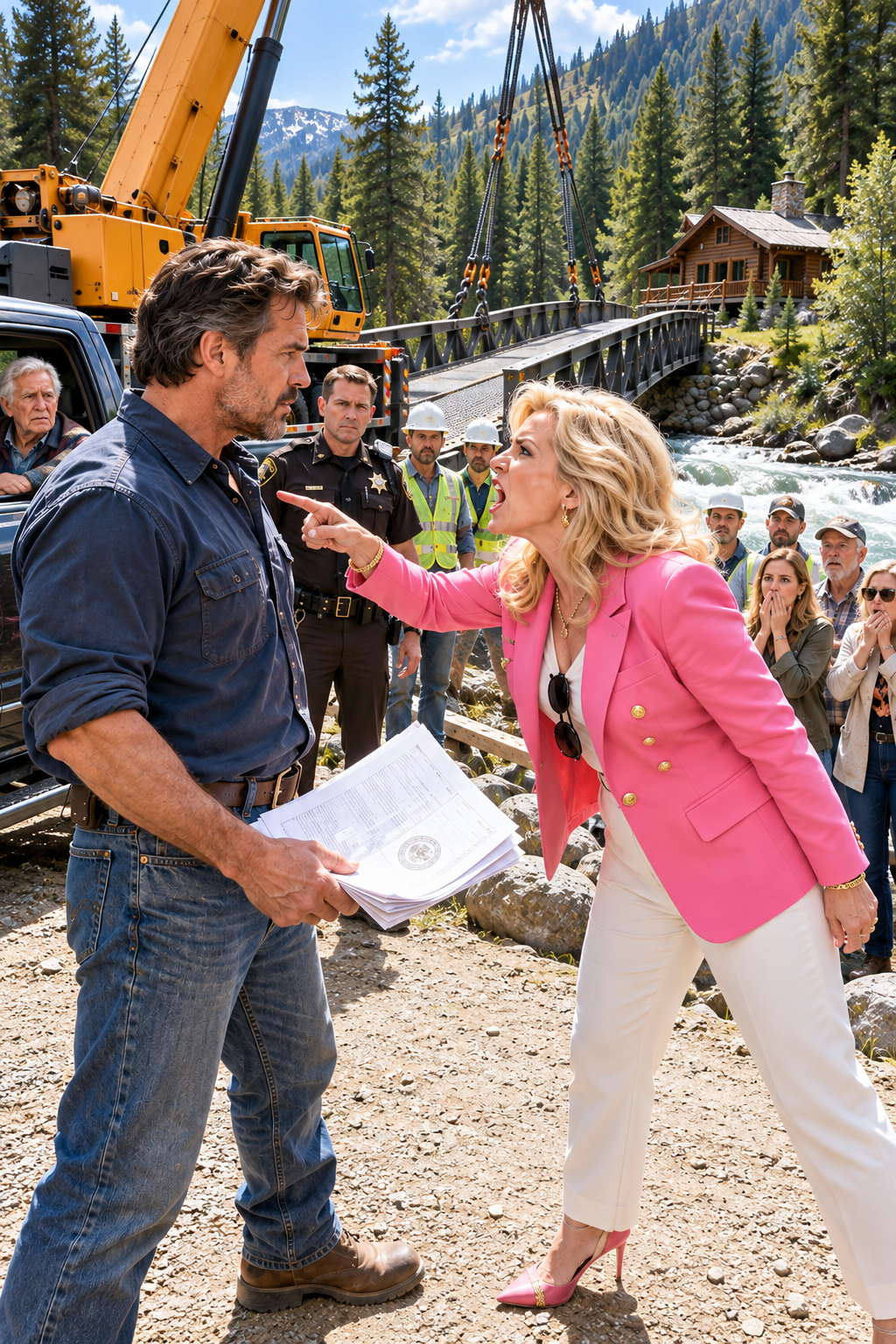
I’d barely tightened the first lifting sling when Sloan’s Escalade swept around the bend.
She marched onto the rigged bridge wearing a cream cashmere coat and four-inch heels.
“Get that rust bucket off my bridge? Absolutely not!” she shouted. “Forty-two important guests arrive in two days.”
“Ma’am,” I replied, “this is my bridge.”
“Then you’ll have to lift me with it.”
Kowalski stepped toward her. “You’re standing on a suspended-load worksite. Get clear immediately.”
Tess raised the permit. “If this bridge remains tomorrow, Mr. Hollister violates state requirements. This is not HOA infrastructure.”
Sloan looked from the paperwork to my crane.
Then she spat, “That drooling old fossil belongs in a nursing home, not my lodge. Keep him hidden when my guests arrive.”
My hands tightened around the control levers.
“Don’t speak about my father that way.”
She jabbed her nail against my chest. “I’ll speak however I please. You understand me, trailer trash?”
I glanced at Dad, safely inside the truck, watching us through the windshield.
“Yes, ma’am,” I said. “I understand.”
Kowalski directed her away from the work area. Once she cleared the bridge, I resumed lifting.
The sixty-foot steel span groaned free of its bearings. Water streamed from the deck as I swung it over the bank and gently lowered it onto the waiting trailer.
“Good steel,” Dad called from his truck. “Knows when to move.”
At 9:42 a.m., Tess documented full permit compliance.
By noon, my bridge was headed to Boise.
That evening, I installed the approved warning signs.
At 11:15 p.m., a security camera showed Doug removing them with a socket wrench while Sloan watched from her Escalade. I forwarded the video to Kowalski.
The next morning, Carla sent me another disturbing email.
Sloan had promised the credit union that a brand-new bridge would be installed by dawn on May second.
Attached was a $23,000 invoice from Treasure Valley Crane and Shoring.
She’d ordered a sixty-foot rental span for installation on my abutments without my permission or the required authorization.
That evening, Cody Barrett, a crane operator I’d trained fifteen years earlier, called.
“Boss, I’ve been assigned a strange job at Boulder Fork. The owner’s authorization has your signature, but there’s no middle initial.”
I explained everything.
Cody put his manager on speakerphone. After reviewing my permit and deed, the company canceled the installation and forwarded the suspicious authorization to the sheriff.
At 9:41 p.m., Sloan received the cancellation by email.
I immediately informed Carla that no bridge would exist.
At 5:12 the next morning, Carla replied.
The credit union’s CEO had telephoned Sloan, who insisted her replacement crew was already installing the bridge.
Their charter bus was leaving Boise anyway.
I stood beside the empty abutments that morning, watching the creek thunder through sixty feet of open space.
Across the water, Dad’s cabin stood untouched.
At 11:20, the sound of a diesel engine echoed through the pines.
Sloan’s white Escalade rounded the corner.
A fifty-passenger charter coach followed.
And behind it came a catering van.
## Part 4: Forty-Two Witnesses Expose the Lies and Restore My Father’s Legacy
Sloan stepped from her Escalade wearing a white designer jumpsuit, gold sandals, and a broad-brimmed hat. A champagne flute glittered in her hand. She turned toward the creek wearing the triumphant smile of a woman expecting applause.
Then she stopped.
Two bare concrete abutments faced each other across the roaring water.
There was no bridge.
The champagne tipped onto her sandals.
“Where,” she whispered, “is my bridge?”
Cody stepped forward. “Your rental bridge is still in our yard, ma’am. We canceled after discovering the forged authorization.”
Her mouth opened. “My crew confirmed they were here!”
“We emailed you the cancellation at 9:41 last night.”
The bus doors hissed open.
Forty-two credit union guests stepped onto the gravel, carrying suitcases, jackets, and weekend bags. Their CEO, Paula Grange, emerged beside Carla Whitfield, whose phone was already recording.
Sloan turned toward me, her face twisting.
“He stole the bridge!” she screamed. “Deputy, arrest this man!”
Kowalski calmly shook his head. “I watched Mr. Hollister remove his bridge under a valid permit two days ago. You were present.”
Tess held up the compliance report.
“Removal was completed April thirtieth at 9:42 a.m. No replacement can be installed without proper authorization.”
Paula stared at Sloan.
“You told me this morning the new bridge was almost finished.”
Sloan swallowed. “There must have been a scheduling misunderstanding.”
Carla raised the alleged management agreement.
“Mr. Hollister, is this your signature?”
“No, ma’am. My legal signature includes a J. I’ve never authorized anyone to rent that cabin.”
A murmur moved through the guests.
Then another vehicle arrived.
Gene Larkin climbed from his Subaru carrying a binder, with Joyce Albright beside him.
“Mrs. Grange,” Gene said, “I’m the Timber Rim HOA treasurer. Your eighteen-thousand-three-hundred-dollar deposit didn’t go to our association. It went to an LLC registered through Mrs. Pettybone’s husband.”
He opened the binder.
“Furthermore, the HOA paid fourteen thousand dollars to market this supposed lodge and another twenty-three thousand for the replacement bridge that never arrived.”
Paula slowly turned toward Sloan.
“You’ve been using other people’s money to rent property you don’t own?”
Sloan backed toward her Escalade, but the charter bus blocked the road.
Kowalski approached her.
“Mrs. Pettybone, I need you to come with me. We have questions about forged authorizations, removed warning signs, and the financial records.”
She whirled toward me.
“You did this! Put my bridge back!”
I rested my coffee cup on the hood of my pickup.
“My bridge isn’t missing, ma’am. It’s in Boise, being repainted, exactly where my state permit requires it to be.”
She stared at me, breathing hard.
“You were standing there when Tess explained the rule,” I continued. “But you were too busy choosing table linens to listen.”
Someone laughed.
Then several others did.
Inside my truck, Dad began clapping.
As Kowalski escorted Sloan to his patrol car for questioning, her wide-brimmed hat slipped sideways. The woman who’d called my father’s home a shack couldn’t bring herself to look at him.
The charter coach eventually backed carefully down the narrow road with Gene helping direct the driver from a safe distance.
I watched those forty-two guests depart, angry for them rather than at them. They’d trusted a polished website, paid their money, and planned an ordinary retreat.
Gene arranged an alternative before afternoon. The legitimate Timber Rim clubhouse had a fireplace and a large kitchen, and the credit union’s caterers relocated their dinner there.
That evening, Dad and I joined them.
When we entered, forty-two people rose and applauded.
Dad looked bewildered for a moment. Then Paula invited him to sit near the fireplace and tell everyone about his years fighting wildfires.
He described his first jump from a DC-3 in 1965, the terrible wind, the burning pines, and a meadow filled with purple lupine. The room fell completely silent.
Carla lowered her phone.
For those few minutes, Dad wasn’t an elderly man struggling with his memory.
He was Walt Hollister, smokejumper, husband, father, and the man who’d built a cabin that somebody else had tried to steal.
Three weeks later, fifty-six Timber Rim homeowners gathered in that same clubhouse for a special meeting.
Gene projected the financial records onto a screen. Joyce read Sloan’s accusations against Dad, followed by the letter confirming that the neglect report was unsubstantiated.
Sloan was removed as HOA president by a vote of fifty-four to two.
The two opposing votes were hers and Doug’s.
The investigation continued through summer. Sloan faced charges involving forgery and theft, while Doug’s conduct and the LLC’s finances were examined. Eventually, Sloan accepted a plea agreement requiring probation, community service, and restitution totaling more than $100,000.
The defrauded renters received reimbursement. The association’s reserve funds were restored. TR Retreats LLC was dissolved, and the Pettybones put their house on the market.
The new HOA board formally recognized our family’s 1964 easement, removed the iron gate, and covered my legal expenses.
On July eighteenth, Tess approved the bridge’s return.
I drove the newly sandblasted, forest-green span back up the mountain. About twenty Timber Rim families gathered along the creek to watch. Children sat safely beyond the work area eating maple bars while their parents talked with Dad.
When the steel settled onto its bearings, the crowd cheered.
Joyce had brought a handmade banner.
WELCOME BACK BRIDGE.
The letters grew smaller toward the end because the children had run out of room.
That afternoon, Gene proposed something I never expected: one Saturday each August when neighborhood families could visit our land, learn about the creek, and hear stories from former smokejumpers.
We called it Walt Hollister Creek Day.
Tess taught the children about fish habitat and spring runoff. Two retired smokejumpers demonstrated fire safety. The credit union sponsored supplies, and Paula Grange helped cook huckleberry pancakes.
Dad loved it.
His memory continued to fade, as we knew it would. Some mornings, he couldn’t recall Sloan or the trouble she’d caused. But he still recognized the sound of the creek and the way our bridge rang beneath passing tires.
One August afternoon, a little girl approached his porch chair.
“Mr. Hollister, why do you take your bridge away every spring?”
Dad watched the clear water moving beneath the green steel.
He thought for a long moment.
“Because the creek was here first,” he finally said. “Good steel knows when to step aside. And it knows when to come home.”
The little girl smiled, then ran back toward her mother.
I sat beside him, listening to the water.
Sloan had wanted our cabin because she saw money in its walls, its porch, and its beautiful mountain views. She never understood that the property held something no contract could purchase: a lifetime of memories, built by a man who’d spent his best years protecting other people’s homes.
Dad turned toward me.
“Wade, did I ever tell you about the time your mother burned the huckleberry pancakes?”
I smiled.
“Only about a hundred times.”
“Well,” he said, settling deeper into his chair, “you ought to hear it again.”
And with the mountain sunlight falling across the porch, I listened as though it were the first time.
THE END.
All characters and events in this story are fictional, created for storytelling and entertainment purposes. Thank you sincerely for reading. Your feedback and support are invaluable and motivate me to continue sharing more stories with you.


