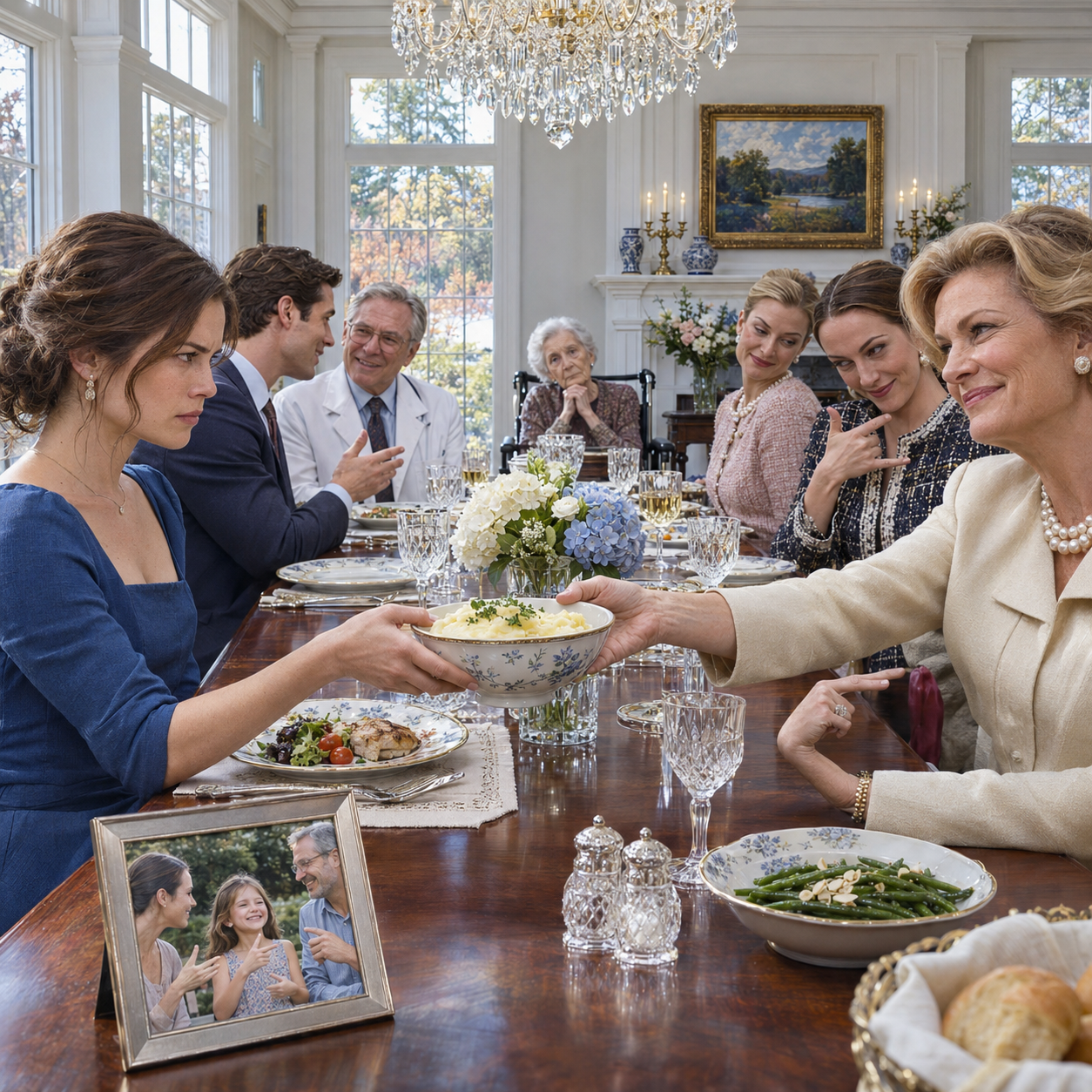
Patricia slid the bowl of potatoes toward me, smiling like a woman welcoming a daughter into her family. Beneath the edge of the dining table, her left hand moved quickly, shaping three ugly messages: cheap dress, fortune hunter, six months. I tightened my fingers around the serving spoon. If I answered her in the language she was using, that dinner would end very differently.
## Part 1: A Family Dinner Exposes the Cruelty Behind Polite Smiles
My name is Nora, I’m thirty-two years old, and I teach elementary school art in a small Vermont town where children regularly mistake my hair for a place to store glitter. My fiancé, Ben, teaches high school science, and he still insists our relationship began because he spilled an entire cup of coffee across my portfolio at a teachers’ conference. I remember standing there with brown liquid dripping off my drawings while this tall, embarrassed stranger offered to replace everything, including the floor beneath our feet. By the following spring, I knew I wanted to marry him, and when he proposed a year after we met, I thought the hardest part of our future would be deciding whose terrible jokes our children might inherit.
There was something Ben knew about me that his family didn’t, although it wasn’t supposed to remain a secret. My parents, Tom and Ann, were both born deaf, met at fifteen at a school for deaf students, and built a marriage so full of laughter that our little kitchen sometimes seemed brighter than the rest of the world. Dad worked as a printer and could deliver an entire punch line with one eyebrow, while Mom, a seamstress, ended disagreements by closing her eyes until he surrendered. I was their only hearing child, and American Sign Language was the language I learned before I could form spoken sentences.
By eight, I was interpreting at restaurants, helping with telephone calls, and explaining bank paperwork that adults should have made accessible to my parents in the first place. I also learned how casually strangers could humiliate someone they assumed couldn’t understand them, especially when they believed nobody nearby would object. Once, after a cashier mocked my father’s hearing, I burst into tears outside a grocery store, but Mom crouched before me and signed something I’ve carried ever since: “Be still long enough, sweetheart, and people will reveal what’s inside them.” Dad died when I was twenty-six, and Mom followed fourteen months later, leaving me with their photographs, their old recipe cards, and the language in which I’d first understood love.
When Ben learned about my childhood, his face brightened because his grandmother Evelyn had lost her hearing when she was young. “Mom and my sisters sign with her,” he explained, rubbing the back of his neck. “I never bothered learning properly, which I know is awful, but Gram would absolutely love talking to you.” He suggested I surprise everyone at our first family dinner, and I agreed, imagining an elderly woman delighted to discover she could communicate easily with her future granddaughter-in-law. I even bought a blue dress for the occasion, spending thirty-eight dollars on something that made me feel beautiful.
Ben’s parents lived in a grand white colonial house above town, surrounded by trimmed hedges and a driveway long enough to make me nervous before we reached the front steps. His father, Richard, was an orthodontist who spoke softly, while his mother, Patricia, seemed to chair every organization that included the words community, fundraiser, or prestige. His sisters, Whitney and Paige, sold expensive houses and wore the kind of polished smiles that made their father’s profession seem like a family tradition. Patricia greeted me with an air kiss and a compliment about my hair, then ushered us into a dining room bright with polished silver and afternoon sunlight.
At the far end sat Evelyn, eighty-nine years old, small and silver-haired, her wheelchair angled toward a window overlooking the garden. Nobody introduced me to her, and nobody signed a greeting when they entered; Patricia merely brushed her mother’s shoulder while passing, then began discussing an upcoming charity auction. I was already raising my hands to introduce myself when Patricia passed me the potatoes and secretly signed to Whitney that my dress looked cheap and I was probably interested in Ben’s family money. Whitney answered that I wouldn’t last six months, and Paige added a remark about my worn shoes, all while they smiled across the table as though I were a cherished guest.
My face burned, but I lowered my hands and thanked Patricia for the potatoes. Ben was beside me, discussing a laboratory experiment with his father, completely unaware that his mother and sisters had just judged my character without asking me a single meaningful question. I could have answered them immediately, but I remembered my mother’s advice and wanted to know whether those insults were an isolated lapse or something uglier. When Ben asked in the car whether Evelyn had enjoyed my surprise, I watched the dark road beyond the windshield and told him I’d decided to save it for another occasion.
I promised myself there would be one more dinner before I made any judgment. One dinner became several, and soon every other Sunday found me seated beneath Patricia’s chandelier, smiling through insults disguised as silence. They called me Ben’s little charity project, mocked my teacher’s salary, and once dismissed a homemade apple pie as something that should be thrown away after I left. But as the months passed, the cruellest thing in that room wasn’t what they said about me; it was what happened to the elderly woman sitting at the end of the table, watching everyone else live as though she had already disappeared.
## Part 2: An Overlooked Grandmother Discovers the Secret Behind My Silence
The day Ben told his family that both my parents were dead, Patricia pressed a hand to her chest and offered such tender condolences that even I nearly believed her. Beneath the table, her other hand delivered a different reaction to Whitney: at least there would be no troublesome in-laws to accommodate. I excused myself, shut the powder-room door, and gripped the porcelain sink until the urge to cry turned into anger. I could forgive ignorance, but watching someone imitate kindness while privately celebrating my parents’ deaths felt like seeing their memories deliberately dragged through the mud.
Still, I couldn’t stop noticing Evelyn, who received less attention at dinner than the flowers arranged beside her wheelchair. When she tried signing a question, Patricia usually gestured for her to wait, then turned back to the conversation without ever returning to her. Richard rarely challenged his wife, and the sisters behaved as though their grandmother’s silence meant she had nothing to contribute. I’d seen that particular loneliness before, in hospital waiting rooms where strangers spoke around my parents, and I recognized the slow resignation in Evelyn’s eyes whenever her hands fell back into her lap.
One Sunday afternoon, while the family argued in the kitchen over who had burned a casserole, I found Evelyn alone in the sunroom with sunlight warming her thin hands. I knelt beside her wheelchair, positioned myself where she could see my face clearly, and signed, “Hello, Evelyn. I’m Nora, and I’ve wanted to meet you properly for a long time.” Her mouth opened in astonishment, and then her fingers flew forward so quickly I almost laughed. “Where did you learn to sign so beautifully?” she asked, studying my hands before adding, “You remind me of someone from my childhood.”
I told her about my parents, their little kitchen, Dad’s expressive eyebrows, and the way Mom could win any argument without moving a finger. When I explained that they had both passed away, Evelyn covered my hand with hers and stayed quiet until the tears in our eyes settled. Then she glanced toward the kitchen and signed a question that made my stomach tighten: “Does Patricia know you understand her?” I shook my head, and Evelyn stared for a moment before dissolving into such delighted, silent laughter that her shoulders bounced against the wheelchair. She wiped her eyes and signed, “Then don’t spoil the surprise just yet.”
After that afternoon, the sunroom became our private corner of the world. Evelyn told me about growing up on a dairy farm, about the boy named Frank who learned to sign during one summer because he wanted to ask her to a dance, and about their long marriage before his death eleven years earlier. “They think being old means there’s nobody left inside me,” she signed one afternoon, her smile fading as she glanced toward the dining room. “I’ve listened to them plan things around me for years, but until you arrived, nobody bothered asking what I wanted.”
We spent our Sundays exchanging stories while Ben gradually noticed that his grandmother seemed happier, although he never understood the reason. Evelyn remembered my parents through my hands, and I discovered that her husband had once played practical jokes so outrageous she still laughed decades after his death. Sometimes, when Patricia called us back to dinner, Evelyn squeezed my wrist as if reluctant to leave a room where she was finally a person again. I began to understand that keeping my secret wasn’t only about exposing Patricia anymore; it was also about protecting the first real companionship Evelyn had enjoyed in years.
In May, Patricia announced an elaborate celebration for Evelyn’s ninetieth birthday, complete with a white garden tent, a string quartet, one hundred guests, a professional photographer, and a reporter from the county newspaper. Ben and I were planning our September wedding, so Patricia graciously assigned me responsibility for the floral centerpieces, emphasizing how suitable such work was for an elementary school art teacher. Three days before the party, I stood arranging white roses at the kitchen island while Patricia and Whitney organized seating cards nearby. Believing me safely occupied, Whitney signed a question about my engagement ring, and Patricia answered that she’d already contacted a lawyer about a prenuptial agreement and could persuade Ben to sign whatever she placed before him.
Then Patricia added that she expected me to be out of their lives before Christmas. She looked up, admired my flowers, and praised my “adorable little crafts” with a smile so polished that I almost admired the performance. I carried the arrangement into the sunroom, where Evelyn listened as I repeated every word, including the part about secretly controlling Ben’s marriage. She sat very still, staring at the garden where her birthday tent was being assembled, before turning toward me with an expression I hadn’t seen before.
“Nora,” she signed, straightening in her chair, “there’s something I want you to give me for my birthday.” I asked whether she wanted a photograph, a special meal, or something that reminded her of Frank, but she shook her head at each suggestion. Then she explained what she had in mind, and I realized that the woman everyone treated as helpless had understood her family far better than they understood themselves. For the first time in an entire year, I knew exactly when my silence would end.
## Part 3: One Birthday Celebration Shatters a Year of Secret Cruelty
The morning of Evelyn’s birthday arrived beneath a cloudless Vermont sky, and Patricia’s lawn looked like a wedding venue borrowed from a glossy magazine. White roses filled the tables, musicians played beneath the enormous tent, and the photographer moved among guests capturing scenes of what appeared to be a perfectly devoted family. Evelyn sat near the front in a lavender dress, her silver hair carefully brushed, watching conversations she couldn’t follow because nobody had thought to interpret them. I sat beside Ben, feeling the weight of my mother’s old bracelet against my wrist as Patricia approached the microphone.
Patricia delivered a magnificent speech about sacrifice, family loyalty, and the privilege of caring for an aging mother. She described Evelyn as the family’s greatest treasure, pausing occasionally for applause while the photographer captured her affectionate glances toward the wheelchair. I watched Evelyn studying her daughter’s lips, trying to assemble whatever meaning she could from a speech supposedly honoring her. When Patricia finally raised her champagne glass and invited anyone else to share a birthday message, I pushed back my chair and stood.
Ben caught my hand and whispered, “Are you going to say something about Gram?” I nodded, walked past the crowded tables, and stopped directly before Evelyn without touching the microphone. I waited until her eyes met mine, then lifted my hands and began signing a birthday message large enough for everyone to see. Her expression brightened immediately, but behind me, a peculiar silence spread through the tent as the guests realized I was speaking in a language most of them couldn’t understand.
I thanked Evelyn for her friendship, for teaching me about Frank, and for reminding me that growing older should never mean becoming invisible. Then I turned toward Patricia and signed, “My parents were deaf, and I grew up speaking this language every day.” Whitney’s face drained of color, Paige gripped the edge of her chair, and Patricia stood motionless with her champagne glass suspended near her lips. I continued signing, carefully repeating the insults I’d endured over the past year: the cheap dress, the supposed hunger for Ben’s money, the homemade pie they mocked, the cruelty surrounding my parents’ deaths, and Patricia’s intention to end our marriage before Christmas.
Ben rose from his seat, looking between us with increasing alarm, and demanded to know what I was saying. I lowered my hands and explained aloud that his mother and sisters had spent a year insulting me through sign language because they believed I couldn’t understand them. Patricia’s glass trembled, spilling champagne across her fingers, while the reporter stopped writing and looked directly at her. Before anyone could interrupt, Evelyn touched my arm and asked me to give her the microphone’s voice.
I stepped beside her wheelchair and spoke each sentence as she signed it, allowing her words to reach everyone beneath the tent. Evelyn told the guests that her daughter had just praised eleven years of devoted care, yet in those eleven years, Patricia had barely attempted a genuine conversation with her. She explained how the family routinely made decisions around her without asking her opinion, while Nora, a stranger they considered unworthy, had knelt beside her and treated her like a human being. Then Evelyn looked at Ben and signed, “Your grandfather learned my language in one summer because he wanted to take me dancing. Benjamin, how much longer are you planning to wait?”
Ben covered his mouth, and for a moment I thought he might cry. Evelyn wasn’t finished; she lifted her chin toward Patricia and told the entire gathering that if her family couldn’t welcome me, she certainly could. The guests remained quiet as Ben walked toward his mother and asked her directly whether the things I’d described were true. Patricia stared at her daughters, then at the photographer and the newspaper reporter, but not one word escaped her lips.
Richard finally placed his folded napkin beside his plate and stood. His voice was quiet, yet everyone heard him tell Patricia that she needed to leave the celebration and go inside. She looked at Evelyn as though expecting her mother to rescue her from the humiliation, but Evelyn had turned toward me and was holding my hand. For the first time all afternoon, the birthday girl was smiling at someone who was smiling back.
## Part 4: A Grandmother’s Final Surprise Restores the Family’s Lost Language
Ben and I drove home in silence that evening, but this time he didn’t mistake my quietness for happiness. At my apartment door, he admitted that he had never imagined his mother capable of such cruelty, then asked why I hadn’t trusted him enough to tell him sooner. I explained that I had been afraid of making him choose between me and the people who raised him, but I also confessed that waiting an entire year had hurt us both. He held my hands, looked at the bracelet my mother had left me, and promised that he wouldn’t allow anyone to treat me that way again.
The following week, Ben started studying American Sign Language three evenings a week. He practiced while making breakfast, while grading science tests, and sometimes while walking through the grocery store, attracting curious glances whenever he accidentally signed something completely different from what he intended. I realized he wasn’t learning merely to impress me; he was trying to recover the conversations he’d missed with a grandmother who had been waiting patiently for him his entire life. When Evelyn first saw him sign a clumsy greeting, she laughed so hard she had to reach for a tissue, then guided his fingers into the correct position.
We married that September in a small church in my hometown, without Patricia’s proposed prenuptial agreement or any grand spectacle. Ben surprised me by signing his wedding vows before speaking them, although one unfortunate mistake transformed his promise of lifelong devotion into a declaration that he would love me until I became a potato. Evelyn nearly slipped out of her chair laughing, and I cried so hard I couldn’t finish my own vows without stopping. It was the happiest mistake anyone had ever made for me.
Soon afterward, Evelyn moved into our home, where we converted the spare bedroom into a bright space overlooking the garden. By her ninety-second birthday, she and Ben were conducting passionate debates about scientific discoveries, and she occasionally ended arguments by closing her eyes, exactly as my mother once had. Patricia remained distant for most of the following year, and although Ben struggled with the separation, neither of us tried to force Evelyn into a reconciliation she hadn’t requested. Then, on an ordinary Tuesday afternoon, someone knocked on our front door.
Patricia stood on the porch without makeup or jewelry, holding a beginner’s sign language workbook against her chest. She looked past me toward the living room, where Evelyn sat reading beside the window, and slowly stepped inside when I moved aside. Her fingers trembled as she signed a simple question to her mother: “How are you?” Evelyn watched her for such a long time that I could see Patricia struggling to remain composed.
Finally, Evelyn raised one hand and signed a single word: “Later.” Patricia’s face crumpled, but before she could turn away, Evelyn’s eyes sparkled with mischief, and she began laughing that wonderful silent laugh I’d come to love. She reached for her daughter’s hand and signed, “Come sit beside me, you ridiculous girl. We have eleven years of conversations to catch up on.” I quietly walked into the kitchen, leaving them together, because some words belong only to the people who have waited years to say them.
Two photographs now hang side by side in our hallway. One shows Evelyn and me beneath that white birthday tent, our hands lifted in conversation while a hundred people watched; the other shows my parents laughing in our old kitchen, caught in the middle of an argument neither needed a voice to win. Every morning, I look at those photographs and remember what my mother taught me about silence and the truths people reveal when they think nobody understands. I spent a year believing I was waiting for the perfect moment to defend myself, but in the end, the greatest gift wasn’t exposing the people who had mocked me—it was helping someone they had forgotten find her place in the world again.
THE END.
All characters and events in this story are fictional, created for storytelling and entertainment purposes. Thank you sincerely for reading. Your feedback and support are invaluable and motivate me to continue sharing more stories with you.