
Part 2: One Dollar Exposed A Betrayal That Went Beyond Favoritism
Exactly one week after Daisy’s birthday, Mom sent a message to our extended family group chat.
“Brinley’s Sweet Sixteen is going to be spectacular! Event hall downtown, 120 guests, live DJ, chocolate fountain, professional photo booth. Every family contributes $2,600. Payment due Friday. Non-negotiable. Brinley deserves the best!”
A separate message followed, addressed directly to me.
“Jackie, I’m counting on your share. Don’t start being difficult.”
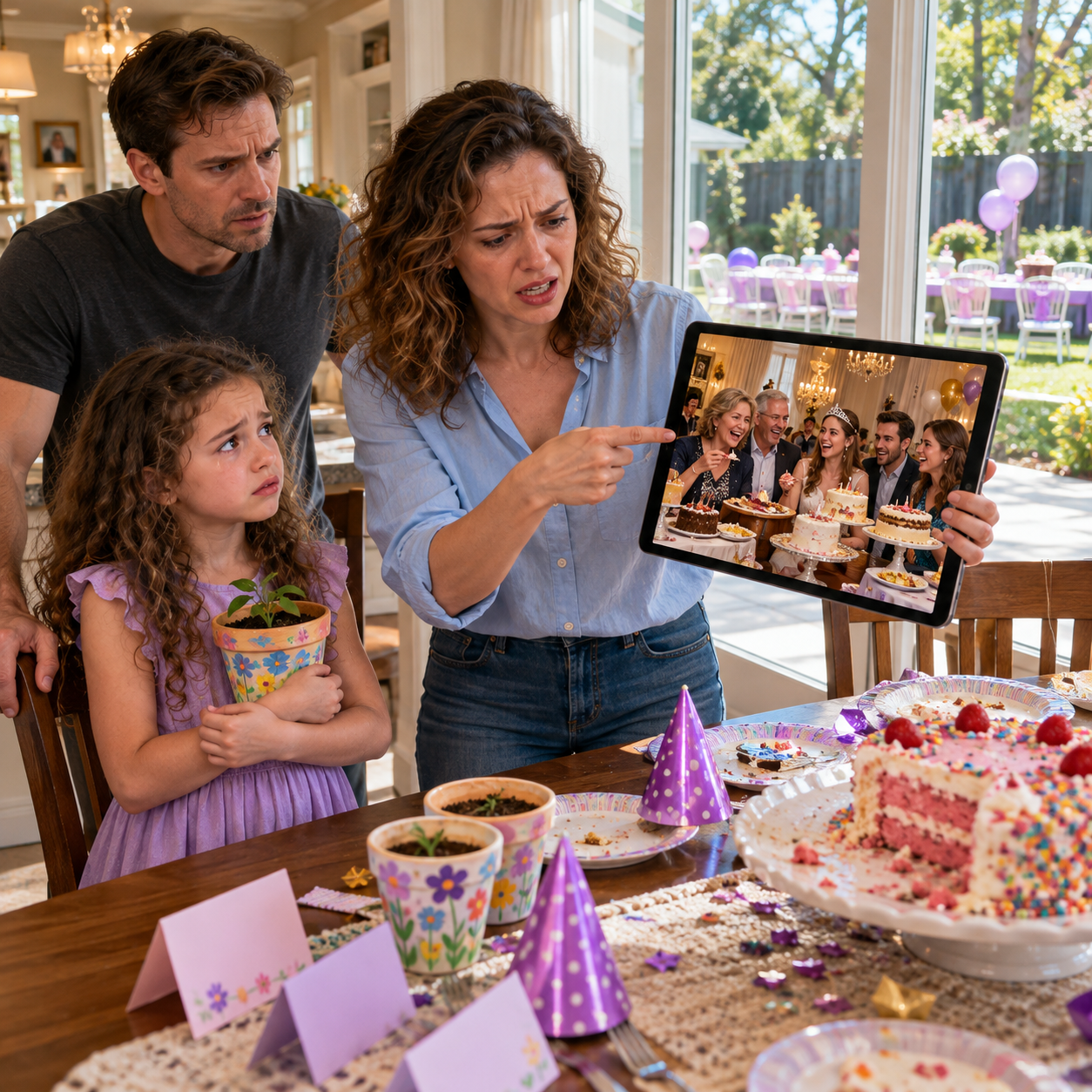
I read those messages while standing in the same kitchen where Daisy had discovered the cake-tasting video. There hadn’t been one question about her birthday, one apology, or one attempt to make things right.
I opened my payment app, selected my mother’s account, and transferred one dollar.
In the note, I typed, “CONGRATULATIONS.”
Ryan watched from the couch. “What did you just do?”
“Contributed to the party.”
When I showed him the receipt, he laughed into a sofa cushion, although his expression changed when my phone began ringing.
Micah called first. “A dollar? You sent Mom a dollar? Are you trying to humiliate her?”
“You missed Daisy’s birthday to taste cake.”
“It was one birthday, Jackie. She’s eight. She’ll forget.”
“She’s growing beans in the presents she made for you.”
He hesitated, then said, “Brinley only turns sixteen once. Daisy can have another birthday next year.”
“Then you can find somebody else to pay for this one.”
“Send the money or don’t come.”
“I wasn’t planning to.”
On Monday, Mom called my workplace and told the receptionist she had an emergency. I stepped away from sterilizing dental instruments, expecting news about Dad’s health.
“Your aunt saw that dollar payment,” Mom announced. “Do you know how ridiculous you made me look?”
“I’m working, Mom.”
“Your brother is upset. Brinley is upset. You’re a grown woman competing with a teenage girl.”
“Is anybody upset about Daisy?”
“Children bounce back, Jacqueline. Stop creating drama and send the money.”
I ended the call before my coworkers could hear anything else.
The following morning, I had our house locks changed. Mom still possessed a key I’d given her when Daisy was a baby, and I no longer wanted her arriving unannounced. I blocked her number, along with Micah’s and his wife’s.
I nearly left Dad unblocked. Then I remembered he had also been sitting at that cake-tasting table.
There was one more thing I needed to do: disconnect my credit card from Mom’s accounts. I made a list of the pharmacy, phone service, and shopping websites, intending to contact the bank on my next morning off.
I should have done it immediately.
Thursday afternoon, between patients, my phone displayed a fraud-alert notification.
“Did you authorize a $5,200 transaction at Magnolia Event Hall?”
I called the card company, told them I hadn’t approved the charge, and asked them to investigate. Then I called the event hall.
A polite woman checked the reservation and confirmed that my mother had come in the previous afternoon to pay the outstanding balance for Brinley’s celebration.
“She explained that her daughter was covering her own contribution and her brother’s,” the woman said. “We have a signed payment authorization.”
“Whose signature?”
“Jacqueline Parker.”
I pressed my fingertips against the edge of the reception counter. “Could you repeat that?”
“Your mother signed the form on your behalf.”
“I never gave her permission.”
The woman stopped typing. “Ma’am, I’ll need to notify our manager.”
That evening, Dad called from the part-time job he still worked at the post office.
“Jackie, please hear me out.”
He sounded tired. In the background, I could hear machinery and people talking.
“I heard your mother discussing the payment with Micah,” he said. “She was angry about that dollar. She said your card was still saved on her account.”
I waited.
“She said you’d never challenge the charge because you hate fighting with family. Micah told her to pay his share too.”
“Did you stop her?”
“I told her it wasn’t right.”
“And?”
“She told me to go water the tomatoes.”
There was a long pause.
“And I went,” he admitted.
He apologized for missing Daisy’s party, explaining that Mom had insisted the tasting appointment couldn’t be rescheduled. He had wanted to come but hadn’t challenged her.
For the first time, Dad sounded less like a man defending his wife and more like somebody recognizing what his silence had cost.
After we hung up, Ryan found me sitting at the kitchen table with my phone and the event hall receipt.
“Are you going to let her get away with it?” he asked.
For thirty-two years, avoiding arguments had seemed easier than fighting them.
I pulled a folder from the desk drawer and wrote the date of Dad’s call on the front.
“No,” I said. “Not this time.”
Part 3: A Forged Signature Turned My Mother’s Demands Into Evidence
The next morning, I contacted my credit card company again, formally disputed the $5,200 charge, and requested a replacement card. They suspended the disputed transaction while their fraud department investigated. I spent the rest of the morning collecting everything that might establish what had happened.
I printed Mom’s payment demands, my one-dollar transfer, and the transaction alert. I saved screenshots of Brinley’s cake-tasting video, including its timestamp, and wrote down what Dad had told me. Then I drove to the police station.
The desk officer was a gray-haired woman whose reading glasses hung from a chain around her neck. She examined the documents carefully before looking over her glasses.
“Your mother used your credit card for a party and signed your name without permission?”
“Yes, ma’am.”
“Do you have anything showing you refused to contribute?”
I slid the payment messages across the desk.
She read them twice before beginning her report. When I left, I had a case number and the name of a detective.
Four days later, Mom learned the card payment was being disputed.
At six that evening, my doorbell camera showed her marching onto our porch, handbag swinging against her hip. She inserted her old key, twisted it, and tried again when the lock wouldn’t turn. Eventually, she began pounding.
“Jacqueline! Open this door! You cannot do this to your mother!”
Daisy was completing her spelling homework at the kitchen table. I turned on some music and sat beside her until Mom finally drove away.
At eight-thirty, two police officers knocked on our door.
My mother had requested a welfare check, claiming I’d isolated myself from my family and might be a danger to myself or Daisy.
I invited the officers inside. Daisy greeted them politely and showed one officer the bean plants on her windowsill while I retrieved my folder.
“This is the police report I filed about my mother,” I explained, handing over the case number. “She signed my name on a $5,200 credit card payment. She’s the person who called you.”
The younger officer checked the information with dispatch. After listening to the response, he glanced at his partner.
“We can see your daughter is safe,” he said. “We’ll document the circumstances of this call.”
As they left, the female officer crouched beside Daisy’s plants.
“Those are growing nicely,” she told her.
Daisy smiled. “They were supposed to be presents.”
I watched the officer’s expression change, but she didn’t ask Daisy to explain.
The detective contacted me the following week. He had obtained the payment authorization, which carried my name in Mom’s familiar rounded handwriting, along with records from the card company and event hall.
He explained that the investigation would take time. I understood, although I hated knowing that Mom was still insisting the payment was legitimate.
She had already told the event hall I’d simply misunderstood our arrangement. According to its manager, she promised I would arrive at the party with a cashier’s check covering the balance.
Nobody had asked whether that was true.
On the morning of Brinley’s celebration, the manager called me personally.
“Mrs. Parker, your mother says you’re paying the outstanding balance tonight. Is that correct?”
“No. I’ve filed a fraud report. I’m not providing any money.”
He sighed. “Then we have a problem. The event is going ahead while we try to resolve payment, but if the balance isn’t settled, we’ll have to close at nine.”
He explained that the authorization bearing my name remained part of their file. He asked whether I could come in, verify my identity, and sign a written statement denying responsibility, preferably while the relevant staff were working.
I considered refusing. Then I thought of Mom continuing to use my name whenever it suited her.
“I can be there at seven.”
Ryan offered to accompany me, but I wanted Daisy nowhere near another family argument. He stayed home with her while I drove downtown wearing jeans and a plain black blouse.
Magnolia Event Hall looked beautiful beneath the evening lights. Purple and gold balloons framed the entrance, music rolled through the glass doors, and elegantly dressed guests crowded around a chocolate fountain.
Inside, Brinley stood in a shimmering silver gown, laughing with her friends.
For a moment, I wished I could simply tell her happy birthday and leave.
The manager met me near the entrance and guided me to a cocktail table with the necessary paperwork. I verified my information, signed the statement, and thanked him.
I was halfway toward the exit when Mom spotted me.
She wore a gold sequin dress and a smile big enough for everyone around her to see.
“Oh, thank goodness!” she called, crossing the dance floor. “Jackie’s here!”
She extended a hand toward my purse.
“Give the manager his check, honey. Then come celebrate with your niece.”
Part 4: The Birthday Celebration Revealed The Truth Nobody Wanted To Hear
“I don’t have a check, Mom.”
Her smile remained fixed. “Jacqueline, don’t embarrass me tonight.”
“I’m not paying for this party. I came to confirm that I didn’t authorize the charge.”
She stepped closer, lowering her voice. “You are not going to ruin Brinley’s birthday over a few thousand dollars.”
“You signed my name.”
“After everything this family has done for you, you want to argue about paperwork?”
Behind her, the music continued. A photographer was arranging a group of teenagers beside the balloon arch, and Brinley was showing someone her dress.
I tried to move past Mom, but she caught my forearm.
“You’re my daughter,” she whispered. “You wouldn’t actually have your own mother arrested.”
“Please let go.”
Instead, she reached into my open handbag, searching for a checkbook I hadn’t carried in years. I pulled it away, and the manager hurried over.
“Ma’am, you need to step back,” he said.
Mom pushed him with both hands.
He stumbled against the cocktail table, knocking my signed statement onto the floor. The DJ cut the music as the manager steadied himself.
Several guests lifted their phones.
The manager told Mom he was calling the police. She accused him of helping me destroy her granddaughter’s party, then turned toward me as though expecting me to rescue her.
For the first time, I didn’t lower my voice to protect her reputation.
“Daisy waited three hours for you on her birthday,” I said. “She made name cards for every one of you. And while she kept watching the driveway, you were here eating cake.”
Mom glanced around at the gathering guests.
“Don’t drag that child into this.”
“She was already in it, Mom. You put her there.”
I held up my phone, showing the disputed charge. “Then you used my credit card and signed my name for five thousand two hundred dollars because I wouldn’t pay for this celebration.”
Brinley had approached from the chocolate fountain. Her silver dress brushed the floor as she stopped beside Micah.
“Aunt Jackie?” she asked. “What do you mean Daisy waited for Grandma?”
I looked at her, realizing she seemed genuinely confused.
“Your cake tasting was the same afternoon as Daisy’s birthday.”
Brinley frowned. “Grandma said Daisy was sick. She said you canceled the party.”
Mom immediately interrupted. “Brinley, sweetheart, this is grown-up business.”
“Was Daisy sick?”
“No,” I answered gently. “She had her birthday party. She was waiting for all of you.”
Brinley looked at her grandmother, then at her father. Neither answered.
The police arrived shortly afterward. The manager explained that Mom had pushed him, and several employees confirmed his account. At least two guests offered recordings from their phones.
Mom insisted the manager had been blocking her from speaking to her daughter. When an officer began questioning her, she pointed toward me.
“She’s the reason this happened! She’s refusing to pay what she owes!”
Micah suddenly kicked a chair backward and grabbed the balloon arch, tearing part of it loose. Purple and gold balloons scattered across the floor.
“You destroyed this for Brinley!” he shouted at me. “Over one stupid birthday party!”
An officer ordered him to step away. Micah continued arguing until they escorted him outside to calm down.
Mom was arrested for the confrontation with the manager. As officers led her toward the entrance, one recognized her name from the open fraud investigation and asked whether I was the complainant.
I confirmed it and provided the detective’s information.
Through the patrol car window, Mom spotted me standing near the sidewalk.
“Jackie!” she shouted. “Call your brother! Tell them who I am!”
I approached close enough for her to hear me.
“Something came up, Mom. Sorry.”
Then I went home.
Ryan was sitting on the couch with the television off when I returned. Daisy was asleep, and the house smelled faintly of the vanilla candle she’d insisted on lighting after dinner.
“What happened?” he asked.
I told him about the manager, the police, and Brinley learning the truth.
“Did they finish the party?”
“They closed at nine. They hadn’t even cut the cake.”
Ryan thought about that before walking into the kitchen. He returned with two leftover slices of Daisy’s strawberry birthday cake, which he’d saved in the freezer.
We ate them cold, standing beside the counter.
The legal consequences unfolded over the following months. Mom faced a battery charge from the confrontation at the event hall, followed by charges connected to the unauthorized credit card transaction and forged authorization.
In July, she pleaded guilty. She received probation, community service, and financial restitution obligations.
Micah was left responsible for the event hall’s unpaid balance under the booking agreement. When he failed to settle it, the venue took him to small claims court and obtained a judgment. He eventually sold his truck to cover what he owed.
His wife reportedly learned the full extent of the credit card arrangement through the investigation. Their marriage remained strained long after the party decorations came down.
Mom also resigned from the reception committee at her church. Several committee members had witnessed the confrontation firsthand, and people who once praised her generosity began asking uncomfortable questions about who had been paying for it.
None of those consequences made Daisy’s eighth birthday different.
But something slowly changed with Dad.
He began coming to her soccer games, sometimes sitting alone on the bleachers with a homemade sign reading “GO DAISY” in green marker. In one corner, he’d drawn a small red tomato.
At first, Daisy barely acknowledged him. Over time, she started waving when she saw him. I allowed their relationship to develop cautiously, with clear boundaries that Dad didn’t argue about.
One Saturday, he approached me after a game.
“I should have gone to her party,” he said.
“Yes, Daddy. You should have.”
He looked toward Daisy, who was running across the grass with her teammates.
“I spent too much time keeping peace with your mother.”
“And not enough time protecting the people who needed you.”
He nodded without offering another excuse.
In August, Mom called from a church friend’s phone. She wanted help paying her legal expenses.
“Jacqueline, I’m still your mother,” she said. “You can’t turn your back on me.”
“I know you’re my mother.”
“Then help me.”
“No, Mom.”
She began to cry, but I ended the call. I blocked that number too.
Brinley, however, surprised me.
A letter arrived for Daisy in a pale purple envelope, her name written across the front in glitter pen. Inside was a handwritten card from her cousin.
“I’m sorry I missed your birthday. Grandma told me you were sick. I would have come if I’d known. I hope your beans are growing. Love, Brinley.”
Daisy read it twice, then placed it beside the three flowerpots on her windowsill.
A week later, she asked whether she could invite Brinley over sometime. I told her we could arrange a visit, separately from the adults who had caused the trouble.
Last Saturday, Daisy hosted a sleepover with seven girls from school. Our living room disappeared beneath sleeping bags, stuffed animals, and mismatched pillows. Ryan made pancakes the next morning while the girls argued cheerfully about whose turn it was to choose a movie.
Before anyone arrived, Daisy made name cards again.
I found her sitting at the kitchen table with colored pencils spread around her elbows, carefully drawing a tiny heart over each letter i.
“Want me to help?” I asked.
“No, Mama. I can do it.”
I watched her arrange seven cards in front of seven places at the table.
That evening, the doorbell rang again and again. Every girl arrived carrying a sleeping bag, a pillow, and something for the snack table.
After the last guest came inside, Daisy counted the girls, then counted her cards.
“Everybody’s here,” she announced, smiling.
I glanced toward the windowsill, where the beans she’d planted months earlier had climbed their little wooden supports. Those flowerpots had once been gifts for people who never showed up, and Daisy had turned them into something living.
For years, I’d believed being a good daughter meant making room for everyone, no matter what they demanded. But watching Daisy laugh with seven girls who were genuinely happy to be there, I understood that love wasn’t measured by how much money I contributed or how much disrespect I could tolerate.
Sometimes it was as simple as keeping a promise.
Seven girls. Seven name cards.
And not one empty chair.
The End .
All characters and events in this story are fictional, created for storytelling and entertainment purposes. Thank you sincerely for reading. Your feedback and support are invaluable and motivate me to continue sharing more stories with you.


