
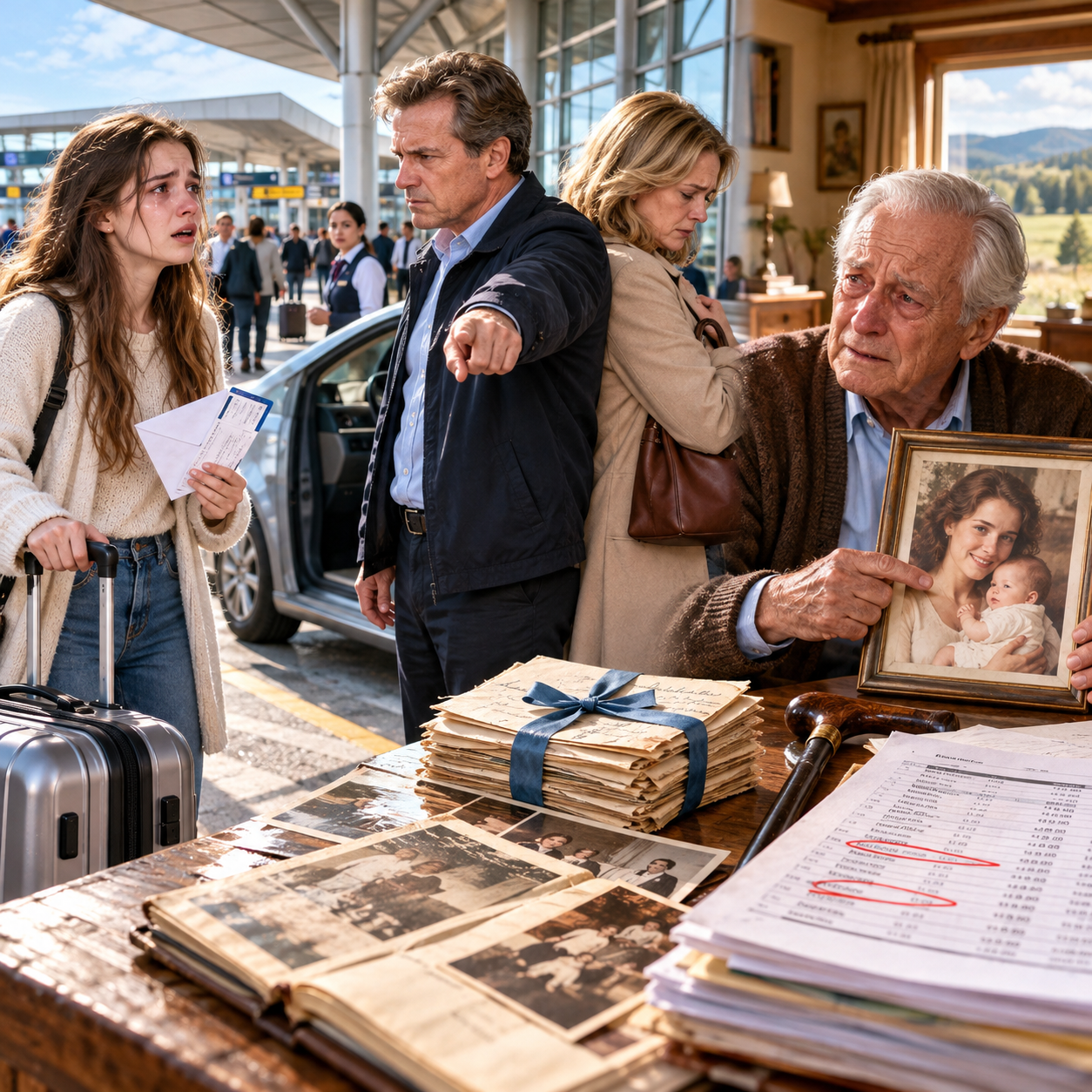
### Part 2: Grandpa’s Hidden Records Exposed My Father’s Eighteen Years of Lies
Walter spread the financial statements across the kitchen table while rain tapped against the windows. I recognized my father’s signature on one document, the same sharp handwriting he’d used to sign my report cards. “How much money are we talking about?” I asked. Walter hesitated. “Enough to help pay for your education and give you a secure beginning. Enough that someone may have had a powerful reason to keep you from asking questions.”
He explained that Claire had been twenty-three when she died. She was independent, stubborn, and determined to build a life on her own terms. Before her death, she’d asked Walter to protect me because she worried Richard cared more about the financial security surrounding her family than about becoming a dependable father.
“I tried to keep that promise,” Walter said, opening another folder. “I wrote. I called. I hired an attorney after Richard moved you to Ohio. Every time, I was told you didn’t want me involved in your life.”
“I was a child,” I whispered. “Nobody ever told me you existed.”
Walter looked down at his hands. “I know.”
That night, he gave me Claire’s final letter, written before I was born. I carried it upstairs to a little bedroom overlooking the orchard. The paper was yellowed at its folds. Claire had written about the kind of life she hoped I’d have, filled with freedom, kindness, and people who loved me without conditions.
One sentence made me press the letter against my chest.
Never believe you must earn the right to be loved.
My father had spent eighteen years teaching me the opposite.
The next morning, Walter took me to meet Margaret Ellis, an attorney whose office occupied the second floor above an insurance agency in town. She listened as I described the airport, the photograph, and the money. When I finished, she pulled the financial statements closer.
“Emily, unexplained withdrawals aren’t automatically proof of wrongdoing,” she said. “But if these assets were held in trust for you, you’re entitled to an accounting. We need evidence, not assumptions.”
For once, an adult wasn’t telling me to be grateful or keep quiet. She was telling me I had rights.
Over the following weeks, I built a life that would have been unthinkable on my birthday. I enrolled at Bellweather’s community college and found a part-time job at a bookstore. I learned the bus schedule, bought secondhand textbooks, and discovered the peculiar comfort of eating dinner with someone who actually asked about my day.
Walter never demanded that I call him Grandpa. He simply left a cup of tea beside my homework and listened when I wanted to talk.
Meanwhile, Margaret requested the trust’s formal accounting and obtained additional records through legal channels. Some withdrawals appeared connected to legitimate expenses from my childhood. Others led toward my father’s personal financial affairs, with no clear documentation explaining how they benefited me.
One evening, Margaret slid a statement across her desk. “These transfers raise serious questions.”
I recognized the dates. One was from the year Dad had told me we couldn’t afford the summer science program I’d been desperate to attend. I’d accepted his explanation and spent that summer washing neighbors’ cars to save for school supplies.
Now I stared at the numbers until they blurred.
My phone rang that night. Richard’s name filled the screen.
“You’ve been gone long enough,” he snapped when I answered. “That old man is manipulating you. Come home.”
I looked toward Walter, who was quietly washing dishes.
“Then explain Claire’s trust,” I said.
Silence.
“Your mother and I spent a fortune raising you,” Richard finally replied. “You have no idea what children cost.”
“I’m not asking you to pay me for my childhood. I’m asking where my money went.”
The call ended.
Susan left a voicemail an hour later. Her voice trembled as she insisted they’d only wanted to protect me. Then she begged me not to destroy the family over something I didn’t understand.
I saved the recording for Margaret.
The formal accounting eventually established enough evidence to support a claim that Richard had transferred substantial trust assets for his own benefit without adequate justification. Margaret sent a legal demand seeking an explanation and repayment.
Two days later, Richard called again.
This time, he wasn’t angry.
He sounded terrified.
“Tell your attorney to stop,” he whispered. “You don’t understand what’s at stake.”
I held the phone against my ear and remembered every time he’d made me apologize simply to end an argument.
“Then I suppose it’s time I understood,” I said.
After I hung up, I walked to the window.
A familiar sedan was turning into Walter’s driveway.
My mother had come to Pennsylvania.
And whatever she’d traveled there to tell me, she’d brought it without my father.
### Part 3: My Mother’s Confession Revealed Why They Abandoned Me on Purpose
Susan stepped out of the car clutching her purse against her chest. Her eyes were swollen, and her carefully styled hair had begun slipping loose. For a moment, I saw the woman who used to sit beside my bed when I was sick, pressing a cool washcloth against my forehead. Then I remembered her staring through the windshield while Dad ordered me never to return.
“Emily,” she whispered. “I need to tell you something.”
“Then tell me why you let him leave me at that airport.”
She looked past my shoulder toward the farmhouse. “Can we go inside?”
Walter was in the kitchen when we entered. He rose slowly from his chair, and Susan stopped in the doorway. They hadn’t seen each other in eighteen years. Neither spoke. Finally, Walter moved toward the living room, leaving us alone at the table.
Susan twisted her purse strap until her knuckles whitened.
“I knew about Claire’s trust,” she said. “I’ve known for years.”
The kitchen clock ticked above the refrigerator.
“How many years?”
She swallowed. “Almost from the beginning.”
I felt something inside me go terribly still. “You knew he was using the money?”
“I knew he was moving money. Richard always said it was for the household. For your expenses. I wanted to believe him.”
“And when Grandpa tried to contact me?”
Her silence answered before she did.
“Richard said Walter would turn you against us. He said we’d lose our family if we let him interfere.”
I pushed my chair away from the table. “You told me my grandfather was dead.”
“I know.”
“You watched me cry because I thought nobody wanted me.”
“I know, Emily.”
“No,” I said, my voice shaking. “You don’t get to say that like it makes everything better.”
Susan covered her mouth. Tears spilled between her fingers.
Then she told me about the months after Claire died. Richard had been angry and restless. Susan had feared losing him, and when he asked her to help raise his daughter, she convinced herself that becoming my mother would finally make him stay.
“I kept telling myself that if I could hold the family together, everything would eventually be all right,” she whispered.
“But it wasn’t all right for me.”
She lowered her head.
Then I asked the question that had followed me from Ohio.
“Why did you send me away on my birthday?”
Susan looked toward the kitchen window. “Your father knew you were becoming an adult. He knew you might start asking about your future, about college, about money. He wanted you out of the house before those questions began.”
“So the ticket wasn’t a gift.”
“No.”
“And you knew it was one-way?”
“Yes.”
The answer struck harder than anything Richard had said at the airport. She had helped me pack. She’d watched me search the envelope for a return ticket. She’d known there was no birthday surprise waiting at the end of the flight.
“Did you ever love me?” I asked.
Susan began crying harder. “Of course I did. I still do.”
I remembered her homemade birthday cakes, the stories she used to read aloud, and the nights she’d stayed beside me through a fever. Those moments hadn’t disappeared. But they stood beside eighteen years of silence and one terrible decision.
“Then why didn’t you protect me?”
She couldn’t answer.
We sat in silence until the shadows stretched across the kitchen floor. Finally, I told her that if she wanted a place in my life, she would have to stop defending what she’d done. Love wasn’t an excuse for keeping secrets. Fear wasn’t permission to sacrifice a child.
“I can’t forgive you today,” I said.
Susan nodded, wiping her cheeks. “I understand.”
“And I’m not coming home.”
She closed her eyes. “I know.”
When she left, Walter returned to the kitchen. He didn’t ask me to be kind to her. He didn’t tell me that family deserved another chance.
He simply pulled out the chair beside mine.
“Your mother made her choices,” he said quietly. “Now you’re allowed to make yours.”
I looked at the photograph of Claire standing on the mantel.
For eighteen years, Richard had controlled my life by making me afraid of losing his approval.
Now I understood the ugliest part of his secret.
He hadn’t kept me close because he loved me.
He’d kept me close enough to control what I knew.
### Part 4: My Father’s Final Reckoning Gave Me Back My Stolen Future
The settlement agreement arrived on a cold morning in March. Margaret called me into her office and placed the document between us. Richard had agreed to repay the amount established as improperly transferred from the trust. He would also relinquish any remaining control over my assets.
I read the agreement twice, running my finger along the figures. The money would not all appear in my account overnight. There were repayment arrangements and legal obligations that Margaret carefully explained. But for the first time, my future no longer depended on Richard’s permission.
“Is this really happening?” I asked.
Margaret nodded. “It’s a formal settlement. You have enforceable rights under these terms.”
I thought about the little girl who’d been told there wasn’t enough money for school activities, new shoes, or anything that seemed unnecessary. I remembered Richard insisting that I should be grateful he kept a roof over my head.
Now there was written evidence that substantial money intended for me had been used without adequate justification.
Yet when Margaret handed me a pen, my hands trembled.
Not because I doubted the decision, but because signing meant accepting something I’d spent my childhood refusing to believe.
My father had been willing to hurt me to protect himself.
I signed.
A week later, a letter arrived from Ohio. Richard had written it himself. He claimed he’d made mistakes while trying to protect the family. He described the pressure of raising a child and insisted that he’d never intended to cause harm.
I read his words at Walter’s kitchen table.
Not once did he acknowledge what it felt like to be abandoned at an airport on your eighteenth birthday. Not once did he ask whether I was safe after he drove away.
I folded the letter and placed it in a drawer.
I didn’t call him.
For once, I didn’t mistake guilt for an obligation.
Life in Bellweather continued. I attended classes, worked closing shifts at the bookstore, and learned to manage money that was finally under my control. Walter helped me sort Claire’s photographs into albums, carefully labeling the people and places I’d never known.
Sometimes, we’d spend an entire evening talking about her.
He told me she loved thunderstorms, laughed at her own terrible jokes, and refused to leave a bookstore without buying something. Once, he showed me a photograph of Claire standing in the farmhouse garden with dirt on her knees.
“She planted those roses herself,” he said, pointing toward the window.
I looked outside at the flower beds beginning to bloom.
For the first time, my mother’s life felt like something more than a tragedy I’d inherited.
Susan began counseling. At first, her letters still contained explanations, the same familiar attempts to convince me she’d done what she thought was best. I didn’t answer those.
Months passed before the tone changed.
She stopped defending Richard. She stopped asking me to come home. Instead, she acknowledged specific things she’d done: hiding Walter’s letters, concealing Claire’s identity, ignoring the questions I’d asked as a child.
One letter contained only a few sentences.
Emily, I was supposed to be the adult who protected you. I chose my fear over your trust. You have every right to be angry, and I won’t ask you to make this easier for me.
I kept that letter.
Eventually, we met at a little café near the college. Susan looked older than I remembered, and when I sat down, she didn’t reach for my hand or demand a hug.
We talked about my classes. She asked whether Walter was well. Finally, she looked directly at me.
“I don’t expect you to forgive me,” she said.
“I don’t know if I ever will.”
“I understand.”
For the first time, she let those words remain between us without filling the silence with excuses.
It wasn’t reconciliation. But it was an honest beginning.
I continued college, using part of the recovered funds toward tuition, and began volunteering with an organization that supported young adults facing family rejection. I couldn’t change my childhood, but I could help someone else feel less alone while rebuilding theirs.
Then my nineteenth birthday arrived.
That morning, I walked downstairs to find Walter standing in the kitchen wearing an apron dusted with flour. Thomas sat at the table pouring coffee, and several friends from the bookstore and college crowded around a homemade cake.
Nineteen candles flickered across the frosting.
Walter smiled. “Make a wish, sweetheart.”
I looked around the room. Nobody was waiting for me to prove I deserved to be there. Nobody had threatened to withdraw their affection if I disappointed them.
I thought about Richard’s final words at the airport.
Go where you belong.
For months, I’d believed those words had destroyed my life. But beneath the cruelty, there had been a truth my father never intended me to discover.
I did belong somewhere.
Just not where he’d kept me.
Before blowing out the candles, I reached into my pocket and unfolded Claire’s letter. The paper had softened from being opened so many times.
Never believe you must earn the right to be loved.
I looked at Walter, whose eyes were already shining with tears.
“Thank you for waiting for me,” I whispered.
He shook his head. “I never stopped being your grandfather.”
I leaned forward and blew out all nineteen candles.
Everyone cheered, and Thomas began cutting the cake while Walter pulled me into a gentle embrace.
Outside, sunlight spilled across the Pennsylvania hills. The roses Claire had planted were blooming beside the porch, and the old farmhouse no longer felt like somewhere I’d been sent against my will.
It felt like home.
I still don’t know whether I’ll ever fully forgive Richard. My relationship with Susan remains a work in progress, measured in honesty rather than promises. And some losses, including the eighteen years Claire’s family and I were kept apart, can never be returned through a settlement.
But I know this much.
The day my parents abandoned me, they believed they were getting rid of a problem. They never imagined I would discover a grandfather who loved me, a mother whose final words would help me reclaim my dignity, and a future that belonged to me.
My father gave me a one-way ticket because he wanted me gone.
It became the first journey I ever took toward a life I could choose for myself.
And this time, nobody else would decide where I belonged.
THE END.
All characters and events in this story are fictional, created for storytelling and entertainment purposes. Thank you sincerely for reading. Your feedback and support are invaluable and motivate me to continue sharing more stories with you.


