
### Part 2: A Demolition Call Exposed What My Wife Believed She Owned
“Who?” Celeste asked.
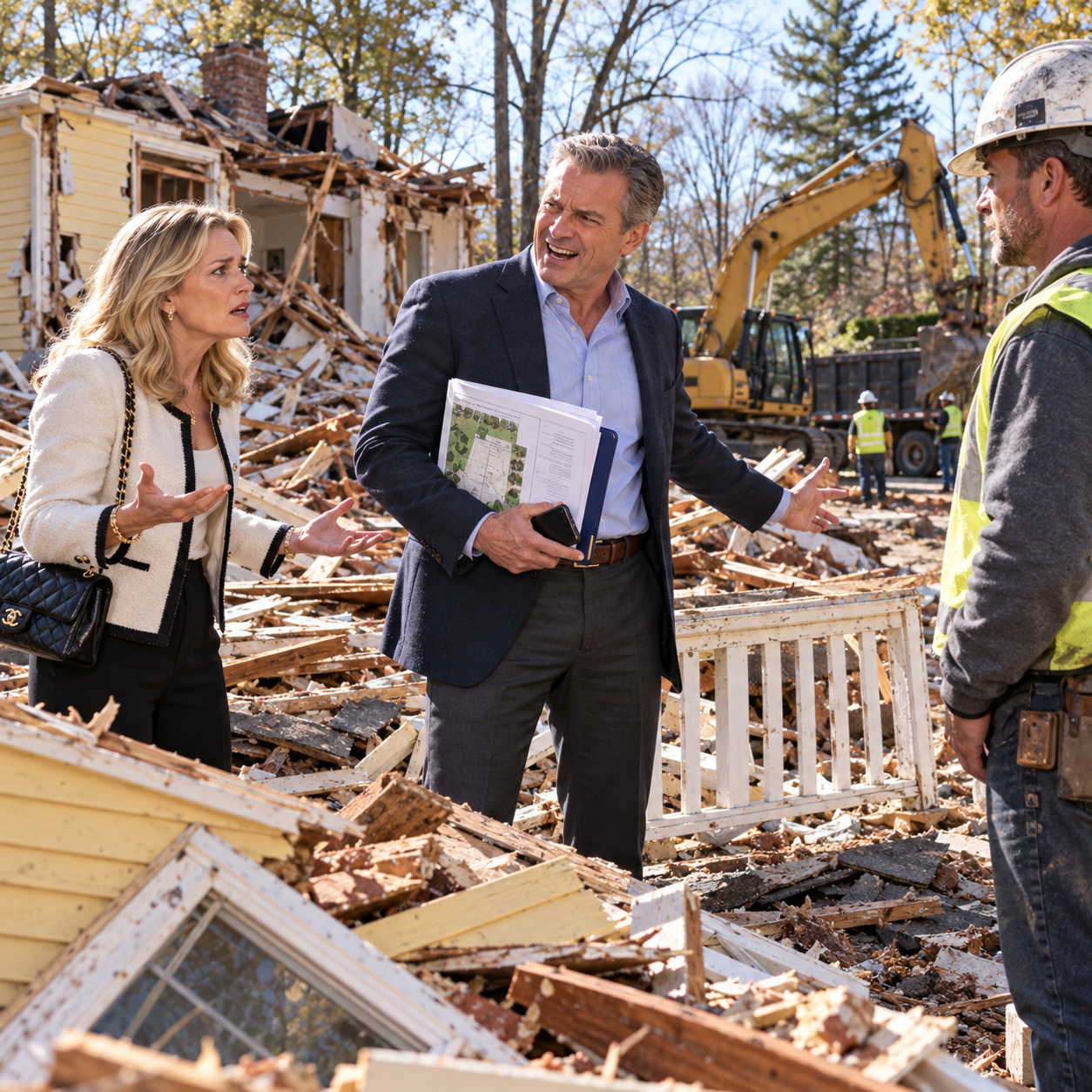
“The man who’s been paying rent to live there for nearly two years.” I could hear dishes clinking in our kitchen, and she lowered her voice as though the answer were an inconvenience. “I told him the building had to come down, Hale. He was given notice, and I provided his contact information to a relocation service.” When I asked how much notice, she admitted it had been forty-eight hours.
I walked toward my rental car, pressed my hand against its warm roof, and asked how she’d authorized demolition of property titled solely in my name. She answered that she’d told the contractor we were married and that the house had become unsafe. “They required paperwork, and I handled it,” she said. “Honestly, I thought you’d be relieved once you saw how quickly everything could move.” Then she mentioned she’d already taken photographs for potential buyers.
I looked at the call timer on my phone. Three minutes and eleven seconds had passed since she’d told me she had destroyed my parents’ house. Instead of anger, I felt an unexpected, almost embarrassing urge to laugh. Celeste heard it and immediately became defensive. “Is this funny to you?” she demanded. “Not the part you think,” I replied, and ended the call.
My first call was to Alister. His daughter answered, and I spent several minutes apologizing before she’d let me speak directly to him. He was staying in her guest room, safe but shaken, with two suitcases and a cardboard box of belongings he’d managed to remove. “She said the property had been condemned,” he told me quietly. “I figured you’d have called if there was anything to discuss, but she seemed to know exactly what she was doing.”
When I asked whether anything had been left inside, he mentioned an old rocking chair, several gardening books, and a framed photograph of his late wife. His voice faltered on that last item. I promised to cover his immediate housing and replacement expenses, although I knew money couldn’t restore the picture. Then I called Francis, who listened without interrupting and requested copies of every message, permit, contractor agreement, and photograph.
By evening, we had enough information to establish how Celeste had done it. She’d contacted a demolition company, claimed an urgent structural hazard, and signed an authorization representing herself as a property owner. The contractor had relied on her statements and photographs of the replacement house, unaware that the deed identified only me. Francis told me that local officials and the contractor would need to examine the documents, but the unauthorized work and Alister’s abrupt displacement raised serious legal concerns.
There was another detail that mattered: Celeste had sent me several messages over the preceding week. One read, “When you’re back, there won’t be any more excuses about Birchwood.” Another said, “Sometimes someone has to make the decision you won’t.” I saved both, along with a voicemail in which she’d boasted about finally making the property profitable. Francis advised me not to confront her until he’d obtained the recorded ownership documents and demolition paperwork.
I flew home Thursday evening. When I entered our house, I smelled chicken marsala and saw two candles burning on the dining table. Celeste was wearing a dark green dress I’d given her for our tenth anniversary, and she’d opened a bottle of the expensive wine we normally saved for special occasions. She kissed my cheek, studied my expression, and said, “I know this has been difficult, but I wanted us to have a nice evening.”
I sat across from her while she described real estate agents she’d contacted and neighborhoods where she wanted us to purchase a retirement home. She’d calculated potential development profits without asking whether the wooded acreage could legally be developed or even whether we still owned it. When she mentioned a property listing estimated at nearly five million dollars, I put down my fork. “Celeste, what exactly do you believe we own on Birchwood Drive?”
She glanced at her notes. “A little over an acre. Why?”
“Not anymore.”
I placed a folder on the table and slid the first survey toward her. She studied the boundary lines, her eyes moving toward the highlighted dates. I followed it with the recorded deed, the conservation restriction, and a copy of the closing statement showing that Meridian Development Group had purchased the rear parcel twenty-two months earlier.
“Four million three hundred thousand dollars?” she whispered.
“That’s the final sale price.”
She looked up sharply. “You sold it without telling me?”
“I sold property I inherited, kept the proceeds separate, and had the transaction documented by counsel.” I turned the next page, showing the construction contract and storage inventory. “The house you demolished wasn’t my parents’ original house, either. Their belongings are safe, and the original structure was already replaced.”
Celeste stared at the photographs of the completed replica. Her fingers tightened around the edge of the table, and I realized she was trying to decide which revelation deserved her attention first.
Then she asked the question that told me exactly where her thoughts had gone.
“Where is the money now?”
### Part 3: At Our Dinner Table The Marriage Finally Told The Truth
I didn’t answer immediately. I watched Celeste turn through the documents again, pausing longest on the sale price. When she finally looked at me, she wasn’t asking about the trees, the house, or even Alister. She wanted to know why she’d spent nearly two years planning around property that had already been sold.
“Francis has the financial records,” I said. “The proceeds are in a separately maintained investment account. They’ll be disclosed as required in any legal proceedings.”
“Legal proceedings?” She leaned back. “You’re talking as if we’re getting divorced.”
I asked whether she’d thought about that possibility before hiring a crew to demolish a house she didn’t own. She rubbed her forehead and told me I was making the situation sound criminal when she’d only been trying to improve our future. “You were never going to sell that place,” she said. “Every time I brought it up, you hid behind your parents. I thought once the house was gone, you’d finally consider what made sense.”
“What about Alister?”
“He’ll find another rental.”
“He lost belongings. He was told he had two days to leave. You didn’t even know where he went.”
Celeste looked away. “I wasn’t trying to hurt an old man.”
I believed that part. Hurting Alister hadn’t been her objective; she’d simply considered him an obstacle she could move aside. That distinction didn’t make what she’d done any easier to accept. I told her I’d arranged temporary accommodations and hired someone to help him find a suitable apartment, then asked whether she’d ever considered calling me before the demolition.
“You would have said no,” she replied.
“Exactly.”
Celeste stood and carried her untouched wine to the kitchen. For several minutes, she spoke about everything she’d contributed to our marriage: business dinners, charitable events, vacations she’d arranged, the house she’d maintained, and the connections she’d helped me establish. Some of it was true, and I told her so. She had worked hard at building the life she believed we should have, but she’d started treating my unwillingness to follow her plans as permission to make decisions without me.
“You have a company most people would envy,” she said, returning to the doorway. “And you still drive a used Honda. You spend your weekends with retired mechanics and warehouse employees. I wanted us to enjoy what we’ve earned before we’re too old to do anything with it.”
“I do enjoy my life, Celeste.”
“Well, I didn’t.”
It was the first completely unguarded answer she’d given me all evening. She looked almost surprised by it herself, then turned toward the darkened kitchen window. I thought about the trips she’d proposed that I’d postponed, the larger houses she’d wanted, and the dinners where she’d compared our lives with people who seemed to spend every dollar they made. I’d assumed we disagreed about money. I hadn’t understood how deeply she resented the life we actually shared.
I told her we needed to separate and that she should consult her own attorney. She demanded to know whether I intended to report the demolition, and I explained that Francis was already collecting documents for the appropriate authorities. She accused me of planning to humiliate her, then started crying when I said I wouldn’t withdraw truthful evidence to protect our marriage. I offered to stay elsewhere while we made arrangements, but she grabbed her purse and left before I finished speaking.
The next morning, I drove to Birchwood Drive. The replacement house was gone, leaving a rectangle of disturbed earth and a broken section of front walkway. Someone had pushed my mother’s boxwoods into a pile beside the driveway, and a crushed piece of porch railing lay near the curb. I stood holding that piece of wood for several minutes, surprised by how much it hurt even though the original railing had been removed long before.
Francis called while I was there. The demolition company had confirmed receiving a signed authorization from Celeste and statements indicating she had authority to direct the work. Investigators would review the documentation, and Alister had agreed to provide an account of his forced departure. I told Francis to proceed appropriately, then arranged for the remaining debris to be secured and the surviving shrubs protected.
The divorce lasted eleven months. Celeste’s lawyers challenged the classification of the inherited proceeds and examined the sale, the holding arrangements, and our financial history. Ohio’s rules concerning separately identifiable inherited property became central to the negotiations, and Francis’s detailed records supported my position. We ultimately reached a settlement under which Celeste received almost $400,000 from our joint marital assets, while the inherited land-sale proceeds remained mine.
The criminal matter resolved separately through a negotiated plea involving the false representations, property damage, and unlawful displacement. Celeste received probation, community service, and restitution obligations. Alister recovered compensation for his losses, though neither of us pretended the process had been pleasant. I didn’t attend every hearing, and I refused the invitations from mutual acquaintances who wanted to discuss how far Celeste had fallen.
When everything was finalized, I moved into a smaller house with a porch and enough yard to grow tomatoes. Celeste took her share of the settlement and moved away. We exchanged a few necessary communications through our attorneys, and then our lives finally separated. I had no interest in a reconciliation built on apologies that couldn’t undo her decisions.
That December, Theo flew home from Portland for Christmas. He found me at the kitchen table reviewing investment statements and asked why I looked as though I’d received another work assignment.
“You’ve spent a year cleaning up everyone else’s mess,” he said. “What do you actually want to do now?”
I looked toward the back door, where snow was gathering along the porch railing.
“I haven’t figured that out.”
Theo poured another cup of coffee. “What would Grandpa have done with an empty piece of land?”
### Part 4: From Broken Ground We Grew What My Parents Valued
Two weeks after Christmas, I returned to Birchwood Drive with Theo. The demolition site had been cleared, but the old front walkway remained, and several of my mother’s shrubs had survived near the property line. Beyond the vacant foundation area, the protected oaks stood against the winter sky. Theo walked beneath them, looking up through the branches, and said, “Grandpa would’ve liked knowing these were still here.”
I told him about the development agreement, the money, and the condition requiring preservation of the oldest trees. He listened carefully, then asked why I’d kept the front lot instead of selling everything. I looked toward the street where my parents had waved goodbye to us for so many years. “I guess I couldn’t imagine somebody else deciding what belonged here,” I said.
Theo suggested a neighborhood garden. At first, I pictured a few vegetable beds and a bench, something small enough to maintain on weekends. But Theo worked in renewable energy and knew people who understood community projects better than I did. Within a month, we were meeting with a landscape designer, a local food pantry director, and representatives from the senior center three blocks away.
The plans grew into a garden with wheelchair-accessible raised beds, a greenhouse, a rainwater collection system, and paths wide enough for neighbors using walkers. We kept the surviving shrubs and planted new fruit trees along the street-facing boundary. I funded construction and established an operating reserve from part of the inheritance. Theo handled much of the planning, although he warned me that enthusiasm wouldn’t compensate for having no idea how to grow vegetables.
Alister proved him right. By then, he’d found a comfortable apartment near his daughter, and I’d gotten to know him through our frequent conversations about the demolition and his housing search. When I invited him to inspect the garden site, he arrived wearing old work boots and carrying a notebook full of planting schedules. He’d grown up on a farm in Kentucky, something I’d somehow never learned during the nearly two years he’d rented my property.
“You’ve got decent southern exposure,” he told me, kneeling to crumble a handful of soil between his fingers. “But this ground needs work before anything worth eating will grow here.”
I asked whether he’d consider supervising the volunteers.
He gave me a sideways look. “You planning to pay me?”
“Of course.”
“Then you’d better find somebody willing to tell you when you’re doing something stupid.”
That spring, Alister became our unofficial garden manager. He trained volunteers, organized seed purchases, and established planting schedules with the authority of a man who’d spent seventy years learning from seasons rather than spreadsheets. The senior center sent retirees who wanted somewhere meaningful to spend their mornings, while local families began arriving on Saturdays. By the second full growing season, our volunteers were producing roughly 4,000 pounds of vegetables annually for the food pantry, neighborhood households, and senior meal programs.
The project cost approximately $60,000 each year to operate, including paid coordination, maintenance, supplies, and insurance. The inherited funds made that commitment sustainable without requiring donations from people who needed the food. We called it Birchwood Community Garden. I didn’t name it after my parents because my father would have considered that unnecessary ceremony, but I placed a small bronze plaque beside the entrance.
It read: “For those who believe some things are worth keeping.”
On the day we installed it, Theo stood beside me while Alister adjusted the soil around the first raised bed. Nobody made a speech. Theo took a photograph and sent it to his wife, then rested his hand briefly on my shoulder. I knew my father would have spent more time inspecting the construction than admiring the plaque, and the thought made me smile.
I occasionally heard news about Celeste through old acquaintances. She’d moved into a condominium and was working in commercial property consulting again. Someone mentioned she’d told friends I had concealed millions from her throughout our marriage, and I didn’t dispute the account. There were things I’d kept from her because I no longer trusted how she’d respond, and that truth belonged to the history of our marriage as much as her actions did.
I don’t look back on those eleven years and pretend there were no good ones. We traveled together, laughed together, and cared for each other through ordinary illnesses and difficult workweeks. But affection isn’t permission to disregard another person’s boundaries, and a marriage cannot survive when one partner believes the other’s refusal is merely a problem to overcome. I can acknowledge what was once good without inviting the person who destroyed that trust back into my life.
Last Saturday, I was working near the greenhouse when a woman arrived with two young children and a printed list of vegetables. She explained that her family had recently moved into the neighborhood and that her children had never grown anything before. Alister handed the older child a trowel, showed the younger one how to loosen the soil, and launched into an enthusiastic explanation of why worms were a gardener’s best friends.
The children listened as though he were revealing a secret treasure. I stood beneath one of my father’s oaks, watching Alister kneel beside them while my son’s voice carried from the greenhouse, where he was helping another volunteer repair a watering line. The old house was gone, and so was the marriage I’d once believed would last the rest of my life. Yet something familiar remained in the way people gathered there, offered one another help, and found reasons to stay a little longer.
Alister eventually waved me over and handed me another trowel. “Hale, these kids are going to finish planting before you even start.” I knelt beside the younger child, who carefully placed a lettuce seedling into the earth and asked whether my father had taught me to garden. “He tried,” I said, pressing soil around the roots. “I’m still learning.”
That afternoon, I drove home in my four-year-old Honda and cooked dinner in my small kitchen. I called Theo to thank him for coming, then sat on the porch as the sun settled behind the neighboring rooftops. For years, I’d believed my inheritance was a house I had to protect from being taken away. It took losing that house, and the marriage surrounding it, to understand that my parents had left me something that could survive both.
They’d taught me that money mattered because of what it allowed you to care for, not because of what it allowed you to control. Celeste had seen an aging building standing in the way of her future. I now saw a garden where an old man had found purpose, families gathered for fresh food, and children learned to nurture things they couldn’t purchase ready-made.
I could never rebuild the Sunday dinners in my mother’s kitchen or hear my father’s footsteps crossing the porch again. But on Birchwood Drive, beneath the trees he’d refused to sacrifice, there were new voices, new memories, and a place where people could belong.
For the first time in years, I wasn’t trying to hold on to the past.
I was helping something grow.
The End .
All characters and events in this story are fictional, created for storytelling and entertainment purposes. Thank you sincerely for reading. Your feedback and support are invaluable and motivate me to continue sharing more stories with you.


