
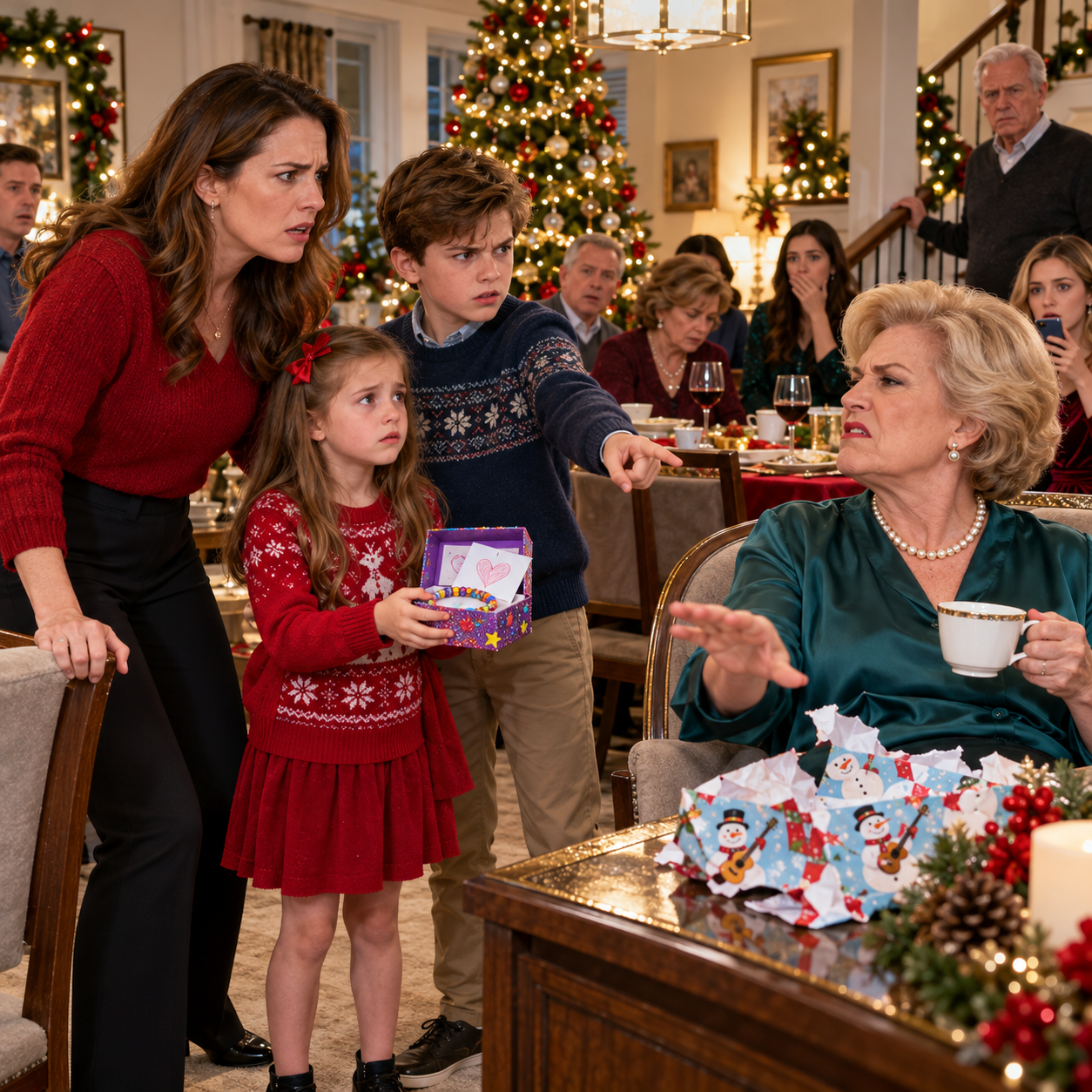
Part 2: An Unwanted Visitor And Two Videos Reveal Years Of Betrayal
Ten days passed without a message from my parents or sister. I spent that time enjoying ordinary afternoons with my children, helping Ethan build a Lego castle and listening to Lily explain why her stuffed penguin needed its own pillow. Then, on a Saturday in January, someone knocked hard enough to interrupt the movie playing in our living room.
My parents stood on the porch, and behind them was Jerry, their neighbor, a divorced man in his late fifties who had made uncomfortable comments about me since my marriage ended. My mother carried a wrapped present, while my father kept his hands buried in his coat pockets. Jerry leaned against the railing with a smile that suggested he’d already been told I would welcome him.
“Family shouldn’t stay angry forever,” my mother announced, moving forward before I invited anyone inside. She pressed the gift into Lily’s hands and glanced toward my living room. “And we thought you might enjoy some adult company, Michelle.”
My father added that the furniture misunderstanding had gone far enough. Then my mother gestured toward Jerry and explained that a woman my age shouldn’t be alone, particularly with two children. Jerry chuckled and said he wasn’t bothered by my “history,” as though my divorce were an embarrassing condition he was generously willing to overlook.
“You need to leave,” I told them.
My mother stepped across the threshold instead. “You’re making this difficult for everyone,” she said, watching Lily begin unwrapping the present. Inside was a thin coloring book with bent corners, several missing pages, and crayon marks already scattered across the pictures.
Lily studied it for several seconds before looking up at me. Ethan came into the hallway, saw Jerry, and stood beside his sister. I repeated that everyone needed to leave, and this time my father took my mother’s elbow and guided her toward the porch.
Jerry lingered long enough to suggest I’d eventually change my mind. I closed the door, turned the lock, and sank against the wall, where both children immediately came to sit beside me. Ethan rested his shoulder against mine and said, “Can we go somewhere they won’t find us today?”
We went to the movies, bought too much popcorn, and watched Lily fall asleep halfway through the afternoon showing. Ethan covered her with his hoodie without being asked. Watching him care for her with a gentleness the adults in my family had never offered made me realize how much he’d understood about Christmas morning.
The following day, my Uncle Frank called. He was my father’s older brother, a retired mechanic with a stubborn sense of fairness, and one of the few people who’d ever challenged my parents. He’d heard about the visit from my mother, who had apparently expected him to agree that I was behaving disgracefully.
Instead, he asked whether my children and I were safe.
He invited us to dinner the following weekend, promising other relatives would be there and that nobody would force me to reconcile. I hesitated, remembering how often family gatherings had left me apologizing for things I hadn’t done. Frank simply said, “Come eat something decent, Michelle. You don’t have to defend yourself at my table.”
When we arrived, cousins I hadn’t seen in years were filling his living room, passing plates and laughing over stories. Frank greeted Ethan with a joke about his growing appetite and handed Lily a small stuffed rabbit from a basket of toys he’d prepared for the younger children. My parents were already seated at the dining table, looking irritated that nobody had warned them I was coming.
Dinner passed with careful conversation until dessert, when Frank asked permission to share something with the family. He’d obtained two videos, he explained, and thought everyone should understand what had actually happened. I agreed, although my hands tightened around Lily’s shoulders when he turned on the projector.
The first recording came from the security camera of my neighbor across the street. It showed my parents arriving with Jerry, my mother stepping inside despite my refusal, and the three of them leaving only after I’d repeatedly asked them to go. The second recording was from Ethan’s new phone, which he’d used to capture our Christmas gathering before realizing what he was filming.
On the screen, Lily asked why Santa had forgotten her. Valerie’s voice followed, unmistakably clear, and then came the laughter. When I looked toward my parents, my mother was staring at the table, while my father’s jaw moved as though he were chewing something he couldn’t swallow.
Frank switched off the projector and addressed the family. He described the years I’d spent paying for repairs, vacations, holidays, and emergencies, while my parents treated that help as an obligation. Then he asked my father whether humiliating a six-year-old child was an acceptable return for such loyalty.
My mother attempted to interrupt, but Frank raised his hand. “You can disagree with Michelle about furniture,” he said. “You cannot pretend you didn’t hear what happened to that little girl.”
My father said nothing until my mother pushed back her chair and announced that she wouldn’t sit through a family trial. He stood beside her, muttered, “Fine,” and followed her toward the door. Nobody tried to stop them.
Afterward, Frank pulled me aside and handed me an envelope containing a substantial check. He knew I’d accumulated credit-card debt helping my parents and wanted to relieve some of that burden. Inside was a handwritten note: “You’re not alone anymore. And from now on, neither are your kids.”
I stayed until Ethan finished playing with his cousins and Lily fell asleep against my shoulder. Driving home, I passed the familiar streets where I’d spent years worrying whether my parents approved of me. For once, their approval wasn’t what occupied my thoughts.
Part 3: My Parents Turn Their Hurt Pride Into A Legal Threat
Several quiet weeks followed before a package arrived addressed to Lily in my mother’s unmistakable cursive handwriting. I opened it privately and found a silver heart-shaped locket resting inside a worn velvet box. It was the necklace my father had given me when I turned sixteen, something I’d believed lost during the hurried move after my divorce.
The accompanying note contained only two sentences. “We wanted her to have something of yours. Maybe she’ll grow up better than you did.” I held the locket under the kitchen light, noticing the same tiny scratch beside the clasp that I’d made years earlier, and wondered how long my parents had kept it without telling me.
The following Tuesday, Lily’s school called while I was attending a work meeting. My parents had appeared at the front office demanding to have lunch with their granddaughter, claiming I’d already approved the visit. Fortunately, I’d updated Lily’s authorized-visitor paperwork after their unexpected appearance at our home, and the receptionist contacted me before allowing them anywhere near her.
I arrived to find my mother seated in the lobby, smiling pleasantly at the staff, while my father paced beside a display of children’s artwork. My mother stood when she saw me and asked why I’d made such an ordinary family visit into another confrontation. I asked how she’d obtained my old necklace.
“We found it in a drawer,” she answered, adjusting her handbag. “Some of your things are still at our house.”
“Then I’d like them returned.”
Her smile tightened. “You really intend to make everything a transaction now, don’t you?”
I told them they weren’t permitted to visit Lily without my express approval and asked them to leave the school. My father accused me of teaching my children to hate their grandparents. Before walking away, he said I’d regret shutting out family when I grew older and discovered there was nobody left to care about me.
Three days later, Frank arrived at my house carrying a flash drive. Several relatives had forwarded him screenshots of messages from my parents claiming I’d become emotionally unstable after my divorce. According to those messages, I was punishing my children, refusing necessary help, and using accusations against my parents to hide my own problems.
One message from my mother particularly caught my attention. She’d written that I was no longer capable of distinguishing a harmless joke from abuse. I read it twice, remembering Lily sitting beneath their Christmas tree with her drawing in her hands, and asked Frank whether anyone believed her.
“Some people did at first,” he admitted. “But I’ve already sent them the recordings.”
That evening, I placed the flash drive beside the locket in my desk drawer and began preserving everything. I saved messages, printed the delivery cancellation, and organized years of financial records that showed how frequently my parents had requested money. It was unpleasant work, particularly when I found receipts for vacations I’d paid for while postponing trips with my own children.
Then my friend Rachel, who worked at the furniture store, called with another problem. My parents had visited the showroom attempting to reinstate their canceled order under my name. They’d presented a letter supposedly authorizing the purchase, complete with a signature that only vaguely resembled mine.
Rachel refused the request and preserved a copy of the document. When she sent me a photograph, I recognized the shape of my mother’s handwriting in several letters, despite the attempted imitation of my signature. I thanked Rachel, placed the photograph with my other evidence, and contacted an attorney.
A few days later, an envelope was delivered to my front door. It contained a formal letter from my parents’ lawyer demanding scheduled visitation with Ethan and Lily and warning that they might seek court intervention if I refused. My own attorney explained that grandparent visitation depended on state law and the circumstances, and that my parents’ demands didn’t automatically give them legal rights.
I read the letter at the kitchen table while Lily played with her dollhouse nearby. She carefully arranged three little figures around a miniature table, making sure every one had a chair. When she noticed me watching, she asked whether I wanted to help decorate the pretend living room.
I put the letter facedown and joined her on the floor.
Not long afterward, a woman named Darlene, an old friend of my mother’s, contacted me privately. My mother had been showing people at church photographs taken shortly after my divorce, when I was visibly exhausted and struggling through an especially difficult period. She was presenting those pictures as proof that I couldn’t care properly for my children.
Darlene sounded deeply uncomfortable as she explained what she’d witnessed. “I don’t know what’s happened between you,” she said, “but I remember that time in your life, Michelle. You were working two jobs and raising those babies. Being tired didn’t make you unstable.”
That conversation finally helped me understand why my parents had refused to let the argument end. They hadn’t simply lost access to my money; they’d lost the authority they’d always expected to exercise over my decisions. If they couldn’t persuade me to return voluntarily, they were prepared to convince others that I wasn’t competent to decide for myself.
My attorney and I began preparing a complete chronology, supported by messages, financial statements, witness accounts, school records, and video evidence. Frank agreed to provide a statement, as did Rachel and Darlene. I also reviewed my household finances and established separate savings accounts for both children, something I should have prioritized years earlier.
That night, Ethan found me sorting documents at the dining table. He looked at the photographs, the folders, and the pile of receipts before quietly asking whether Grandma and Grandpa could force us to visit them. I pulled out the chair beside me and told him that adults sometimes made difficult things more complicated than they needed to be, but that protecting him and Lily was my responsibility.
He nodded, then asked a question that stayed with me.
“Why did we keep going there when they were always mean to her?”
I had no answer that could excuse what I’d allowed. I told him I’d spent too many years hoping my parents would become kinder if I tried harder, and that I should have recognized sooner that kindness wasn’t something I could purchase for his sister.
Part 4: One Final Letter Ends The Fight And Changes Our Christmases
By early spring, my parents’ attorney had followed the original demand with a formal petition seeking grandparent visitation. My attorney prepared our response, including evidence of their unauthorized school visit, the attempted furniture purchase, and the Christmas recording. She also advised me to let the legal process handle any further contact rather than engage in another personal confrontation.
Before the scheduled hearing, we sent their attorney a carefully organized packet of evidence and a letter explaining the position we would take in court. I also sent my parents a certified copy of the records documenting years of financial support, including home repairs, holiday expenses, vacations, and money transfers. At the front was a personal letter I’d written by hand.
“This is the history you chose to forget,” I wrote. “If you continue this legal action, I will answer every allegation truthfully and provide these records through the proper legal process. You are free to disagree with my decisions, but you are no longer free to make them for me.”
Frank later told me my father had signed for the envelope himself. My mother called several times that evening, leaving messages that alternated between demanding a conversation and accusing me of humiliating her. I forwarded the messages to my attorney without responding.
Two days later, Valerie sent her first personal message since Christmas. She said our mother had been crying, our father barely spoke, and everyone thought I’d taken things too far. I started typing a reply about the little girl who had cried quietly in my car on Christmas morning, then deleted it.
There was nothing Valerie could say that would erase the laughter, and nothing I could write that would make her admit she’d enjoyed it.
A week before the hearing, a white envelope arrived in my mailbox. I recognized my father’s handwriting, uneven and slanted, from the birthday cards he’d written when I was young. Inside were two pages that I read standing in the kitchen while afternoon sunlight stretched across the floor.
He wrote that he barely recognized the way he’d behaved over the previous months. He admitted he’d allowed my mother and Valerie to dominate family decisions because confronting them meant enduring arguments he preferred to avoid. For years, he’d mistaken remaining quiet for keeping peace, even when that silence allowed someone else to be hurt.
He mentioned the Christmas recording. Seeing Lily’s face on the screen, he wrote, had forced him to acknowledge something he’d avoided for months: his granddaughter hadn’t been wounded by a misunderstanding. She had been deliberately excluded, and every adult in that room had chosen comfort over defending her.
He said my mother was struggling emotionally and that their marriage had become strained by the conflict. He didn’t blame her for his conduct, however, and admitted he had participated through his silence. His final paragraph was the first thing he’d written in years that asked nothing of me.
“I don’t expect you to forgive us, Michelle. But please protect Lily from us until we’ve given you a reason to believe we can do better.”
I sat down and reread those words until Ethan came home from school. Part of me wanted to remember my father as the man who’d given me that silver locket sixteen years earlier. Another part remembered him sitting beside his television while his granddaughter searched beneath the Christmas tree for a present that wasn’t there.
Both memories belonged to the same man.
The following afternoon, my attorney called to say my parents had withdrawn their visitation petition. There would be no hearing, and they were no longer asking the court to intervene in my parenting decisions. She explained that the withdrawal resolved the immediate case, though I should continue retaining the evidence and maintaining clear boundaries.
After hanging up, I went outside, where Lily was drawing chalk hearts along the driveway. Ethan sat on the porch steps reading a paperback, and a breeze carried the scent of freshly cut grass from the neighbor’s lawn. I sat beside him and watched his sister move from one bright heart to another.
I didn’t tell my children that we’d won. There had been too much grief, too much wasted money, and too many ordinary afternoons interrupted by adults who couldn’t accept the word no. Instead, I told them that Grandma and Grandpa wouldn’t be visiting for the foreseeable future, and that neither child needed to worry about being surprised at school or home.
Lily considered this while drawing another heart. “Does that mean Santa will remember me next Christmas?” she asked.
I told her he would, then gently explained that Santa had never been the problem. The adults responsible for making Christmas welcoming had made a terrible choice, and she hadn’t done anything to deserve it. She returned to her chalk without asking anything else.
Frank came by the following weekend with groceries and a toolbox. He repaired a loose hinge on my front door, helped Ethan adjust his bicycle brakes, and patiently admired every drawing Lily brought him. He never asked me to forgive my parents or congratulated himself for intervening.
By summer, I’d paid down a significant portion of my debt with his help and the money I was no longer spending on my parents’ expenses. More importantly, I had enough savings to take Ethan and Lily on our first vacation together in years. We rented a small cabin beside a quiet lake, without Wi-Fi, television, expensive restaurants, or anyone criticizing the way we chose to spend our days.
Ethan swam until his fingers wrinkled, while Lily gathered stones and painted them with tiny flowers. I drank coffee on the porch each morning, watching sunlight move across the water. There were no elaborate plans, no matching sweaters, and no photographs taken for the purpose of proving how happy we were.
On our final evening, Lily sat beside me coloring a picture of the cabin. She’d drawn herself, Ethan, and me standing beneath a large yellow sun, with a small penguin peeking from the window. Then she looked up and said, “Mommy, I don’t think Santa skipped me. I think he was just waiting.”
I kissed the top of her head and asked what he’d been waiting for.
“For us to have Christmas at our own house,” she answered, returning to her picture.
I looked at the three figures she’d drawn, each holding the other’s hand. There was no empty space between them, and nobody had been left outside.
That December, we celebrated Christmas morning at home. Ethan helped Lily hang paper snowflakes, Frank arrived with homemade cinnamon rolls, and I placed Lily’s carefully wrapped presents beneath the tree beside her brother’s. When she opened the first one, she smiled at me before looking inside.
My parents never received another payment from me, and I didn’t resume contact simply because my father had finally acknowledged the truth. Perhaps someday they would demonstrate the patience and accountability needed to rebuild a relationship, but my children would not spend their childhood waiting for that transformation.
The silver locket remained in my jewelry box, a reminder that a meaningful gift could come from someone capable of causing considerable pain. Lily’s drawing from that terrible Christmas, however, hung in a frame near our front door. I kept it because it reminded me how long my daughter had believed our family could hold hands without anyone being excluded.
And every Christmas afterward, I made certain she never had to ask why there wasn’t a present with her name on it.
The End .
All characters and events in this story are fictional, created for storytelling and entertainment purposes. Thank you sincerely for reading. Your feedback and support are invaluable and motivate me to continue sharing more stories with you.


