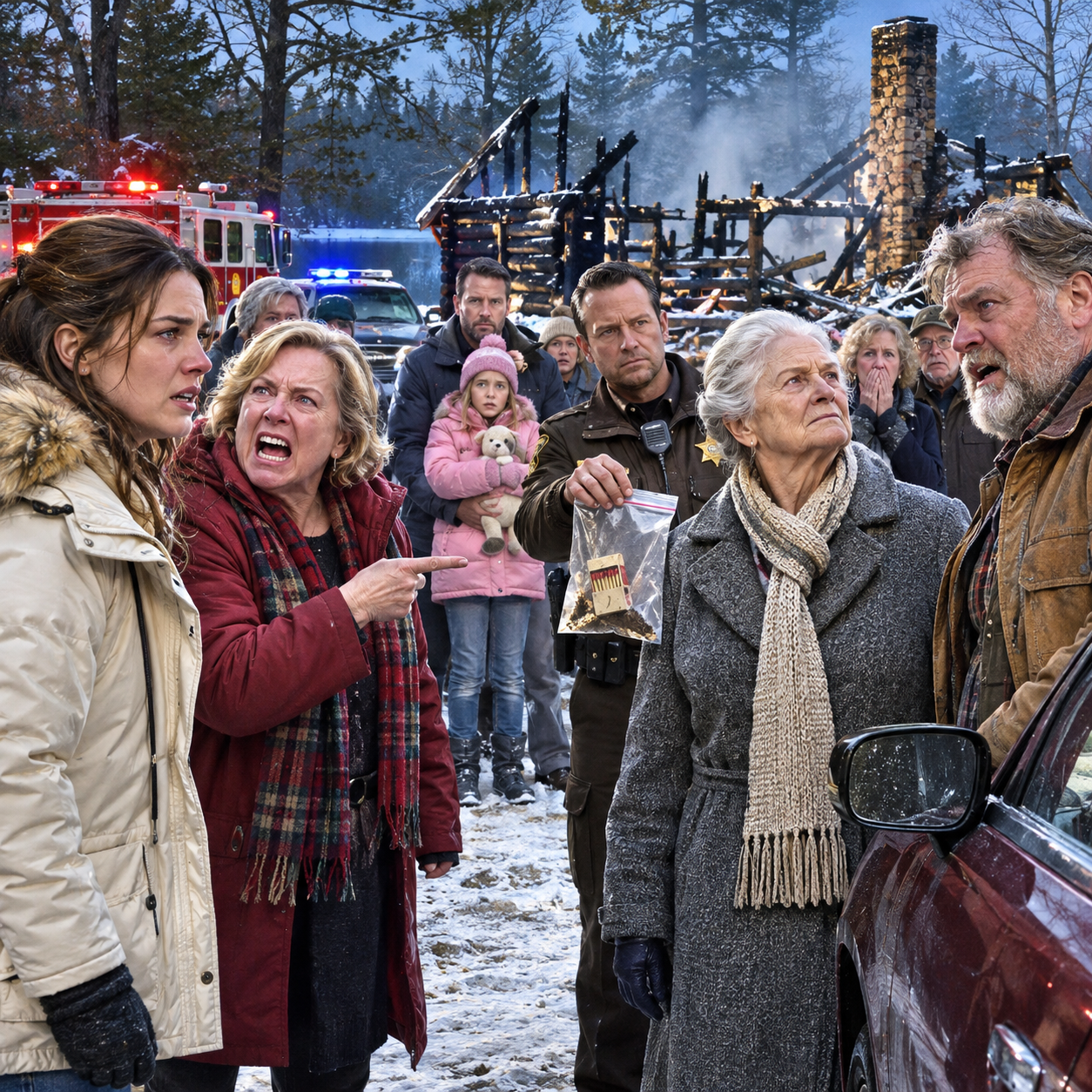
Part 2: An Old Christmas Card Reveals The Husband’s Hidden Life
Margaret studied the letters the following Monday, arranging them across her desk beside Grant’s financial disclosures. She said they undermined his claim of certainty but didn’t establish who had fathered Hannah’s baby. Her next step would be to seek the urology records through proper legal discovery, while Hannah continued receiving prenatal care and preparing for the support hearing.
Hannah listened with one hand resting on her abdomen. “I keep thinking about those years,” she said. “He let me spend our savings looking for something wrong with me.” Margaret closed the file and answered carefully. “We can’t recover those years. But we can insist that what happens now is based on evidence.”
By June, the allegations had spread beyond our family. Women Hannah knew from church avoided her at the grocery store. Someone told Sophie’s classmate that her aunt had destroyed her marriage, and the girl repeated it during recess. Sophie came home asking why adults were discussing her aunt instead of talking to her directly.
That night, Rebecca and I sat at the dining table after Sophie went to bed. She was turning her wedding ring around her finger, something she did when she was worried. “I doubted Hannah,” she admitted. “And now my own daughter is asking whether the people who love you can just decide you’re lying.”
I reminded Rebecca that I had briefly wondered the same thing. Neither of us felt better after saying it.
A week later, Grant appeared at my office wearing a pale blue shirt and carrying a leather document folder. He waited until my employees had gone to lunch before approaching my desk. Without sitting down, he said he wanted to settle everything privately.
He offered to pay off Hannah’s car and withdraw the allegations against Eli if Hannah agreed to waive any claim for spousal support. “Everyone has suffered enough,” he told me. “We should be reasonable before the lawyers take what’s left.”
I studied the agreement he’d brought. It contained no acknowledgment that he’d concealed his surgery, no explanation for his financial decisions, and no protection for Hannah’s future medical expenses.
“Why would Eli’s lawsuit depend on Hannah giving up support?” I asked.
Grant adjusted his watch. “Because I’m trying to put an ugly situation behind us.”
I told him he should send the proposal to Margaret. His expression hardened before he recovered his familiar smile. “You’ve always taken care of your little sister, Nathan. Sometimes that means helping her accept reality.”
After he left, I called Hannah. She listened to the terms while sorting tiny baby clothes Rebecca had bought at a thrift store. “He’s worried,” she said. “I just don’t know what he’s worried about.”
The answer began arriving two weeks later.
Eli came to my office on a rainy Thursday evening. He looked older than he had in May, with dark circles beneath his eyes and paint dust clinging to his work boots. He told me something he’d been withholding because he hadn’t thought it was relevant.
In early March, while Hannah was visiting our mother in Charlotte, Eli returned to the Wallace house to retrieve a forgotten tool. Grant’s car was in the driveway, although he was supposed to be traveling for work. As Eli approached, Grant emerged with a dark-haired woman wearing a hospital identification badge.
“They weren’t discussing a sales contract,” Eli said. “He kissed her before she got into a white SUV.”
I leaned against the workbench. “Why didn’t you tell Hannah?”
“Because I thought it wasn’t my place to wreck somebody’s marriage over something I couldn’t explain.” He looked away. “And because I’d have wanted someone to be certain before telling Beth a thing like that about me.”
Then he described Grant noticing him on the sidewalk. Grant had smiled, waved, and asked about the renovations as though nothing unusual had happened. Three months later, at Sophie’s party, Grant had looked straight at Eli before accusing Hannah.
That evening, Hannah listened to Eli’s account without speaking. When he mentioned the hospital badge, she asked whether it had a blue stripe along the bottom. Eli said it had.
Grant managed several hospital accounts in Raleigh. Hannah remembered a Christmas card addressed only to him that had arrived the previous December, signed by someone from a hospital purchasing department.
We found it inside a shoebox where Hannah kept old greeting cards.
The sender was Corinne Shaw. The envelope carried an apartment address in Raleigh, and the handwritten message thanked Grant for making the year special. It was affectionate without being explicit, the sort of message a wife might question and a husband could easily explain away.
Hannah found Corinne’s public social media profile. She worked in hospital procurement, appeared to be in her early thirties, and had recently posted a photograph of an ultrasound beside a small pair of blue knitted shoes.
The caption announced a baby boy expected in November.
Hannah counted backward on her fingers. “She was already pregnant in March,” she said. “He knew about her before he heard my announcement.”
We showed Margaret the card and the public post the next morning. She cautioned us that neither proved Grant was the father, although Eli’s account made the connection worth investigating. She began preparing requests for relevant records and possible witness testimony.
I made a decision around that time that I regret.
I drove to Raleigh without telling Rebecca why. I had convinced myself that seeing Grant with Corinne would settle the question, even though Margaret had already explained that suspicion was not evidence. I went to the apartment complex printed on the Christmas card, parked in the visitors’ area, and nearly turned around.
Then Grant’s silver sedan pulled into the lot.
Corinne came down the stairs carrying a small canvas bag, visibly pregnant beneath a loose summer dress. Grant took the bag, leaned forward, and kissed her. He rested his palm against her belly while she smiled up at him.
I approached and said his name.
Grant turned, still holding Corinne’s hand. He introduced me as someone he knew from Wilmington, but I told her I was Hannah’s brother. Corinne looked from one of us to the other.
“Hannah?” she asked. “Your wife?”
“She knows about the separation,” Grant said quickly.
Corinne stepped away from him. “You said she had an affair with the contractor. You said that was why you left.”
I told her Hannah was pregnant and that Grant was accusing her of infidelity because he’d had a vasectomy. Corinne stared at him, then touched her own stomach.
“You told me the surgery hadn’t worked when I found out about this baby,” she said. “You said it was an old procedure that never got properly checked.”
Grant reached for her arm, but she moved back.
He began talking about misunderstandings and complicated circumstances. I realized I had forced a painful discovery on someone who hadn’t invited me there, and I left rather than prolonging the confrontation.
Rebecca was angry when I told her where I’d been. She said Hannah needed reliable evidence and legal protection, not a brother creating another conflict. She was right, and I apologized to Hannah for taking the risk.
But Corinne’s words mattered.
Grant had acknowledged the uncertainty of his vasectomy to another woman months before accusing his wife of cheating.
Margaret learned that Corinne was willing to speak with her attorney. When Hannah heard this, she sat at our kitchen table with her hands wrapped around a cup of tea.
“She didn’t know,” Hannah said. “He lied to her, too.”
For the first time, my sister wasn’t asking whether Grant believed her pregnancy was possible.
She was asking why he’d worked so hard to convince everyone else it wasn’t.
Part 3: Medical Evidence Restores The Truth And Changes Our Family Forever
The temporary support hearing took place in late August. Hannah wore a navy maternity dress Rebecca had altered for her, and my mother arrived early enough to help her arrange the papers in her folder. The three women sat together outside the courtroom while I went to the vending machine for water none of us wanted.
Grant appeared with his attorney shortly before nine. He looked thinner than I remembered, and the expensive watch he’d always worn was missing. When he noticed Hannah, he started toward her, then stopped after his attorney touched his elbow.
Margaret had obtained records confirming that Grant underwent his vasectomy in October 2019 but never completed the recommended follow-up test. Corinne had also provided a statement explaining that Grant knew about her pregnancy by March and had acknowledged that his procedure might not have made him sterile.
The records did not independently establish paternity, but they contradicted the certainty Grant had repeatedly claimed.
Before the hearing began, Grant’s attorney requested a private conference with Margaret. When she returned, she told Hannah that Grant was withdrawing his allegation of marital infidelity for purposes of the support proceedings.
Hannah pressed her lips together. “Does he get to pretend none of this happened?” she asked.
“No,” Margaret answered. “But today we’re here to make sure you have the support you need.”
During the hearing, the judge reviewed the medical records, financial information, and disputed allegations. Grant’s attorney acknowledged that no semen analysis had ever established sterility and that his client was no longer relying on the pregnancy as evidence of adultery.
The judge approved temporary financial support for Hannah and directed that her health insurance and necessary expenses be addressed while the divorce proceeded. A determination of the baby’s paternity would require further evidence, but the accusation that had justified cutting Hannah off had no reliable support.
Outside the courtroom, Hannah leaned against the hallway wall. My mother hugged her first, then Rebecca. I stood nearby holding her folder, watching my sister cry without trying to hide her face.
She had spent months being called dishonest. The hearing didn’t repair her marriage or restore her reputation overnight, but it meant she no longer had to defend herself against a medical claim Grant had never verified.
We encountered Grant again in the parking garage.
He approached slowly, keeping several feet between himself and Hannah. His face had lost the polished confidence I’d always associated with him.
“Hannah, I want you to understand something,” he began. “When Corinne told me she was pregnant, I thought she must be mistaken. Then her doctor explained that these procedures sometimes fail. I didn’t expect you to be pregnant, too.”
Hannah watched him without moving.
“So you knew it was possible,” she said.
“I knew there was a possibility.”
“And you let me spend years getting tested while you kept your surgery a secret.”
Grant looked at the concrete beneath his shoes. “I didn’t want children when we got married. I thought eventually you would accept it. Then it became impossible to tell you.”
Hannah smoothed the front of her dress. “You could have told me any day during those six years. Instead, you waited until I finally had a baby growing inside me, and you made me look like a liar in front of everyone I loved.”
He tried to explain that he hadn’t expected things to become so public. She reminded him that he’d chosen her niece’s birthday for his accusation and then filed legal papers naming Eli.
“You weren’t protecting yourself from an affair,” she told him. “You were protecting yourself from the consequences of your own decisions.”
Grant had no answer that changed anything.
Hannah asked him to communicate through their attorneys and walked toward my truck. I followed her without speaking.
Within days, Grant voluntarily dismissed the lawsuit against Eli. That ended the immediate legal threat, although Eli still had attorney fees to pay and contracts he’d lost. Beth returned home with their sons, but Eli told me later that rebuilding trust would take time. He didn’t blame her for being frightened, and she didn’t pretend her doubt hadn’t hurt him.
When he finally came back to my workshop one evening, we sat behind the building listening to rain striking the metal roof. I offered to help with his legal expenses. This time, he accepted a modest loan with a written repayment schedule.
“I used to think being a good friend meant staying out of other people’s marriages,” he said.
“Sometimes it does,” I answered. “Sometimes staying quiet leaves someone else holding the blame.”
In September, Grant agreed to participate in a prenatal paternity test arranged through the attorneys. Hannah provided a blood sample, and Grant submitted a cheek swab. The laboratory report arrived several days later, confirming a probability of paternity greater than 99.9 percent.
Hannah opened the result while Rebecca and I were making dinner. She stared at the screen for a moment before closing the laptop.
“I wanted him to know,” she said. “Not because it would make him love our son. Because I wanted him to stop pretending he had the right to decide whether this child belonged to him.”
Grant’s financial obligations and parenting arrangements still required formal agreements. Hannah knew the years ahead could include uncomfortable conversations, custody decisions, and the difficult work of raising a child with someone she no longer trusted.
She began applying for part-time administrative positions that could become full-time after maternity leave. The first interview made her nervous enough to change clothes three times, but she came home smiling because someone had asked about her experience instead of her marriage.
My mother apologized for having questioned her honesty. Hannah accepted the apology without pretending it erased the weeks when she had needed unquestioning support most. Rebecca apologized as well, admitting how fear of defending someone who might be lying had made her hesitate to defend someone she loved.
Their relationship improved gradually, through ordinary gestures. Rebecca drove Hannah to appointments, helped organize the baby’s room, and sat beside her during difficult phone calls without offering opinions she hadn’t been asked for.
In early October, Corinne sent Hannah a message through social media.
She explained that she’d believed Grant’s marriage was already ending when they became involved. She had accepted his account of Hannah’s supposed affair, partly because she wanted their relationship to have a respectable beginning.
Corinne said Grant had moved out of her apartment and that she was preparing to raise her baby with help from her family.
Hannah read the message twice before responding.
She told Corinne that neither of them had chosen the circumstances their sons would inherit. She wasn’t ready to discuss visits or family relationships, but perhaps someday the boys could know each other without carrying the shame of their father’s mistakes.
After sending it, she placed the phone on the table and went to help Sophie finish a school project.
One evening, Sophie asked whether Hannah’s baby would still be her cousin even though Uncle Grant wasn’t living with her anymore.
“Of course,” Hannah answered. “Families don’t disappear just because grown-ups make mistakes.”
Sophie considered this while pressing glitter onto a cardboard star. “Then can we have another birthday party?” she asked. “The first one wasn’t very good.”
We arranged a small celebration the following Saturday.
There were no expensive decorations or elaborate plans, just a fresh cake, homemade lemonade, and a handful of Sophie’s closest friends. My mother came from Charlotte, and Eli and Beth arrived with their boys. Everyone understood that the afternoon belonged to Sophie.
Before the cake was served, Hannah asked my daughter whether she minded a small announcement. Sophie looked at her aunt’s growing belly and grinned.
“Only if nobody argues this time.”
Hannah laughed. She stood beside the picnic table, holding Sophie’s hand, and told everyone that she was expecting a healthy baby boy in December. The adults congratulated her, the children asked whether the baby would have hair, and my mother started crying again.
This time, the tears didn’t frighten anyone.
Later, as the guests were leaving, I found Sophie carefully folding her paper birthday crown and placing it inside a shoebox beneath her bed. I asked why she wanted to keep something so wrinkled.
“Because I got to wear it twice,” she said.
Hannah’s son was born healthy in early December. She named him Daniel after our father, and when I held him for the first time, his tiny fingers curled around mine with surprising strength.
Grant’s betrayal had cost more than anyone could calculate. It had damaged marriages, friendships, careers, and years of trust. Nothing about Daniel’s arrival erased those consequences.
But watching Hannah settle into the chair beside the nursery window, exhausted and smiling down at her son, I understood something I hadn’t before.
The truth doesn’t always put a family back the way it was. Sometimes it simply gives the people who were hurt a chance to build something safer, with honest foundations and enough room for the children who never deserved any of the damage.
The End .
All characters and events in this story are fictional, created for storytelling and entertainment purposes. Thank you sincerely for reading. Your feedback and support are invaluable and motivate me to continue sharing more stories with you.