
### Part 2: Two Desperate Lies Expose a Plot Against Their Parents
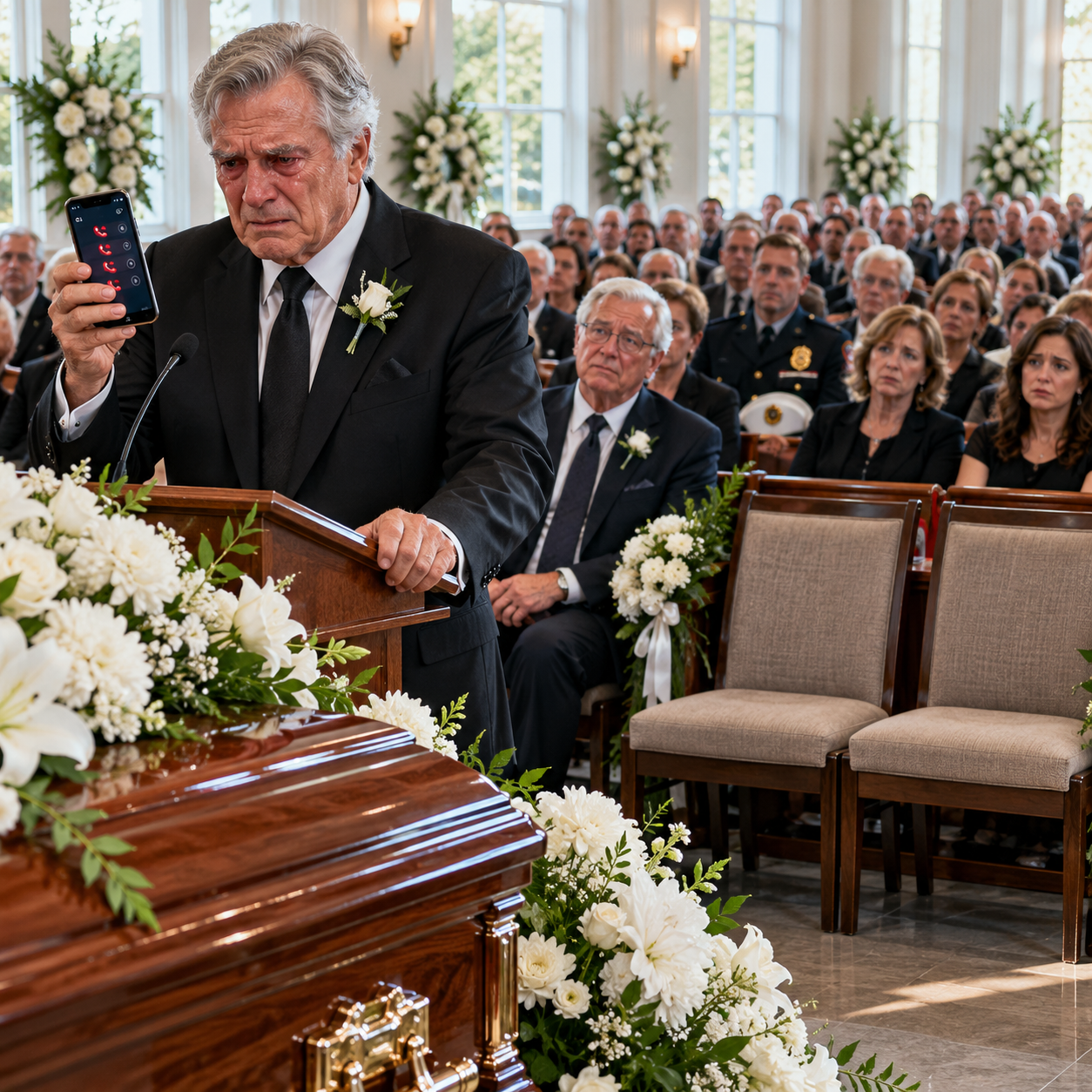
By one o’clock, the reception hall was nearly empty, and Bruce was carrying the last coffee urn into the kitchen. I sat beside a window listening to nine voicemails from Dylan, each more frantic than the previous one. Eight years earlier, Darlene and I had given him an emergency supplementary Visa card for situations like medical bills or roadside repairs. He had apparently decided his mother-in-law’s extravagant birthday celebration qualified.
On the seventh message, Terry Richardson’s booming voice came through the speaker. “Get that freeloader away from my guests!” Dylan answered with a desperate promise that his father would pay everything.
Bruce listened beside me. “Forty-four calls, Glenn. Did he ask how you were doing even once?”
I shook my head.
Before Bruce could answer, Brianna appeared in the doorway with her eight-year-old son, Wyatt. Her party dress was wrinkled, her mascara smudged, and Wyatt clutched a rolled piece of drawing paper. “I left the birthday party,” she said. “Dylan told me I was overreacting. I’m sorry we missed the service.”
Wyatt handed me his drawing. It showed a smiling woman with gray curls standing among enormous flowers. Across the top, he’d written GRANDMA’S GARDEN.
I knelt in front of him. “She would have loved this.”
“Does Grandma still have flowers?” he asked.
“More than you can imagine, buddy.”
While Brianna held him close, our attorney, Monica Hayes, approached with a cream-colored envelope sealed in red wax. My wife’s handwriting crossed its front: For Glenn. When the time is right. Monica will know.
“She gave it to me three weeks ago,” Monica explained. “She made me promise not to let you open it early.”
I tucked it into my coat.
Chelsea was waiting on my porch when Bruce drove me home. She rushed forward, crying, claiming she’d flown directly from Cancún because she’d become seriously ill. According to her, a Mexican hospital wanted eleven thousand dollars, and her travel insurance had refused payment.
“Which hospital?” I asked.
She hesitated.
I spotted a train ticket protruding from her purse. Toronto to Kitchener. That afternoon.
I’d spent thirty years investigating insurance claims. Chelsea had forgotten that detail when inventing her story.
Within minutes, the truth emerged. She hadn’t left Ontario. She’d spent four months in Toronto helping a man named Aaron finance an online business that never seemed to launch. Darlene had given her twenty-two thousand dollars for a yoga studio. Chelsea had handed it all to Aaron, then borrowed another eleven thousand from a private lender.
“Mom would have helped me,” she insisted.
“Your mother did help you. She emptied her savings to give you another beginning.”
“Dad, I need the money by Monday.”
I stared at the face I’d once kissed goodnight.
“Your mother spent her final eleven days asking whether you’d visit. She kept lipstick beside her bed because she wanted to look beautiful when you arrived.”
Chelsea’s expression crumpled, then hardened.
“You’re cruel,” she whispered. “Mom was always better than you.”
She slammed the front door so hard that Darlene’s photographs shook.
Bruce had witnessed everything from the driveway. Inside, he placed a small silver storage device on our kitchen table. “Darlene asked me to keep the doorbell-camera recordings from September. I think you need to see them.”
Monica brought her laptop the following morning. She cautioned that any legal use of the recording would require careful review, but she believed I deserved to know what it contained.
The date on the video was September 6.
Dylan and Chelsea entered our house using their old keys. Darlene was resting in the front sitting room, apparently asleep.
“She’s out until five,” Dylan whispered.
Chelsea opened a folder.
“Continuing power of attorney for property,” she said. “Once she signs, we control the house and accounts.”
Dylan mentioned a notary who owed him a favor. Chelsea discussed arranging a capacity assessment for me, then placing me in a facility in Cambridge.
“The house is worth eight hundred thousand,” Dylan said. “Terry needs money for his business. I already promised I’d find it.”
“What about Mom’s jewelry?” Chelsea asked.
“Take it. I need the property.”
Then Chelsea said something that made my chest feel hollow.
“They told us six weeks back in July. She’s taking forever.”
Dylan told her to stop, but she laughed.
“She’s living too long.”
Monica closed the laptop when I raised my hand.
I remembered Darlene standing beside our bedroom window that September evening, her oxygen tubing trailing over her nightgown. She’d told me she’d finally realized that protecting our children from every consequence had taught them to expect protection from everything.
“She heard them,” I whispered.
Monica nodded.
“She heard enough to change her plans. And Glenn, she left instructions for both of them.”
For the first time, I understood why Darlene had seemed strangely peaceful during her final weeks.
She hadn’t surrendered.
She’d made a decision.
### Part 3: My Wife’s Last Decisions Bring Betrayal Into the Light
Dylan arrived Monday morning wearing yesterday’s shirt, his face gray with exhaustion. Brianna had taken Wyatt to her mother’s house, and Terry was demanding payment for the banquet. Dylan claimed the balance was $31,400, personally guaranteed by him. He sat on our sofa, bouncing one knee, and promised he’d repay me if I rescued him.
“With what money?” I asked.
“I’ll figure something out.”
“Your mother stopped paying your debts in September.”
He froze.
I asked where he’d been on September 6 at three in the afternoon. His gaze darted toward the staircase, then the hallway photographs.
“I don’t remember.”
“Your mother remembered.”
His embarrassment turned into anger. He accused me of allowing Darlene to die at home instead of sending her to a hospital. Kathy Garcia, the palliative nurse who’d come to return Darlene’s walker, stepped out of the kitchen. She calmly reminded him that his mother had chosen home hospice care and that Kathy had spent more evenings beside her than either of her children.
I held out my empty hands.
“Ask me one question, Dylan. Any question that isn’t about money.”
He stared.
“Ask how I’m managing without your mother.”
His mouth opened, but no words followed. He grabbed his jacket and headed for the door. His elbow caught a shelf, sending Darlene’s framed wedding portrait crashing onto the hardwood.
Glass scattered across my shoes.
“I hope you rot in this house,” he snapped.
After he left, I knelt to gather the broken frame. A shard sliced my palm, staining the photograph with blood. Kathy wrapped my hand in a clean towel while I stared at Darlene’s smiling face.
Thursday’s meeting took place in Monica’s office overlooking King Street. Chelsea and Dylan arrived early, sitting stiffly in matching leather chairs. Monica explained that Darlene had left everything she personally owned to me. Our jointly owned home passed directly to me, and her $400,000 life insurance policy now named Grand River Hospice as beneficiary.
“That can’t be legal,” Dylan protested.
“Your mother was examined and found mentally capable when she made the changes,” Monica replied, displaying the physician’s written confirmation.
Then she handed each child a personal letter and explained the new restrictions on entering our home. Darlene had requested that neither be allowed inside without my permission.
Chelsea stared at the papers. “You’re shutting us out?”
“I’m respecting your mother’s wishes.”
Dylan shoved back his chair. Chelsea followed him to the elevator, but turned before the doors opened.
“I hope you die alone in that house,” she said.
I didn’t answer.
The consequences came slowly, and none required me to pursue revenge. Monica helped Chelsea report her predatory lender, while an investigation exposed Aaron’s fraudulent investment scheme. She never recovered her mother’s twenty-two thousand dollars, lost her housing deposit, and eventually took an early-morning job at a Tim Hortons.
Dylan received formal demands for the banquet debt. His truck was repossessed, and Terry refused to help him. Brianna moved away temporarily with Wyatt, insisting Dylan needed a dependable plan before they could rebuild their marriage. He found warehouse work on the night shift, earning eighteen dollars an hour and living in a small basement apartment.
Then Terry Richardson appeared on my porch.
He wore an expensive camel-colored overcoat and offered condolences that sounded rehearsed. Within two minutes, he brought up the six-acre industrial yard his logistics company rented.
Most people didn’t know that Darlene and I owned Peterson Holdings, the company that had held that property since 1994. Our tenant was Cole Logistics. Terry’s lease expired on December 31.
“I assume we’ll renew at the same rate,” Terry said.
“Market rent,” I replied. “Forty-one percent higher, month to month, with ninety days’ notice.”
His smile disappeared.
“I have forty trucks.”
“Then you have some important decisions to make.”
He stood on the porch for several seconds before retreating to his car.
By March, Cole Logistics had relocated, and nine drivers had lost their jobs. I took no pleasure in that collateral damage, but I wasn’t prepared to subsidize Terry’s business with a below-market lease either.
Through Bruce, I occasionally heard about my children. Chelsea was learning how much work it took to earn an ordinary paycheck. Dylan was making regular payments toward the banquet debt. Brianna and Wyatt eventually returned to him, although their marriage remained fragile.
I didn’t call either child.
Sometimes I sat at our kitchen table with Darlene’s unopened envelope resting beside her reading glasses. I wanted to break the seal every day, but Monica had made the condition clear.
The right moment would come when one of our children returned without asking for anything.
For nearly a year, that moment never arrived.
### Part 4: A Final Letter Reveals What Forgiveness Really Requires
On October 24, exactly one year after Darlene’s funeral, I drove to the cemetery in Waterloo carrying a thermos of her favorite tea. Her gray granite headstone bore a small carved chrysanthemum. I’d planted real chrysanthemums around it that summer, and their bronze-edged petals trembled in the October breeze.
I sat on the bench beside her grave, the unopened envelope tucked inside my coat.
Footsteps sounded on the gravel.
Dylan stood several feet away wearing scuffed work boots and a cheap winter coat. He looked thinner than I remembered. An envelope shook slightly between his fingers.
“Dad,” he said. “Could I sit?”
I moved my thermos aside.
For a while, we watched two geese cross the cloudy sky.
“I’ve been working nights for eleven months,” he finally said. “Four hundred dollars goes to the banquet debt every month. It’ll take years, but I haven’t missed a payment.”
I nodded.
“Brianna and Wyatt came home in June. We have rules now. I’m trying to follow them.”
“Good.”
He swallowed.
“I didn’t come for money.”
I looked at him.
“I came because of what you asked me that day in the hallway. One question. I couldn’t even think of it.” He pressed his hands together. “I’ve spent almost a year wondering what kind of son can’t ask his father how he’s doing.”
His voice broke.
“I’m sorry I missed Mom’s funeral. I’m sorry I planned to take the house. I’m sorry I let Chelsea talk about Mom like she was something standing in our way.”
He looked toward the headstone.
“And I’m sorry I broke her picture.”
I felt the cold wind pass beneath my coat.
“Ask me now,” I said.
He turned toward me. His eyes filled.
“Dad, how are you holding up?”
For a long moment, I couldn’t speak.
Then I gave him the answer I’d given the funeral director a year earlier.
“Upright. Mostly.”
He laughed through his tears. I reached across the bench and placed my hand between his shoulders, feeling him tremble beneath my palm.
“I haven’t forgiven everything,” I told him. “I can’t promise when I will. But you’ve come here without asking me to rescue you, and that matters.”
He wiped his eyes.
“Chelsea’s at the gate. She was afraid you’d send her away.”
I looked past the rows of headstones.
My daughter stood near the entrance wearing a brown work jacket, holding two paper cups. Her face was thinner, her hair pulled back without much care. She looked exhausted and nervous, like a woman who finally understood what surviving a hard week meant.
“She wanted to bring you coffee,” Dylan said.
I reached inside my coat and removed Darlene’s envelope.
The red wax broke beneath my thumb.
Inside was a single sheet of paper, covered in the handwriting I knew better than my own.
My dearest Glenn,
If you’re reading this, one of our children has come back without being summoned. I hoped this day would come, although I was afraid I wouldn’t live long enough to see it.
I know what they intended to do. I know the terrible things they said when they believed I couldn’t hear. It broke something inside me, but it didn’t erase the years when they were little and good, when they held our hands and believed we could protect them from everything.
Perhaps that was where we made our mistake. We kept protecting them long after they needed to learn how to stand.
I put those boundaries in place because I loved them enough to stop helping them destroy themselves. But, Glenn, please don’t turn my anger into a prison for your heart.
If they return with empty hands and changed hearts, you may open the door. Not because they deserve your money, but because they finally understand that your love was never something they could purchase or demand.
I love our children. I love you. And I trust you to recognize the difference between another promise and real change.
Forever yours, Darlene.
I finished reading with tears running down my cheeks.
Dylan covered his face. Across the cemetery, Chelsea began walking toward us.
She stopped an arm’s length away.
“I know I don’t deserve anything from you,” she said. “I just wanted to bring you Mom’s favorite coffee. Two sugars, too much cream.”
Her hands trembled as she offered the cup.
I accepted it.
She looked at her mother’s headstone and began crying quietly.
For a moment, I saw the little girl who used to fall asleep against my chest during thunderstorms. Then I saw the woman who had lied to me on our front porch. Both were real. Neither could cancel the other.
“Your mother left me something,” I told her. “A letter about forgiveness.”
Chelsea shook her head.
“I don’t expect you to forgive me today.”
“That’s probably the first sensible thing you’ve said to me in a long time.”
A small, startled smile crossed her face.
I moved my thermos and invited her to sit.
She did.
We stayed there until the afternoon wind grew colder. Dylan spoke about his job, Chelsea about the customers who stopped by the coffee shop every morning. Neither asked me for a dollar. Neither mentioned the house or the inheritance.
Before we left, I told them they could come back the following Sunday to help me tend Darlene’s garden. They could bring Wyatt. We would have lunch afterward, nothing elaborate.
But the boundaries would remain.
The house was still mine. Their debts were still theirs. Trust would have to grow again, slowly, through ordinary acts that mattered more than apologies.
As we walked toward the cemetery gate, Chelsea slipped her arm through mine. Dylan carried the empty thermos. Behind us, the chrysanthemums bent gently in the breeze.
I had spent a year believing Darlene’s last gift was protection from our children’s selfishness.
Standing between them, I finally understood the truth.
Her final gift wasn’t the changed will, the cancelled credit card, or the boundaries she’d drawn.
It was the courage to love our children without rescuing them from the consequences of their choices.
Forty-four telephone calls couldn’t bring me back to my son when all he wanted was money. One quiet question at his mother’s grave had brought us closer than we’d been in years.
I didn’t know whether our family would ever be whole again. Some things can’t be repaired simply because people finally regret breaking them.
But I knew something else.
My children had come to their mother’s grave with nothing to gain.
And for the first time in a very long while, we were walking home together.
THE END.
All characters and events in this story are fictional, created for storytelling and entertainment purposes. Thank you sincerely for reading. Your feedback and support are invaluable and motivate me to continue sharing more stories with you.


