
Part 2: I Closed The Accounts And Left Ohio Behind
Over the next ten days, I emptied my house with surprising ease.
I sold the dining table Walter and I had refinished together in 1985 to a young couple expecting their first baby. I donated four boxes of clothes. I packed Walter’s fishing hat, our photographs, and the letters he had written during a work trip in 1992.
A young nurse named Priya from my old hospital needed an affordable place near the medical center.
I offered her my house on a private lease.
When she signed the papers, she hugged me.
“You have no idea what this means.”
Maybe I did.
A home had once been the center of my whole identity. Now I liked the thought of someone beginning her own life inside it while I went looking for the rest of mine.
Kayla spent those days posting inspirational messages online about “protecting your peace” and “removing toxic people.”
I laughed at one of them while wrapping dishes.
She had no idea her toxic mother-in-law had purchased a one-way ticket to Charleston.
Daniel called four times that weekend.
I let each call go to voicemail.
His first message was irritated.
The second was confused.
By Sunday evening, when I failed to arrive with my usual casserole, he sounded worried.
“Mom, where are you? Call me.”
I wasn’t trying to frighten him.
I had simply stopped reporting for duty.
Monday morning, before leaving for the airport, I asked my neighbor to drive me past Daniel’s house.
Everyone was at work or school.
I used the spare key they had given me years earlier.
Laundry covered one end of the sofa. Ruthie’s dance shoes were by the door. Dishes were stacked in the kitchen sink.
Six months earlier, I would have started cleaning automatically.
That morning, I walked past all of it.
I placed the spare key beside the fruit bowl and left a handwritten note.
Here is your key.
I love you both more than words.
Take care of my grandbabies.
Mom.
Then I noticed my grandmother’s blue ceramic pie dish on the counter.
Three weeks earlier, I had brought them an apple pie in it. Kayla knew the dish had belonged to my mother.
I wrapped it in a towel and tucked it under my arm.
Some possessions are more than objects.
That one was coming with me.
By afternoon, Ohio was beneath the clouds.
I read half a mystery novel on the plane and ordered a glass of wine far earlier in the day than I normally would have allowed myself.
Linda was waiting when I landed.
She wrapped both arms around me.
“I knew you’d come.”
“You apparently knew before I did.”
The cottage behind her house had one bedroom, weathered cedar shingles, and a porch facing the marsh. Herons stood in shallow water beyond the grass. At sunset, everything turned gold.
It was smaller than my Ohio house.
I loved it immediately.
Three mornings later, Linda and I went to a farmers market. I bought tomatoes, fresh basil, and a jar of local honey.
I knew the canceled payments would be hitting by then.
I did not check my phone.
That afternoon, I finally turned off airplane mode.
Eleven missed calls from Daniel.
Six from Kayla.
Messages filled the screen.
Mom, where are you? There’s some woman living in your house.
Then:
The bank says the truck payment didn’t go through.
Then Kayla:
Ruthie’s dance studio says the account was closed. The cleaning lady says she hasn’t been paid. This is completely irresponsible.
That one almost made me smile.
A woman telling me it was irresponsible to stop paying for her housekeeper had apparently never considered how strange the sentence sounded.
Daniel’s final voicemail was different.
“You’re abandoning the family over one bad night. The kids didn’t do anything. We could have fixed this if you’d just talked to us.”
I sat on Linda’s porch with my sweet tea sweating against my palm.
He still believed the problem was that I had left.
Not why.
I called him.
He answered before the first ring finished.
“Mom? Where are you?”
“South Carolina.”
“What?”
“I’m with Aunt Linda.”
He exhaled hard. “When are you coming back?”
“I don’t know.”
“What does that mean?”
“It means I don’t know.”
His voice sharpened. “The truck payment bounced. Ruthie might lose her place at the studio. Kayla’s furious. You can’t just shut everything off without warning.”
“Daniel.”
“What?”
“Those bills were never mine.”
He stopped talking.
“I paid them because I loved you,” I continued. “And because somewhere along the way I became afraid that if I stopped helping financially, I’d lose my place in your family.”
“That’s not fair.”
“Maybe not. But it’s true.”
“The kids are being punished.”
“No. You and Kayla are being asked to pay for the life you chose.”
He breathed into the phone for several seconds.
Then came the sentence that hurt most because of how naturally he said it.
“You can’t just leave us like this, Mom.”
“I’m not leaving you, Daniel.”
I looked across the marsh.
“I’m leaving your bills.”
Part 3: Without My Money My Son Finally Faced His Life
My days in South Carolina developed a rhythm.
Coffee on the porch. Walks beside the marsh. Watercolor classes at the community center.
Linda introduced me to women who invited me to book club without first asking whether I could babysit their children or cover an expense.
I had forgotten what it felt like to enter a room with nothing to provide except my company.
Back in Ohio, consequences arrived one invoice at a time.
Daniel’s truck was eventually repossessed after missed payments. He replaced it with a used sedan he could afford.
Ruthie left competitive dance.
I cried the night Daniel told me.
Then he added, “She joined a community rec program. Honestly, Mom, she loves it.”
“Does she?”
“She made three friends the first week.”
Kayla had to let the cleaning service go.
Daniel learned to cook more often.
They sold things.
They argued.
They started looking at bank statements they had ignored for years.
Not everyone approved of my decision.
My cousin Patricia called one evening.
“Family helps family, Margaret.”
“I agree.”
“Then how can you do this?”
“I helped them for six years.”
“That’s what mothers do.”
“Sometimes mothers also stop doing things their grown children can do themselves.”
Patricia changed the subject.
Some nights were harder.
I would see Ruthie’s watercolor set on a store shelf and miss her so sharply that I had to stand still for a moment. Sometimes I nearly called Daniel and offered to restore one small payment.
Just the dance fees.
Just the phones.
Just something.
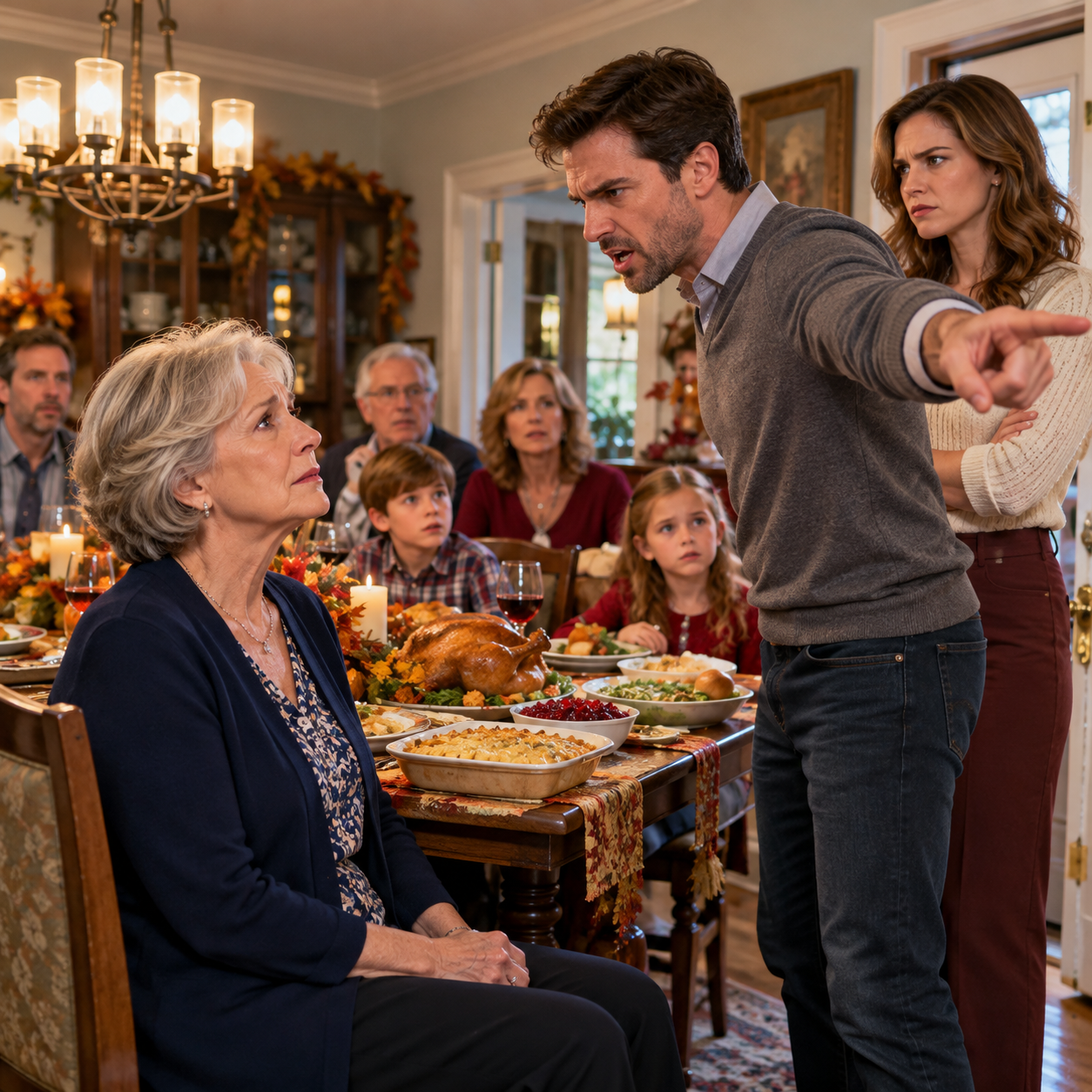
Then I remembered Thanksgiving.
Not Kayla’s anger.
Daniel’s silence.
That was the part that kept me steady.
So I spent some money on myself.
I took a train to Savannah for a weekend because I had wanted to see it since I was twenty-five.
I bought a leather handbag I had admired for two years.
I attended a blues concert on the water with women from my book club and danced badly enough that Linda laughed until she had tears in her eyes.
Five months after I moved, Daniel called on a Tuesday afternoon.
His voice sounded tired.
Not panicked.
We talked about weather, the cottage, and the children.
Then he cleared his throat.
“Mom, I owe you an apology.”
I said nothing.
“A real one.”
I waited.
“I should have defended you at Thanksgiving.”
My fingers tightened around the coffee mug.
Daniel continued.
“I told myself I was keeping the peace by staying quiet. Really, I was making you absorb the whole fight so I wouldn’t have to deal with it.”
He paused.
“And that wasn’t the only thing.”
“What do you mean?”
“These months without you… I didn’t realize how much you were carrying.”
He gave a small, humorless laugh.
“The bills. The kids. The house. Our emergencies. Every problem had one solution.”
I knew what he would say before he said it.
“You.”
I looked out toward the water.
“Daniel, I wanted to help.”
“I know. We just stopped noticing it was help. We started treating it like the normal way things worked.”
That was closer to an apology than anything I had expected.
“The kids miss you,” he said. “I miss you.”
“I miss you too.”
“Would you let us visit this summer?”
My eyes filled before I could stop them.
“I’d love that.”
He hesitated.
“What about Kayla?”
There it was.
I took my time.
“Not yet.”
He didn’t respond.
“I’m not asking you to choose between us,” I said. “She’s your wife. But she hasn’t apologized, Daniel. She hasn’t even acknowledged what happened. I’m not ready to invite her into my home.”
“I understand.”
Two words.
No pressure.
No accusation.
That was when I first believed something in my son had truly changed.
Part 4: Respect Returned Only After I Stopped Buying It
Summer came bright and heavy with coastal heat.
Daniel emailed me his flight information and a reservation confirmation for a small inn near Linda’s house.
He had booked it himself.
He never asked if I would pay.
I stared at that confirmation longer than necessary.
Boundaries are strange things. At first, people hear them as rejection. Eventually, if they care enough, they begin to understand that a boundary is simply the place where one person ends and another begins.
The afternoon they arrived, I waited outside the inn.
Tucker saw me first.
“Grandma!”
He and Ruthie ran across the courtyard so fast that Daniel shouted for them to watch the gravel.
I dropped to my knees and caught them both.
Ruthie smelled like sunscreen. Tucker had grown at least two inches.
I cried into their hair without caring who saw.
Daniel approached carrying two bags.
He set them down.
For a moment, we simply looked at each other.
Then he hugged me.
“I’m sorry,” he whispered.
I pressed my cheek against his shoulder.
“I know, honey.”
During that week, we ate shrimp on the dock, wandered historic streets, and let the children chase gulls until they were exhausted.
Ruthie asked me to teach her watercolor.
We spent two afternoons on my porch painting the marsh. Her version had a purple sky, three orange birds, and something she insisted was an alligator although it looked more like a floating shoe.
Every evening, Daniel walked the children back to the inn.
He never hinted about sleeping at my cottage.
Never asked to extend the trip.
Never treated my hospitality like a debt he was owed.
One evening, after the children were asleep, he and I sat on the dock with our feet above the dark water.
“It was awful after you left,” he said.
“I imagine so.”
“I was furious with you.”
“I imagined that too.”
He smiled faintly.
“For weeks, I blamed everything on you. The truck. The money. Ruthie leaving dance.”
“What changed?”
“I started doing the math.”
I turned toward him.
“We were spending like your money was part of our income. Not a gift. Income.”
He shook his head.
“I’m embarrassed saying that out loud.”
“You don’t need to be embarrassed forever. Just don’t do it again.”
He laughed.
“We sold the boat.”
“The boat you used twice?”
“Exactly that boat.”
“And?”
“We made a budget.”
I raised an eyebrow.
“A real one?”
“With categories.”
“Your father would faint.”
Daniel grinned.
“Kayla’s doing more around the house. I am too. And before you ask, yes, I know how to separate whites from colors now.”
I laughed so hard I had to grab the edge of the dock.
When I settled, I looked at him.
“I’m proud of you.”
His smile disappeared.
For a second, he looked like the boy who used to wait for Walter and me to clap from the bleachers.
“That means more than you know.”
The visit ended too quickly.
At the airport curb, Tucker wrapped his arms around my waist.
“You’re coming for Christmas, right?”
I looked at Daniel.
He didn’t answer for me.
That mattered.
I looked back at Tucker.
“Yes. I’ll come.”
“Promise?”
“Cross my heart.”
After they left, I returned to the cottage and sat on my porch as evening settled over the marsh.
Kayla and I were not reconciled.
She had not called to apologize, and I no longer needed her apology badly enough to chase it.
I wasn’t angry anymore.
There are relationships that heal through closeness and relationships that can only become peaceful through distance.
I had finally learned not to confuse forgiveness with surrender.
A year earlier, I would have believed keeping my family together meant paying whatever emotional or financial price was demanded.
Now I understood something Walter had tried to teach me in a dozen quiet ways.
Love cannot survive indefinitely without dignity.
Helping someone is generous.
Making yourself indispensable so they will keep you near is something else entirely.
I had done that without realizing it.
I had given money because I loved my son. Then I had given more because I feared what would happen if I stopped. Eventually, Daniel and Kayla stopped seeing the difference.
So had I.
At sixty-nine, I no longer believed my purpose was to rescue everyone before they felt the consequences of their own choices.
Daniel became a better man when I stopped preventing him from carrying the weight of his own life.
I became a fuller woman when I stopped measuring my worth by how much weight I could carry for everybody else.
The blue ceramic pie dish now sits on a shelf in my little cottage.
Sometimes I make an apple pie in it when Linda comes over.
Sometimes I leave it empty.
Either way, it belongs to me.
So does my money.
So does my time.
So does the quiet life I built after walking away from that Thanksgiving table.
I still love my son.
I love my grandchildren beyond words.
And maybe one day Kayla and I will sit across from each other and find a different way forward.
But if that day comes, it will not be because I bought my place back into the family.
Respect does not work that way.
Sometimes the bravest thing a mother can do for her grown child is stop catching him every time he falls.
And sometimes the bravest thing a woman can do for herself is set down her fork, pick up her purse, and finally walk toward a life where no one mistakes her love for an unlimited line of credit.
The End .
All characters and events in this story are fictional, created for storytelling and entertainment purposes. Thank you sincerely for reading. Your feedback and support are invaluable and motivate me to continue sharing more stories with you.

