
## Part 2: A Stranger’s Son Protected Me When My Family Returned
Two days after I arrived, Walter’s son came home from a business trip. I was sitting at the kitchen table with a cup of ginger tea when the side door opened and a tall man carrying a laptop bag stepped inside. “Bridget, this is Reed,” Walter said. Reed looked about thirty-five, with dark hair, tired eyes, and the calm expression of someone who didn’t waste words.
He didn’t ask why I was pregnant and unmarried or whether my parents knew where I was. Instead, he glanced at the medical appointment card beside my cup. “Three babies means a lot of checkups,” he said. “Dad tells me transportation is a problem. I can drive you.” I thanked him, expecting the offer to disappear once his business schedule became inconvenient.
But Reed showed up the following Tuesday, then Thursday, and every appointment after that. He kept bottled water in his car, adjusted the air conditioning when I felt sick, and waited until I was safely inside before driving away. At one appointment, the doctor ordered additional blood work, and Reed quietly moved an important meeting to the following morning. When I apologized, he looked almost confused. “You haven’t done anything wrong, Bridget.”
One afternoon, after an unusually long ultrasound, Reed stopped at a small park near the clinic. We sat beneath a maple tree while I told him about Daniel, my abandoned classes, and the night my mother ordered me out. He listened without interrupting, rubbing his thumb along the rim of his coffee cup. “You don’t have to do everything by yourself anymore,” he said. I looked down at my hands. “I’m not used to people staying.”
He didn’t promise me the world. He simply drove me home, carried my bag upstairs, and arrived on time the next morning. As the weeks passed, I began recognizing his footsteps in the hallway and the sound of his car entering the driveway. Sometimes we talked for an hour; sometimes we sat together without speaking. After a lifetime of believing love required proving my worth, his quiet consistency frightened me almost as much as it comforted me.
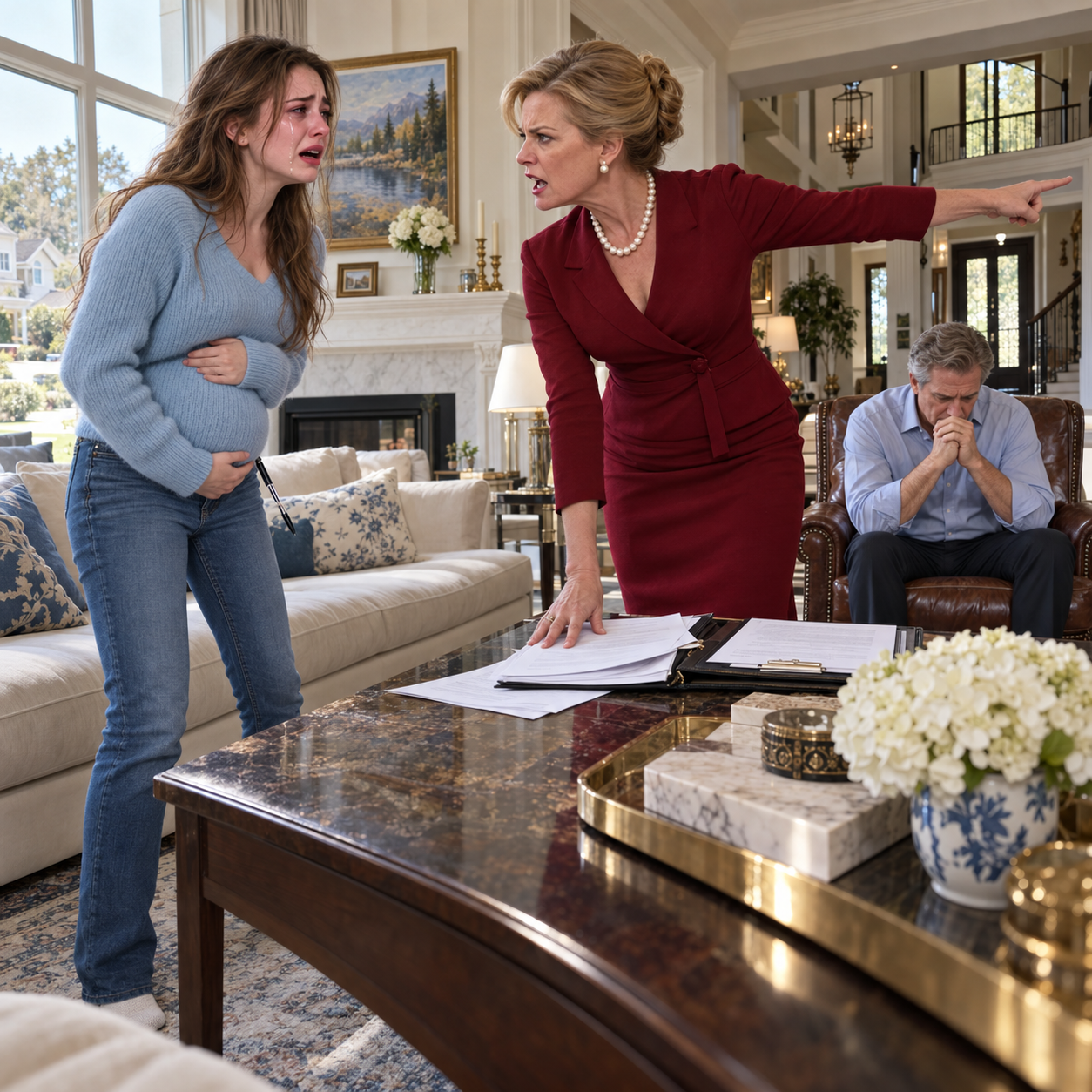
Three months after I moved into the house, the front doorbell rang while I was coming downstairs. I stopped halfway down when I heard my mother’s unmistakable voice. “We’re here to see Bridget.” Diane stood in the entryway wearing her expensive cream coat, with Dad beside her holding a leather folder. Her eyes swept across the children’s shoes, the staircase, and finally my growing stomach.
“So it’s true,” she said. “You’re living here with all these children.” My father cleared his throat and opened the folder. He announced that their attorney had revised their wills and that I would receive nothing from the family estate. “We’ve made our position clear,” he said, refusing to meet my eyes. “There will be no financial support and no future claims.”
I gripped the stair railing. “You came all this way just to tell me I’m not getting your money?” My mother’s lips tightened. “We came because people are asking where you went. You’ve embarrassed us enough, Bridget. We don’t want any more trouble.” She glanced toward my stomach. “You made your choice.”
Before I could answer, Reed appeared from the kitchen. He walked into the entryway and positioned himself beside the stairs, leaving plenty of space between us. “She has a home here,” he told them. “And you’re upsetting her. I think it’s time you left.” My mother stared at him in disbelief. “This is a family matter.” Reed’s expression hardened. “Then perhaps you should have treated her like family.”
My father closed the folder. For one brief moment, I thought he might finally apologize, but he turned toward the door instead. My mother followed him, muttering that I would regret everything. When the door clicked shut, my knees weakened, and I sat heavily on the bottom step.
Reed returned with a glass of water and sat beside me. He didn’t tell me to stop crying or insist that my parents would eventually come around. He simply stayed until my breathing settled. “You can stay here as long as you need,” he said.
That evening, I found him on the back porch watching the children finish a game in the yard. I stood beside him and rested one hand against my stomach. “They moved today,” I whispered. Reed glanced toward me. When I took his hand and pressed it gently against my belly, his whole expression changed.
A tiny kick answered beneath his palm. He smiled, and I realized I hadn’t seen that expression before. Then the baby moved again, and Reed laughed softly.
For the first time, I wasn’t thinking about the family that had rejected me. I was thinking about the man standing beside me, looking at three unborn children as though their existence were something wonderful.
## Part 3: A Dangerous Pregnancy Forced Me To Choose My Future
The trouble began during an ordinary ultrasound a few weeks later. The technician measured each baby twice, then excused herself to find the doctor. Reed was waiting outside when the physician entered and explained that my blood pressure was rising and one baby was growing more slowly than the others. “We need to monitor you much more closely,” he said. “You’re going to require significant rest.”
Reed drove us home without turning on the radio. By evening, he’d rearranged his meetings, organized my prescriptions, and placed a notebook beside my bed for recording blood pressure readings and medical instructions. Walter made sure the household staff could help with meals and anything else I needed. I watched these people reorganize their lives around mine and struggled to understand why they would do so without demanding anything in return.
During the second week of restricted activity, Reed sat beside my window working on his laptop. I had been staring at the ceiling for almost an hour when I finally spoke. “I’m scared I’ll be a terrible mother.” He closed the computer. “What makes you think that?” I twisted the blanket between my fingers. “Because the person who was supposed to teach me how to love a child couldn’t even love me when I needed her.”
Reed moved his chair closer. “My father has cared for children who arrived with nothing but a suitcase,” he said. “Some stayed for years. Some eventually returned to relatives or found permanent families. But he always taught me that being a parent isn’t about saying the right words. It’s about showing up every morning.” His eyes settled on my stomach. “And you’ve already been showing up for those three.”
Later that afternoon, a staff member brought me a message from my mother. Diane’s recorded voice filled the quiet bedroom, bitterly complaining that friends were canceling dinner invitations and people at her social club were asking uncomfortable questions. She blamed me for ruining the family’s reputation. I deleted the recording before it finished.
Reed found me sitting on the edge of the bed. “I don’t want them involved in my children’s lives,” I told him. “Not after what they’ve done.” He listened as I explained that I wanted the babies to grow up without having to earn the love of their grandparents. Then I said something I had been afraid to admit since arriving. “And I don’t want to give them away.”
He remained silent for a moment. “Then don’t.”
I looked at him. “Walter brought me here because I agreed to consider adoption.” Reed nodded. “You were scared and alone when you signed those papers. That doesn’t mean you have to remain scared and alone.” He reached across the bed and took my hand. “Whatever you choose, you deserve to make that decision freely.”
The following morning, Walter arranged for me to speak privately with an independent attorney. She reviewed the preliminary documents and explained that I had not surrendered my parental rights. I could choose to raise my children, and no one could make that decision for me. When I told Walter I wanted to keep all three, he looked at me for a long moment before nodding. “Then we’ll change the plan.”
I started crying. “But the medical bills, the room, everything you’ve done—” Walter raised one hand gently. “Bridget, help isn’t supposed to become a debt that costs you your children.” He leaned forward. “You’re welcome here while you get established. What happens after that is yours to decide.”
That night, Reed joined me on the back porch. I told him that the babies would remain mine and that I intended to raise them, no matter how difficult the future became. He watched the darkening yard before speaking. “I want to be part of that future,” he said. “Not because my father asked me to help. Because I care about you.”
I turned toward him, afraid to believe what I was hearing. Reed brushed a tear from my cheek. “I can’t promise I’ll know everything about being a father,” he whispered. “But if you’ll let me, I’d like to learn.” I leaned against his shoulder, and he wrapped an arm around me.
The following weeks brought more medical appointments, additional monitoring, and long conversations about the future. Walter prepared three cribs in an upstairs nursery while Reed and I argued affectionately over baby names and tiny clothes. We discussed marriage, adoption, and the legal steps that would eventually allow Reed to become their father. Nothing was rushed; for once, I was allowed to choose.
Then, one morning before sunrise, a sharp contraction pulled me awake. Another followed before I could reach the bedroom door. I called Reed, gripping the hallway railing as he hurried upstairs. Walter appeared behind him carrying the hospital bag.
Reed helped me into the car while Walter called ahead. “Look at me,” Reed said, fastening my seat belt. “We’re going to the hospital, and I’m staying with you.”
I clutched his hand as another contraction began. The house disappeared behind us, and I realized that the three little lives I had nearly surrendered were finally coming to meet me.
## Part 4: Three Newborn Babies Exposed The Truth Behind My Mother’s Betrayal
The hospital lights seemed painfully bright as nurses guided me into a delivery room. Monitors beeped beside the bed while doctors checked the babies’ heartbeats and prepared for an early delivery. Reed stayed close, answering questions when I was too frightened to concentrate. Whenever I reached for him, his hand was already there.
The hours blurred into voices, medical instructions, and the steady pressure of Reed’s fingers around mine. When the doctor finally announced that the first baby had arrived, I heard a tiny cry and burst into tears. A second cry followed, then a third. All three needed careful checks and extra attention because they had arrived early, but the medical team reassured me that they were doing well.
When I was finally allowed to hold them, I couldn’t stop staring. Two girls and a boy, each with a tiny face and fingers that curled around mine. Reed stood beside the bed, his eyes shining as he watched me cradle the smallest girl. “They’re beautiful,” he whispered. I looked up at him. “They’re ours to love.”
Walter visited that afternoon carrying three small knitted hats. He stood at the foot of my bed, smiling at the babies with an expression that made him look younger. “Welcome to the family,” he whispered. For several minutes, none of us said anything more. The three heartbeats that had once terrified me were now three sleeping children wrapped in white hospital blankets.
The following morning, the hospital social worker helped me confirm my plans to parent the babies and update the necessary records. Reed remained my chosen emergency contact, and we discussed the adoption process we hoped to pursue after marriage. When the meeting ended, Walter asked whether he could speak with me privately. Something in his expression made me sit straighter.
He placed a folded letter on the bedside table. “There’s something I should have told you when we first met,” he said. I recognized the handwriting on the envelope immediately. My mother’s name was written across the bottom.
Walter explained that Diane had contacted a private adoption coordinator before my first ultrasound. She had asked about arranging a confidential placement for my baby and had provided his name when the coordinator discussed possible caregivers. Walter had agreed to an introductory meeting because he believed the young mother needed assistance, but he hadn’t understood how much pressure my parents were putting on me.
I unfolded the letter with trembling fingers. My mother’s instructions were painfully clear: she wanted any adoption handled discreetly, without our family’s name being publicly associated with the pregnancy. She had even requested that future communication be directed away from my parents’ home.
“So she arranged all of this?” I whispered.
Walter shook his head gently. “She made the inquiry. But only you could decide what happened to your children.” He lowered his eyes. “I should have explained her involvement sooner. I was wrong to keep it from you.”
I stared at the letter. My mother hadn’t simply wanted me out of her house. She had tried to arrange a future in which my children disappeared from her life without anyone asking why.
Before I could answer, a nurse knocked and entered the room. “Bridget, your parents have called the hospital,” she said. “They’re asking to speak with you. Your mother says she’d like to see her grandchildren.”
I almost laughed.
For months, Diane had insisted that my pregnancy was a disgrace. Now that three healthy babies had arrived, she wanted to claim a place in their lives. I imagined her smiling for photographs, telling her friends how proud she was, never mentioning the documents she’d pushed across her coffee table.
“Please tell them I won’t be accepting visitors or calls from them,” I said. My voice shook, but the decision didn’t. Reed moved beside me and rested his hand on my shoulder. The nurse nodded and quietly left.
I looked at Walter. “I need to know one more thing. If I had decided not to go through with the adoption, would you really have let me leave?” He met my eyes. “Yes. No one has the right to take your children because you’re frightened or poor.” He glanced toward the three little beds. “And I hoped that once you had a safe place to think, you’d know what you truly wanted.”
Three days later, Reed drove us home. Walter opened the front door while the staff helped carry the car seats inside, and the older children gathered excitedly along the hallway. They stood back while we settled the babies in their nursery. That night, Reed pulled a chair beside mine and stayed through the feeding, the diaper changes, and the quiet hours when the rest of the house slept.
News of my parents’ treatment of me eventually reached their friends and business associates. The story Diane had been telling—that I had rejected my family’s help—began to unravel when people learned she had threatened to disown me for keeping my babies. Invitations stopped arriving, and several business relationships my father had relied upon quietly ended. Their social standing suffered, but I no longer followed the gossip closely enough to celebrate it.
Several months later, Reed and I married in a small ceremony on the front lawn. Walter stood beside us, the older children helped arrange flowers, and the triplets were brought outside afterward in matching white outfits. Reed held my hand while we exchanged vows, promising not that our lives would be easy, but that neither of us would face them alone. We later began the legal process for him to adopt the children.
After the ceremony, Walter handed me an old photograph of the house taken years before. The porch was crowded with children of different ages, and a younger Reed stood near the steps holding a little boy’s hand. On the back, Walter had written, Family is the people who make room for you.
I carried that photograph upstairs and placed it beside the three knitted blankets he’d given us. Reed appeared in the nursery doorway with our son asleep against his shoulder. Our daughters were already dreaming in their cribs, their tiny fingers curled beneath their cheeks.
“Are you happy?” Reed asked softly.
I looked at him, then at the children who had changed everything. “I am,” I whispered. “More than I ever thought I could be.”
My mother had once told me that keeping my baby would cost me my family. She’d been wrong about almost everything, including the number of babies I was carrying.
She had taught me that love could disappear the moment I needed it most. But the people who took us in had taught me something far more important: real love makes room when life becomes difficult.
I switched off the nursery light and followed my husband into the hallway, leaving three small night-lights glowing above the cribs.
For the first time in my life, I wasn’t afraid of someone walking away.
I knew who would still be there in the morning.
THE END.
All characters and events in this story are fictional, created for storytelling and entertainment purposes. Thank you sincerely for reading. Your feedback and support are invaluable and motivate me to continue sharing more stories with you.


