
## Part 2: An Unpaid Propane Bill Reveals Who Truly Cares About Family
The first call came from Dena at Otter Creek Propane. She’d managed my parents’ account for years and wanted to confirm that I really intended to stop paying. “Your father says you abandoned them,” she told me. I reminded her the tank was almost full, and she fell silent before mentioning that I’d never missed a payment in seven years.
Mom called next. “You’ve embarrassed your father over a harmless joke,” she snapped. When I reminded her that she’d said I needed nothing from them, her voice hardened. “After everything we’ve done for you?” I stared at the new house keys on my kitchen counter and realized she had no idea what those words cost me.
On January second, Harlo helped me move into the new house. My belongings fit inside one small bedroom, leaving the larger room untouched, with its handmade quilt, two nightstands, and lowered closet rod. Harlo stood in the doorway, studying everything I’d prepared. “You ever going to tell them?” he asked. I shook my head, and he quietly suggested leaving the room alone until I knew what to do with it.
Ten days passed. I repaired equipment at the mountain, came home, and ate dinner standing over kitchen counters designed for someone shorter than me. I never sat in Dad’s recliner. Each night, I walked past the empty bedroom and wondered whether love could turn into resentment simply because someone finally stopped giving.
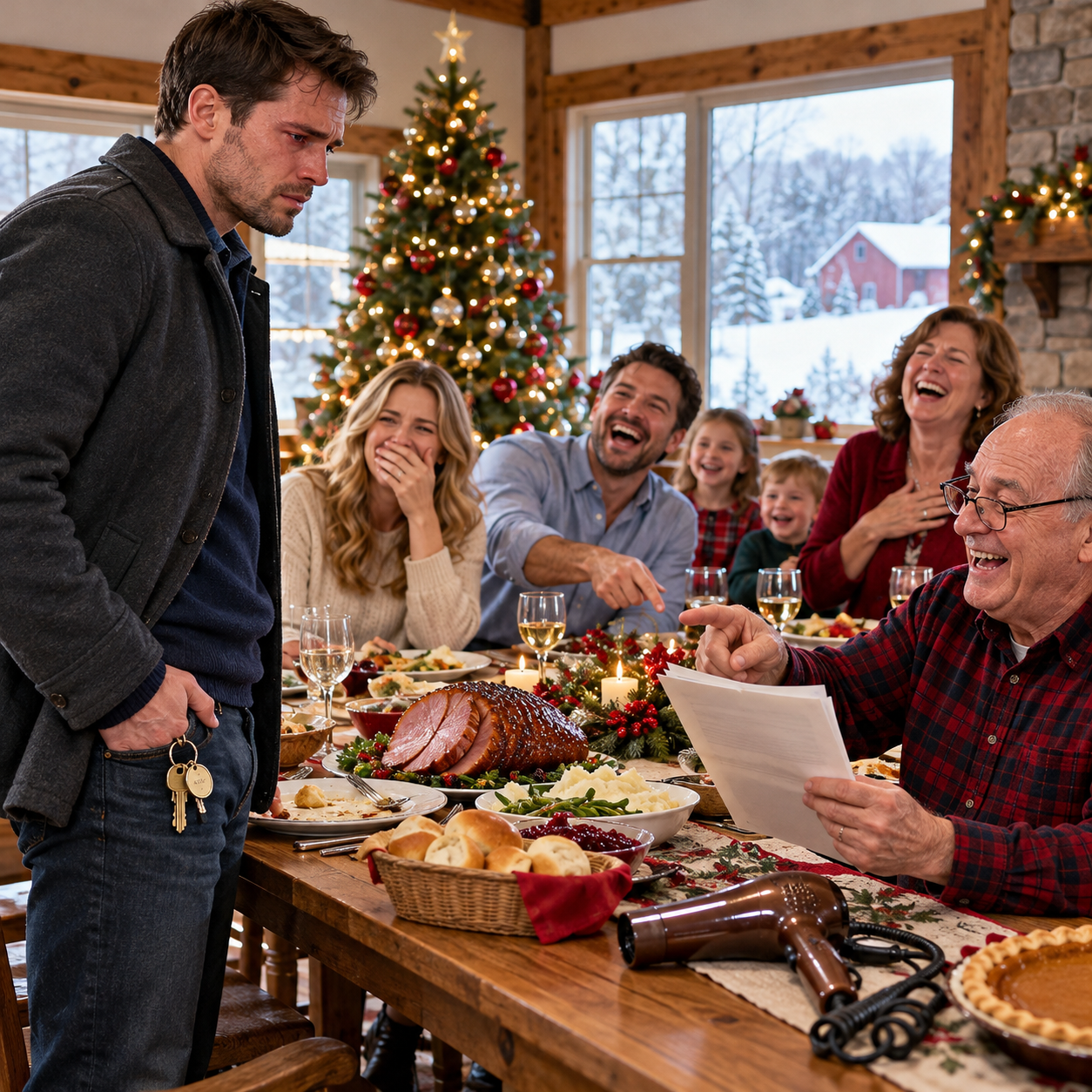
On Monday, January twelfth, my phone vibrated while I was repairing a lift tower. Mom’s message contained three words and two exclamation points: “Propane’s due!!” No greeting, no question about my Christmas, not even an acknowledgment of our last conversation. With my fingers stiff from the cold, I typed, “Just use the hair dryer.”
I regretted the cruelty of it almost immediately, but I didn’t send another message.
Mom called Caitlyn instead. I learned later that she’d explained the tank needed filling and asked whether Caitlyn and Nolan could help, considering they would eventually inherit the property. My sister’s answer was immediate. “It’s not our house yet, Mom. We’re not spending money heating somewhere we don’t live.”
On Tuesday, the propane truck arrived. The driver, Arch, knocked on the farmhouse door, but Mom insisted I was responsible for payment. Dena called me at work, and I confirmed that the account was no longer mine. Arch offered to wait while Dad brought out his checkbook, but Mom stopped him. “If we pay it ourselves this once, Brett will never start again,” she insisted.
The delivery truck left without filling the tank.
That evening, a dangerous cold front moved south from Quebec. I sent Dad a message warning him that temperatures could fall to twenty below zero by Thursday. I gave him Dena’s hours and urged him to arrange delivery immediately. His reply arrived an hour later: “Your mother’s handling it.”
I considered paying anyway. I even picked up my truck keys before remembering my mother’s laughter and the way Caitlyn had squeezed my arm while thanking me for keeping her future inheritance warm.
Thursday arrived with biting wind and thickening frost. I worked late, drove home beneath a sky without stars, and lit my wood stove. By eleven, the thermometer outside my porch read twenty below zero. I was drifting toward sleep when headlights swept across my living room.
Dad’s silver pickup was idling in the driveway.
He climbed out wearing flannel pajama pants, a work coat, and bedroom slippers. In his hand was the old brown hair dryer he’d once used to dry his fishing gloves. I opened the door as he approached, and the freezing air rushed into my chest.
“The furnace quit around six,” he said, his voice trembling. “Tank’s empty. The kitchen pipes started freezing, so I’ve been trying to warm them with this thing.” He lifted the dryer, then stared at it with an expression I couldn’t read. “They can’t restart the system until they do a safety inspection. Tomorrow afternoon, earliest.”
Through the windshield, I could see Mom sitting beneath a blanket. “Why didn’t you go to Caitlyn’s?” I asked.
Dad looked toward the truck. “We called her first. Paisley’s got a cough, and Nolan has an important morning at work.” He swallowed before repeating my sister’s exact words. “She said it wasn’t a good night.”
My mother rolled down her window. “We’re certainly not paying for a motel when our son has an entire house!”
For a moment, I looked at my father standing in twenty-below weather, holding the very thing he’d decided was all I deserved.
Then I stepped aside.
“Get Mom inside, Dad. Before somebody gets frostbite.”
## Part 3: A Desperate Night Reveals The Christmas Gift They Rejected
I hung Mom’s blanket beside the front door and filled the kettle while Dad placed the hair dryer on my kitchen counter. Neither parent apologized. Mom sat rigidly at the table, still wearing her winter coat, while Dad rubbed warmth into his hands. I made him black coffee and gave her the pale, milky cup she’d preferred my entire life.
“Whose house were you planning to leave Caitlyn?” I asked quietly. Dad lowered his eyes. “Brett, please. We’ve had a terrible night.” I nodded toward the window, where frost covered the glass. “I know. I’ve had seven years of them.”
Mom stood, apparently determined to end the conversation, and reached for a cupboard above the coffee maker. Her hand stopped halfway. She opened the door, then another, and looked down at the countertop as though something was wrong. “Why is everything so low?” she whispered.
“An inch and a half below standard,” I answered.
Dad had already wandered toward the wood stove. His fingers rested on the brown corduroy recliner, tracing the left arm where the spring had always poked through his old chair. “This looks like mine,” he said.
“It’s the same model, Dad. Just new.”
Mom walked down the hallway without asking permission. She stopped at the bathroom, examining the walk-in shower and the grab bar beside it. Then she opened the larger bedroom and froze. My grandmother’s quilt lay across the bed, her favorite style of reading lamp stood on one nightstand, and Dad’s familiar little water coaster rested on the other.
“Whose room is this?” she asked.
I reached into the pocket of my Christmas coat and removed the keys and folded floor plan. When I opened the paper, Mom recognized the handwriting immediately. She read the Christmas greeting, then stared at the brass tag bearing their names.
“Last April, you told me you’d give anything for a house without stairs,” I said. “I owned the land, so Harlo and I built one. Every door is wide enough for a wheelchair. The counters are your height. That shower is for your safety, and the stove is for Dad.”
Mom pressed her fingers against her mouth. Dad stepped into the bathroom and instinctively gripped the safety bar at exactly the height I’d measured from his hand resting against his truck. His shoulders dropped.
“I was going to give you these keys on Christmas,” I continued. “You could’ve lived here while I moved into the farmhouse. I thought I was keeping a promise Dad made when I started paying your bills.”
Mom began crying, and Dad sat on the edge of the bed. Neither spoke as I folded the plans and returned the keys to my pocket.
“You can sleep here tonight,” I told them. “There are clean towels in the bathroom.”
I took the couch. Through the wall, I heard Mom crying and Dad speaking softly to her, but I couldn’t make out the words.
By morning, the air outside had cleared. I scrambled eggs while Mom quietly set the table, discovering that I’d arranged every plate and cup exactly where she kept them at the farmhouse. We were eating when Caitlyn’s minivan pulled into the driveway.
Nolan entered first, inspecting the ceiling, the flooring, and the bathroom tile as if he were preparing a real estate estimate. Caitlyn embraced Mom, then settled at the table while her husband wandered through the rooms eating a piece of my toast. Mom seemed desperate to find something comforting to say.
“Well, sweetheart,” she told Caitlyn, patting her hand, “at least the farmhouse will belong to you and the children someday.”
Nolan returned to the kitchen. “We’d sell it, obviously,” he announced. “That old place costs a fortune to heat.”
Caitlyn grabbed his sleeve, but he’d already spoken. Mom’s hand slid away from her daughter’s. “Sell it?” she asked. Caitlyn sighed and explained that Nolan’s business had been struggling and they couldn’t afford to maintain an aging farmhouse so far from town.
Mom stared at her. “You told me in October that Brett didn’t need the house because he was building his own. You pushed us to change the will so the children would have somewhere secure.”
“Exactly,” Caitlyn replied. “And now he’s built you somewhere better.”
I watched Mom’s expression change as she understood how carefully she’d been persuaded. Then Caitlyn looked toward the bedroom, saw the quilt, and smiled with sudden excitement.
“This actually works out perfectly,” she said. “Mom and Dad can move here, and we can sell the farmhouse right now.”
Dad slowly put down his fork.
For the first time that morning, he looked directly at his daughter.
## Part 4: My Family Faces The Truth And I Finally Choose Peace
“No,” Dad said.
The single word silenced Caitlyn. She stared at him as though she’d never heard him refuse her anything. Nolan stopped chewing, and Mom sat with both hands wrapped around her coffee mug.
Dad turned toward me. “Son, I made a terrible mistake,” he said. “I’ll go back to the lawyer. I’ll leave you the farmhouse like I always promised. Just let your mother have the kitchen you built for her.”
I looked at the man who had once taught me to change a tire in freezing rain and never leave another person stranded. I still loved him. But love didn’t erase the memory of sitting at Christmas dinner while my entire family laughed at what they believed I deserved.
“Dad, I didn’t build this place to buy an inheritance,” I said. “I built it because you needed somewhere safe to grow old. I trusted your promise, but I was going to give you these keys without asking for a contract.”
Mom wiped her eyes. “Then why can’t we still move in?”
“Because something changed at Christmas. I realized you’d come to expect everything I gave you, and you couldn’t even see what it cost me.”
Caitlyn pushed back her chair. “So you’re leaving a beautiful bedroom empty just to punish them?”
I looked toward the hallway. “It’s not empty,” I answered. “It just isn’t theirs anymore.”
Nolan quietly set down his unfinished toast.
Caitlyn collected her purse and offered to drive our parents home after the propane delivery. Dad refused. He stood, reached for Mom’s coat, and told her they would drive themselves. Before leaving, Mom washed every breakfast dish and returned each one to its proper cupboard.
That small, familiar gesture hurt more than another argument would have.
At two that afternoon, I followed Dad’s truck to the farmhouse. Arch was waiting with his equipment, and Dad walked outside wearing proper winter boots. He took his checkbook from his coat, leaned against the truck hood, and paid for the propane himself.
Four minutes.
The same amount of time it had taken me to end seven years of automatic payments.
After the safety check, the boiler restarted, and Dad watched steam rise from the chimney. He walked over to my open truck window and cleared his throat. “That old hair dryer’s still on your kitchen counter.”
“Keep it, Dad.”
He managed a faint smile. “Can’t. Says right there in the will it’s yours.”
It wasn’t quite forgiveness, but it was the first honest joke we’d shared in weeks.
In February, Dad visited his attorney without telling anyone. Caitlyn informed me about it afterward in a furious text. The new will required the farmhouse to be sold after both parents died, with the proceeds divided equally between us.
Caitlyn accused me of destroying her children’s future. I didn’t answer. By March, Nolan’s hot tub showroom had closed, and they were living in his mother’s basement in Castleton.
My parents continued living in the farmhouse and paying their own bills. Dena told me their account was always current, which didn’t surprise me. Dad had never been incapable of taking care of himself. He had simply grown comfortable letting me do it.
I still visit occasionally. Mom makes my favorite mashed potatoes, and Dad asks about the ski lifts. We talk about work, the weather, and sometimes nothing at all. Mom passes my house every morning on her way to the school cafeteria, and occasionally she raises two fingers from her steering wheel. I wave back without expecting her to stop.
Then something happened that I hadn’t anticipated.
One February afternoon, I stopped at the Otter Creek office to thank Dena for her kindness throughout the whole ordeal. She was sitting behind her desk wearing two sweaters, with a tiny space heater humming beside her feet. When I introduced myself, she grinned.
“You’re Brett? I thought you’d be shorter.”
We had coffee at a diner in Proctor. The following week, we had dinner, and by April, she was spending Sunday evenings at my house.
One cold, rainy evening, she stepped inside, glanced at my thermostat, and gasped. “Sixty-five degrees? Brett, do you actually enjoy freezing?”
“It’s a perfectly respectable temperature,” I protested.
“Maybe for penguins.” She turned the dial to seventy-two.
I watched her do it, remembering how I’d spent years complaining about the heat in my parents’ farmhouse. Then I smiled and said nothing. For the first time, I was paying to keep someone warm because I wanted her beside me, not because she expected me to sacrifice for her.
Later, after using the walk-in shower, Dena called from the hallway. “Brett, do you have a hair dryer?”
I opened the closet and handed her the ancient brown machine. She examined its scratched casing and twisted cord before looking up at me.
“Wait. Is this the famous hair dryer?”
“The very one,” I said. “My inheritance. Please handle it carefully.”
She plugged it in, and the motor roared like an aging lawn mower. Dena laughed so hard she had to sit on the bed beneath my grandmother’s quilt. I stood in the doorway watching her, and something that had been painfully tight inside my chest finally loosened.
The room I’d built for my parents was now a guest room. Dena’s mother stayed there when she visited, delighted by the low counters and the easy shower. Dad’s brown recliner still stood beside the stove, but sometimes Dena curled up in it with a book while I added another log to the fire.
One Sunday, she caught me looking at the brass key ring hanging beside the front door. The little tag still said “Mom and Dad,” and for a moment, I considered taking it down. Then Dena slipped her hand into mine and asked whether I was all right.
“I think so,” I said, and realized I meant it.
I’d spent seven years believing that keeping my family warm would eventually make them appreciate me. What finally changed my life wasn’t shutting off their payments or inheriting a farmhouse. It was learning that I could love people without letting them decide what my love was worth.
Outside, snow drifted against the windows. Inside, the wood stove crackled, Dena leaned against my shoulder, and the house I’d built out of love finally felt like home.
THE END.
All characters and events in this story are fictional, created for storytelling and entertainment purposes. Thank you sincerely for reading. Your feedback and support are invaluable and motivate me to continue sharing more stories with you.


