
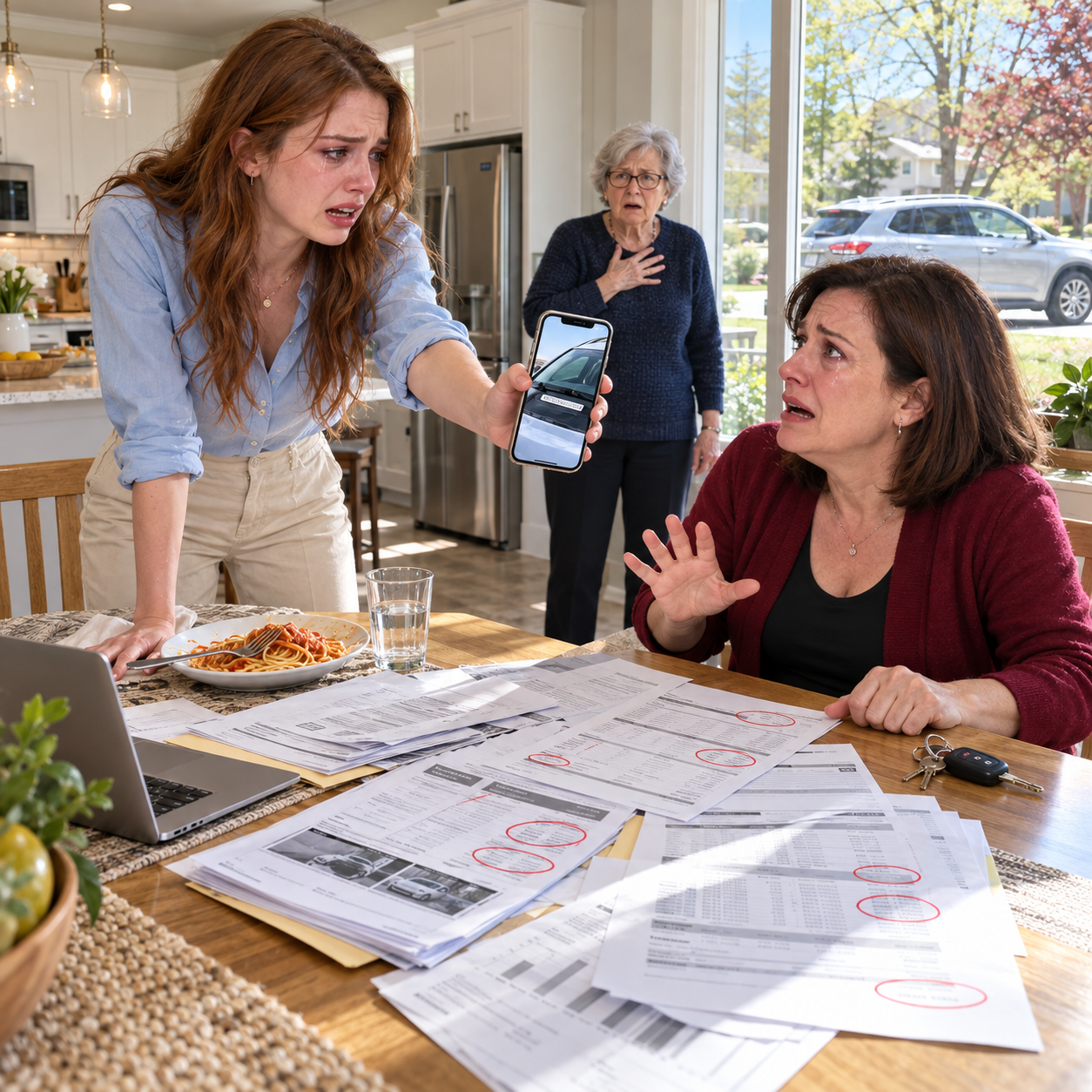
Part 2: One New Credit Application Exposed Seventeen Years of Betrayal
Grandma was sitting on her porch glider when I returned to Lawrence. I told her about the SUV, the unpaid debts, and Mom’s promise, watching the porch light attract small insects while the evening cooled. When I asked what she thought I should do, she didn’t offer the certainty I desperately wanted. She simply said, “It’s your name, honey. That means you get to decide.”
For the next week, I tried to believe my mother. I sent messages asking which creditors she’d contacted and whether she had payment arrangements in writing. Her replies were affectionate but vague, and no balances changed. Meanwhile, the apartment manager gave me until April 30 to provide a qualified co-signer or a much larger deposit, neither of which I could readily manage with $400 in savings.
At 6:40 on April 19, my credit monitoring application sent an alert. Someone had applied for another credit card using my identity on April 17, five days after I’d confronted my mother. I called twice and received no answer. Three hours later, she texted that it must be the identity thieves again.
I read that message several times before forwarding it to Grandma. My mother wasn’t even waiting for July. She was still using my information while promising to repair the damage she’d already done.
That evening, Grandma asked me to sit with her on the porch. She kept smoothing the hem of her cardigan, searching for words, before telling me something she had hidden for twenty-seven years.
“In 1999, when your mother was eighteen, she opened two credit cards in my name,” she said. “She spent seventy-eight hundred dollars. Mostly clothes and a stereo.”
I turned toward her, waiting for the part where she’d reported it.
“I paid them off myself,” Grandma continued. “Worked extra Saturdays for almost two years. I didn’t want your mother arrested, and I told myself she’d learned something. I never even confronted her about it.”
“Why are you telling me now?”
She looked down at her hands. “Because I thought keeping quiet was protecting my daughter. Now I’m looking at what that silence cost my grandchild.”
On April 24, I met Detective McKay at the Topeka police department. He had a worn tie, a careful manner, and a box of tissues positioned near the edge of his desk. I handed him the credit reports, the photograph of the SUV’s identification number, and the messages from my mother. He listened while I described the financial aid accounts and the collection letter I’d thrown away three years earlier.
McKay explained how filing identity theft reports could help me challenge fraudulent accounts with the credit bureaus. He also explained that reporting the suspected crimes could initiate an investigation beyond my control. I told him I wanted to recover my financial identity, not see my mother behind bars.
“Those are two separate things,” he said gently. “You can decide whether to report what happened. Once it’s reported, the criminal case isn’t yours alone to stop.”
I signed the statement at 11:20 that morning. McKay helped me complete the federal identity theft report and explained the documentation I’d need to dispute the debts. When I walked back outside, my car was still parked in the same space, the traffic lights still changing, and people were carrying grocery bags along the sidewalk. I remember being surprised that such an ordinary day could contain a decision so difficult.
My mother learned about the report the following Monday. I called her myself, hoping she’d at least understand why I’d done it. Instead, she accused me of destroying her livelihood and demanded to know how I could turn against the woman who’d raised me. She hung up before I finished speaking.
By Tuesday, relatives were calling. My aunt asked whether I understood what criminal charges could do to someone’s life, and an uncle left an angry voicemail suggesting my education had made me arrogant. A cousin stopped speaking to me altogether. Almost nobody asked how I was supposed to rent an apartment or repay debts I hadn’t created.
Wednesday evening, Mom posted a Facebook message about ungrateful children betraying the people who sacrificed for them. Forty-seven people liked it. I recognized names from birthday parties, family cookouts, and church gatherings, people who’d known me since I was little.
My roommate found me sitting on our dormitory floor reading the comments. She returned twenty minutes later carrying two deli sandwiches, settled beside me, and handed me one without asking for an explanation. After a while, she said, “My dad always says people get awfully loud when they don’t want anyone checking their math.” I laughed despite myself and finally took a bite.
The following afternoon, I was studying at Grandma’s kitchen table when my mother called her. I could hear Mom crying through the receiver, asking Grandma to convince me to stop cooperating with police. Grandma listened, then said, “Lawana, you don’t get to borrow somebody else’s good name just because you’ve used up your own.”
Whatever Mom said next made Grandma’s expression change.
“I know about the cards you opened when you were eighteen,” Grandma told her. “I’ve known all these years.”
She ended the call and returned to drying dishes, but her hands trembled enough that she dropped a fork.
On May 1, after my last college lecture, I called Detective McKay and asked whether I could withdraw the complaint. I kept picturing Mom driving through a snowstorm when I was sick freshman year, bringing medicine and sitting beside my bed until I fell asleep. McKay explained that the investigation had already begun and that abandoning my disputes could leave my credit problems unresolved.
“She’s still my mother,” I told him.
“I understand,” he said. “But you shouldn’t have to accept the debt to prove you love her.”
I stayed on the campus bench long after our conversation ended. Then I put the phone in my bag and went to finish my last assignment.
Part 3: The Oldest Evidence Revealed How Long My Mother Had Lied
On May 6, Detective McKay called with information obtained during his investigation. The dealership had supplied the 2022 loan application, which carried my name and a signature resembling my mother’s handwriting. The contact number belonged to her, and the employment and income information matched her medical billing position. Those details gave the investigation something considerably stronger than my photograph of her windshield.
But the utility records contained an even older account. A gas service application had been opened under my identity in October 2009 at an apartment on Southwest Gage Boulevard. I remembered the place immediately: the narrow hallway, the rattling air conditioner, and the kitchen window that faced a brick wall.
I had been five years old.
I sat beneath Grandma’s redbud tree that evening, holding a cup of tea she had brought outside. In kindergarten, I’d been learning to spell my name with fat purple crayons. While I practiced forming those letters, my mother had already been using them on financial applications. The rule against opening my own mail suddenly looked very different.
Grandma stayed beside me until the mosquitoes came out. She didn’t tell me that my mother had never loved me, because neither of us believed the situation was that simple. Mom had loved me in ways I remembered clearly, but she had also repeatedly chosen her own needs over my future. Both things were true, and neither canceled the other.
On May 9, Grandma accompanied me to the campus bookstore to collect my graduation cap and gown. While I waited in line, she wandered over to the diploma frames and selected a dark wooden one with a narrow gold border and the university seal. It cost $140. When I objected, she opened her purse and counted out ten- and twenty-dollar bills she’d saved in an envelope.
“I’ve been putting money aside for this since you were in kindergarten,” she said, refusing to let me return it.
That was the same year my mother had used my identity to open the old gas account. Grandma didn’t know that when she began saving, of course. But watching her carry the frame to the register, I wondered how two people could shape the same child’s life in such different ways.
On May 11, McKay informed me that my mother had hired an attorney and declined an interview. Four days later, the district attorney filed multiple identity theft charges, and a judge signed an arrest warrant. McKay said he’d tried contacting her attorney to arrange a voluntary surrender but hadn’t received a response.
That Friday evening, I drove past my mother’s rental house without announcing myself. The garage door was open, revealing cardboard boxes labeled KITCHEN, BATHROOM, and WINTER in black marker. Loy was carrying a lamp toward a pile of unwanted furniture near the curb. I watched from across the street, trying to understand why Mom hadn’t mentioned packing.
The following morning, my aunt called. Her voice was quieter than it had been during our previous conversation.
“Your mother’s moving to Florida with Loy,” she said. “They rented a truck. They’re leaving Monday morning, and she asked me not to tell you.”
Monday was May 18, the day after my graduation. I pictured the silver SUV heading south, loaded with everything my mother wanted to keep, while I stayed behind with the creditors and police reports. I called Grandma and explained what I’d learned.
“I’ll speak with Detective McKay,” she said.
That night Mom sent her first personal message to me since the argument about the police report. She said she’d be at graduation because I was her child and nothing could change that. I showed Grandma the screen, uncertain whether I wanted Mom there or wished she would stay home.
Grandma read it, gave the phone back, and said, “Let her come.”
She explained that she’d already told McKay about the planned move. He had alerted university police to the outstanding warrant and my mother’s expected presence at the stadium. If Mom appeared, Grandma could contact them, and the officers would handle the matter.
I stared at her. “You’d really call them during graduation?”
“I wish she’d surrendered on her own,” Grandma replied. “I wish none of this had happened. But she’s had opportunities to make a different choice.”
Sunday morning, Grandma made scrambled eggs while I dressed. She adjusted my tassel, smoothed the shoulders of my blue gown, and handed me a cup of coffee I barely touched. Before leaving, she slipped McKay’s business card into her purse beside a folded tissue.
At the university, thousands of graduates gathered for the traditional walk down the hill toward the football stadium. Friends shouted congratulations, parents waved from the sidewalks, and cameras flashed beneath the bright May sun. I walked beside classmates who were talking about summer plans and new apartments, trying to hold on to the knowledge that I’d earned the right to be there.
Inside the stadium, I found Grandma in the lower seating section wearing her good navy cardigan. Three rows behind her sat my mother with an enormous bouquet of sunflowers in brown paper across her lap. Loy was beside her in a cowboy hat.
Mom saw me looking and lifted the flowers above her head. Her smile was so familiar that I automatically waved back.
For two hours I listened to speeches, applauded classmates, and moved my tassel when everyone else did. Each time I glanced toward the stands, I saw my mother watching me with unmistakable pride. I couldn’t understand how someone who had endangered my future could look so genuinely happy to see me reach it.
After the ceremony, I walked toward gate four, where Grandma and I had arranged to meet. Graduates crowded the walkway, balloons bobbing above their heads as families searched for one another.
Grandma was waiting near the grass when my mother emerged from the crowd with Loy several steps behind her. She called my name, pushed the sunflowers into my arms, and wrapped me in a fierce embrace.
Part 4: At Gate Four My Grandmother Finally Broke the Family Silence
“I’m so proud of you, baby,” Mom said, pressing her cheek against mine. “You did it. Look at you.”
I could smell her familiar perfume beneath the sharp green scent of the sunflower stems. She straightened the collar of my gown, brushing away a loose thread as if I were still a little kid getting ready for school.
Then she leaned close enough that her lips almost touched my ear.
“Withdraw it, please,” she whispered. “I’m leaving tomorrow. Nobody ever has to know.”
I eased away and looked at her. She kept smiling for the families passing beside us, though her fingers tightened around my sleeve. Behind her, I saw Grandma step onto the grass, take out her phone, and speak into it with one hand covering her other ear.
I could make out three words through the crowd: “Gate four. Here.”
Mom followed my gaze. She looked toward Grandma, then back at me, and something guarded entered her expression.
“Don’t let them make you do this,” she said quietly.
“Mom, I already filed the report.”
“You can tell them it was a misunderstanding.”
Before I could answer, two university police officers approached. The female officer asked my mother to confirm her name and explained there was an active warrant from Shawnee County. Mom looked toward Loy, who stood several feet away with his cowboy hat in his hands, apparently unable to find anything useful to say.
Then she looked at Grandma.
“Mama?”
Grandma stood with her purse hanging from her elbow. Her face looked tired, and for a moment I thought she might turn away.
“Not this time, Lawana,” she answered.
The officer asked Mom to turn around. My mother complied, her shoulders sinking as the handcuffs were secured behind her back. She didn’t shout or struggle, but before the officers escorted her toward their vehicle, she looked directly at me.
I wanted to say something that would make the whole scene less terrible. I wanted her to understand that I’d loved her before I knew about the credit cards, and that discovering them hadn’t erased every good memory we had. But the officers were already guiding her through the crowd, and the words wouldn’t come.
It was 12:58 when I checked my phone. The bouquet lay on the concrete, its brown paper torn and several sunflowers crushed beneath passing shoes. All around us, families were taking photographs, hugging graduates, and planning celebratory lunches. Someone nearby was laughing so loudly that I could hear it above the traffic.
Grandma came to stand beside me. She took my hand without asking me to stop crying or promising that everything would be fine.
After a while, she said, “Come on, honey. Let’s go home.”
We walked back to her car without speaking. I didn’t look behind us, and I didn’t pick up the flowers.
Mom was released on bond two days later. She didn’t move to Florida, and for the first time in my life, I stopped checking my phone every few minutes to see whether she had called. I still missed her, especially during ordinary moments when something funny happened and my first instinct was to tell her.
Using the police report and identity theft documentation, I disputed the fraudulent accounts with the credit bureaus. Over the summer, the accounts were blocked from my credit files one by one. By the end of August, my score had risen from 512 to 694.
I didn’t get the apartment overlooking the fountain. Grandma co-signed for a different one-bedroom in Overland Park, and I moved in on July 1, one month after starting my job. My balcony overlooked a parking lot, and the refrigerator made a clicking noise whenever the compressor started. I loved every inch of that apartment because I could finally plan a future without wondering what new bill might arrive under my name.
In September, my mother pleaded guilty to two counts of identity theft. She received two years of probation, sixty days in county jail, and an order to pay $31,200 in restitution. Her employer had terminated her after the charges were filed, a consequence she’d warned me about repeatedly and one I still wished she’d chosen to avoid.
I hadn’t seen her since gate four. In October, a letter arrived from the county jail, addressed in handwriting I recognized immediately. I set it inside my desk drawer without opening it. Some evenings I considered reading it, but I was learning that I didn’t owe anyone an immediate answer simply because they wanted one.
One Sunday, Grandma visited my apartment carrying the graduation frame she’d bought in May. My diploma was already mounted inside, and I noticed the backing had been wrapped in crinkled brown paper tied with string.
“Where did you find that?” I asked.
She avoided my eyes for a moment. “I went back after we got to the car that day. I couldn’t stand the thought of leaving those flowers there.”
She had recovered the torn wrapping from Mom’s bouquet, cleaned it, and used it to protect the frame. She’d also written something on the back in her careful, slightly slanted handwriting.
This one I didn’t let slide.
I ran my fingertips over the words. Grandma stood beside the desk, watching me without trying to explain herself.
“Why didn’t you tell me you went back?” I asked.
“You had enough to carry that afternoon,” she said. “I thought I’d take care of one little thing.”
I looked at the diploma, at the gold-edged frame, and at the seventy-year-old woman who had finally refused to hide another generation’s wrongdoing. She’d once believed that loving her daughter meant absorbing the damage without complaint. Now she’d shown me that love could also mean telling the truth, even when everyone wished you wouldn’t.
I hung the diploma above my desk while Grandma held the frame steady. Then we stepped back together to straighten it, shifting it slightly until the edges aligned with the shelf below.
She stayed for dinner. We ate spaghetti from mismatched bowls, and she asked about my new supervisor, my neighbors, and whether I’d remembered to have my car serviced. For the first time in months, our conversation wasn’t dominated by my mother’s decisions.
Before leaving, Grandma hugged me at the apartment door and said she was proud of the person I’d become. I held her a moment longer, remembering the sunflowers on the concrete and the way she’d stood beside me after the police drove away.
I didn’t know whether my mother and I would ever speak again. I hoped she might someday accept what she’d done without asking me to carry the consequences for her. But rebuilding our relationship would require more than an apology, and I no longer felt obliged to decide its future before I was ready.
After Grandma left, I returned to my desk and looked at the diploma hanging above it. That piece of paper represented four years of studying, working, worrying, and believing I could build a different life. The writing on the back represented something I’d needed just as badly: a grandmother who understood, finally, that protecting me meant refusing to protect a lie.
My favorite graduation gift wasn’t the sunflowers, the frame, or even the diploma itself. It was the moment Grandma stood at gate four, frightened and trembling, and chose to let the truth stand.
The End .
All characters and events in this story are fictional, created for storytelling and entertainment purposes. Thank you sincerely for reading. Your feedback and support are invaluable and motivate me to continue sharing more stories with you.


