
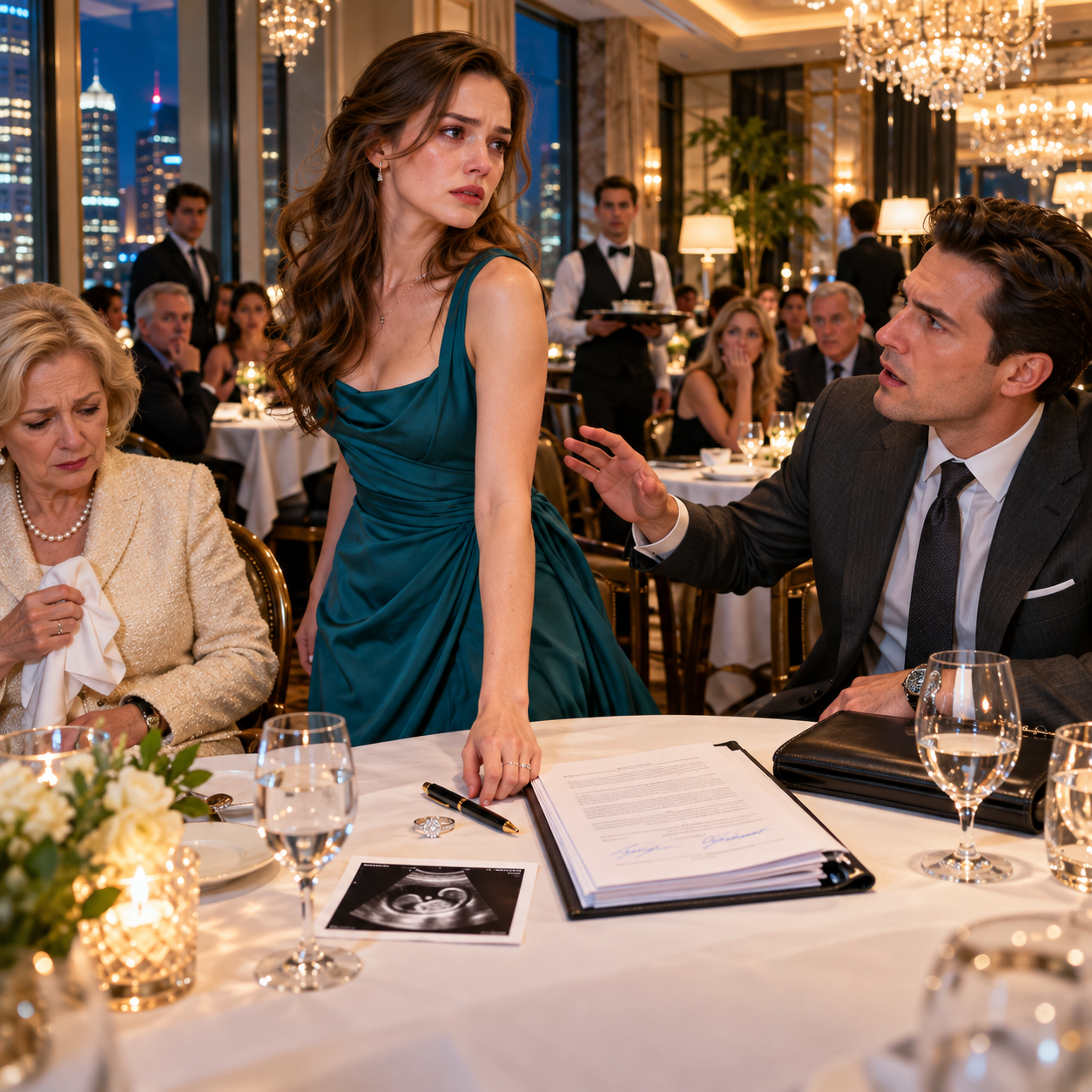
Part 2: A Recovering Father Learned To Choose Without Making Demands
Three weeks later, I traveled to a rehabilitation center outside Newburyport, Massachusetts. Eleanor met me in the lobby, carrying a paper bag filled with sandwiches neither of us wanted. She explained that Julian could speak in short sentences, although exhaustion sometimes left him unable to find familiar words. His progress was encouraging but unpredictable, and the doctors had warned against expecting anything resembling a complete recovery.
I found him beside a tall window overlooking a garden. He was thinner than the boy I remembered, with a scar disappearing into his dark hair and a wheelchair positioned beside his bed. A therapist had left a wooden puzzle on his tray, its pieces scattered after an unsuccessful attempt. When I introduced myself, he studied my face for several seconds before saying, “Yellow raincoat.”
I almost laughed. My mother had made that raincoat from discarded waterproof fabric when I was twelve, and I’d hated how brightly it stood out among the expensive jackets worn by the other neighborhood children. One afternoon, Julian had found me crying beside a bus stop after classmates mocked it. He’d sat beside me, spread his newspaper over our schoolbooks to protect them from the rain, and told me that anyone wearing a gray jacket in November lacked imagination. “You remember that?” I asked. He nodded slowly. “Your mother made it. You told me she could make anything.”
His mother had explained the pregnancy before my visit, and Julian didn’t pretend to understand all of its implications. He asked to see the medical records, then spent several minutes turning the pages with an unsteady hand. “They used something of mine,” he said finally, “and put you through something neither of us agreed to.” I confirmed that was what had happened. He looked toward the window before asking, “Are you keeping the baby?”
“Yes.” He pressed his thumb against the edge of the folder. “I’d like to know him, if that’s possible. I can’t promise how much I’ll be able to do at first.” His voice caught on the last words, and I noticed how carefully he was holding his right hand still. I told him we could take things slowly, with lawyers handling the legal questions and his medical team determining what he could manage.
Eleanor offered me the use of a guest cottage near the rehabilitation center while the clinic’s investigation continued. I accepted a temporary arrangement, paying what rent I could and insisting on a written agreement. Marcus had taught me how easily generosity could become leverage, even when the person offering it meant well. Eleanor looked slightly wounded when I requested the paperwork, then returned the following morning with a signed lease and an apology for not suggesting it herself.
During the next several months, Julian and I became familiar through ordinary afternoons rather than dramatic declarations. I watched him struggle to button a shirt, recover forgotten words, and walk twelve steps before needing to sit down. He asked about my design work, my mother’s death, and why I’d stayed with Marcus after the relationship had become so unhappy. I told him some of the truth, including how frightened I’d been of starting over without savings. He never tried to turn those admissions into evidence that he should take care of everything.
One rainy afternoon, he noticed sketches protruding from my tote bag. I reluctantly showed him a collection of practical dresses designed for women who wanted elegance without sacrificing comfort. He studied the drawings and asked why none had been produced. “Because factories require deposits,” I said, “and my bank account currently contains enough money for groceries and approximately half a sewing machine.”
“Could you start with three samples instead of thirty?” he asked. I admitted that I could, if I took an evening pattern-making course and found a small production studio. He offered to introduce me to someone in the industry, but when I said I wanted to try independently, he accepted that answer. Two weeks later, I enrolled in the course using money I’d earned from alterations, and Julian asked to see my assignments after class.
By my sixth month, he could walk short distances with a cane. One evening, while we sat on the cottage porch, the baby began kicking hard enough to disturb the notebook resting against my stomach. Julian noticed me shifting and asked whether I was uncomfortable. I took his hand and placed it against the fabric of my dress, waiting until another kick pushed against his palm.
His expression softened, then tightened with an emotion he seemed reluctant to display. “Hello in there,” he whispered. We remained that way until the baby stopped moving, and Julian withdrew his hand carefully. “I spent four years missing my own life,” he said. “I don’t want to miss his.” I told him that showing up mattered more than being perfect, though I was beginning to realize how much that lesson applied to both of us.
Around that time, Danielle called with news about Marcus. He and Ivy were engaged, and Ivy was pregnant. Their photographs appeared in society columns, accompanied by cheerful descriptions of a romance rekindled after years apart. Danielle also mentioned rumors that Ivy had continued seeing a London art consultant named Preston during her relationship with Marcus. I asked Danielle not to send me the photographs anymore. The old apartment, the ring, and Marcus’s polished assurances had finally begun to feel like things that belonged to someone else.
One night, Julian asked whether I could imagine us becoming more than parents to the same child. I was sitting beside him at the kitchen table, finishing a seam while he practiced writing with his recovering hand. “I don’t know,” I admitted. “I like being here, and I like you. But I need to know I’m choosing something because I want it, not because I’m afraid of leaving.” He set down his pen and said, “Then we won’t rush.” For the first time in years, uncertainty didn’t feel like a problem somebody expected me to solve immediately.
Part 3: Two Men Faced The Truth While I Built Home
Our son arrived six weeks early, on a cold Tuesday morning in February. His name was James Oliver Cole, although the decision to use the Cole surname had taken several thoughtful conversations and a formal agreement about parental responsibilities. He weighed just over six pounds and needed additional observation in the neonatal unit because of his early arrival. Julian stood beside my hospital bed, leaning against his cane, asking the nurses so many questions that one eventually handed him a printed newborn-care guide.
When he finally held James, his recovered hand trembled beneath the baby’s blanket. “I thought I’d forgotten how to be useful,” he murmured. I watched him adjust the blanket with painstaking concentration before gently touching our son’s cheek. Eleanor stood nearby, pressing a tissue against her mouth. Nobody mentioned family legacies or inheritance that morning. We were simply three exhausted adults watching a small boy breathe.
Six weeks later, Eleanor hosted a reception connected to the family’s maritime scholarship foundation. She wanted several relatives and trustees to meet James, and she’d promised to keep the occasion small. By the time guests began arriving, nearly sixty people had gathered beneath the glass ceiling of the family’s coastal conservatory. Julian wore a navy jacket and carried James in a soft infant carrier, pausing whenever someone approached too quickly.
I was speaking with a foundation volunteer when I saw Marcus enter with Ivy. Their invitation had come through a business associate on the foundation’s board, and neither Eleanor nor I had known they were attending. Ivy rested one hand against her visibly pregnant stomach. Marcus saw me first, then Julian, then the baby sleeping against his chest.
“Nora,” Marcus said when he approached. “I didn’t realize you’d be here.” I told him that Eleanor was hosting the reception and introduced him to Julian. His gaze moved to James again. “So the information your attorney sent about the clinic was true.” Julian nodded and said, “The independent testing confirmed it. James is my son.”
Marcus seemed to search for something to say. Ivy touched his arm and suggested they find their table, but he remained beside us. “I thought you were just trying to make the breakup difficult,” he said to me. I glanced at James, who had begun stirring, and answered, “I was trying to protect my pregnancy and get accurate medical records. I wasn’t trying to make anything difficult for you.”
He looked down at his hands, then excused himself. Later, Danielle told me she’d seen Ivy speaking urgently to him on the terrace. I could imagine a hundred reasons for their disagreement, but none required my involvement. I spent the rest of the reception helping Eleanor greet guests and watching Julian patiently soothe our son through his first difficult evening away from home.
Three months later, Marcus requested a meeting through my attorney. We met at a quiet coffee shop with Danielle waiting nearby, because I wanted the conversation to have a beginning and an end. Marcus looked tired, and for once he wore an inexpensive sweater instead of one of his carefully tailored suits. He told me he’d discovered proof that Ivy’s relationship with Preston had continued throughout their engagement. A prenatal paternity test, performed with Ivy’s agreement after they separated, had established that her baby wasn’t his.
“I’m not telling you because I expect sympathy,” he said, turning his coffee cup between his hands. “I thought I knew how to recognize betrayal. Apparently, I only knew how to accuse other people of it.” He admitted that he’d ended their engagement and was seeking counseling. Then he pushed a folded letter across the table, formally withdrawing the demands he’d made concerning my pregnancy and confirming that he would not pursue the separation agreement.
I read the letter without speaking. His attorney had already acknowledged that the pregnancy provision was unenforceable, but I appreciated having the matter settled in writing. Marcus watched me refold the paper before asking, “Would you have kept the baby if he’d been mine?” I answered yes. He closed his eyes briefly and said, “I owe you an apology for making you feel that our child would have been a punishment.”
I believed he meant it, but I didn’t offer him forgiveness as a way of making the conversation easier. “You knew I wanted to be a mother,” I said. “You knew how hard the treatments were. I needed you to remember that before you handed me that folder.” He nodded, paid for his coffee, and left without asking whether we could be friends.
The fertility clinic eventually accepted responsibility through a settlement that included compensation, independent oversight of its specimen procedures, and provisions protecting our family’s medical privacy. Julian’s legal parentage was established, and we agreed that James’s future would be shaped by his needs rather than the company’s expectations. With my portion of the settlement placed partly in savings for James, I finally had enough stability to invest carefully in a small clothing business.
I named the label Ruth Bennett Designs after my mother. Danielle handled marketing on weekends, and a production manager named Talia helped turn my sketches into samples. Our first collection sold modestly, but the orders were enough to finance another. Julian celebrated by taking me to dinner at a neighborhood Italian restaurant, where we ordered inexpensive pasta and talked about whether I could afford a second sewing machine.
We still disagreed sometimes. When Julian contacted a retailer to improve the terms of a contract without consulting me, I told him he’d crossed a boundary. He listened, apologized, and helped me prepare for a meeting in which I renegotiated the agreement myself. That ordinary willingness to correct a mistake meant more to me than any grand gesture he could have purchased.
Fourteen months after James was born, Julian proposed in our kitchen while our son slept upstairs. His cane rested beside the refrigerator, and he was wearing an old sweatshirt stained with applesauce. He opened a small box containing a sapphire that had belonged to his grandmother, reset in a simple silver band. “I want to spend my life with you,” he said. “But I don’t want you to feel that you have to say yes because we’re already a family.”
I took the ring and asked whether he was prepared to share closet space with several hundred unfinished dresses. He smiled and told me he’d already researched storage solutions. We married the following spring in a small chapel near the harbor, with James carried down the aisle by Eleanor and Danielle standing beside me. My wedding dress had deep pockets and a narrow blue ribbon sewn inside the lining, cut from the last raincoat my mother had made for me.
Two years later, I opened a resource center in the Providence neighborhood where I’d grown up. We offered free workshops on budgeting, job applications, and basic legal rights, along with donated interview clothing from my company. On opening morning, Julian arrived with James on his shoulders and a box of notebooks balanced against his hip. He placed the box beside the front desk and asked where I wanted the chairs.
I looked around the bright room, at the women waiting to register for their first classes, and at the old photographs of my mother hanging beside the entrance. Then I told him we should put the chairs in a circle so everyone could see one another. James tugged at my sleeve, asking whether he could have another cookie, and Julian laughed as he lifted him down.
For years, I’d believed security meant being chosen by someone powerful enough to protect me from uncertainty. Now I had a business I could support, a marriage in which my decisions mattered, and a son who knew that both his parents would come when he called. Julian slipped his hand into mine as the first workshop began. I squeezed it once, then opened the door for the next woman coming in.
The End .
All characters and events in this story are fictional, created for storytelling and entertainment purposes. Thank you sincerely for reading. Your feedback and support are invaluable and motivate me to continue sharing more stories with you.


