
## Part 2: One Property Record Exposes the Lie My Parents Sold
Vance emailed me the documents while we were still speaking. I opened the first attachment and stared at the familiar address where I had spent my childhood. Beneath my parents’ names was a completed sale dated three weeks earlier, with no foreclosure proceedings anywhere in the record. The second document identified the buyer of a luxury suburban property on the other side of Indianapolis: Julian Vance.
The purchase price was $950,000.
I scrolled through the supporting information, hoping there had been some terrible misunderstanding. But the transaction details Vance had uncovered told a devastating story. The proceeds from my parents’ sale had been directed into an escrow account for Julian’s new property, which was registered solely in his name. My parents had liquidated the home they owned outright and used the money to give my brother a house he could never have purchased himself.
“Are you certain?” I whispered.
“I’m certain about the ownership and the sale,” Vance replied. “And from what you’ve described, I think they’ve been hiding something from you. You need to protect yourself, Khloe.”
I thanked him and ended the call. For several minutes, I remained beside the kitchen counter, staring at the documents while the refrigerator hummed behind me. The numbers were perfectly clear, yet I kept reading them as though the truth might change. My parents hadn’t been forced out of their home; they had voluntarily given away nearly a million dollars and then arrived at my doorstep expecting me to provide everything they had chosen to surrender.
From the living room, my father called, “Khloe! We’re out of coffee filters.”
His voice carried the same impatient authority I had heard throughout my childhood. I remembered working two jobs during college while Julian drove a car my parents had purchased for him. When I bought my townhome, my mother had congratulated me by saying it was sensible to choose something small, since I didn’t have a family to support. But Julian’s future apparently required a mansion.
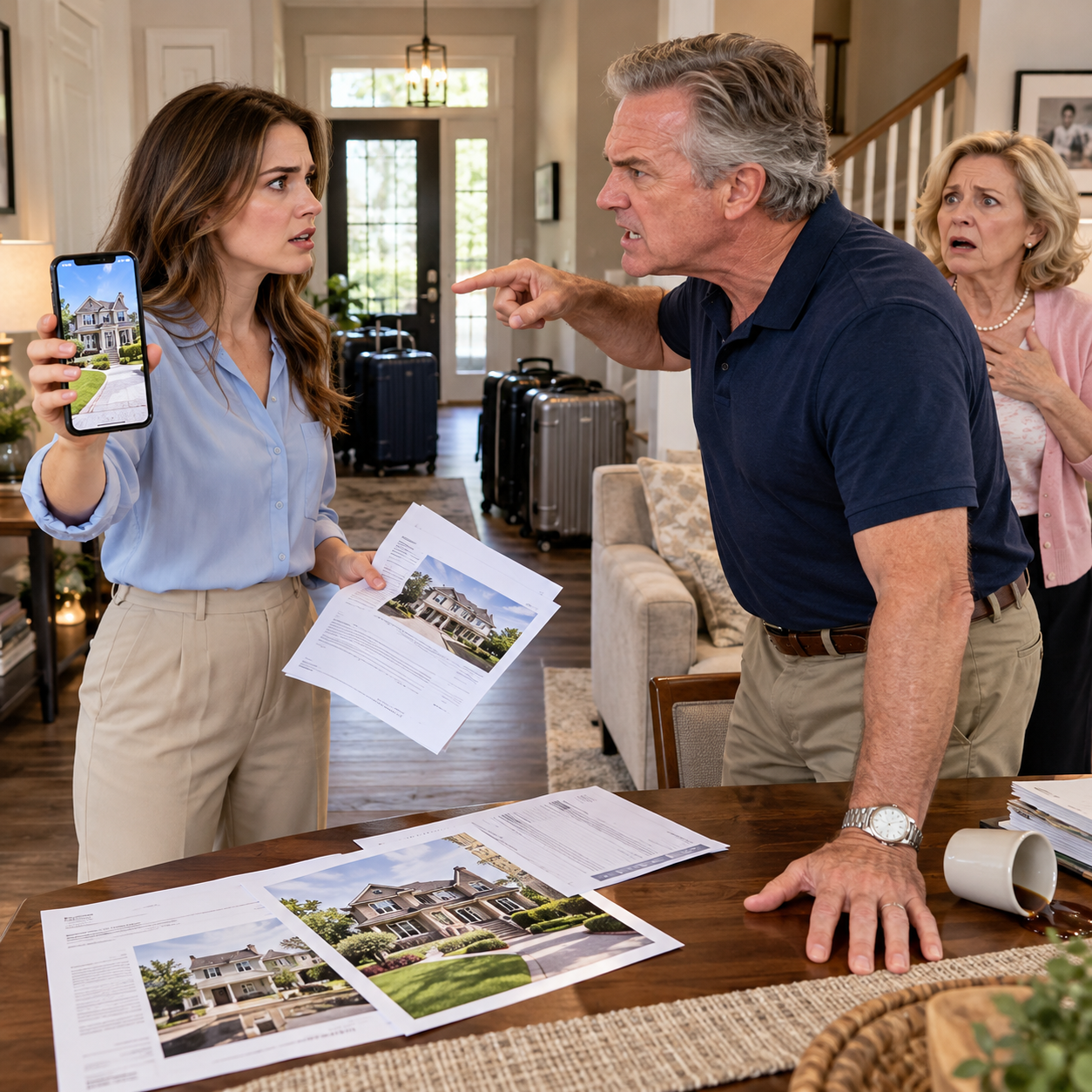
I printed the documents and laid them across my dining table. In the first photograph accompanying the property listing, Julian’s new house stood behind an immaculate driveway, with tall windows and a manicured lawn. I imagined my brother walking into that beautiful place while our parents packed their belongings for mine. Every detail suddenly made sense, including their four suitcases, their lack of urgency, and my father’s determination to make himself comfortable.
My mother appeared in the doorway carrying a folded dish towel. “What are you looking at, sweetheart?”
I turned the top page toward her. “Julian’s new house.”
Her expression changed so quickly that I almost missed it. The gentle smile disappeared, and her fingers tightened around the towel before she looked toward the living room. “Your father should be here for this conversation,” she said.
“He will be.”
I gathered the papers and walked into the living room. My father was stretched across my sofa, his television remote resting against his stomach, while a half-empty coffee cup stood on the table I had saved three months to purchase. I stopped directly in front of the television, blocking the screen.
“Both of you need to pack your bags,” I said. “You cannot stay here anymore.”
My father slowly lowered the remote. “Excuse me?”
“I know you sold your house. I know about the nine hundred and fifty thousand dollars. And I know you used that money to buy Julian a luxury home.”
For the first time since they arrived, neither parent spoke. My mother sat down heavily, pressing one hand against her pearl necklace. My father stared at the documents, then lifted his eyes to mine.
“So?” he finally said.
One short word seemed to erase every hope I had left.
“Julian needs a proper foundation for his future,” my father continued. “He has opportunities ahead of him. Your mother and I decided to give him the advantage he deserves.”
“And what about your future?” I asked. “Where were you planning to live?”
My mother looked wounded. “With our daughter, of course. We thought you’d be happy to have us.”
My father stood, straightened his shirt, and stepped closer. “You’ve got a steady job, no husband, no children, and a perfectly good spare bedroom. Why should your brother struggle when you can help us without sacrificing anything?”
I stared at him, finally understanding that they hadn’t come to ask for shelter.
They had come to claim it.
## Part 3: A Single Refusal Breaks the Rules of Our Family
My father held out his hand for the documents. I kept them against my chest, watching the color rise in his face. “You don’t get to decide how we spend our money,” he said. “Everything we have done has been for this family.”
“Then why did you lie to me?”
My mother began crying, but her tears no longer had the power to make me apologize. “We were frightened you wouldn’t understand,” she said. “Julian is trying to establish himself. Your father and I have always believed he could do something important.”
“And you believed I’d pay for it?”
“Don’t twist your mother’s words,” my father warned.
I looked from one face to the other. “You gave Julian nearly a million dollars, then came here pretending you were homeless because of bad investments. You expected me to support you indefinitely, and you never planned to tell me the truth.”
My father’s expression hardened. “We’re your parents. After everything we’ve done for you, you owe us a place to live.”
I thought about the years I had spent trying to earn his approval, the birthdays overshadowed by Julian’s achievements, and the times I had hidden my disappointment to keep the peace. I had mistaken my ability to survive without help for proof that I didn’t deserve any. Now the man standing before me was demanding the last peaceful thing I owned.
“No,” I said.
He blinked. “What did you say?”
“I said no. You need to leave my house.”
His hand moved before I could step away. The blow caught my cheek and sent me stumbling sideways into the doorway, where I grabbed the frame to keep my balance. A photograph fell from the nearby shelf, striking the floor with a sharp crack.
My mother gasped. “Oh, Richard!”
But she stayed seated.
I touched my burning cheek and looked at my father. He seemed almost surprised by what he had done, although he made no attempt to apologize. Instead, he pointed toward me and said, “That’s what happens when you forget how to respect your parents.”
Something inside me became very still.
I walked into the kitchen, picked up my phone, and dialed 911. My father’s voice followed me, demanding that I put it down, while my mother rushed after me with tears streaming down her face. “Khloe, please,” she begged. “Don’t destroy this family over one mistake.”
I looked directly at my father as the dispatcher answered. “My father has struck me inside my home,” I said. “I need police assistance, and I need him to leave.”
My mother covered her mouth. My father stopped speaking.
Within ten minutes, flashing red and blue lights swept across my front windows. Two officers approached the door while their partners remained outside near the cruisers. I explained what had happened, showed them my property deed, and told them my parents had arrived as temporary guests only three days earlier.
“I want them formally warned not to return without my permission,” I said. “I do not feel safe having them here.”
One officer spoke privately with my father while another checked whether I needed medical attention. I declined an ambulance but accepted the information needed to document the incident. My father argued about family obligations until an officer firmly told him that my consent to their staying had ended.
Twenty minutes later, my parents carried their four suitcases down the driveway. My mother looked back from beside the police cruiser, waiting for me to change my mind. I stood beneath my porch light, one hand pressed against my aching cheek, and watched them leave.
When the last cruiser disappeared around the corner, I closed my front door and turned the lock.
The house was quiet again.
But this time, the silence wasn’t something I had to earn.
## Part 4: My Brother’s Final Gamble Leaves Them With Their Choices
For the next two weeks, I tried to remember how to live without constantly listening for someone else’s footsteps. I returned my mother’s spices to a cardboard box, moved my books back onto their shelves, and replaced the photograph that had fallen during the confrontation. The bruise on my cheek faded gradually, but I still found myself flinching whenever someone knocked on my door.
I changed the locks and kept a copy of the police report in my desk. Vance checked in several times, reminding me that I had every right to protect myself. I told him I was fine, although the truth was more complicated. I missed the parents I had spent thirty years believing I had, even while I knew I could never welcome the people they had revealed themselves to be.
Then, on a quiet Thursday evening, my grandmother called.
“Khloe, honey,” she said, her voice unusually strained. “Have you heard what’s happened with Julian?”
I set down the book I was reading. “No. Why?”
She hesitated before continuing. “Your brother mortgaged that beautiful house almost immediately after your parents bought it. He borrowed against the property to finance some business venture with a friend. The whole thing has fallen apart.”
I sat upright. “He mortgaged a nine-hundred-and-fifty-thousand-dollar house?”
“Your parents didn’t know until the lender started demanding repayment,” she said. “Julian’s business has failed, and now the house may be lost. Your mother and father put everything they owned into that property. They have almost nothing left.”
For a moment, I couldn’t speak. I remembered my father’s proud declaration that Julian deserved an advantage because he had such a promising future. My brother had received an extraordinary gift, then risked it on an investment he apparently hadn’t understood. The very people who had accused me of being selfish had sacrificed their security to protect a son who had gambled it away.
“Are they all right?” I finally asked.
“They’re frightened,” Grandma replied. “And they’re angry. Mostly, they’re arguing about whose fault it is.”
I looked around my living room. The television was off, a cup of tea rested beside my chair, and the evening light softened the walls I had painted myself. I felt sorrow for what had happened to them, but I couldn’t find the familiar urge to rush in and make everything right.
That night, my mother called.
“Khloe,” she began, her voice breaking, “we need to talk. Things have become very difficult.”
“I heard about Julian.”
She began crying. “Your brother made a terrible mistake. Your father is beside himself. We might lose everything.”
I waited, knowing what was coming.
“We were hoping,” she continued, “that perhaps we could stay with you for a little while. Just until things improve. We’re still your parents, sweetheart.”
I closed my eyes. Two weeks earlier, I would have felt guilty before she even finished speaking. Now I heard the same carefully chosen words, the same expectation that my life would absorb the consequences of someone else’s decisions.
“Mom, I can’t do that.”
She fell silent.
“Your father regrets what happened,” she finally whispered. “He was under tremendous pressure.”
“He struck me because I refused to give him something he wanted.”
“Families make mistakes, Khloe.”
“Yes,” I said. “But families also have to take responsibility for them.”
I heard my father speaking angrily in the background. My mother covered the receiver, but his words reached me anyway.
“Tell her this is her last chance to make things right.”
I almost laughed, not because anything was funny, but because the threat was so familiar. Even after losing their home, their money, and their relationship with me, my father still believed obedience was something he could demand.
“Mom,” I said gently, “I need to ask you something. When you sold your house and bought Julian his mansion, did you ever consider asking whether I wanted you to live with me?”
She didn’t answer.
“Did you ever consider what would happen if I said no?”
After a long silence, she whispered, “We never thought you would.”
There it was.
The final truth was not hidden in a financial statement or a property deed. My parents had counted on my obedience as surely as they had counted on the money from their house. They had built their plans around a daughter they believed would never defend herself.
“I can give you information about housing assistance and financial counseling,” I told her. “You should also speak to an attorney about Julian’s mortgage. But you cannot move back into my home, and I will not take on his debts.”
My mother cried harder. “So you’re really abandoning us?”
“No, Mom. I’m refusing to abandon myself.”
I ended the call before she could answer.
The next morning, I opened my front windows and let the cool autumn air drift through the living room. I made coffee, straightened the books on my shelf, and noticed that the cabinet hinge my father had repaired still worked perfectly. For a moment, I stood looking at it, understanding that someone could do a useful thing for you without earning the right to control your life.
I wished my parents well. I hoped Julian would eventually learn from the consequences of his choices, and I hoped my mother and father would find a way to rebuild without sacrificing anyone else. But their future was no longer mine to manage.
I picked up the framed photograph that had fallen the night my father struck me. It showed me standing outside my townhome on the day I received the keys, smiling so widely that my eyes were nearly closed.
I placed it back on the shelf, this time where I could see it from my favorite chair.
My parents had given my brother a $950,000 house because they believed he deserved a better future. They had come to take mine because they believed I would never say no.
They were wrong.
And the home I had worked so hard to build was finally, completely, mine.
THE END.
All characters and events in this story are fictional, created for storytelling and entertainment purposes. Thank you sincerely for reading. Your feedback and support are invaluable and motivate me to continue sharing more stories with you.


