
## Part 2: The Football Camp Secret That Stole My Own Name
Dad left the folder behind and warned me that Luke had already resigned from his high school position. The college needed my signature by Friday, or the opportunity would disappear. After his footsteps faded down the stairs, I opened my closet and pulled out a shoebox I hadn’t touched in years. Inside were the objects I’d saved from a June morning when I was seventeen, a morning that had changed the direction of two lives.
Luke had attended a football combine in Omaha that spring and run the forty-yard dash in 4.66 seconds. He was an excellent running back, strong and disciplined, but recruiters wanted more speed. A Nebraska coach suggested he attend their summer camp, and Dad spent the drive home staring through the windshield. Six days before that camp, Luke supposedly injured his hamstring at a seven-on-seven tournament. Mom iced his leg every evening with a kitchen timer while Dad paced the hallway, speaking about missed opportunities as though someone had already died.
Thursday night, Dad found me in the garage changing the oil in my truck. Instead of shouting instructions from the doorway, he sat on an overturned bucket and spoke softly. “That camp is Luke’s only chance,” he said. “If he doesn’t go, they’ll forget him.” When I suggested waiting another year, Dad shook his head. “Nobody up there can tell you boys apart, Levi. You go, run a few drills, and keep his name on their list. His game films will earn the scholarship.”
I remember wiping oil from my fingers while he waited. He hadn’t asked about my races, my plans, or my dreams in months, but suddenly he needed something only I could give him. I wanted to believe that helping Luke might finally make Dad proud of me, too. So I agreed. Dad squeezed my shoulder and said, “You’re a good brother,” and I carried those four words like a prize.
Saturday morning, Dad drove me to Lincoln while Luke supposedly recovered at home. At a gas station in Wahoo, my phone buzzed with a message from Dad, who was standing ten feet away pumping gas. “Remember, you’re Luke today. Answer to his name. Keep your left hand in your pocket.” I read it twice and slipped the phone away, feeling suddenly less like a son than an accomplice.
At the camp, they fastened a white wristband marked LUKE, number 312, around my wrist and handed me a red shirt. Two hundred boys crowded the indoor practice field while coaches circulated with clipboards. I tried crouching with my right hand down for the forty-yard dash, but it felt as awkward as writing backward. After I stumbled, a coach with a gray goatee told me to start however felt natural. I placed my left hand on the ground, exploded forward, and crossed the line in 4.48 seconds.
The coaches stared at their watches. A linebacker from Kansas slapped my shoulder and asked where I’d learned to run like that. When he asked my name, I glanced at the wristband and whispered, “Luke.” He grinned and said I’d made everyone else look slow. It was the first time in my life I’d heard somebody praise my brother’s name for something I’d actually done.
I completed the shuttle drill, the vertical jump, and several receiving exercises without drawing attention to myself. At the end, the staff handed me a printed results card with Luke’s name above that 4.48. A photographer also caught me crossing the finish line, my head turned just enough to expose the birthmark behind my left ear. When the photograph appeared online, I printed a copy and tucked it away with the wristband. I couldn’t explain why I kept everything, except that some part of me already understood how easily the truth could disappear.
Nebraska offered Luke a scholarship that August, and the acceptance letter specifically mentioned the remarkable speed he’d demonstrated at camp. Dad read that passage aloud twice at dinner. Nobody looked at me, and nobody thanked me. At Luke’s signing celebration, an uncle told me I must be proud of my brother, and I answered, “I’m proud of his legs.” Everyone laughed, including Dad.
The lie grew larger after Luke arrived at Nebraska. When strength coach Kenny Wall timed him at 4.67 seconds, Luke blamed a hamstring problem. Dad told reporters his heroic son had run 4.48 on an injured leg, and the newspaper printed the story beside a photograph of our porch. Coach Ruska confronted me after one of my final track races. “Your brother never ran a four-five in his life,” he said, watching me carefully. I looked at his stopwatch rather than his eyes and refused to answer.
Years later, I encountered Luke and Danielle at the Nebraska State Fair. She told me Luke always said I was the fastest boy in Norfolk, especially whenever they passed the high school track. Luke stood beside her holding two lemonades, unable to meet my eyes. I realized he hadn’t forgotten whose speed earned him that scholarship. He simply preferred a version of the truth that never required him to apologize.
Now Dad wanted me to swear that I’d never been to Lincoln. I laid the wristband, photograph, phone, and results card beside his unsigned declaration. Those objects had spent ten years in darkness while Luke’s career unfolded in the sunlight. For the first time, I stopped wondering whether my family would ever tell the truth voluntarily. I started wondering what would happen if I told it myself.
## Part 3: My Brother’s Confession Revealed A Crueler Ten-Year Deception
Wednesday evening, Mom called for the first time in nearly a year. She sounded irritated rather than worried and said Dad believed I was being difficult about a simple formality. I asked whether she knew what he wanted me to sign. “You helped your brother once,” she replied. “You were so sweet about it. You offered without anybody asking. Why can’t you help him again?”
My fingers tightened around the phone. “Mom, who told you I volunteered?”
“Your father,” she answered. “Isn’t that what happened?”
I looked at the shoebox sitting open on my table. “No,” I said quietly. “That’s not what happened.” Then I asked whether she remembered the night I’d given her my graduation cap. She sighed and told me not to start that argument again. I ended the call, but one word kept echoing through my apartment: offered. Dad hadn’t merely erased what I’d done; he’d rewritten why I’d done it.
Thursday morning, I was sixty feet above the grain elevator with my screwdriver pressed against a fan motor when the plant manager radioed that someone was waiting below. I climbed down and found Luke beside his pickup in a gray coaching pullover, a whistle still hanging around his neck. He looked like an exhausted version of me, with worry carved into the corners of his eyes. “You didn’t sign it,” he said, skipping any greeting. When I shook my head, he began talking about his mortgage, his resignation, and how the college job had already been promised.
“Then tell the athletic director what happened,” I said. “You’re a good coach, Luke. You’ve got years of experience. Maybe he’ll understand.”
Luke laughed bitterly. “Understand what? That my twin got me a scholarship? That everything everybody thinks I was came from you?” I stepped closer, keeping my voice level. “You played college football. You earned your degree. You’ve coached kids who believe in you. None of that changes because you weren’t fast enough to run a 4.48.” His eyes filled with something I hadn’t seen since we were children, a mixture of shame and resentment.
Then he said, “It wasn’t even my idea. Dad decided you’d run because you were faster. I wasn’t hurt, Levi. I was at the lake that whole week.”
The noise from the grain trucks seemed to disappear. “You were where?”
Luke looked away. “Forget I said that.”
“Mom iced your leg every night. She set the timer on the stove.”
“I know,” he muttered. “Just sign the paper.” He climbed into his truck and drove away before I could say another word.
That evening, I searched through old social media photographs posted by Luke’s former teammate Corbin. Within twenty minutes, I found pictures taken at Lewis and Clark Lake on the exact Saturday of Nebraska’s camp. In one, Luke was wakeboarding behind a boat, knees bent, grinning as he sailed over the water. No bandage, no limp, no injured hamstring. He hadn’t stayed home recovering; he’d spent the day enjoying himself while I impersonated him in Lincoln.
I sat staring at that image until the room darkened. Dad hadn’t improvised a desperate solution to an injury. He had watched Luke run 4.66, calculated what my speed could accomplish, and invented a medical emergency that would make his neglected son feel indispensable. He had persuaded Mom to perform a week of careful nursing, not because Luke needed treatment, but because I needed to believe the lie. I remembered Dad sitting on that garage bucket, speaking gently to me for the first time in months, and felt something inside me go completely still.
Friday morning, I printed the lake photograph at the same drugstore where I’d printed the camp picture ten years earlier. Dad called twice that afternoon, and I ignored both calls. At four, I phoned the athletic director in Kearney, a man named Palmquist, and introduced myself. He expected me to send a signed declaration, but I asked instead for a meeting on Monday. “I have things you should see before you offer my brother that job,” I explained.
Palmquist was silent for a moment. “Your brother’s a respected coach,” he said. “I’m not interested in humiliating him.”
“Neither am I,” I answered. “But I’m not putting my name beneath something false.”
Monday morning, I drove west with the shoebox beside me. Palmquist’s office sat beneath the college gym, where a narrow window offered a view of shoes passing outside. Kenny Wall waited in the corner, broad-shouldered and gray-haired, studying me as though searching a memory. Before I sat, he glanced at my hands and said, “Left-handed.” I nodded.
I arranged the objects across Palmquist’s desk, one at a time. The wristband marked 312, the original results card, and the camp photograph with my birthmark visible behind my left ear. I showed them the same birthmark on my neck, then plugged in my old phone to display Dad’s message instructing me to answer to Luke’s name. Finally, I placed the lake photograph beside everything else. My brother was clearly wakeboarding while I was running the forty-yard dash in Lincoln.
Wall leaned over the desk and examined the photograph of me finishing my sprint. “I timed that kid,” he murmured. “I told my wife we’d found one of the fastest backs in the state.” He rubbed his forehead. “Then Luke arrived at Nebraska and couldn’t come close to that time. I spent two years wondering what we’d done wrong.”
I looked directly at Palmquist. “I agreed to go when I was seventeen. I know that was wrong, and I’m responsible for my part. But now my father wants my signature on a new lie, and that’s one thing I won’t give him.” Palmquist asked why I’d remained silent for ten years. “Because nobody asked me to put my own name on the deception before,” I replied. “My name is the one thing they never managed to take away.”
He requested copies of the evidence and shook my hand before I left. Kenny Wall stayed standing beside the desk, staring down at the old camp results as though an unanswered question from ten years ago had finally found its owner.
## Part 4: The Last Family Confrontation Finally Returned What Was Mine
Wednesday afternoon, Palmquist called Luke and withdrew the coaching offer. He handled the conversation privately, explaining that the position would go to another candidate and inviting Luke to discuss the reasons in person. Luke immediately contacted our old high school, hoping to reclaim the job he’d resigned from, but the school board had already given it to his defensive coordinator. They offered him a long-term substitute teaching position in the math department, and he accepted because his mortgage still needed paying.
That Saturday, I drove to Norfolk for the first time in years. The red Husker flag still hung from my parents’ porch, though the sun had faded it almost pink. Dad opened the door before I knocked and glared at me. “You’ve got some nerve showing up here.” I stepped past him and said, “I brought something Mom needs to see.”
Mom sat at the kitchen table, and Luke occupied a chair near the window, staring at his hands. Dad followed me inside, already raising his voice. “You destroyed your brother over a forty-yard dash! Ten years ago, Levi! Now he’s going to be teaching fractions instead of coaching college football.” I set my jacket on a chair and faced him. “I didn’t destroy Luke. You built his future using something that belonged to me, and you expected me to keep paying for it.”
Dad struck the table with his palm. “I gave this family a chance!”
“You gave Luke a chance,” I answered. “You gave me a wristband with somebody else’s name on it.”
Luke lifted his head. “Dad, just tell her.”
Mom looked between us. “Tell me what?”
I removed the lake photograph from my folder and placed it before her. She studied Luke flying above the water, then moved her finger to the date printed in the corner. Her face drained of color. “This was the Saturday of the football camp,” she whispered.
Luke didn’t answer. Mom stared at him, and when she spoke again, her voice had changed. “I iced your leg every night that week. Twenty minutes on, twenty minutes off. I set the kitchen timer.”
“Mom,” Luke began.
“You weren’t hurt?”
Dad reached for the photograph, but she pulled it away. “Gary, you told me Levi offered to take his brother’s place because Luke couldn’t walk properly. You let me nurse him all week. You let our son believe he was saving his brother’s future.” Dad muttered that everything had happened a long time ago, but Mom stood and pushed her chair backward. “You didn’t just lie to the coaches,” she said. “You lied to all of us.”
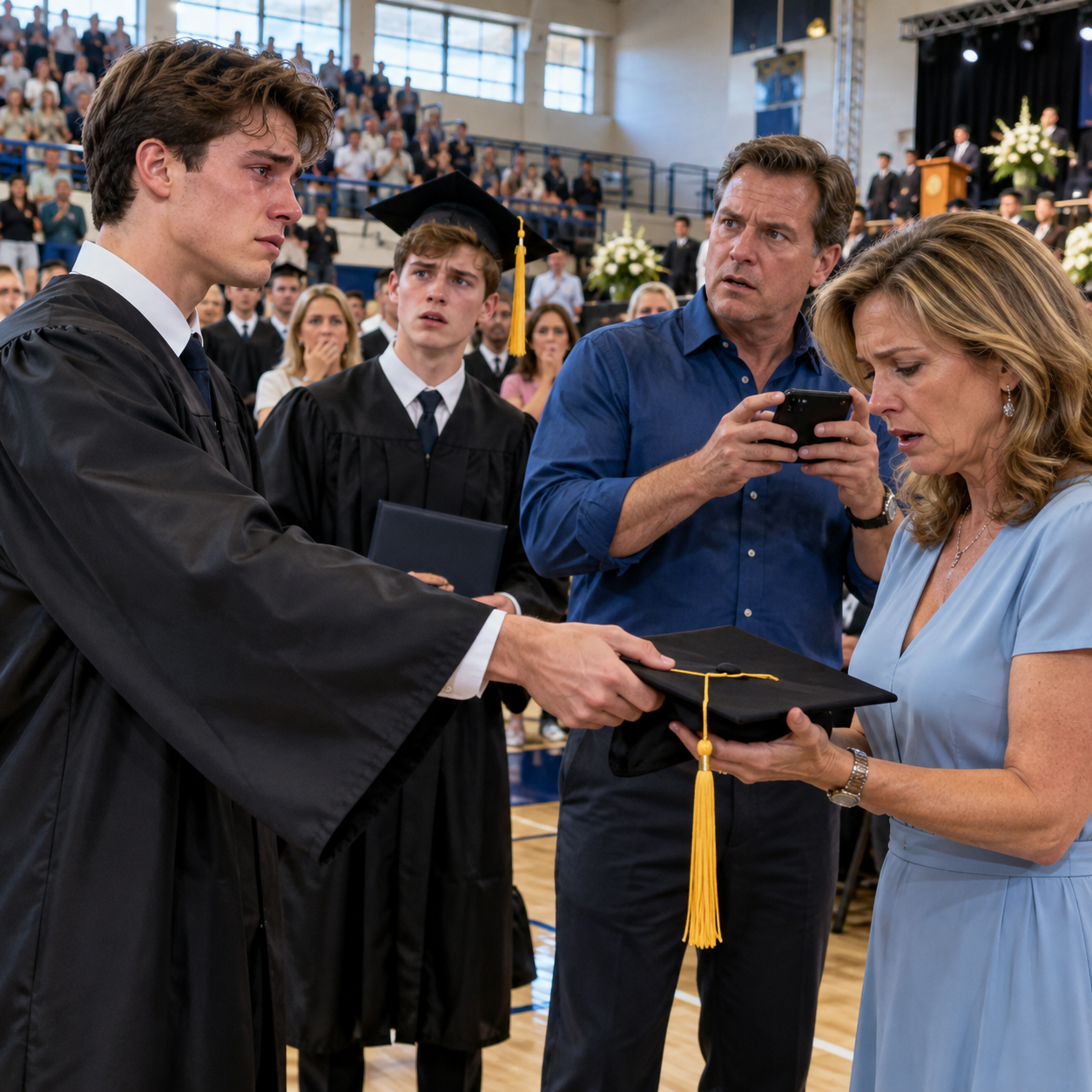
The kitchen clock ticked in the silence. Mom left the room, and when she returned, she was holding something black and square against her chest. My graduation cap. Its tassel still carried the little brass charm from 2016, and the fabric had a faint crease where I’d folded it in her hands ten years earlier.
“I should have returned this to you that night,” she said.
I looked at the cap, remembering the empty family seats and the way I’d searched the crowd for somebody who might be looking back. For an instant, I wanted to take it, because it was mine and always had been. Then I realized the cap wasn’t what I’d come for. “No, Mom,” I said gently. “Remember what I told you? Give it to him, too.”
She pressed it against her chest, tears slipping down her cheeks. Dad opened his mouth to interrupt, but she turned toward him. “Don’t.” Just one word, spoken so firmly that he stopped. I’d lived twenty-eight years without hearing my mother tell my father no.
Dad glared at me. “Are you satisfied now? You got what you wanted.”
I held his eyes. “I wanted you to know which son was standing in front of you. That’s all. When they called me Luke at graduation, you didn’t even look up.” His expression faltered, and I saw him search for something to say. Nothing came. I picked up my jacket and walked out without asking anyone to follow.
Two weeks later, Mom moved in with her sister in Columbus. Dad called me once that summer, not to apologize, but to complain that she refused to come home. In July, he finally took down the Husker flag. The men who had listened to his favorite story at the gas station no longer asked about Luke’s legendary speed, and Dad stopped bringing the old newspaper clipping everywhere he went.
Luke began teaching fractions, and from what I heard, he was surprisingly good at it. He never called me, and I didn’t reach out. I didn’t hate my brother, but forgiveness wasn’t something I could manufacture simply because the truth had finally been told. Danielle remained with him, and I hoped the man who emerged from that disappointment would become somebody she could truly rely on.
In August, Kenny Wall sent me a handwritten letter on college stationery. He’d searched through his old notebooks and found an entry beside camp number 312: “Hands left. Check.” He apologized for never following up and said that if I’d continued training, he believed I might have run the forty in 4.42 seconds by age twenty. I folded the letter carefully and placed it with the other evidence, no longer needing to imagine the life I might have lived.
One Sunday in September, I returned to the high school track. Coach Ruska waited by the gate with his old stopwatch hanging from a shoelace and a thermos tucked beneath his arm. When I finished telling him the entire story, he stared across the empty lanes. “I knew that was you in Lincoln,” he admitted. “I didn’t know what your father did to get you there.”
Then he pointed toward the starting line. “Come on. Forty yards.”
I laughed. “Coach, I’m twenty-eight. I climb grain bins and repair motors for a living.”
“Then you’ve still got legs. Get down there.”
I walked to the line and crouched with my left hand against the track, just as I’d done a thousand times before. The air smelled of cut grass, and for one brief moment, I was seventeen again, waiting for somebody to see what I could do. Coach raised his hand, and I ran as hard as I could.
When I crossed the finish, he checked the stopwatch and shook his head. “Four point six one,” he announced. “You’re getting slow.”
“I’m twenty-eight!” I protested.
He grinned. “Your brother never ran that fast, either.”
Then he held out his hand, and I understood what he wanted. I reached into my shirt pocket and gave him the original camp results card, the one I’d carried from my apartment that morning. Coach took a pen from his jacket, drew a single line through the printed name Luke, and wrote LEVI above it in large, unmistakable letters.
He handed it back. “There,” he said. “Now it’s right.”
I stood beside the track holding that little piece of paper, feeling something settle inside me that hadn’t been still in ten years. There was no cheering crowd, no college recruiter, no father filming with his phone. Just an old coach, an empty running track, and a name that finally belonged to the person who had earned it.
The card hangs inside my locker at the grain elevator now, beside the screwdriver Merv taught me to use. When a motor stops at three in the morning during harvest, I open that locker, see my name above the number 4.48, and remember the boy who once believed he had to disappear so his family would love him.
Then I take out my screwdriver, press it against the motor housing, and listen for the sound of whatever has gone wrong.
Machines have a way of telling you the truth, even when people won’t.
And these days, I listen.
THE END.
All characters and events in this story are fictional, created for storytelling and entertainment purposes. Thank you sincerely for reading. Your feedback and support are invaluable and motivate me to continue sharing more stories with you.


