
## Part 2: The Old Family Albums Exposed Six Years Of Convenient Lies
Mom called again the following afternoon, and this time I answered. Her voice trembled when she said my television interview had surprised everyone, but she recovered quickly enough to explain the real problem. People were beginning to think our family had deliberately excluded me, and Madison had already lost a promotional opportunity because of the controversy.
“Is the artwork supposed to be about us?” she asked.
“Does it remind you of something?” I replied.
Dad took the phone before she could answer. “We made mistakes, Chloe, but you could clear this up with one statement. Just tell people we weren’t terrible parents.”
“You want me to say those holidays never happened?”
“I want you to stop making your family look bad.”
I stared at the screen of my laptop, where an old email showed Mom purchasing three Christmas vacation packages despite knowing I’d requested time off work. “I haven’t identified anyone,” I said. “Madison brought our family into this herself.”
When Mom suggested meeting in person, I agreed to one conversation at a public café. I asked her to bring our holiday photo albums, and something in her silence told me she’d never considered what those photographs might prove.
Saturday morning, they arrived together. Mom looked thinner than I remembered, and Dad’s hair had turned almost entirely gray. For a moment, the sight of them pulled at something tender inside me. Then Dad spotted the printed messages beside my coffee, and his expression tightened.
I slid the first page across the table. Mom had written, We found a great package for three. Chloe won’t care. She hates skiing anyway. Underneath was my earlier message asking whether I could join them.
“I don’t remember writing that,” Mom whispered.
“I remember reading it.”
Next came Thanksgiving. Dad had complained that four flights were too expensive, then upgraded their hotel suite to accommodate Madison’s preferences. When he claimed I’d wanted to stay home, I opened Mom’s photo album to three smiling faces beside a restaurant window overlooking Manhattan.
“Where was I?” I asked.
“You had work,” Mom answered.
“My shift ended two days before you left.”
I turned another page. Christmas, three faces. New Year’s Eve, three faces. The same familiar people smiling in beautiful places, with no suggestion that anyone was missing.
“We thought you were independent,” Dad finally said. “Your sister needed more support.”
I rested my palm on the open album. “You decided that because Madison demanded more, I deserved less. Every time I accepted being left behind, you used my silence to justify doing it again.”
Mom’s eyes filled with tears, but Dad continued insisting they hadn’t intended to hurt me. I told him intention didn’t erase repeated choices, and the worst part wasn’t spending the holidays alone. It was watching them come home, spread photographs across the table, and expect me to celebrate memories they’d deliberately made without me.
Eventually, Dad said, “We were wrong.”
I waited, but neither parent asked how those years had changed me.
Instead, Mom asked whether I would issue a statement protecting Madison’s reputation.
I closed the album.
“I’ll give her one opportunity,” I said. “She deletes her accusation and admits she spoke without knowing the full story. Otherwise, I’ll correct what she said with the evidence.”
Dad leaned toward me. “You’d really humiliate your own sister?”
“She publicly called me dishonest. I’m asking her to stop.”
I left the café without promising reconciliation. For the first time, my parents seemed to understand that an apology wouldn’t automatically reopen the door to my life.
Madison refused my offer.
Two days later, she uploaded a video claiming someone close to her had transformed ordinary family disagreements into a profitable victim narrative. She insisted I’d repeatedly declined invitations because I disliked traveling, and that our parents had always treated us equally.
I watched the video once, then wrote a brief public response. I explained that my artwork identified no relatives, but the claim that I’d voluntarily excluded myself from family holidays was false. Beneath it, I attached four dated records, including a reservation for three, Dad’s complaint about airfare, and Mom’s reply to my request to attend: This trip is complicated enough already. Please don’t make it harder.
I removed private information and made no personal accusations. Then I turned off my phone.
Six hours later, thousands of strangers had shared the post. Many recognized the excuses immediately, describing childhoods spent being praised for needing less while everyone else received more. Madison deleted her video, but one brand postponed a campaign and another delayed a public appearance.
Dad called furious. “Your sister’s losing work!”
“She made a public accusation. I corrected it.”
“You could’ve handled this privately.”
“I tried. You were sitting across from me when I did.”
A week later, Mom sent me a photograph of a dusty box she’d discovered in the attic. Inside were holiday cards written years earlier, including one celebrating a perfect family weekend with three names beneath it. Another card had a sentence heavily crossed out.
I enlarged the photograph until the handwriting became readable.
Chloe stayed behind again.
Again.
That single word stopped me.
For years, my parents had claimed they hadn’t realized how often they excluded me. Yet someone had written down the pattern, noticed it, and crossed it out.
When I called Mom, she answered quietly.
“I kept telling myself we didn’t know,” she said. “But we did know, Chloe. I knew you stayed behind. I just never asked myself why we were so comfortable with it.”
For the first time, her apology didn’t sound like an attempt to rescue her reputation.
It sounded like the truth.
## Part 3: Three Empty Spaces Forced My Family To Face Reality
Three weeks later, my gallery announced the final lineup for Reserved Seat. The centerpiece had been renamed Three Tickets, and beneath its glass display were four phrases drawn from my parents’ old messages: She’s independent. She understands. She’s easier. She’ll get over it.
Opening night sold out within an hour.
Mom asked whether she and Dad could attend. I considered refusing, then realized I was tired of organizing my decisions around their presence or absence.
“The exhibition is public,” I replied. “You can come like anyone else. No family photographs, no interviews, and no announcements about reconciliation.”
They arrived forty minutes after the gallery opened. Mom studied the artwork while Dad scanned the crowd, clearly uncomfortable with people examining a story he could no longer control. I finished speaking to a curator before walking over.
“Congratulations,” Dad said stiffly.
“Thank you.”
Mom asked to see the centerpiece, and I led them toward the illuminated display. Three metallic travel cards rested beneath glass beside an empty fourth space, while the words they’d once used to dismiss me filled the wall below.
Dad read the phrases twice.
“We really said those things.”
“Yes.”
Mom stared at the blank space for a long time. “We made your silence useful to us,” she whispered. “That’s what we did.”
I didn’t correct her or offer comfort. There was nothing left to explain.
A gallery assistant approached and quietly informed me that a museum-affiliated foundation had purchased the installation for a traveling collection about identity and belonging. Mom overheard and covered her mouth in surprise.
“So it’s going to other cities?” she asked.
“Apparently.”
Dad shook his head. “I suppose this will follow us everywhere now.”
I met his eyes. “It isn’t following you, Dad. It’s going with me. This is my work.”
Later, when a reporter asked whether any relatives had attended, I simply said that several family members were present. I didn’t identify them or turn their discomfort into a spectacle. My success no longer required their approval, and their embarrassment didn’t need to become my entertainment.
Near closing time, Mom approached me again.
“We thought we might invite you home for Thanksgiving,” she said. “Maybe we could finally celebrate together.”
“I’m hosting dinner here.”
“With your friends?”
“My friends, coworkers, and people who’ve been part of my life these past six years.”
She hesitated. “Could we come?”
Years earlier, I’d have given anything to hear my mother asking for permission to sit at my table. Now I thought about all the people who had helped me when I was struggling, celebrated my smallest victories, and never once made me feel inconvenient.
“Not this year, Mom.”
Her eyes glistened. “Maybe next year?”
“Maybe. I’m not making promises.”
When my parents left, I watched them through the gallery windows. Dad touched Mom’s shoulder as they crossed the sidewalk, and for a moment they looked heartbreakingly ordinary. I felt sadness, but no urge to run after them.
Six weeks later, my apartment smelled of roasted turkey, butter, and slightly burned dinner rolls. Ten people crowded around my table while someone argued about the music and another tried to rescue a disastrous dessert. Every chair was occupied by someone I’d deliberately invited.
At four that afternoon, Mom sent me a photograph from our old dining room. Three place settings waited beneath the familiar chandelier.
We hope you’re having a good Thanksgiving.
I looked around my noisy apartment and replied, I am. Thank you.
Ten minutes later, Madison messaged me for the first time since deleting her accusations.
Happy now? My contracts are a mess. Mom talks about your exhibition constantly, and Dad acts like every holiday was some terrible crime.
I stepped into the kitchen, away from my guests.
I didn’t ask anyone to cancel your work, Madison. You accused me of lying.
You could’ve called me.
Our parents asked you to delete the accusation before I posted anything.
Several minutes passed before another message appeared.
They told me you were threatening to expose us unless I apologized.
I stared at those words, recognizing the familiar habit of reshaping every conversation to make the next person easier to manage.
That’s not what happened, I wrote. I asked you to stop making claims that weren’t true.
Her next response surprised me.
They always said you hated traveling. They told me you liked staying home.
I asked to go. More than once.
I saw your screenshots.
Then silence.
Finally, Madison wrote, If that’s true, I have to rethink a lot of things.
I glanced toward my dining room, where my friends were laughing over an unevenly sliced pie. Six years earlier, I’d believed losing my family meant losing every possibility of belonging. Now I understood something my sister was only beginning to confront.
Sometimes the truth doesn’t simply reveal what other people did to you. It forces everyone to reconsider the story they’ve told themselves about who they are.
Then rethink them, I replied.
Nearly an hour later, my phone lit up.
I’m sorry I called you a liar. No excuses.
I thanked her, told her I wasn’t ready for anything more, and returned to my guests.
For once, nobody at my holiday table had to earn their place by pretending they needed nothing.
## Part 4: The Final Holiday Photograph Revealed What Freedom Really Meant
In December, Dad sent me an email instead of calling repeatedly. He’d counted fourteen major family holiday trips in our old albums. I was missing from nine of them.
I always remembered the times we included you, he wrote. I let those few occasions convince me we were fair.
Then came the sentence I never expected from him.
I thought we lost you when you moved away. Now I understand we lost you gradually, every time we decided you would understand.
I read it three times before closing my laptop. Three days later, I thanked him and said I hoped that understanding would change how he treated people who rarely complained.
It already has, he replied.
The following spring, Reserved Seat traveled to two more cities. Strangers stood before Three Tickets and recognized their own childhoods in the empty space. When a reporter asked whether the exhibition had repaired my family, I shook my head.
“It clarified what happened,” I said. “That’s different from pretending it never happened.”
Our relationships changed slowly. Mom sent occasional messages, Dad learned to accept unanswered invitations, and Madison and I exchanged cautious greetings. I didn’t pretend we had become a happy, reunited family, but I stopped believing distance automatically meant hatred.
One year after those ninety-nine missed calls, the same morning television program invited me back. The host showed my original artwork and asked whether my family’s door was finally open.
“There’s a door,” I answered. “But I decide when it opens.”
A few months later, Mom mailed me an old family album. On its final page, she’d placed a photograph of me standing alone before Three Tickets, surrounded by visitors studying my work.
Underneath, she’d written:
This was the year we learned that being proud of you didn’t entitle us to stand beside you.
I closed the album and looked toward my dining room, where ten chairs waited for the next holiday.
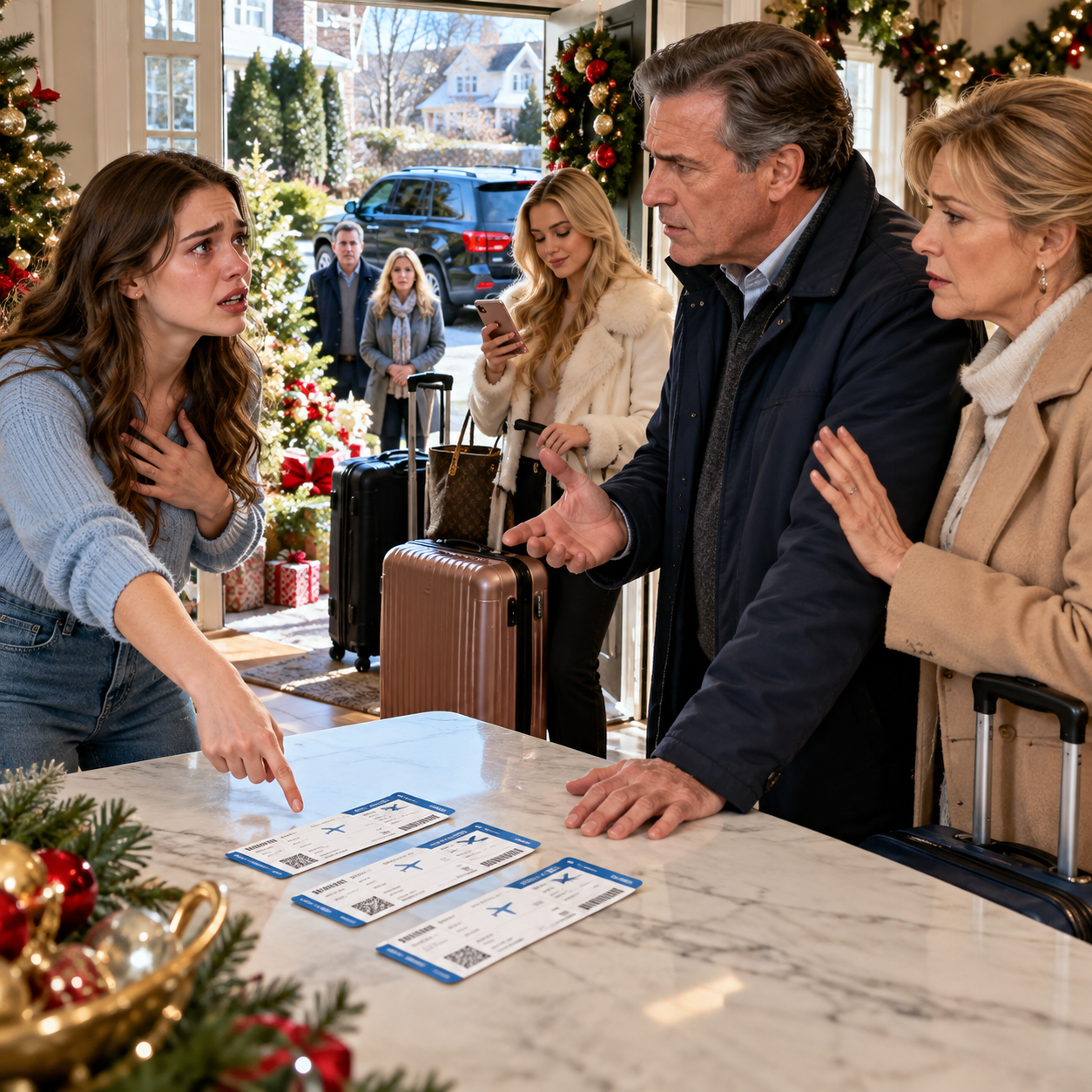
Once, I’d spent Christmas staring at three boarding passes, wondering why nobody had thought to buy a fourth.
Now I understood.
I hadn’t needed their invitation to become somebody worth celebrating.
I’d needed to stop waiting for it.
THE END.
All characters and events in this story are fictional, created for storytelling and entertainment purposes. Thank you sincerely for reading. Your feedback and support are invaluable and motivate me to continue sharing more stories with you.


