
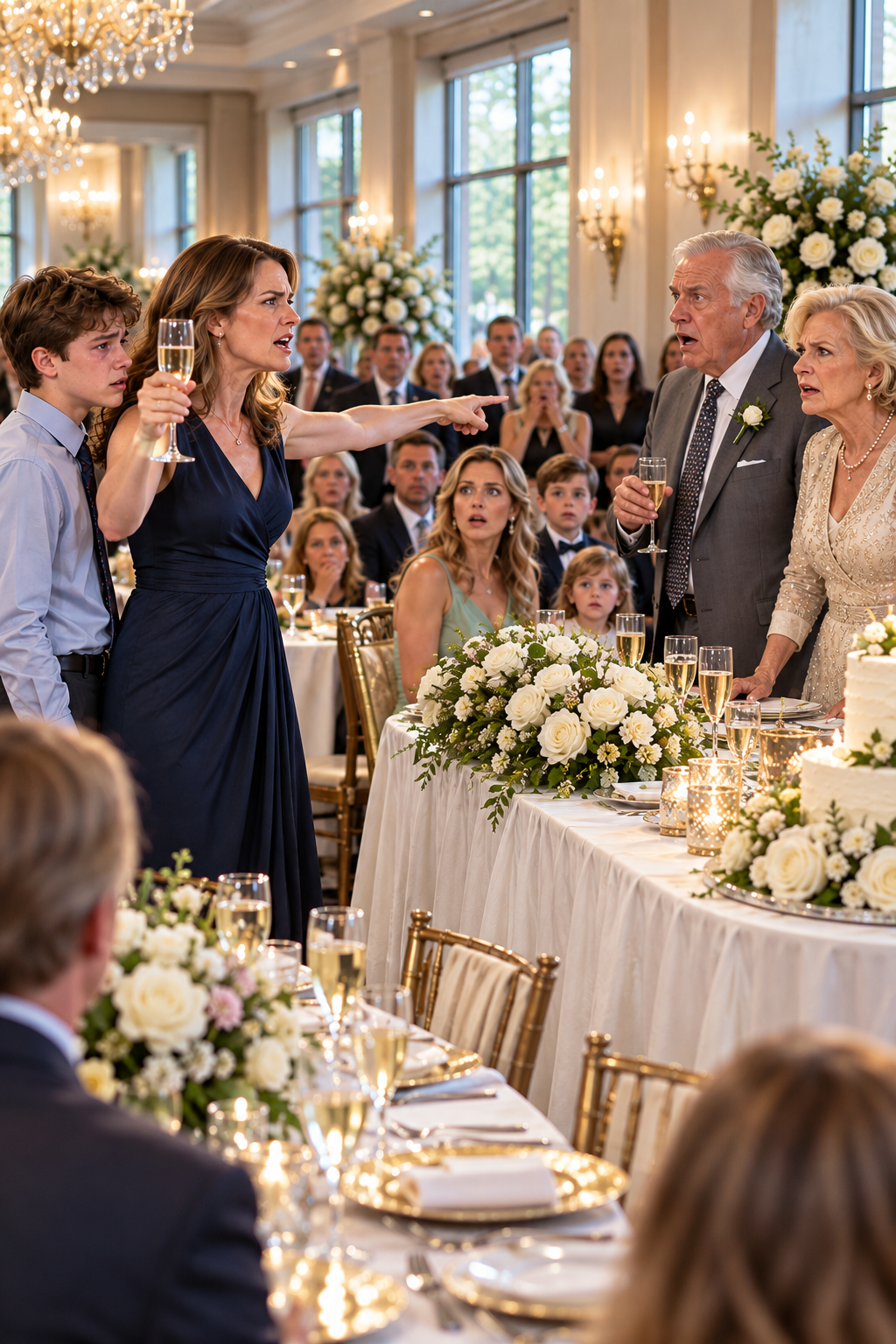
## Part 2: My Sister Finally Confronted The Lies Our Parents Protected
The following morning, I stood at my kitchen window holding a cup of coffee that had gone cold. Brian was asleep on the couch beneath a throw blanket, still wearing yesterday’s clothes. Neither of us had slept much, and my phone remained silent. Around ten, someone knocked, and when I opened the door, Danielle stood on the porch with swollen eyes and the same coat she’d worn to the anniversary.
She entered, sat at my kitchen table, and folded her hands together. “They were horrible last night,” she said. “And I should have said something before you left.” I watched her carefully as she explained that our parents had returned to their hotel and laughed about my dramatic behavior, treating the humiliation of their grandson as an amusing inconvenience.
“I told them they were delusional,” Danielle continued, her voice shaking. “I told them I’m sick of being their perfect daughter if being perfect means watching them treat you like you don’t matter.” She wiped her eyes and glanced toward the living room, where Brian was sleeping. “I saw his face, Linda. I don’t think I’ll ever forget it.”
For years, I’d believed Danielle enjoyed being the favorite, but the woman sitting across from me looked ashamed of the attention she’d received. Before leaving, she asked whether she could speak privately with Brian sometime, just to remind him that he mattered to her. I agreed, although I still wasn’t certain what to do with the unexpected feeling of having someone on my side. For once, my sister had looked past our parents’ carefully arranged family portrait and seen what was missing.
That evening, Mom called three times before I answered. She immediately demanded to know how I could humiliate them after everything they’d sacrificed for me. “Tell me what you’ve actually done,” I replied, and she snapped that they’d allowed Brian and me to live in their basement rent-free for almost three months after Greg died. She conveniently neglected to mention that they’d then given me thirty days to leave while I was attending grief counseling, working two part-time jobs, and desperately searching for affordable child care.
“You were too emotional to make sensible decisions,” she insisted when I reminded her that they’d refused to co-sign a small loan so I could secure an apartment. I gripped the phone, remembering the nights I’d cried quietly while Brian slept beside me on a borrowed mattress. “I was grieving my husband, Mom,” I said. “And you treated my grief like a character flaw.”
She ended the call without apologizing.
Over the next several days, the messages multiplied. Mom sent long emails about gratitude and respect, while an aunt accused me of tearing apart a loving family. Dad left a voicemail claiming I’d dragged Brian into adult problems and resented Danielle because she’d built a better life. Then he added something that finally broke the last fragile thread connecting us: “Danielle has always carried more responsibility because you’ve never been capable of handling your own life.”
I replayed those words while remembering the birthday parties he’d missed and the winter Brian had been sick when I could barely afford his medication. My parents hadn’t come to his eighth birthday because Danielle’s youngest had a school play. They’d barely visited except to deliver an occasional gift card in a recycled envelope. Yet Dad spoke as though I’d spent my adulthood depending on everyone else.
That night, I called Danielle and told her something I’d never admitted aloud. I’d quietly paid for Dad’s replacement glasses when his insurance changed, covered overdue utility bills twice, and bought groceries when our parents struggled after the holidays. One winter, I’d even tucked gas money into Dad’s coat pocket because he’d mentioned he couldn’t afford to fill his tank. I’d never told Brian, and I’d never demanded recognition.
Danielle was silent for several seconds. “Linda, I didn’t know any of that,” she finally whispered. I told her I’d spent years trying to earn the affection our parents gave her freely, but I was finished paying emotionally and financially for a place in their lives. She didn’t argue. Instead, she said, “Maybe they’ve become so comfortable being rescued that they’ve forgotten who keeps rescuing them.”
I hung up and opened Mom’s latest email. Near the bottom, she’d written that I would always be their daughter whether I liked it or not. For the first time, I didn’t feel obligated to reply, because being someone’s daughter shouldn’t require accepting a lifetime of disrespect.
One week later, Danielle returned carrying a thick folder that would prove our parents’ favoritism wasn’t merely emotional.
They had put it into a legal document.
## Part 3: A Secret Will Exposed The Cruelest Betrayal Of All
Danielle placed the folder on my kitchen table and pushed it toward me. “I asked Mom and Dad to show me their will,” she said. “I thought they’d be embarrassed enough to explain themselves, but Linda, you need to read this.” I opened the document and slowly turned its pages, recognizing our parents’ names, the family house, their savings, and the life insurance policy.
Everything was assigned to Danielle. The house, the car, the accounts, even the sentimental possessions Mom had promised we’d inherit someday. My name appeared once beside a vague reference to a small financial gift, without any specified amount. Brian wasn’t mentioned at all.
“They said you’re unstable,” Danielle told me, her face tightening. “Mom said you couldn’t be trusted with responsibility, and I was the only daughter capable of handling their estate.” I stared at the document until the letters blurred. I’d survived losing Greg, raised our son, maintained a household, and helped support the very people who considered me incapable of managing money.
Danielle explained that she’d confronted them immediately and then moved out of their hotel into a short-term rental. She’d also consulted a lawyer about arrangements to divide anything she eventually inherited equally with me, since she couldn’t rewrite our parents’ will herself. “They aren’t going to use me as a weapon against you anymore,” she said. “Whatever they leave me, I won’t let their favoritism decide what happens between us.”
Then she produced a folded handwritten note our parents had asked her to deliver. They’d called it a peace offering and suggested that accepting it would allow the family to return to normal. I didn’t open it. I tore it in half, dropped it into the trash, and watched Danielle nod quietly across the table.
That evening, Dad called from an unfamiliar number. He insisted they hadn’t intended to hurt me and claimed they’d simply assumed I was independent enough not to need attention. “After Greg died, you changed,” he said. “We didn’t know how to reach you.” I pressed my hand against the kitchen counter and replied, “You could have knocked on my door, Dad. You could have called your grandson. You could have asked whether we were okay.”
He sighed and said they’d done what they believed was best. I told him I could no longer participate in a relationship where I was tolerated when convenient and dismissed whenever I needed love. He went quiet, and I ended the conversation without waiting for another explanation. The next morning, a deposit of several thousand dollars appeared as a pending transfer from my parents, but I declined it.
The apologies that followed were mostly requests disguised as regret. Dad eventually admitted they were struggling financially: they’d refinanced their house twice, exhausted their credit cards, and fallen behind on the mortgage. Mom’s medical expenses had grown, their retirement savings were nearly gone, and their comfortable lifestyle had become increasingly difficult to maintain. I listened to his voicemail with an awful realization.
My parents hadn’t overlooked my financial contributions because they were insignificant. They’d accepted them while publicly insisting I was the daughter who couldn’t manage her life.
Then Dad called Brian.
I was preparing dinner when my son entered the kitchen holding his phone. “Grandpa left me a voicemail,” he said, looking deeply uncomfortable. He hadn’t listened to it, but he’d recognized the number, and now he wanted to know whether we would eventually be responsible for caring for his grandparents. I turned off the stove and sat beside him.
“Brian, being family doesn’t give someone permission to hurt you and then demand that you rescue them,” I explained. “Helping people should come from love, not fear or guilt. You can care about someone and still refuse to let them mistreat you.” He studied me for a long moment before asking whether that meant we could stop pretending everything was fine.
“Yes,” I said, taking his hand. “We can.”
Later, Danielle called after visiting our parents. She’d told them that neither of us would provide more money to avoid an honest conversation, and that any relationship with us would require accountability rather than gifts or excuses. Mom had cried, and Dad had stared silently at the dining table. As Danielle prepared to leave, Mom followed her to the door and asked whether I would ever forgive them.
“I told her I didn’t know,” Danielle said. “And that forgiveness wasn’t something she could ask me to arrange.”
For nearly a month afterward, my parents stopped calling. The silence was unfamiliar, but gradually my home began feeling peaceful again. Brian laughed more, and I stopped checking my phone whenever it vibrated. Then a plain white envelope arrived in Dad’s unmistakable handwriting.
For once, it contained neither a demand nor a request for money.
## Part 4: One Final Dinner Revealed The Truth Behind Our Family
I opened Dad’s letter beside the kitchen sink, expecting another lecture about loyalty. Instead, I found three handwritten paragraphs admitting that he and Mom had mistaken my silence for strength and my independence for proof that I needed nothing. He wrote that they’d watched me struggle after Greg’s death and convinced themselves I wanted distance because acknowledging my grief had made them uncomfortable. At the bottom, he invited Brian and me to a quiet family dinner, promising they would listen without asking for anything.
I reread the letter several times before showing Brian. He sat beside me on the couch and carefully studied every sentence, his expression serious. “Do you think they actually mean it?” he asked, and I answered that I didn’t know. “Then if we go,” he said, “we should go because we want to, not because they made us feel bad.”
Danielle offered to host the dinner at her rental instead of our parents’ house. When we arrived, she welcomed Brian with a long hug, then squeezed my hand before leading us into a dining room with simple place settings and a pot roast cooling on the table. My parents were already seated, looking older and strangely uncertain without their usual audience. Mom stood when Brian entered, but she didn’t approach him until he quietly accepted her invitation to sit nearby.
Dinner began awkwardly. We talked about Brian’s classes, Danielle’s youngest child joining a theater group, and the new dog she’d adopted that had already destroyed three television remotes. Nobody mentioned the anniversary, the will, or the mortgage until Dad finally put down his fork and looked directly at me.
“Linda, we’ve spent years telling people how proud we are of Danielle,” he began. “And somewhere along the way, we started acting as though her life was the only one that reflected well on us.” He swallowed and glanced at Brian. “After Greg died, we were afraid of your pain because it reminded us that terrible things could happen to our family. Instead of helping you, we treated your suffering as something embarrassing.”
I felt my throat tighten. “You didn’t just embarrass me, Dad,” I said. “You made Brian believe there was something wrong with him.” Dad turned toward my son, his eyes filling with tears. “Brian, there has never been anything wrong with you. We were the ones who failed, and you deserved grandparents who showed up.”
Mom reached into her purse and pulled out a copy of their will. She admitted that they’d prepared it assuming Danielle was the responsible daughter, then confessed that Danielle had since explained how much I’d quietly contributed to their household. “We called you unreliable while accepting help from you,” she said. “And when you needed us most, we acted as though three months in our basement made us generous parents.”
She set the document on the table but didn’t ask me to read it. “We’re arranging to reconsider everything properly,” she continued. “But I understand now that changing a will cannot erase what we did.” Her voice shook as she looked at Brian. “I thought loving my family meant keeping everything looking perfect. I was wrong.”
That was the revelation I’d waited my entire adult life to hear. My parents had never truly believed I was incapable of surviving; they’d simply found my suffering inconvenient because it disrupted the image they wanted other people to admire. Danielle’s beautiful family had become their proof of success, while Brian and I represented hardships they refused to acknowledge. And the daughter they’d called irresponsible had quietly helped keep their comfortable lives from collapsing.
“I don’t know whether I can forgive you yet,” I told them. “But I appreciate hearing you admit what happened.” Dad nodded without arguing, and Mom didn’t reach for another excuse. When I added that I couldn’t provide financial assistance and wouldn’t accept money in place of a relationship, neither objected.
After dessert, Danielle and I washed dishes while Brian joined the others in the living room. Through the doorway, I watched Dad ask him about his science competition, then sit quietly as Brian described his project. It was a small conversation, the kind ordinary families probably had every day, but I had waited years to witness it. I knew one pleasant evening couldn’t undo eight years of neglect, and I wouldn’t let it convince me otherwise.
Danielle handed me a cup of tea and leaned against the counter. “Do you think anything really changed tonight?” she asked. I watched Brian laugh at something our father had said, then looked at my sister. “I think they finally understand that being allowed into our lives is something they’ll have to earn.”
She nodded and took my hand. “You’re the strongest person I know, Linda,” she whispered. “I just wish you hadn’t needed to be.”
For the first time, I didn’t feel like the forgotten daughter standing outside someone else’s perfect family. I had my son, my sister, and a peaceful life I’d worked hard to build. My parents might become part of that life again, but only through honesty, patience, and actions that matched their promises.
As we were leaving, Dad approached Brian near the front door. He hesitated, then asked whether he’d be willing to show him more of his science project sometime. Brian looked at me, and I let him make his own decision.
“Maybe next weekend,” he answered. “If you really want to.”
Dad nodded. “I really do.”
On the drive home, Brian leaned against the passenger window and watched the lights of Portland pass through the darkness. After several miles, he turned toward me and smiled. “Mom, I think Grandpa actually listened to me tonight.”
I reached across the console and squeezed his hand. “He did, sweetheart.”
And I realized that the greatest gift my parents could ever give us wasn’t an inheritance, an apology, or an expensive anniversary celebration. It was the choice to finally see us as people worthy of love, even when our lives weren’t perfect.
This time, though, I wasn’t waiting for them to make that choice before allowing myself to be happy.
I already had everything I needed sitting beside me.
THE END.
All characters and events in this story are fictional, created for storytelling and entertainment purposes. Thank you sincerely for reading. Your feedback and support are invaluable and motivate me to continue sharing more stories with you.


