
## Part 2: I Built Another Diner While My Sister Destroyed Everything
Fred Mrossek removed his glasses when I told him Myron’s was no longer available. He’d known my cooking for years, especially my Thursday sour cream raisin pie, and he understood how much of myself I’d poured into that place. I asked whether his bank would finance a smaller restaurant somewhere else. He leaned forward and said, “Ben, I wasn’t lending on your father’s building. I was lending on you.”
That October, I drove through northern Michigan looking at abandoned restaurants, including one in Oscoda that smelled so terrible I never made an offer. Eventually, I found an old root beer drive-in in Rogers City, thirty-five miles north of Alpena. Its orange roof had faded, the counter barely accommodated eight stools, and the kitchen was ridiculously small. But the limestone quarry nearby had an early shift, and when I sat in the parking lot before sunrise, I counted dozens of trucks passing the building.
I signed a lease with an option to buy, spent most of my savings on repairs, and hauled in a used flat-top grill from a closed truck stop. I rebuilt the counter myself and painted a sign whose final letter leaned slightly crooked. I called the restaurant The 4:30 because that was when my grill would be ready.
We opened April 3, 2023.
The exhaust fan failed on our second day, and I spent the following week cooking in a sweatshirt with the back door open to the freezing spring air. Some days, only nine customers came through the door. Then one Saturday, Stash drove thirty-five miles to sit at my counter. “Two over medium, rye toast, and hash browns,” he ordered, studying my face. “Assuming the potatoes came with you.”
I made his breakfast, and he finished every bite.
“Yep,” he said, pushing his plate toward me. “They came with you.”
Meanwhile, Myron’s was unraveling.
Wanda called me regularly from the old office telephone. She told me Marissa had changed the opening time to eight, immediately losing the mill workers who needed breakfast before six. The regulars went back to the gas station, and even Stash stopped visiting after being served frozen hash browns twice. Marissa insisted customers would adapt.
By December, two hundred champagne glasses sat unopened in the hallway because she’d ordered them before securing a liquor license. The following month, the restaurant received an expensive new sign advertising Myron’s Kitchen and Mimosa Bar. In February, she refinanced the building and removed the original counter, replacing thirty-six years of familiar stools with a communal table. Two eggs and toast jumped from $6.50 to thirteen dollars.
In March, Wanda called, furious about the pink uniform shirt she’d been ordered to wear.
“It says brunch is my love language,” she complained. “Ben, I’ve been married forty-four years. My love language is Melvin taking out the garbage.”
I laughed until my eyes watered.
But the laughter stopped in May when Marissa called to accuse me of stealing her customers. She claimed my new restaurant was responsible for her declining sales. I reminded her that our diners were thirty-five miles apart and that she’d lost the customers who lived right down the street. She demanded to know why I hadn’t taught her how to prepare fresh potatoes.
“I spent six months showing you,” I said. “You were busy photographing them.”
In June, a health inspector discovered a malfunctioning walk-in cooler. Unpaid repair bills had driven away the technician, suppliers were demanding cash, and the meat distributor stopped delivering altogether.
On July 14, 2023, Marissa locked Myron’s doors and taped a handwritten notice to the glass announcing renovations.
There were no renovations planned. There was no money left.
Ten months after my father handed her the keys, his thirty-six-year-old diner was gone.
That night, Dad called at eleven. I watched his name glow across my phone until the call went to voicemail. The recording lasted six minutes, most of it filled with the sound of a sixty-five-year-old man struggling to control his crying. He apologized for the retirement party, admitted he’d never understood the refinancing, and said he’d given Marissa everything, including his name.
Near the end, his voice steadied. “I’ll never ask you for another thing as long as I live, son. Not one more thing.”
I listened inside my restaurant’s cold storage room the following morning, then saved the recording.
He’d apologized for losing the diner, the building, and the money. But he’d never admitted that he had been wrong about me.
I put my phone away and returned to the grill.
## Part 3: My Family Returned With A Plan Hiding Forty-One Thousand Dollars
The next two years gave me something I’d never experienced while working for my father: peace.
The quarry crews discovered The 4:30, followed by their families and the lakeboat workers coming into Rogers City harbor. I hired two cooks and a waitress named Patrice, who could balance six plates while telling a customer exactly what she thought of his attitude. By our second spring, the Saturday line stretched beyond the orange roof. In October 2024, I purchased the building, and Fred attended the closing with a slice of cherry pie in his hand.
In August 2025, the same television station that had once honored Myron’s named The 4:30 one of northern Michigan’s best breakfast restaurants. I stayed in the kitchen during the interview, so the reporter spoke with Stash instead. Asked why he loved the place, the old man looked straight into the camera and said, “Best hash browns since Myron’s.”
Then he added, “Same hands.”
Three days later, Wanda arrived for her Saturday breakfast and left her coffee untouched. She said Marissa was telling people she would soon become my business partner. I hadn’t spoken to my sister in more than two years, so I knew something was wrong.
The following Wednesday, Mom called. She said Dad wanted a family business meeting and begged me to give him a chance. I agreed to meet on Monday, my day off, at my restaurant.
Beforehand, I asked my accountant, Dorene, to investigate Marissa’s financial history.
Dorene called the next afternoon. “Ben, turn your grill down and listen carefully.”
Marissa had collected sales tax throughout her ten months running Myron’s without properly remitting it to Michigan. She had also failed to send in taxes withheld from employees’ paychecks. Including penalties, the unpaid liability totaled $41,000, and the state’s records connected both Marissa and my father to the debt.
Dad had transferred the building but left his name attached to the operating business. Worse, Dorene discovered an unpaid wage claim filed by Wanda for her final two paychecks.
I felt sick. Wanda had been visiting me every Saturday without mentioning a word.
Monday morning, Dad arrived leaning heavily on a cane. Mom carried a white gift bag, and Marissa brought a thick blue binder labeled “Five-Year Vision.” I poured four coffees and invited them into the window booth.
Marissa immediately opened her presentation. She would handle marketing, events, and management while I continued cooking. When I asked about operating hours, she suggested opening at eight to attract brunch customers.
“The quarry starts at six,” I reminded her.
“They can adapt,” she answered.
Then Dad leaned forward. “Your sister deserves half this business, Benny. Fifty-fifty. No buy-in. You’ve done well, and she needs another chance.”
I stared at him. “You want me to give away half my restaurant?”
“Everything you learned came from my kitchen,” he answered. “We could put Myron’s name on the sign again.”
Marissa nodded enthusiastically.
I took Dorene’s report from the seat beside me and pushed it across the table.
“Before we discuss ownership, there’s something you need to see.”
Dad held the pages at arm’s length, struggling to focus. As I explained the $41,000 liability, his fingers began trembling.
Marissa dismissed the debt as a misunderstanding. Dad turned toward her, stunned. “You told me everything was settled when the bank took the building.”
“Most of it was,” she muttered.
I explained Wanda’s missing wages and the risk of giving someone with unresolved liabilities an ownership interest in my restaurant. Nobody spoke until the ice machine dropped a fresh load, startling everyone.
Finally, Dad whispered, “Benny, I’m not asking for myself. I’m asking for your sister.”
I placed my phone beside his coffee and played the recording I’d saved for two years.
His own crying voice filled the booth.
“I’ll never ask you for another thing as long as I live, son. Not one more thing.”
I stopped the recording.
“You asked for half, Dad.”
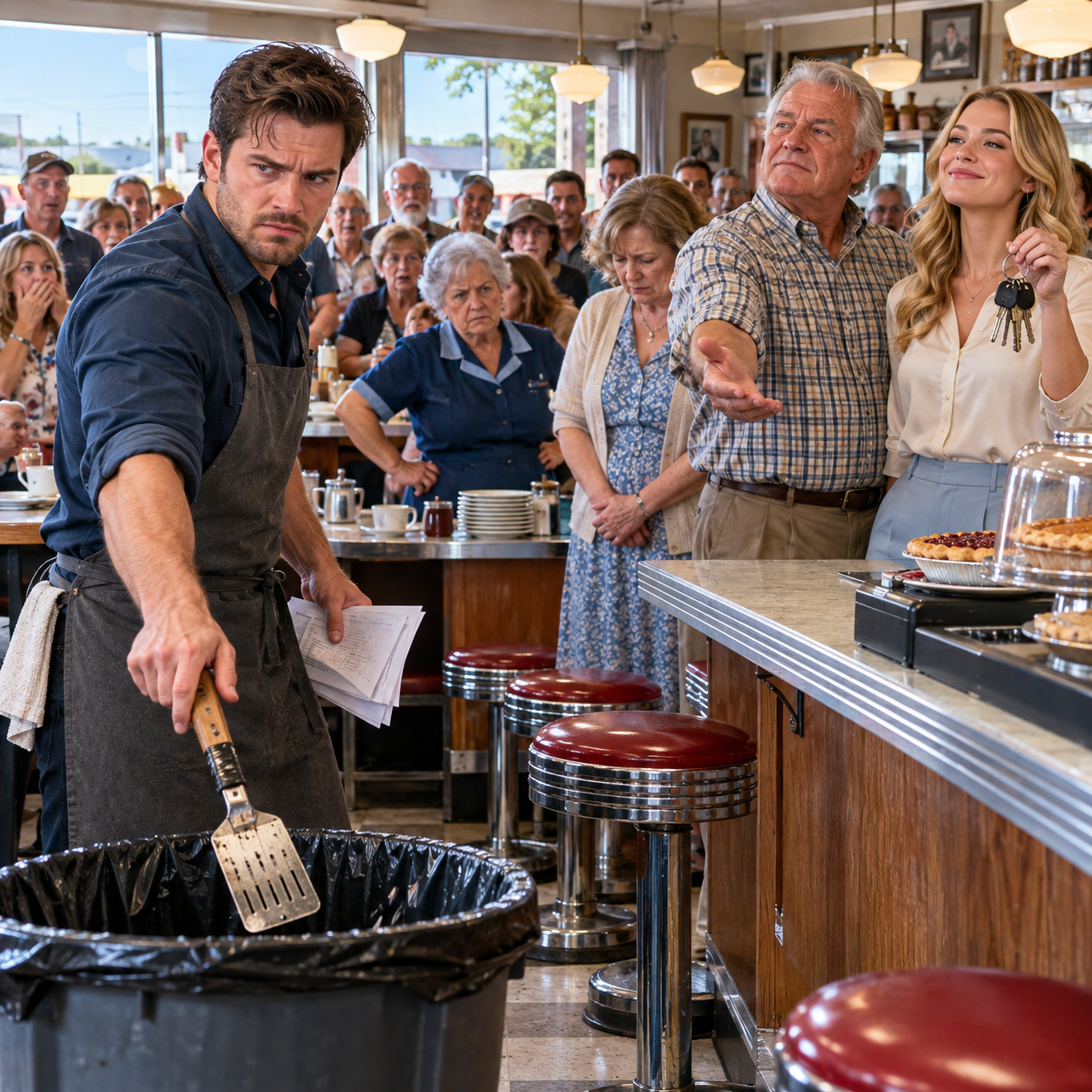
Mom began crying silently. Then she reached into her gift bag and pulled out the old spatula, its wooden handle still wrapped in electrical tape.
“I saved it from the trash after your father’s party,” she whispered. “He always wanted you to have it.”
I carried it into my kitchen and dropped it into the empty trash can beside the dish station.
The familiar hollow clunk echoed through the room.
I returned to the booth. “It still isn’t mine.”
Then I opened the front door.
Marissa left with her binder. Mom followed, wiping her eyes. Dad paused with his cane, staring at me as though searching for words he’d forgotten years earlier.
He said nothing.
And this time, I didn’t follow him outside.
## Part 4: The Final Breakfast Revealed What My Father Had Finally Understood
The state eventually began collecting money from Marissa’s wages, and when those payments couldn’t cover the liability quickly enough, Dad received his own demand for payment. My parents sold their cottage on Long Lake that October to help settle the debt. It was the cottage Dad had always promised Marissa because, supposedly, the diner belonged to me.
Marissa found work at the gas station near the old Myron’s building. Her shift started at four-thirty every morning, serving the same workers she’d once insisted would adapt to her schedule.
Dad visited Wanda personally and repaid her two missing paychecks. She told me he stood on her porch holding his hat and apologized for failing her.
“I told him it should’ve been handled years ago,” she said, stirring her Saturday coffee. “But I waited until he got down the steps before closing the door. I’ve still got manners.”
The old Myron’s building eventually became a tire shop. Its large front window remained, but stacks of tires stood where my pie display used to be. Mom told me Dad took the longer road to church rather than drive past it.
At The 4:30, I installed a second grill, and the television award hung beside my register. My employees received their paychecks on time, my customers received food worth getting up early for, and nobody needed to pretend the restaurant belonged to someone else.
Then, one Tuesday morning in April, the front bell rang at six-thirty.
Dad walked inside alone.
He looked older than he had at our meeting, his shoulders bent and his cane gripped tightly in one hand. He didn’t ask to speak with me or approach the kitchen. Instead, he settled onto Stash’s usual stool and told Patrice he wanted two eggs over medium, rye toast, and hash browns.
I heard every word through the kitchen window.
I cooked his breakfast myself, carefully turning the eggs, crisping the potatoes in butter, and arranging the toast exactly as I’d done thousands of times at his old restaurant. Patrice carried the plate to him.
Dad ate slowly. He finished every bite.
When Patrice brought the check, he paid the full price without asking for anything. On his way out, he stopped beside the kitchen window and pointed his cane toward the spatula hanging above my grill.
It was an ordinary twelve-dollar spatula I’d bought when I opened the place.
“That one any good?” he asked.
I looked at him. “It’s mine.”
For several seconds, he studied the utensil, then looked back at me.
“Good,” he said quietly.
He turned and walked outside.
I watched through the window as he placed his cane on the passenger seat and started his car. For the first time, I didn’t feel the need to chase him, explain myself, or make him understand.
Patrice returned carrying his check folder.
“Ben, look at this.”
Dad had left a twenty-percent tip.
When I told Wanda that Saturday, she stared at me in disbelief. In thirty-one years of working for him, she couldn’t remember him ever leaving a proper tip.
I thought about that for a long time.
It wasn’t a grand apology. It didn’t restore nine years of unrecognized work or erase the day sixty people laughed while my father handed away my future. We still had a great deal left unsaid, and I didn’t know whether we’d ever become the family we should have been.
But he’d come into my restaurant, eaten food prepared by my hands, and paid for it without claiming he was the reason it existed.
For a man who’d spent his life believing everything belonged to him, that was something.
I put the check folder down, turned toward my grill, and reached for my spatula.
Outside, another truck pulled into the parking lot.
It was almost seven, the quarry shift was changing, and people were waiting for breakfast.
This time, I wasn’t working to inherit somebody else’s dream.
I was living my own.
THE END.
All characters and events in this story are fictional, created for storytelling and entertainment purposes. Thank you sincerely for reading. Your feedback and support are invaluable and motivate me to continue sharing more stories with you.


