
### Part 2: A Sealed Military Order Exposes The Truth Dad Denied
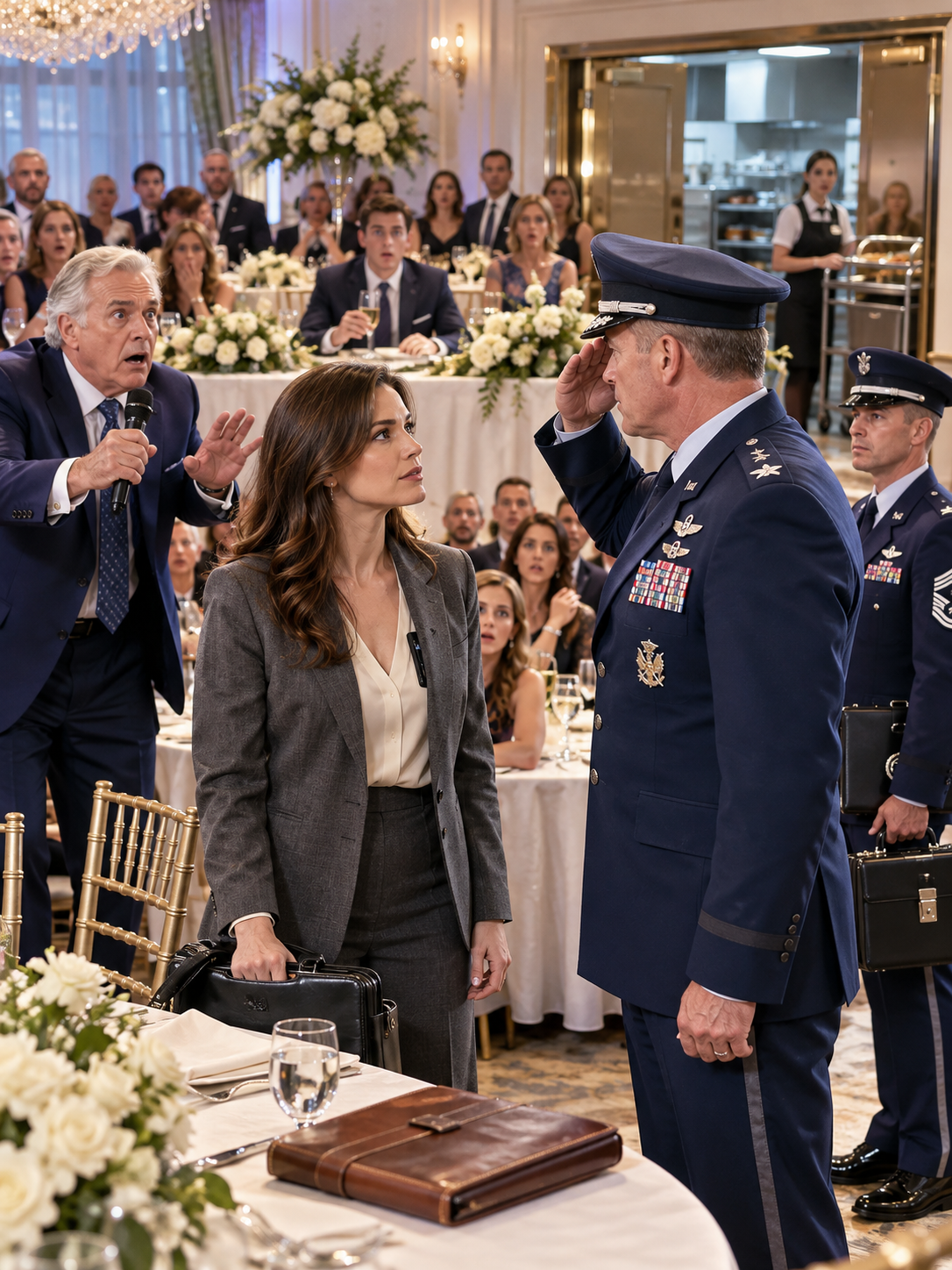
The silence felt almost physical, pressing against the walls of the banquet hall. Nolan’s champagne glass remained suspended halfway to his mouth, while my father’s smile slowly collapsed into an expression I had never seen before. He glanced at the colonel’s uniform, then at me, searching for some explanation that would allow the evening to return to normal. Instead, he stepped forward and pointed an accusing finger.
“Hold on,” he demanded. “What exactly is this supposed to be? Some kind of ridiculous prank?” His voice rose as several guests exchanged uncomfortable looks. “My daughter is a flight attendant. She serves drinks on commercial airplanes. She isn’t a colonel.”
The officer didn’t react to Dad’s outburst. “Colonel Marcus Mercer, Presidential Airlift Group,” he said, presenting his credentials with measured professionalism. The sealed tasking documents bore official military markings, and his expression made it clear that this was neither a ceremony nor a performance. “Sir, we’re executing an authorized priority recall, and Colonel Drake is required to report immediately.”
Dad stared at the documents without touching them. His lips moved, but no words came, and I watched his certainty crumble beneath the weight of information he could neither dismiss nor understand. Behind him, Nolan had risen from his chair, his face pale as his eyes moved between the insignia on Mercer’s shoulders and the woman he had allowed his father to ridicule. Several of Nolan’s airline colleagues were watching now, but nobody looked amused.
“Ma’am,” Mercer said, turning toward me, “do you authorize the release of any nonclassified information regarding your military status to the civilians present?”
I looked toward Dad, whose expression suddenly carried something close to pleading. For years, I had imagined a moment when he would finally discover the truth and understand how badly he had misjudged me. Now that moment had arrived, I felt no desire to explain my accomplishments in front of an audience. I folded my napkin beside my plate and answered quietly, “Negative, Colonel. We should leave.”
I stood, buttoned my blazer, and retrieved the black travel bag waiting beneath my chair. The leather flight-log case remained on the table, carefully positioned where Nolan could find it. I had brought it because I was proud of my brother, and nothing that happened tonight changed the fact that he had worked hard for his promotion. When I passed the head table, Dad instinctively reached toward me, but his hand stopped before touching my sleeve.
“Fallon,” he whispered, “why didn’t you tell us?”
I paused without turning fully toward him. “You never asked me anything you were willing to hear, Dad.”
Mercer and the sergeant escorted me through the brass doors, leaving behind the banquet hall’s suffocating silence. Outside, the hotel lobby smelled faintly of polished marble and fresh flowers, and a black government sedan waited beneath the entrance canopy. I was nearly at the revolving doors when hurried footsteps sounded behind us. “Fallon, please wait!”
Nolan approached with his tie loosened and his breathing uneven. Unlike Dad, he understood enough about military aviation to recognize what had just occurred. He had spent years studying flight systems, navigation procedures, and the enormous responsibility that accompanied command of an aircraft. Now he stared at me as though he were seeing a stranger.
“That was the Presidential Airlift Group,” he said quietly. “Fallon, are you actually qualified to command heavy military aircraft?”
“Yes.”
“How long?”
“Seven years on those platforms.”
Nolan looked down at the polished floor. “Seven years,” he repeated, barely audible, before lifting his eyes again. “And I’ve been letting Dad make those jokes about you.”
I could have told him about every dinner where his laughter had followed Dad’s insults, or every holiday when he accepted praise built on comparisons that diminished me. Instead, I touched his arm and said, “You earned your captain’s seat, Nolan. I’ve always respected that. I just wish you had understood that your success never required my failure.”
His face tightened, and for a moment I thought he might argue. Then he stepped aside, his shoulders dropping beneath the weight of an understanding that had arrived years too late. “I’m sorry,” he said, and there was nothing rehearsed about it. I nodded and walked toward the waiting sedan.
As the car pulled away, I looked through the rear window and saw Nolan standing alone beneath the hotel lights, holding the leather case against his chest.
### Part 3: My Father’s Desperate Apologies Reveal What He Truly Values
Forty-five minutes later, the sedan passed through the security perimeter at Joint Base Andrews. The glittering banquet hall had been replaced by rain-slick pavement, powerful floodlights, and the low mechanical thunder of aircraft preparing for departure. I changed into my flight suit inside the squadron ready room, fastened my lieutenant colonel’s silver oak leaves, and joined the operational planning team. Within minutes, the evening’s humiliations had disappeared beneath charts, weather updates, and decisions that demanded complete attention.
Mercer stood near the briefing display as our team reviewed Atlantic routing, fuel calculations, diversion airfields, and secure communications procedures. Every question received a precise answer, and every unresolved detail was examined before anyone moved forward. Nobody cared where I had sat at dinner, what my father thought of my civilian job, or whether my brother had received louder applause. In that room, responsibility mattered far more than reputation.
During a thirty-minute maintenance hold, I returned to the operations annex and retrieved my personal phone from its locker. The screen illuminated with twenty-two missed calls and four voicemails, all from Dad. I sat on a narrow bench beneath the fluorescent lights, listened to the distant vibration of equipment through the wall, and pressed play. His voice filled the quiet room, unfamiliar in its trembling uncertainty.
“Fallon, it’s Dad. Please call me when you can. Nolan explained what that wing does, and your uncle heard from General Morrison’s office. I didn’t understand any of it.” He stopped, apparently struggling to breathe evenly. “Some of Nolan’s company executives were asking why I put you near the kitchen. I didn’t know what to tell them.”
I stared at the phone while the recording ended. Even now, with his carefully constructed picture of our family shattered, Dad seemed terrified by what other people thought. His daughter had been called away to serve her country, yet his first concern was explaining an embarrassing seating arrangement to important guests. I played the next voicemail, hoping I had misunderstood him.
“I shouldn’t have said those things,” he murmured. “You must think I’m a terrible father. I just wish you’d told me who you really were before tonight.”
That final sentence hurt more than his jokes. I had told him who I was countless times, even without mentioning a military rank: I was his daughter, I worked hard, I cared about my family, and I wanted him to treat me with ordinary kindness. He had decided those things were insufficient because they could not impress his friends. Discovering a decorated officer behind the civilian blazer had suddenly made me worthy of the attention I had requested for years.
I closed the voicemail without returning his calls. There was no pleasure in imagining Dad embarrassed before his business associates, and I had no interest in using my position to punish him. What troubled me was the realization that I had quietly spent much of my adult life waiting for a man to be proud of me when he had never been curious enough to know me. I placed the phone inside my locker and returned to the flight line.
Over the following days, our mission continued according to its demanding schedule. There were long briefings, carefully monitored departures, and hours when my world narrowed to instruments, communications, and the people depending on our decisions. I found something reassuring in that discipline, because competence did not require an audience to become meaningful. When I finally returned home two weeks later, I had decided I would not hide from my family, but I would no longer compete for a place in it.
Nolan called the evening before our usual Sunday breakfast. I could hear an aircraft announcement behind him, followed by the unmistakable rhythm of luggage wheels rolling across terminal flooring. “Dad’s making breakfast tomorrow,” he said. “He’s nervous about seeing you, but I told him I’d come.” After a pause, he added, “I’d like you there, Fallon. Not because of what happened at the hotel. Because I miss my sister.”
I closed my eyes, remembering the little boy who once followed me around the backyard with toy airplanes, asking me to explain why some aircraft could fly higher than others. Somewhere along the way, our father had turned two children who loved flying into competitors in a race neither had agreed to enter. “I’ll be there,” I said, and Nolan exhaled with unmistakable relief.
That night, I hung my charcoal blazer inside the closet, smoothing the sleeve Dad had nearly grabbed at the hotel. I wondered whether his apology would survive beyond the shock of discovering my rank. By morning, I would have my answer.
### Part 4: One Final Betrayal Forces Dad To Understand My Real Worth
Sunday sunlight spilled across my father’s kitchen countertops when I arrived. Dad had arranged fresh pastries, sliced fruit, scrambled eggs, and enough coffee for twice the number of people expected. Nolan sat at the table in an old gray sweater, turning the leather flight-log case over in his hands. When he saw me, he stood, crossed the kitchen, and wrapped his arms around me.
“Thank you for the gift,” he whispered. “I’ve already started using it.”
I hugged him back, feeling the tension in his shoulders slowly release. Dad watched from beside the coffee maker, his expression caught somewhere between hope and fear. He looked older than he had at the banquet, although only two weeks had passed. “Good morning, Fallon,” he said softly, and when I returned the greeting, his hand trembled slightly as he poured my coffee.
For the first twenty minutes, we managed an ordinary breakfast. Nolan told us about a difficult landing in Chicago, I asked about his next route, and Dad listened without interrupting. When Nolan admitted that his promotion still frightened him sometimes, I assured him that responsible pilots never stopped respecting the risks of their profession. Dad looked from one of us to the other, apparently surprised that our conversation could be warm without anyone being declared the winner.
Then the doorbell rang.
Greg, Dad’s longtime business partner, had stopped by to deliver paperwork for a real estate transaction. Dad welcomed him inside, but the instant Greg noticed me at the table, I saw a familiar brightness return to my father’s eyes. He straightened his shoulders, smiled broadly, and placed a possessive hand on the back of my chair. “Greg, you remember my daughter Fallon, don’t you? You’ll never believe what we discovered about her.”
My stomach tightened.
“She’s a lieutenant colonel,” Dad announced, his voice swelling with the same theatrical pride I had heard at Nolan’s banquet. “Presidential airlift operations, specialized military aircraft, the whole thing. Apparently, she’s been doing extraordinary work for years!”
“Arthur,” I said.
He continued, already reaching for his phone. “I have pictures from the ceremony at the hotel. You should have seen those officers come in and—”
“Dad. Stop.”
The kitchen fell silent. Greg shifted awkwardly near the doorway while Nolan set down his fork, watching me with quiet understanding. I rose from my chair and faced the man whose approval I had once wanted more than almost anything. This time, I had no uniform, no military escort, and no official documents to prove my worth.
“You spent five years making jokes about me because you thought I served drinks for a living,” I said. “You put me beside the kitchen during a family celebration because you wanted everyone to understand which child mattered more. Now you want to introduce me to your friends because you discovered a rank you can brag about.” I kept my voice steady, although my hands were trembling. “My service is not another trophy for your collection.”
Dad’s expression collapsed, and he withdrew his hand from my chair. “Fallon, I was only trying to show Greg how proud I am.”
“Would you still be proud if I were only a flight attendant?”
The question hung between us. Dad opened his mouth, closed it, and glanced helplessly toward Nolan, who offered him no escape. For once, my father understood that the right answer could not be manufactured for an audience. He lowered himself into a chair and stared at his coffee.
Finally, he looked up. “I don’t know if I would have treated you differently,” he admitted. “That’s the part I’m ashamed of.”
His honesty surprised me more than the apology I had expected. “I spent so much time wanting everyone to admire my family,” he continued, “that I forgot to appreciate the people in it.” His voice cracked, and he rubbed his forehead with a shaking hand. “I made you feel unwelcome in your own home, Fallon. I’m sorry.”
Nolan quietly closed the flight-log case. “Dad, you did it to both of us,” he said. “You made me believe being successful meant being better than my sister. I let you do it because I liked the attention.” He looked directly at me. “But I’m not proud of that anymore.”
For several moments, nobody spoke. Greg remained near the doorway, pretending to examine the paperwork in his hands, while the kitchen clock ticked above the refrigerator. I could have delivered a speech about military service, sacrifice, and professional achievement, but none of those things addressed what had truly wounded me. What I needed was much simpler.
“Dad, I don’t want you telling people about my rank,” I said. “I want you to be able to introduce me as your daughter without needing to explain why I deserve your respect.”
He looked at me for a long moment, and I watched the practiced pride drain from his face. Then he turned toward Greg, who stood patiently by the door.
“Greg,” Dad said quietly, “this is my daughter, Fallon. She’s a good woman, and I’m lucky she’s here.”
There were no titles, no impressive assignments, and no comparisons with Nolan. It was the simplest introduction my father had ever given me, and somehow it was the first one that felt entirely true. Greg smiled, shook my hand, and left us to finish breakfast.
Afterward, Nolan helped clear the dishes while Dad stood beside me at the sink. He picked up a clean towel and began drying the plates I handed him, moving slowly as though uncertain whether he was welcome in the conversation. “You know,” he said after a while, “I never thought about what your civilian work actually involved.”
I glanced toward him. “You could have asked.”
“I should have.”
I handed him another plate, and he dried it without offering an excuse. Nothing in that small exchange erased the dinners, birthdays, and years of humiliation, but it was the first time he had accepted responsibility without reaching for a justification. I understood then that forgiveness would not arrive as one magnificent gesture; if it came at all, it would be built through ordinary mornings like this one.
When I left, Nolan walked me to the driveway, carrying his new flight-log case. “Next time I make captain somewhere bigger,” he said with a crooked smile, “I’m choosing the seating arrangements myself.” I laughed, and he hugged me once more before stepping back. Through the kitchen window, I could see Dad gathering our empty coffee cups, no longer performing for anyone.
As I drove away, I thought about the night Colonel Mercer had saluted me in front of sixty astonished guests. Everyone in that banquet hall had believed the salute was the moment my father discovered my value. But the truth was that I had possessed that value long before an officer walked through those doors.
I had possessed it when I helped frightened passengers through rough flights, when I studied navigation charts until midnight, and when I chose to celebrate my brother despite knowing I would be humiliated. I possessed it now, driving home in ordinary clothes, with no medals on my chest and nobody watching. My father had finally begun to understand something I had spent years learning: a person’s worth does not increase when someone important recognizes it.
And the most meaningful thing I carried away from that breakfast wasn’t my father’s admiration for a colonel.
It was the possibility that, someday, he would love Fallon just as much.
THE END.
All characters and events in this story are fictional, created for storytelling and entertainment purposes. Thank you sincerely for reading. Your feedback and support are invaluable and motivate me to continue sharing more stories with you.


