
### Part 2: A forgotten military call sign uncovers an extraordinary secret
The restaurant manager offered to relocate our dinner, but everyone remained seated while employees cleared the broken dishes. I washed the blood from my palm and returned to find a fresh white tablecloth covering the place where Malcolm had fallen. Clare’s father stood and raised his glass toward me. “You saved that gentleman’s life.” I shook my head. “He had a pulse when he left. That’s a chance, not a guarantee.”
Travis reached for his wine. “The defibrillator did most of the work, didn’t it?” Clare stared at him. “Your sister performed CPR while everyone else stood there.” My brother shrugged. “I’m just saying the machine deserves some credit.” Dad leaned forward, annoyed that the attention had shifted away from the engagement. “Lena, don’t make this into another heroic military story. You’re not a surgeon.”
“No,” I answered quietly. “I’m not.”
He smiled, satisfied with what he considered a confession.
A server approached carrying my bracelet, which had slipped off during the emergency. Before I could retrieve it, Travis picked up the metal disc. “Rook 27? What’s this, some secret-agent nickname?” I took it from his fingers and fastened it around my wrist. “It’s a crew keepsake.” Dad chuckled, and I suddenly remembered rain hammering against helicopter windows, the smell of aviation fuel, and a young pilot asking whether I understood what would happen if we stayed on the ground.
Black Gorge. My third deployment.
Our helicopter had been dispatched to evacuate casualties from a joint patrol stranded beyond a flooded ravine. The initial report mentioned two urgent patients, but when we landed, six men required immediate care. One had devastating pelvic injuries, another had a serious chest wound, and a third was losing his airway. Our aircraft carried limited blood products, and the landing zone was exposed.
The patrol leader demanded immediate evacuation. I looked at the patient with the pelvic injury, whose blood pressure was nearly impossible to measure, then toward our pilot. “If we lift now, he might not survive the ascent. I need ninety seconds.” The pilot stared through the rain. “We stay, we become targets.” I nodded. “I understand.”
We stayed.
I applied a pelvic binder, began blood resuscitation, and coordinated treatment while our crew worked around me. Another medic managed the damaged airway. Our flight nurse handled the chest injury, and the crew chief monitored the worsening danger outside. Sixty-three seconds after my request, we lifted with six casualties packed into space intended for four.
All six reached surgery alive.
For months afterward, I woke at 3:17 every morning, remembering the moment a patient stopped breathing during that flight. My father never heard about those nights. He remembered only that I’d missed his retirement barbecue, and when I eventually stopped explaining my work, he treated my silence as proof that nothing important had happened.
At 10:43 that evening, as I prepared to leave the restaurant, Malcolm’s wife returned. Her cream jacket was stained from the floor, but her expression carried cautious relief. “He’s alive,” she announced. “He’s in the catheterization lab. His doctors said the early CPR and shocks were critical.”
My knees nearly weakened. She embraced me, then stepped back and examined my face. “He asked me to find out your full name.”
“Lena Ortiz.”
Her eyes widened. “Master Sergeant Lena Ortiz?”
My father’s head turned sharply.
“Yes,” I answered.
The woman took my hands. “My husband knows your voice. He’s listened to the Black Gorge recording for years.”
I stopped breathing for a moment.
“Our son was the patrol leader,” she continued. “My name is Evelyn Voss.”
She opened her purse and handed me a card identifying her husband as Lieutenant General Malcolm Voss, U.S. Army, retired. Travis stared at the three stars printed above his name. Dad pushed back his chair without standing.
Evelyn explained that Malcolm had overseen the medical readiness review following Black Gorge. He knew the radio recording, especially the medic who refused to abandon the landing zone before stabilizing the wounded. “Your daughter helped bring six soldiers home,” she told my father. “My husband has wanted to thank her for years.”
Dad swallowed. “She never told us that.”
“I tried,” I said.
Evelyn glanced between us, then added quietly, “I also heard someone calling for a real doctor tonight. If Lena had waited, my husband might not have survived.”
No one answered.
Dad followed me into the parking lot afterward, his shoes splashing through shallow rainwater. “You could’ve told me how important your work was,” he said. I stopped beside my car and faced him. “I told you I was a flight medic. I told you I’d deployed five times. You called me an ambulance driver.” His expression hardened. “You let me embarrass myself in there.”
“I didn’t make you mock me, Dad.”
He opened his mouth, but I wasn’t finished.
“You assumed my silence meant I had nothing worth saying. You never considered that you were the reason I stopped talking.”
For once, he had no answer.
### Part 3: A retired general reveals how one decision changed countless lives
The following morning, I entered the Pentagon wearing my Army uniform. My father had never asked what the badges on my chest represented, and he still pictured the nineteen-year-old girl who enlisted after her mother’s death. He didn’t know I’d been selected as a senior enlisted medical adviser for a joint casualty care initiative. Our work focused on improving survival when wounded service members couldn’t be evacuated quickly, and my years aboard medical helicopters had shaped many of its procedures.
After the briefing, I received Evelyn’s message. Malcolm was awake and asking for me.
I visited the hospital that afternoon. He looked smaller beneath the blankets, with oxygen tubing resting beneath his nose, but his eyes sharpened when he noticed my uniform. He studied my rank, my flight medic badge, and my name tape before raising his right hand in a deliberate salute. I returned it, surprised by the emotion tightening my throat.
“Rook 27,” he said softly. “I’ve waited nine years to meet you.”
“I’m sorry it happened like this, sir.”
He smiled. “You always did have a talent for difficult landing zones.”
We spoke about my old crew. Our pilot had become a battalion commander, our crew chief now taught aviation maintenance, and our flight nurse worked in a Texas trauma center. Malcolm listened closely, asking about every person who had helped save his son’s patrol. Then he turned serious and told me something I’d never known.
During the Black Gorge review, several officers had questioned our decision to delay takeoff. They believed we should have evacuated the two most critical casualties immediately. But the aircraft recording documented my assessment, the crew’s treatment, our requests for additional blood, and the precise timing of the eventual departure.
“Sixty-three seconds,” Malcolm said, holding my gaze. “That’s how long you asked us to hold before you believed those men could survive the flight.”
I remembered the rain, the warning from our pilot, and the terrible certainty that every choice carried a risk. Malcolm reached for a folder on his bedside table. “That review helped shape delayed evacuation procedures across three commands. Your judgment influenced how medics are trained today.”
I stared at the folder. “Nobody ever told me.”
“Sometimes institutions are poor at thanking the people who teach them their most important lessons.”
I lowered my eyes. For years, I’d remembered every decision that could have gone wrong, never knowing that someone had studied what we’d done right.
Before I left, Malcolm invited me to a military medicine gala scheduled six weeks later. He was presenting an award connected to the casualty care program I’d helped develop. I admitted that formal dinners weren’t my favorite thing. He glanced at his cardiac monitor and smiled. “They’ve become considerably less appealing to me, too.”
I agreed to attend.
What I didn’t know was that Travis’s company sponsored a table at the same event. Following the restaurant incident, Clare had confronted him about his treatment of me. She told him she wouldn’t build a marriage around the habit of humiliating someone and calling it affection. Travis invited Dad to the gala, hoping a respectable evening among hospital executives would repair the family’s discomfort.
Neither realized I would be honored there.
When I entered the ballroom in dress uniform, my father spotted me from across the room. He rose halfway from his chair as a colonel approached and greeted me by name. A command sergeant major shook my hand, asking about our new training standards. Two younger medics thanked me for lessons they’d used during deployment.
I saw Dad watching these exchanges with an expression I couldn’t read. Travis stood beside him, suddenly unable to explain why people he considered important were treating his sister with such respect. I nodded to both men and took my seat near the front.
After dinner, Malcolm walked slowly onto the stage. He described his collapse at the restaurant, and the ballroom quieted when he mentioned the medic who had responded before anyone understood what was happening. Then he spoke about Black Gorge, the six wounded soldiers, and the training protocols developed afterward.
“Master Sergeant Lena Ortiz,” he said into the microphone, “did not ask who I was before she treated me. She saw another human being who needed help.”
He explained that the procedures I’d helped design were already being implemented at four training sites. Around the ballroom, physicians, officers, medics, and military families began applauding.
Then Malcolm asked me to come forward.
Nearly four hundred people rose from their chairs.
From the corner of my eye, I saw Travis stand first, Clare beside him. My father remained seated for one stunned heartbeat before rising with everyone else.
And on the stage, Malcolm lifted an award bearing a name that stopped me in my tracks.
### Part 4: A final revelation transforms public honor into lasting family healing
The engraving read: Major Jonathan Voss Award for Operational Medical Leadership.
I knew Jonathan’s name. He had led the patrol at Black Gorge, a young officer whose determination to protect his soldiers had impressed everyone on our evacuation crew. I’d heard that he’d survived the mission and returned to duty. What I hadn’t known was that he’d later died in an aircraft accident unrelated to combat.
Malcolm watched me read the inscription. “My son talked about that rescue for years,” he said, his voice breaking slightly. “He remembered how your crew refused to leave his soldiers behind. We established this award after losing him, to recognize people who carry that same responsibility.”
For a moment, the ballroom disappeared. I saw Jonathan again, rain running down his face, kneeling beside an injured soldier while our helicopter waited. He’d been terrified, but he’d helped us load every casualty before allowing himself to board. I wondered how often Malcolm had replayed the recording simply to hear his son’s voice again.
Malcolm held the award between us. “You brought my son’s people home, Lena. Then, nine years later, you brought me back to my wife.”
The room fell silent.
I accepted the award with trembling fingers. “Our whole crew brought them home, sir.”
His eyes softened. “That’s exactly what I expected you to say.”
When I turned toward the audience, I found my father standing near the back. His face was wet, and he wasn’t trying to hide it. For fourteen years, he’d treated my service as an unfinished version of the career he thought I should have chosen. Now he stood among people who understood that medical skill wasn’t measured only by the letters following someone’s name.
After the ceremony, Dad approached while I was speaking with two younger medics. He waited until our conversation ended, something he’d rarely done before. “Lena,” he began, staring at the award in my hands. “I didn’t know any of this.”
“I know.”
“I thought you avoided talking about your work because there wasn’t much to tell.”
I looked directly at him. “I stopped talking because you made every answer into a joke.”
His shoulders sagged. “I was proud of Travis because I understood his career. With you, I felt shut out.”
“You were shut out eventually, Dad. Not at first.”
He blinked, then nodded. “You’re right.”
Travis joined us, tugging nervously at his cuffs. “I owe you an apology, too.” I waited without rescuing him from the uncomfortable silence. He glanced toward Clare before continuing. “I liked being the successful one. Even when you weren’t competing with me, I kept making sure Dad thought I was doing better.”
“You are successful, Travis.”
He shook his head. “That should’ve been enough. I didn’t need to make you smaller.”
I accepted his apology, but I didn’t promise that everything would immediately return to normal. I’d spent too many years swallowing disappointment to pretend a few honest sentences could erase it. Still, when Dad asked whether he could learn more about my work, I told him he could start by listening without deciding what my answers meant.
He did.
Over the following months, our relationship changed in small, uncertain ways. Dad began asking real questions and accepting that some experiences weren’t mine to discuss. Travis stopped describing himself as a medical professional at family gatherings. Clare later told me he’d begun correcting people who confused selling medical equipment with knowing how to use it.
Three months after the gala, Dad attended a graduation ceremony for flight medics I’d helped train. He sat quietly in the second row, listening as the graduates described the responsibilities awaiting them. Afterward, one young soldier approached him and asked how he knew me.
Dad looked across the room toward where I was standing. “I’m her father,” he answered. Then, after a moment, he added, “And I’m still learning what that means.”
It wasn’t a perfect apology. But it was the first one that didn’t ask me to make him feel better.
A year after Malcolm’s cardiac arrest, Evelyn arranged a small dinner at the same restaurant. Malcolm had recovered well and insisted on returning, although Evelyn made him promise we’d sit close to the AED. I invited Dad, unsure whether the evening would feel awkward. Instead, we shared a meal full of ordinary conversation, and nobody made a single joke about my years in uniform.
Near dessert, a server recognized Malcolm from the previous year. “You’re the gentleman who collapsed here,” she said, her eyes widening. “I heard someone saved your life.”
Malcolm smiled and pointed toward me.
The server turned, visibly astonished. “It was you?”
I nodded. “A lot of people helped. Someone called 911. Another brought the AED. A gentleman took over compressions when I needed him. It wasn’t just me.”
She thanked us and walked away.
Dad remained quiet until Malcolm excused himself to speak with the restaurant manager. Then he looked at the silver bracelet resting against my wrist. “I used to think you were being modest because you hadn’t accomplished very much,” he said. “Now I understand you were giving other people the credit they deserved.”
I waited, letting him finish.
“And I made that kindness into something to ridicule.”
The admission hurt more than I expected because it was finally accurate. I placed my hand over his and said, “You don’t have to understand every part of my life, Dad. But you do have to respect it.”
He squeezed my fingers. “I will.”
Outside, the evening air was cool, and the restaurant windows glowed behind us. Malcolm and Evelyn walked toward their car, hand in hand. Travis was inside helping Clare with her coat, while Dad waited beside the door instead of hurrying everyone along.
I touched the small metal disc on my bracelet. Rook 27. Fourteen years of training, frightening decisions, sleepless nights, and lives that had briefly depended on my hands were bound up in something most people would mistake for inexpensive jewelry.
My father had spent years asking why I never became a real doctor. I no longer needed to explain what I had become instead.
The stranger who collapsed during dinner had survived because a roomful of people acted when it mattered. My father had changed because he finally listened when the evidence contradicted the story he’d told about me.
And I had learned something just as important.
Being humble never meant I had to accept humiliation. I could honor the people who served beside me, acknowledge the limits of my own achievements, and still refuse to let anyone diminish what those years had cost.
That night, as Dad held the restaurant door open for me, he smiled and said, “After you, Master Sergeant.”
For the first time in fourteen years, I heard pride in his voice without a joke waiting behind it.
And for the first time, I believed him.
THE END.
All characters and events in this story are fictional, created for storytelling and entertainment purposes. Thank you sincerely for reading. Your feedback and support are invaluable and motivate me to continue sharing more stories with you.
My Father Mocked My Years as a Medic — Then a Stranger Collapsed During Dinner
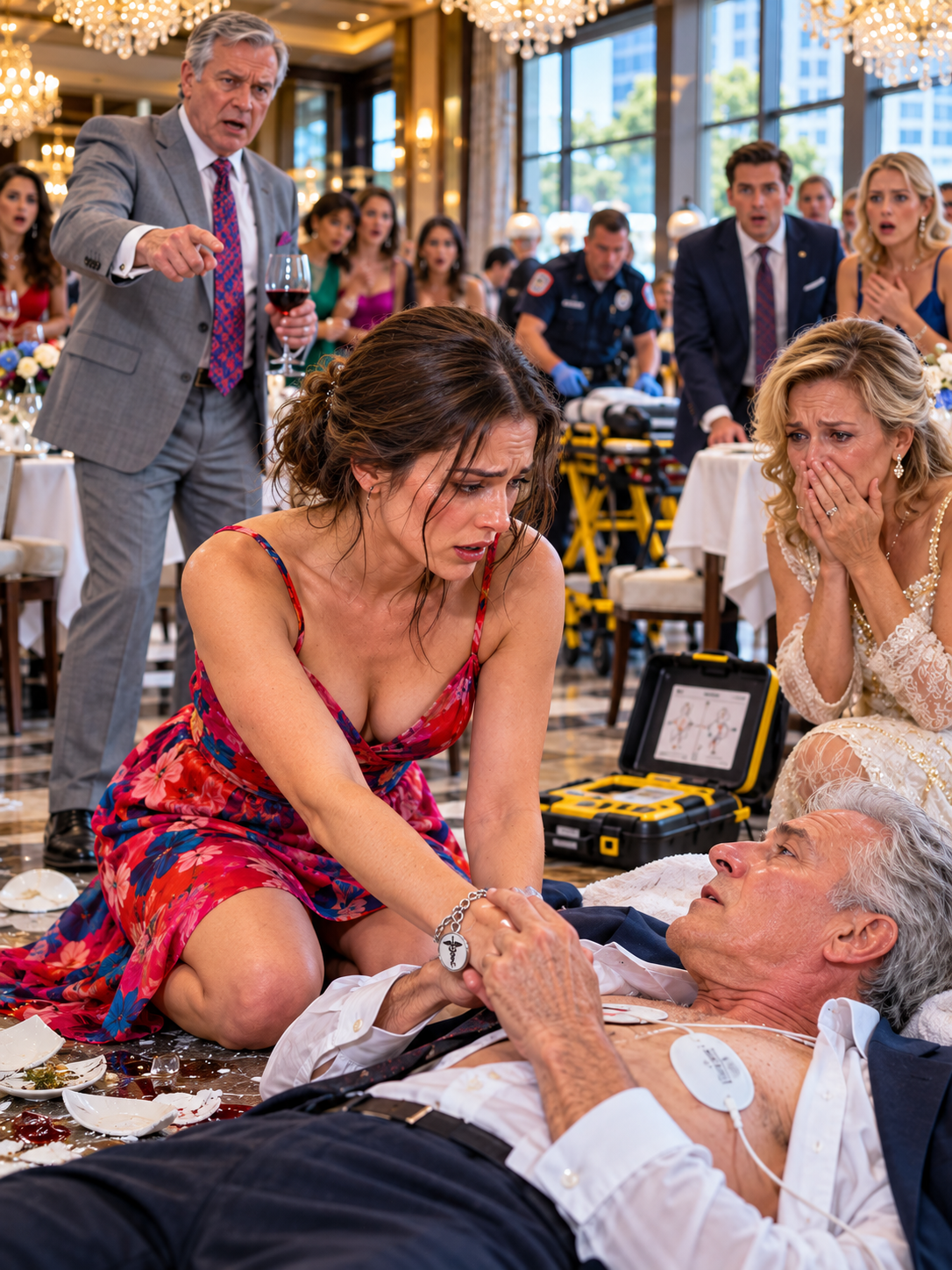
My father lifted his wineglass and laughed at my fourteen years in the Army. “Lena spent all that time changing bandages and still thinks she’s a medical professional.” Several relatives chuckled. Then a plate shattered behind me, a woman screamed, and a stranger collapsed between two tables. My father called for a real doctor.
### Part 1: One terrible dinner exposes the truth behind fourteen years
I was already moving when the man’s shoulder struck the floor. His wife dropped beside him, calling his name, while everyone else seemed frozen in their chairs. I knelt, checked his responsiveness, and found only irregular gasps. When I couldn’t detect a pulse, I looked toward the nearest server. “Call 911. Tell them we have a cardiac arrest. Bring me the AED immediately.”
“Shouldn’t we wait for a doctor?” someone asked. I didn’t look up. “He doesn’t have time to wait.” I positioned my hands over his chest and began compressions, counting steadily while the restaurant erupted around me. Behind the frightened voices, I heard my father’s unmistakable tone. “Well, at least she’s finally getting to use that training.”
My name is Lena Ortiz, and for fourteen years I served as an Army medic, eventually becoming a critical care flight medic. My father, Richard, considered that a polite description for someone who changed dressings and carried injured soldiers. My younger brother, Travis, sold expensive medical equipment, and Dad introduced him proudly as someone who worked in medicine. Apparently, selling surgical technology deserved more respect than treating people whose lives depended on the next sixty seconds.
Tonight was supposed to celebrate Travis’s engagement to Clare Mercer. Her parents had traveled from Richmond, and Dad had reserved an elegant private dining area near Arlington. Before the appetizers arrived, he’d already joked about my Army career three times. When Clare asked whether I’d ever flown medical evacuation missions, I answered, “For several years,” but Dad interrupted with a dismissive wave. “She makes everything sound dramatic. Medics just keep patients alive until the actual professionals arrive.”
Now one of those professionals wasn’t coming quickly enough.
A young man wearing a dark suit crouched opposite me. “I’m trained in CPR,” he said, his voice shaking. “Good. Take over compressions when I tell you, and keep your arms straight.” He positioned himself while I assessed the man’s condition and noticed a small prescription bottle beside his jacket. Nitroglycerin. Important information for the arriving paramedics, but it wouldn’t restart his heart.
The AED finally arrived. I opened the case, exposed and dried the man’s chest, and attached the electrode pads. The machine analyzed his rhythm and instructed us to deliver a shock. “Everybody clear!” I shouted, making certain no one was touching him before pressing the button. His body jerked, and we immediately resumed CPR.
His wife was crying so hard she could barely speak. “His name is Malcolm,” she whispered. “Please don’t let him die.” I met her eyes for one second. “We’re doing everything we can for him. Keep talking to him.” My dress had torn at the knee, and a broken plate had cut my palm, but I barely noticed. I heard only the rhythm of compressions, the AED instructions, and the desperate breathing of the people surrounding us.
The machine advised another shock. We cleared him again, delivered it, and resumed compressions until Malcolm suddenly coughed. I reassessed him and found a weak pulse. His breathing gradually became more effective, and his wife pressed both hands over her mouth. Across the room, my father stood motionless with his wineglass still in his hand.
When Malcolm opened his eyes, he caught my wrist. His fingers brushed the silver bracelet beneath my sleeve, where a small handmade metal disc carried a winged serpent and the number 27. He stared at it, then at my face. His lips moved around a single word.
“Rook.”
My breath caught. Nobody in my family knew that name.
The paramedics arrived moments later, and I reported the witnessed arrest, CPR, two shocks, return of circulation, and medication bottle. Their team leader noticed my military bearing and asked about my training. “Army flight medic. Critical care,” I answered. He nodded with professional recognition and continued treating Malcolm.
As they wheeled him away, Malcolm turned his head toward me and whispered again, “Rook.”
The ambulance doors closed, leaving the restaurant eerily quiet. Then Dad cleared his throat and forced a laugh. “Well, I guess fourteen years of changing bandages finally paid off.”
I looked at him, then toward the empty doorway.
A stranger had recognized a name I hadn’t heard in nine years. And somehow, that frightened me more than my father’s cruelty.
### Part 2: A forgotten military call sign uncovers an extraordinary secret
The restaurant manager offered to relocate our dinner, but everyone remained seated while employees cleared the broken dishes. I washed the blood from my palm and returned to find a fresh white tablecloth covering the place where Malcolm had fallen. Clare’s father stood and raised his glass toward me. “You saved that gentleman’s life.” I shook my head. “He had a pulse when he left. That’s a chance, not a guarantee.”
Travis reached for his wine. “The defibrillator did most of the work, didn’t it?” Clare stared at him. “Your sister performed CPR while everyone else stood there.” My brother shrugged. “I’m just saying the machine deserves some credit.” Dad leaned forward, annoyed that the attention had shifted away from the engagement. “Lena, don’t make this into another heroic military story. You’re not a surgeon.”
“No,” I answered quietly. “I’m not.”
He smiled, satisfied with what he considered a confession.
A server approached carrying my bracelet, which had slipped off during the emergency. Before I could retrieve it, Travis picked up the metal disc. “Rook 27? What’s this, some secret-agent nickname?” I took it from his fingers and fastened it around my wrist. “It’s a crew keepsake.” Dad chuckled, and I suddenly remembered rain hammering against helicopter windows, the smell of aviation fuel, and a young pilot asking whether I understood what would happen if we stayed on the ground.
Black Gorge. My third deployment.
Our helicopter had been dispatched to evacuate casualties from a joint patrol stranded beyond a flooded ravine. The initial report mentioned two urgent patients, but when we landed, six men required immediate care. One had devastating pelvic injuries, another had a serious chest wound, and a third was losing his airway. Our aircraft carried limited blood products, and the landing zone was exposed.
The patrol leader demanded immediate evacuation. I looked at the patient with the pelvic injury, whose blood pressure was nearly impossible to measure, then toward our pilot. “If we lift now, he might not survive the ascent. I need ninety seconds.” The pilot stared through the rain. “We stay, we become targets.” I nodded. “I understand.”
We stayed.
I applied a pelvic binder, began blood resuscitation, and coordinated treatment while our crew worked around me. Another medic managed the damaged airway. Our flight nurse handled the chest injury, and the crew chief monitored the worsening danger outside. Sixty-three seconds after my request, we lifted with six casualties packed into space intended for four.
All six reached surgery alive.
For months afterward, I woke at 3:17 every morning, remembering the moment a patient stopped breathing during that flight. My father never heard about those nights. He remembered only that I’d missed his retirement barbecue, and when I eventually stopped explaining my work, he treated my silence as proof that nothing important had happened.
At 10:43 that evening, as I prepared to leave the restaurant, Malcolm’s wife returned. Her cream jacket was stained from the floor, but her expression carried cautious relief. “He’s alive,” she announced. “He’s in the catheterization lab. His doctors said the early CPR and shocks were critical.”
My knees nearly weakened. She embraced me, then stepped back and examined my face. “He asked me to find out your full name.”
“Lena Ortiz.”
Her eyes widened. “Master Sergeant Lena Ortiz?”
My father’s head turned sharply.
“Yes,” I answered.
The woman took my hands. “My husband knows your voice. He’s listened to the Black Gorge recording for years.”
I stopped breathing for a moment.
“Our son was the patrol leader,” she continued. “My name is Evelyn Voss.”
She opened her purse and handed me a card identifying her husband as Lieutenant General Malcolm Voss, U.S. Army, retired. Travis stared at the three stars printed above his name. Dad pushed back his chair without standing.
Evelyn explained that Malcolm had overseen the medical readiness review following Black Gorge. He knew the radio recording, especially the medic who refused to abandon the landing zone before stabilizing the wounded. “Your daughter helped bring six soldiers home,” she told my father. “My husband has wanted to thank her for years.”
Dad swallowed. “She never told us that.”
“I tried,” I said.
Evelyn glanced between us, then added quietly, “I also heard someone calling for a real doctor tonight. If Lena had waited, my husband might not have survived.”
No one answered.
Dad followed me into the parking lot afterward, his shoes splashing through shallow rainwater. “You could’ve told me how important your work was,” he said. I stopped beside my car and faced him. “I told you I was a flight medic. I told you I’d deployed five times. You called me an ambulance driver.” His expression hardened. “You let me embarrass myself in there.”
“I didn’t make you mock me, Dad.”
He opened his mouth, but I wasn’t finished.
“You assumed my silence meant I had nothing worth saying. You never considered that you were the reason I stopped talking.”
For once, he had no answer.
### Part 3: A retired general reveals how one decision changed countless lives
The following morning, I entered the Pentagon wearing my Army uniform. My father had never asked what the badges on my chest represented, and he still pictured the nineteen-year-old girl who enlisted after her mother’s death. He didn’t know I’d been selected as a senior enlisted medical adviser for a joint casualty care initiative. Our work focused on improving survival when wounded service members couldn’t be evacuated quickly, and my years aboard medical helicopters had shaped many of its procedures.
After the briefing, I received Evelyn’s message. Malcolm was awake and asking for me.
I visited the hospital that afternoon. He looked smaller beneath the blankets, with oxygen tubing resting beneath his nose, but his eyes sharpened when he noticed my uniform. He studied my rank, my flight medic badge, and my name tape before raising his right hand in a deliberate salute. I returned it, surprised by the emotion tightening my throat.
“Rook 27,” he said softly. “I’ve waited nine years to meet you.”
“I’m sorry it happened like this, sir.”
He smiled. “You always did have a talent for difficult landing zones.”
We spoke about my old crew. Our pilot had become a battalion commander, our crew chief now taught aviation maintenance, and our flight nurse worked in a Texas trauma center. Malcolm listened closely, asking about every person who had helped save his son’s patrol. Then he turned serious and told me something I’d never known.
During the Black Gorge review, several officers had questioned our decision to delay takeoff. They believed we should have evacuated the two most critical casualties immediately. But the aircraft recording documented my assessment, the crew’s treatment, our requests for additional blood, and the precise timing of the eventual departure.
“Sixty-three seconds,” Malcolm said, holding my gaze. “That’s how long you asked us to hold before you believed those men could survive the flight.”
I remembered the rain, the warning from our pilot, and the terrible certainty that every choice carried a risk. Malcolm reached for a folder on his bedside table. “That review helped shape delayed evacuation procedures across three commands. Your judgment influenced how medics are trained today.”
I stared at the folder. “Nobody ever told me.”
“Sometimes institutions are poor at thanking the people who teach them their most important lessons.”
I lowered my eyes. For years, I’d remembered every decision that could have gone wrong, never knowing that someone had studied what we’d done right.
Before I left, Malcolm invited me to a military medicine gala scheduled six weeks later. He was presenting an award connected to the casualty care program I’d helped develop. I admitted that formal dinners weren’t my favorite thing. He glanced at his cardiac monitor and smiled. “They’ve become considerably less appealing to me, too.”
I agreed to attend.
What I didn’t know was that Travis’s company sponsored a table at the same event. Following the restaurant incident, Clare had confronted him about his treatment of me. She told him she wouldn’t build a marriage around the habit of humiliating someone and calling it affection. Travis invited Dad to the gala, hoping a respectable evening among hospital executives would repair the family’s discomfort.
Neither realized I would be honored there.
When I entered the ballroom in dress uniform, my father spotted me from across the room. He rose halfway from his chair as a colonel approached and greeted me by name. A command sergeant major shook my hand, asking about our new training standards. Two younger medics thanked me for lessons they’d used during deployment.
I saw Dad watching these exchanges with an expression I couldn’t read. Travis stood beside him, suddenly unable to explain why people he considered important were treating his sister with such respect. I nodded to both men and took my seat near the front.
After dinner, Malcolm walked slowly onto the stage. He described his collapse at the restaurant, and the ballroom quieted when he mentioned the medic who had responded before anyone understood what was happening. Then he spoke about Black Gorge, the six wounded soldiers, and the training protocols developed afterward.
“Master Sergeant Lena Ortiz,” he said into the microphone, “did not ask who I was before she treated me. She saw another human being who needed help.”
He explained that the procedures I’d helped design were already being implemented at four training sites. Around the ballroom, physicians, officers, medics, and military families began applauding.
Then Malcolm asked me to come forward.
Nearly four hundred people rose from their chairs.
From the corner of my eye, I saw Travis stand first, Clare beside him. My father remained seated for one stunned heartbeat before rising with everyone else.
And on the stage, Malcolm lifted an award bearing a name that stopped me in my tracks.
### Part 4: A final revelation transforms public honor into lasting family healing
The engraving read: Major Jonathan Voss Award for Operational Medical Leadership.
I knew Jonathan’s name. He had led the patrol at Black Gorge, a young officer whose determination to protect his soldiers had impressed everyone on our evacuation crew. I’d heard that he’d survived the mission and returned to duty. What I hadn’t known was that he’d later died in an aircraft accident unrelated to combat.
Malcolm watched me read the inscription. “My son talked about that rescue for years,” he said, his voice breaking slightly. “He remembered how your crew refused to leave his soldiers behind. We established this award after losing him, to recognize people who carry that same responsibility.”
For a moment, the ballroom disappeared. I saw Jonathan again, rain running down his face, kneeling beside an injured soldier while our helicopter waited. He’d been terrified, but he’d helped us load every casualty before allowing himself to board. I wondered how often Malcolm had replayed the recording simply to hear his son’s voice again.
Malcolm held the award between us. “You brought my son’s people home, Lena. Then, nine years later, you brought me back to my wife.”
The room fell silent.
I accepted the award with trembling fingers. “Our whole crew brought them home, sir.”
His eyes softened. “That’s exactly what I expected you to say.”
When I turned toward the audience, I found my father standing near the back. His face was wet, and he wasn’t trying to hide it. For fourteen years, he’d treated my service as an unfinished version of the career he thought I should have chosen. Now he stood among people who understood that medical skill wasn’t measured only by the letters following someone’s name.
After the ceremony, Dad approached while I was speaking with two younger medics. He waited until our conversation ended, something he’d rarely done before. “Lena,” he began, staring at the award in my hands. “I didn’t know any of this.”
“I know.”
“I thought you avoided talking about your work because there wasn’t much to tell.”
I looked directly at him. “I stopped talking because you made every answer into a joke.”
His shoulders sagged. “I was proud of Travis because I understood his career. With you, I felt shut out.”
“You were shut out eventually, Dad. Not at first.”
He blinked, then nodded. “You’re right.”
Travis joined us, tugging nervously at his cuffs. “I owe you an apology, too.” I waited without rescuing him from the uncomfortable silence. He glanced toward Clare before continuing. “I liked being the successful one. Even when you weren’t competing with me, I kept making sure Dad thought I was doing better.”
“You are successful, Travis.”
He shook his head. “That should’ve been enough. I didn’t need to make you smaller.”
I accepted his apology, but I didn’t promise that everything would immediately return to normal. I’d spent too many years swallowing disappointment to pretend a few honest sentences could erase it. Still, when Dad asked whether he could learn more about my work, I told him he could start by listening without deciding what my answers meant.
He did.
Over the following months, our relationship changed in small, uncertain ways. Dad began asking real questions and accepting that some experiences weren’t mine to discuss. Travis stopped describing himself as a medical professional at family gatherings. Clare later told me he’d begun correcting people who confused selling medical equipment with knowing how to use it.
Three months after the gala, Dad attended a graduation ceremony for flight medics I’d helped train. He sat quietly in the second row, listening as the graduates described the responsibilities awaiting them. Afterward, one young soldier approached him and asked how he knew me.
Dad looked across the room toward where I was standing. “I’m her father,” he answered. Then, after a moment, he added, “And I’m still learning what that means.”
It wasn’t a perfect apology. But it was the first one that didn’t ask me to make him feel better.
A year after Malcolm’s cardiac arrest, Evelyn arranged a small dinner at the same restaurant. Malcolm had recovered well and insisted on returning, although Evelyn made him promise we’d sit close to the AED. I invited Dad, unsure whether the evening would feel awkward. Instead, we shared a meal full of ordinary conversation, and nobody made a single joke about my years in uniform.
Near dessert, a server recognized Malcolm from the previous year. “You’re the gentleman who collapsed here,” she said, her eyes widening. “I heard someone saved your life.”
Malcolm smiled and pointed toward me.
The server turned, visibly astonished. “It was you?”
I nodded. “A lot of people helped. Someone called 911. Another brought the AED. A gentleman took over compressions when I needed him. It wasn’t just me.”
She thanked us and walked away.
Dad remained quiet until Malcolm excused himself to speak with the restaurant manager. Then he looked at the silver bracelet resting against my wrist. “I used to think you were being modest because you hadn’t accomplished very much,” he said. “Now I understand you were giving other people the credit they deserved.”
I waited, letting him finish.
“And I made that kindness into something to ridicule.”
The admission hurt more than I expected because it was finally accurate. I placed my hand over his and said, “You don’t have to understand every part of my life, Dad. But you do have to respect it.”
He squeezed my fingers. “I will.”
Outside, the evening air was cool, and the restaurant windows glowed behind us. Malcolm and Evelyn walked toward their car, hand in hand. Travis was inside helping Clare with her coat, while Dad waited beside the door instead of hurrying everyone along.
I touched the small metal disc on my bracelet. Rook 27. Fourteen years of training, frightening decisions, sleepless nights, and lives that had briefly depended on my hands were bound up in something most people would mistake for inexpensive jewelry.
My father had spent years asking why I never became a real doctor. I no longer needed to explain what I had become instead.
The stranger who collapsed during dinner had survived because a roomful of people acted when it mattered. My father had changed because he finally listened when the evidence contradicted the story he’d told about me.
And I had learned something just as important.
Being humble never meant I had to accept humiliation. I could honor the people who served beside me, acknowledge the limits of my own achievements, and still refuse to let anyone diminish what those years had cost.
That night, as Dad held the restaurant door open for me, he smiled and said, “After you, Master Sergeant.”
For the first time in fourteen years, I heard pride in his voice without a joke waiting behind it.
And for the first time, I believed him.
THE END.
All characters and events in this story are fictional, created for storytelling and entertainment purposes. Thank you sincerely for reading. Your feedback and support are invaluable and motivate me to continue sharing more stories with you.


