### Part 2: Changing My Estate Plans Revealed What Our Relationship Had Become
Margaret’s office occupied the second floor of a converted brick house downtown, with polished wooden stairs and a receptionist who still offered visitors coffee in ceramic cups. I’d known Margaret since Robert’s death, when she patiently explained probate procedures while I struggled to remember which papers went where. That Thursday, I brought a thick folder and a handwritten list of questions. She waited until I’d finished describing the move before opening her notebook.
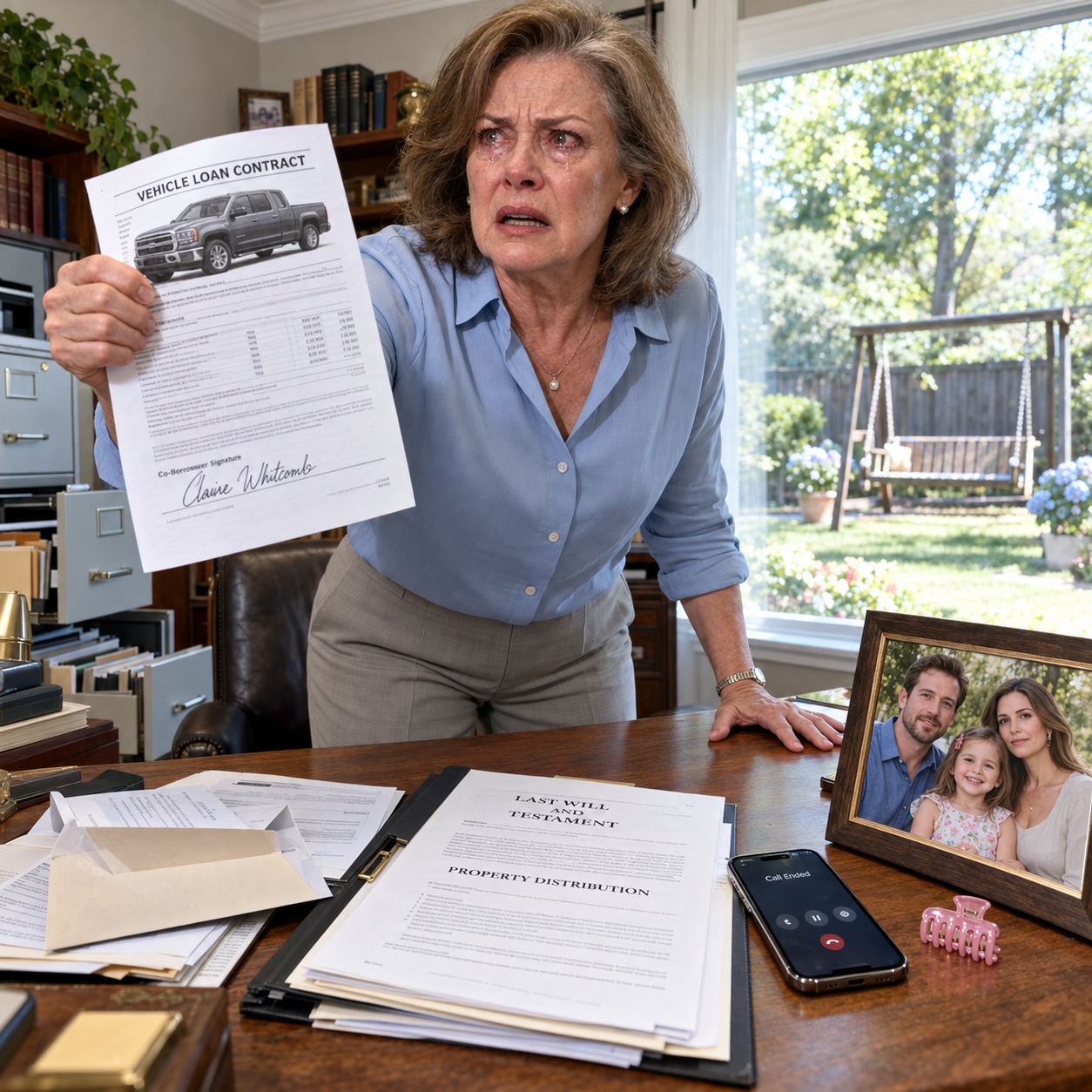
“You can change the beneficiaries in your will,” she explained, “but the truck loan is not something you can simply cancel.” I nodded because I’d suspected as much, although part of me had hoped there might be an uncomplicated way to separate our finances. Margaret said the lender would have to approve a release or Ben and Ashley would need to arrange refinancing without me. “What you can do,” she added, “is tell them clearly that you want the arrangement ended and ask them to pursue a practical solution.”
I looked at the original loan agreement, remembering how Ben had squeezed my shoulder after we signed it. At the time, he’d said he couldn’t imagine getting through that year without my help. Now I was learning that his family had planned a major relocation for weeks without trusting me with the information. “I don’t want to take away his truck,” I told Margaret. “I just don’t want to spend the rest of my retirement worrying about payments I don’t control.”
She suggested writing a formal request and establishing a reasonable timeline for Ben to explore refinancing, while acknowledging that I would remain liable unless the lender approved a change. We discussed what might happen if his credit wasn’t strong enough, and I asked Margaret to make sure the letter contained no threats or demands that couldn’t legally be enforced. I had spent enough years listening to angry patients argue with insurance companies to know that frustration didn’t make an obligation disappear. What I wanted was a responsible attempt to resolve it.
Then Margaret turned to the will. I told her Ashley was currently named to inherit a substantial portion if Ben died before me, and I no longer wanted that arrangement. “I would like most of that contingent share directed to Lucy’s trust instead,” I said, “and I want to reduce Ben’s eventual inheritance enough to strengthen the same trust.” Margaret asked if I understood that the change might upset them if they learned about it, and I said I did.
We reviewed the trust documents before deciding how to proceed. Lucy’s existing account contained money Robert and I had set aside for her education, and Margaret recommended strengthening its provisions so that an independent trustee could manage distributions for approved educational expenses. I wanted Lucy protected from adult disagreements, including any disagreement involving me. Whatever happened between her parents and me, she would not have to earn that support through visits, affection, or loyalty.
Margaret also suggested a private letter explaining my intentions, particularly because I was changing an arrangement I’d maintained for several years. I wrote that my estate should reflect both my commitment to my granddaughter and my wish to maintain financial boundaries with my adult children. I did not mention Ashley’s telephone remark or catalog every disappointment of the previous decade. When I finished, Margaret read the letter and said, “This sounds like a decision you’ve considered, rather than a punishment you’ve designed.”
That distinction mattered to me more than I expected. During Robert’s final months, I’d promised him I would look after Ben and Lucy, and for a long time I’d interpreted that promise as a reason to say yes whenever Ben needed something. But Robert had also trusted me to manage what we’d saved through forty years of marriage. He’d worked long shifts at a manufacturing plant, worn the same winter coat for eleven seasons, and celebrated the day we finally paid off our mortgage by buying a steak to share.
Before I left Margaret’s office, I signed the revised estate documents and authorized her to send Ben the refinancing request. The updated will removed Ashley as a beneficiary, adjusted Ben’s share, and strengthened Lucy’s protection through the trust. Margaret reminded me that Ben was still my son and that nothing in those documents prevented us from repairing our relationship. “I hope we do,” I said, sliding the signed copies into my folder. “I just don’t want reconciliation to depend on whether I’m willing to sign another check.”
Ben called the following Monday after receiving the letter. “Mom, what’s this about the truck?” he asked, sounding bewildered. I explained that I wanted him to refinance it without my name when his finances allowed, and he answered that they had just bought a house and couldn’t easily apply for another loan. “We need time,” he said, and I told him I understood, but that I needed him to take the request seriously rather than assume my guarantee would continue indefinitely.
He began talking about moving costs, higher mortgage payments, and Ashley’s new position with a property management firm. I listened, then asked why they had been comfortable making those commitments while leaving me uninformed about their plans. “Because we knew you’d take it personally,” he said. I let that answer sit between us before reminding him that he’d called me for financial help whenever his own plans became difficult.
“That’s not fair,” he replied, although his voice lacked conviction. I reminded him about the furnace repair, the truck, and the weekends I’d changed my plans so they could work. “I chose to help,” I said, “and I’m not asking you to repay gifts I gave willingly, but I need you to understand why it hurts to be treated like a stranger when nothing is needed.” Ben muttered that he had to return to work and ended the conversation.
Ashley sent a message that evening. She wrote that I’d taken a simple family move and turned it into a financial dispute, adding that she and Ben had a right to live without asking permission. I read the message twice before replying, “You certainly do. My request concerns only the loan I am still responsible for, and I hope we can resolve it cooperatively.” She didn’t answer, and I resisted the urge to add anything else.
Over the next several weeks, I discovered how much of my schedule had quietly revolved around waiting for them. I’d kept Wednesdays free even after the babysitting visits became irregular, and I’d turned down invitations because Ben might call needing something. My longtime friend Carol invited me to a beginner woodworking class at the community center, and when I told her I wasn’t particularly handy, she laughed. “Claire, you managed medical billing for three decades. Surely you can survive a piece of lumber.”
I signed up and spent the first class making crooked cuts in a pine board. Our instructor, a retired carpenter named Frank, showed me how to measure twice and stop trying to rescue mistakes before understanding them. At home, I began clearing Robert’s old tools from the garage, setting aside the ones I wanted to keep and donating equipment I would never use. The work was unexpectedly satisfying, partly because no one was waiting for me to finish it for their benefit.
In October, Margaret confirmed that the revised trust documents were complete and that the additional funds I’d transferred were properly recorded. Ben had contacted two lenders, but neither could immediately offer refinancing terms his household could comfortably afford. He left a voicemail asking whether we could postpone the discussion until after the holidays, and I called back to say we could revisit the schedule if he continued making a genuine effort. I was learning to distinguish patience from abandoning a boundary.
A week later, a small envelope arrived with Ben’s handwriting on the front. Inside was a photograph of Lucy standing in her new bedroom, surrounded by stuffed animals, holding a picture she’d drawn of a yellow house with a red bird on its roof. On the back, Ben had written, “She asked me to send this to Nana.” I placed it on my refrigerator, but when I checked my messages, the address he’d promised me still wasn’t there.
### Part 3: A Son Comes Home And Finally Accepts His Responsibility
Ben appeared on my porch on a cold Saturday morning in late November, carrying a paper bag from the bakery we used to visit when he was little. He’d driven from Centerville without calling first, and I almost made a joke about needing advance notice before visiting someone’s house. Instead, I opened the door wider and asked if he wanted coffee. He nodded, kissed my cheek, and followed me into the kitchen.
We sat at the same table where I’d opened my estate folder two months earlier. Ben looked older than he had during the summer, with faint lines around his mouth and a tiredness that seemed to come from more than missed sleep. He took a cinnamon roll from the bag, broke it in half, and pushed one piece toward me the way Robert used to do. For several minutes, we talked about the weather and the traffic along Interstate 70.
Finally, Ben said, “I should’ve told you we were moving.” I waited because his voice suggested he had more to say. He admitted they’d accepted an offer on the old house six weeks before closing and had already signed a purchase agreement for the new one. “Ashley wanted to wait until everything was settled,” he explained. “She thought you’d ask us to reconsider, and I said I’d handle telling you.”
“But you didn’t,” I said. He shook his head and rubbed a thumb along the rim of his coffee mug. “Every time I thought about calling, I pictured you getting upset about Lucy being farther away, and I told myself I’d do it tomorrow.” He looked at me then and said something I’d been waiting years to hear. “It was easier to let Ashley be the one who upset you than to admit I made the decision too.”
I leaned back in my chair, looking at the man I’d once taught to tie his shoes. “Ben, I would have been sad no matter how kindly you told me,” I said. “I’m allowed to miss my granddaughter, just as you’re allowed to build your life somewhere else.” He nodded, then confessed that Ashley’s new job provided steadier income and her mother could help with Lucy after school. Those were sensible reasons, and I told him so.
Ashley had also been struggling with expectations from both families, he explained. Her mother had recently undergone knee surgery, and Ashley wanted to be closer without feeling she had to justify herself. She sometimes interpreted my offers to help as expectations that I’d be included in every family decision, especially after the misunderstanding over Lucy’s bedroom. “I can understand wanting space,” I told him. “What I cannot understand is deciding that respect becomes optional once you have it.”
Ben didn’t defend the words she’d used on the telephone. He said he’d heard about them that evening and had told Ashley she could have handled the conversation differently, but by then he was angry about the refinancing letter and hadn’t wanted another argument. “I kept thinking you were trying to punish us,” he admitted. I asked if he’d ever considered that I might simply be afraid of owing money on a truck I didn’t drive, and he looked down at his hands.
We talked about the loan for nearly an hour. Ben had found a local credit union willing to reconsider the application if they paid down the remaining balance and reduced one of their credit cards. Ashley had agreed to use part of her year-end commission toward that goal, though it meant delaying some improvements to their new house. He brought copies of the lender’s preliminary requirements and asked if I could give them until February.
I told him I could, provided the payments remained current and we reviewed the situation together then. “I don’t expect this to happen overnight,” I said, “and I don’t want you making decisions that put Lucy’s needs at risk.” Ben nodded and carefully folded the paperwork, visibly relieved that I’d been willing to discuss a practical plan. What surprised me was that he hadn’t asked for money to cover the difference.
As he reached for his coat, Ben hesitated beside the doorway. “Ashley thinks you changed your will,” he said. I didn’t pretend otherwise, and he asked whether I’d removed him entirely. I explained that he remained a beneficiary, although I’d directed more of my estate toward Lucy’s education trust and named an independent trustee. “I also removed Ashley as a contingent beneficiary,” I told him. “I wanted to make decisions about my own estate without assuming that your household and mine would always have the same interests.”
He stood looking at the photograph of Robert on the hallway shelf. “Dad would’ve hated us fighting about money,” he said quietly. I agreed, then reminded him that Robert had also believed promises should mean something, especially promises made on paper. Ben smiled faintly at that, remembering how his father used to write family loans in a notebook even when he never intended to collect them. Before leaving, he hugged me longer than he had in years.
That evening, Ben finally sent me their new address. Beneath it, he wrote that Lucy wanted to show me her bedroom and that he hoped we could arrange a visit in December. I answered that I’d love to see her, but asked him to make sure Ashley was comfortable with the invitation. He replied a few minutes later: “We talked about it. She’s okay with it. I should have been talking to you myself all along.”
Ashley called the following week, and I recognized immediately how much effort the conversation was costing her. She said Ben had told her about our meeting and that she’d been thinking about what she’d said when she called about the move. “I was irritated and tired, and I wanted the conversation over,” she admitted. “That doesn’t excuse making you feel as though you weren’t allowed to care where Lucy lives.”
I thanked her for saying it. There were things I could have mentioned, including missed birthdays and the strange loneliness of being useful without feeling welcome, but I didn’t want an apology to become an interrogation. Instead, I told Ashley that I respected her right to make decisions for her own family and hoped we could be more direct with each other. She agreed, then asked whether I’d consider coming to Lucy’s Christmas program at her new school.
I drove to Centerville two weeks later, carrying a small wrapped present and a container of Lucy’s favorite oatmeal cookies. Their house was smaller than I’d imagined, with a narrow front porch, a young maple tree, and a living room still crowded with unpacked boxes. Ashley welcomed me inside and showed me where to hang my coat. She seemed nervous, and I was nervous too, though neither of us mentioned it.
Lucy came running down the hallway when she heard my voice. She wrapped both arms around my waist, pressed her face into my sweater, and demanded to know whether I’d brought the cookies with raisins or chocolate chips. “Chocolate chips, naturally,” I told her, and she took my hand to show me the new bedroom with purple curtains and a shelf full of books. On her dresser sat a photograph of Robert holding her when she was a baby, a picture I hadn’t realized Ben had taken with them.
At the school program, Lucy stood in the second row wearing a crooked paper crown, searching the audience until she spotted all four grandparents. She waved so enthusiastically that her teacher gently lowered her hand, and Ashley laughed beside me. During the final song, Ben reached over and squeezed my shoulder. It was such an ordinary gesture that I almost overlooked how long I’d missed it.
The afternoon wasn’t a perfect reconciliation. Ashley and I still approached family life differently, and Ben still needed practice having uncomfortable conversations without letting somebody else handle them. But before I left, we agreed to arrange regular video calls with Lucy and plan visits when everyone’s schedule permitted. Nobody asked me to pay for anything, and I didn’t offer.
In February, Ben called to say the credit union had approved their refinancing application. A few weeks later, I received written confirmation that the old loan had been paid off and my obligation had ended. I filed the release beside my updated estate documents, grateful for the peace of mind and quietly proud that Ben and Ashley had handled the refinancing themselves. The trust remained exactly as Margaret and I had arranged it, because my decisions about Lucy’s future had never been intended as bargaining chips.
Spring arrived with patches of yellow crocuses along my front walkway. I finished the small side table I’d been building in woodworking class, sanded the corners smooth, and placed it beside the chair where Robert used to read. Lucy visited one Saturday and insisted we put her drawing of the yellow house on top of it. She asked why the bird in the picture was red, and I explained that cardinals had always reminded me of her grandfather.
Later, while Lucy played on the backyard swing and Ben helped Ashley carry dishes into the kitchen, I stood by the open back door and watched them. I still missed the Wednesdays when my granddaughter lived twenty minutes away, and there were moments when the distance felt much farther than eighty miles. But I’d learned that being included in someone’s life should not require surrendering all the boundaries in my own. My family had chosen a new address, and I had chosen a different way of loving them—one that left room for their independence without erasing mine.
The End .
All characters and events in this story are fictional, created for storytelling and entertainment purposes. Thank you sincerely for reading. Your feedback and support are invaluable and motivate me to continue sharing more stories with you.