
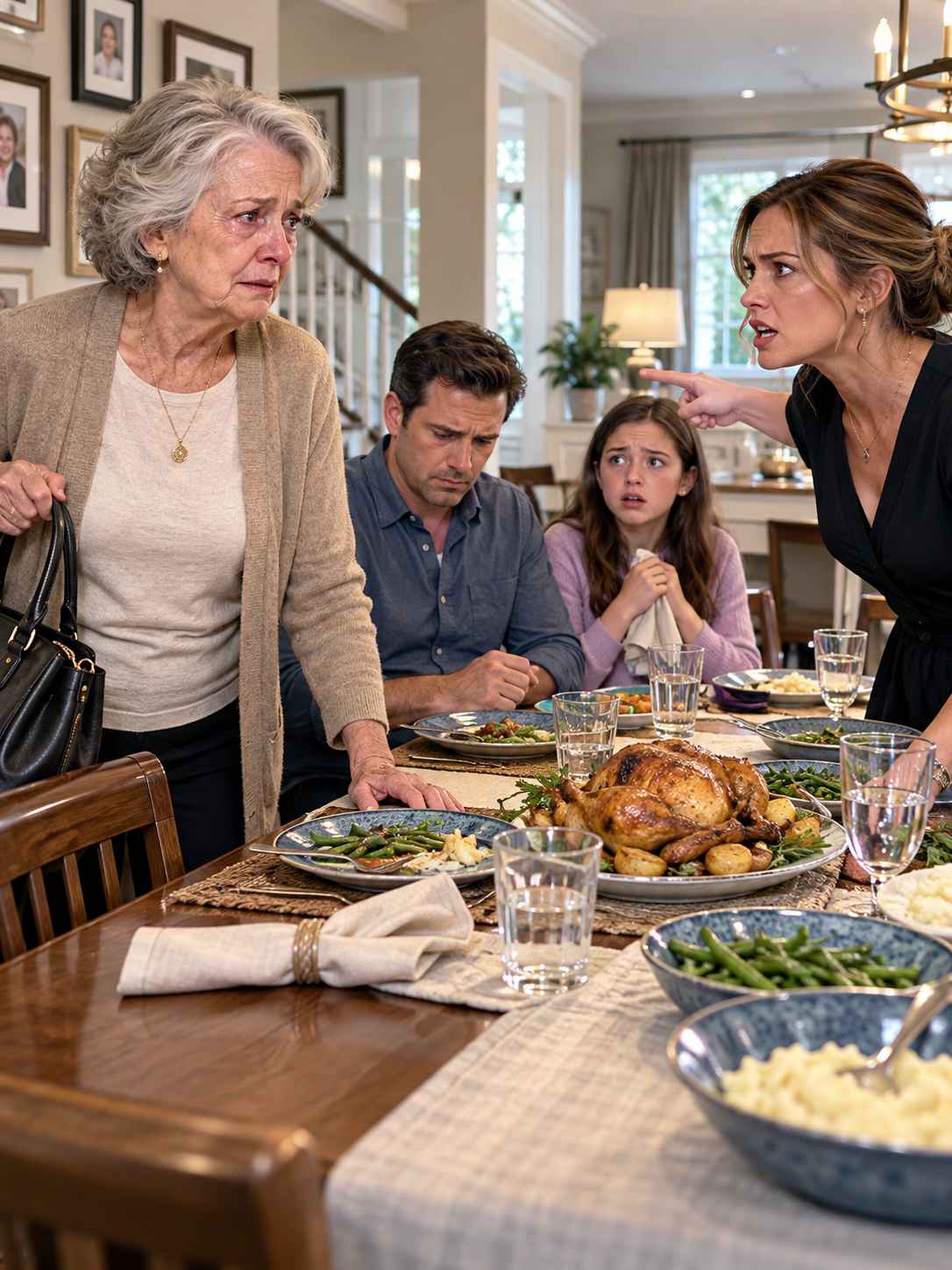
Part 2: A child’s private pages expose the damage adults ignored
The next morning Daniel called before eight. “Mom, I wanted to make sure you got home okay.” I stood at the sink watching coffee drip into the pot and nearly laughed at the absurdity of him checking my driving after helping ban me from his house. Instead I said, “I got home safely.”
He waited, clearly expecting more. When none came, he cleared his throat. “Melissa thinks last night got more dramatic than it needed to.” I looked at the purple notebook on my kitchen table. “Daniel, I’d like you to ask Sophie how last night felt to her.” His voice changed immediately. “What does Sophie have to do with this?” I told him, “More than either of you seems to understand.”
I didn’t mention the notebook. I didn’t quote a single line or tell him his daughter had come running after me. I only said, “Please talk to her alone. Don’t ask whether she’s taking my side. Ask whether she feels she’s allowed to love everyone in this family without somebody getting hurt.” Daniel started to defend Melissa, stopped halfway through the sentence, and finally said, “Okay.”
That evening, he called again. This time he sounded like he had aged several years since breakfast. He told me he’d driven Sophie to the grocery store because Melissa was working late and, instead of going inside immediately, he had parked beneath a sycamore tree and asked whether things between the adults had been bothering her. Sophie had stared through the windshield for so long he thought she might refuse to answer.
Then she’d said, “If I tell you, are you going to tell Mom I betrayed her?” Daniel told me he had gripped the steering wheel with both hands because he did not trust himself to move. “I said she couldn’t betray us by telling the truth,” he explained. “Then she told me she tries not to talk about you because it upsets Melissa. She said sometimes she waits until she’s at school to text you.”
He found Melissa loading the dishwasher when she returned home. Daniel didn’t accuse her of trying to separate me from Sophie; he simply asked, “Have you been telling her she’s hurting you when she spends time with Mom?” Melissa denied it at first, then corrected herself. “Not like that. I told her relationships have consequences.”
“She’s thirteen,” Daniel said. “She thinks smiling when my mother calls is a consequence.” Melissa closed the dishwasher and leaned against the counter. “You don’t understand what it’s like. Your mother walks into a room and Sophie lights up. You leave your mother’s house calmer than when you arrived. Sometimes I feel like the least necessary person in my own family.”
Daniel could have dismissed that as jealousy. Instead he sat at the kitchen table and asked how long she’d felt that way. Melissa admitted it had worsened after her own mother moved to Arizona and rarely called; then after a difficult year at work, she’d begun noticing every joke Sophie shared with me, every recipe Daniel asked me for, every Sunday phone call. “I kept thinking you had this whole family language I wasn’t part of,” she said. “And instead of admitting that, I started treating Helen like she was competing with me.”
“What about last night?” Daniel asked. Melissa’s eyes dropped toward the floor. “I wanted one place where I didn’t feel compared.” He answered quietly, “Nobody was asking you to compete.”
Two days later he came to my house alone. The same broad-shouldered man who negotiated construction contracts for a living stood on my porch with his hands shoved into his jacket pockets like a teenager expecting punishment. I let him in, poured two coffees, and waited.
“I thought not choosing sides was the mature thing,” he said. “Every time Melissa complained about you, I figured if I stayed quiet, eventually everybody would calm down. But I wasn’t neutral. I was letting her decide what was true because disagreeing was inconvenient.” He looked toward the window, then back at me. “And at dinner, when you asked me directly, I still took the easy way.”
“You did,” I said. I loved him too much to turn honesty into comfort. He nodded, eyes wet, and I reached across the table only after he stopped trying to hide it.
Then I placed Sophie’s notebook between us. Daniel stared at it but did not touch it. “She gave me this,” I said. “I’m not giving it to you to read. Most of what’s inside belongs to her.” His brow tightened. “Then why show me?” I rested my hand over the worn purple cover. “Because you need to understand your daughter became frightened enough to document her own family so she could figure out what was real.”
Part 3: A father finally speaks while two mothers face fear
Daniel did not ask to read the notebook. That mattered to me. Instead he asked whether Sophie knew I had shown it to him, and I said no because I had not shown him a word, only its existence. “Talk to her again,” I told him. “Then let her decide what she wants anyone else to know.”
The following Saturday, Daniel brought Sophie to my house. She entered cautiously, looking past me toward the living room as though expecting Melissa to appear. I set the notebook on the coffee table with the rubber band back around it. “This is yours, sweetheart.”
She stared at me. “Did you show Dad?” I told her exactly what I’d done and what I had not done. Relief moved across her face first, then embarrassment. “Some of it’s stupid.” I smiled. “Your drawing of the crowned cat is excellent evidence that you have questionable judgment.”
She laughed once, but tears followed immediately. “I didn’t want Mom to get in trouble. I just wanted somebody to know I wasn’t making it up.” I took her hand and said, “Your mother isn’t on trial, and neither are you. Adults are responsible for their feelings. You are not responsible for making your mother feel more loved by loving someone else less.”
Sophie leaned into me, crying quietly against my shoulder. Daniel sat in the armchair across from us, elbows on his knees, and didn’t interrupt. When Sophie finally pulled away, he said, “I should’ve noticed.” She wiped her face with her sleeve. “You noticed. You just always said Mom was stressed.”
That sentence followed Daniel home.
Nine days later, Melissa appeared at my front door carrying a grocery-store orchid still wrapped in clear plastic. “This looked less aggressive than roses,” she said, then grimaced. “That sounded strange.” I stepped aside and told her, “Most honest conversations start badly.”
She sat on the end of my sofa without removing her coat. For several minutes we discussed nothing important: traffic, the weather, a neighbor’s dog that had developed an enthusiasm for my flowerbeds. Finally Melissa clasped her hands between her knees. “Sophie told me about the notebook.”
I waited. “I asked if I could read it,” she continued. “She said no.” Melissa’s mouth tightened, not with anger but shame. “My first reaction was that I was her mother and had a right to know what she’d written about me. Then I heard myself.”
“Good,” I said. “Hearing yourself is useful.”
She almost smiled. “I was jealous of you, Helen. Not because you’ve done something terrible. That would actually be easier.” She looked down at her hands. “You seem so certain about your place in their lives. I never feel certain about mine.”
I thought about all the cutting responses available to me and chose none of them. “Certainty came with age,” I said. “At thirty-eight, I once cried in a supermarket parking lot because Daniel preferred his kindergarten teacher’s cookies to mine.” Melissa laughed despite herself, and I continued. “Love makes sensible people ridiculous sometimes. But Sophie cannot become the medicine for your insecurity.”
Melissa nodded slowly. “I know.” She took a breath. “I told her that when she defended you, she was choosing you over me. I didn’t realize how often I was doing it until she repeated some of my own words back to me.” Her eyes filled. “I made my child afraid to be happy around someone who loves her.”
“We can’t undo that sentence by sentence,” I said. “You can change what happens next.”
She asked whether I hated her. I told her I didn’t, but I also wasn’t ready to pretend the dinner had never happened. “You didn’t just ask for space,” I said. “You asked your husband and daughter to prove loyalty by excluding me. That’s something trust has to recover from.” Melissa accepted that without arguing.
Before leaving, she paused at the door. “Why didn’t you give Daniel the notebook?” I looked toward the living room, where the orchid sat crookedly on my coffee table. “Because Sophie gave me her fear, not ammunition.” Melissa closed her eyes for a moment and whispered, “Thank you.”
Part 4: The family rebuilds trust without asking anyone to choose
Nothing repaired itself overnight. Daniel stopped acting as messenger between Melissa and me; if she had a concern, she called me herself, and if I felt a boundary had been crossed, I spoke directly to her. Those conversations were awkward, sometimes painfully so, but they were cleaner than the old arrangement in which Daniel carried half-truths back and forth and called the resulting silence peace.
He also began taking responsibility in his marriage. When Melissa complained that Sophie wanted to spend a Saturday baking with me, Daniel no longer muttered, “Whatever you think is best.” He asked, “Is there a real problem, or is this touching the old fear again?” Sometimes Melissa became defensive, but increasingly she could admit when the answer was fear.
Sophie started seeing a school counselor, not because anyone believed something was wrong with her, but because Daniel wanted her to have an adult outside the family who belonged to no side. Melissa supported the decision. One afternoon Sophie called me afterward and said, almost cheerfully, “Apparently I am not the emotional manager of the household.” I told her I hoped she would have that printed on a T-shirt.
Six weeks after the dinner, rain drummed softly against my kitchen windows while I wiped an already clean counter. Someone knocked, and through the frosted glass I saw the yellow hood of Sophie’s raincoat. I opened the door to find my granddaughter smiling on the porch, with Melissa standing one step behind her.
“Sophie wanted to come by,” Melissa said. There was no rehearsed warmth in her face, only nervousness and effort. I looked at Sophie. “Did you?” She nodded eagerly and held up a paper bag. “I brought chocolate chips.”
I opened the door wider. “That sounds serious.”
Sophie hurried inside and kicked off her wet shoes. Melissa remained on the porch. “I have errands,” she said, then glanced toward the kitchen, where the kettle had just begun to whistle. For several seconds I could see the old instinct working in her—the desire to retreat before she risked feeling unwanted.
“I was going to make tea,” I said. “You can have a cup if you’d like.”
Melissa studied my face, perhaps searching for pity or triumph and finding neither. “One cup,” she said.
We sat around the kitchen table where I’d once read Sophie’s notebook, but the notebook itself was safely back in her bedroom where it belonged. Sophie measured flour while Melissa complained that Daniel had bought the wrong kind of laundry detergent again, and I told a story about him flooding my laundry room when he was sixteen. For once, the laughter that followed didn’t leave anyone feeling outside the circle.
Later, Sophie leaned against my shoulder while the cookies cooled. “Mom said maybe we can all go to the botanical garden next weekend,” she said. Melissa looked instantly uncomfortable, as if she’d hoped the suggestion would arrive more gracefully. I met her eyes across the kitchen and said, “That sounds nice.”
Daniel joined us an hour later after Melissa called and told him where they were. He stopped in my doorway, visibly surprised to find his wife drinking a second cup of tea. “I thought you had errands,” he said.
“I did.” Melissa lifted her mug. “Apparently your mother traps people with Earl Grey.”
“It runs in the family,” I said.
Daniel looked at me then, really looked at me, and I saw relief in his face. I also saw caution, which pleased me more. He understood that reconciliation wasn’t permission to forget what had happened. It was a decision to behave differently because we remembered.
Before they left, Melissa helped Sophie into her raincoat. At the door she turned to me and said, “Helen, about that dinner. I know I’ve apologized privately, but I never actually took back what I said.” Daniel and Sophie both became still.
Melissa continued, “You are welcome in our home. I should never have made belonging something I could award or remove because I felt insecure.” She glanced at Sophie. “And nobody in this family is required to choose one person in order to love another.”
Sophie slipped one arm around her mother’s waist and reached the other toward me. For a second we stood there in my narrow hallway, four people who had spent too much time worrying about who belonged where. I took Sophie’s hand but didn’t turn the moment into a ceremony.
“Good,” I said. “Now go home before your cookies get soaked.”
Daniel laughed, and Melissa did too. As they walked toward the car, Sophie turned beneath the rain and waved so dramatically that her hood fell backward. Melissa pulled it over her head, and this time when Sophie laughed, her mother laughed with her instead of wondering who had caused the smile.
I watched them drive away before closing the door.
The purple notebook had not saved our family. Sophie should never have needed it in the first place. What saved us was what happened after we finally understood what those pages meant: Daniel stopped hiding behind silence, Melissa stopped treating love as a competition, I resisted the temptation to turn pain into victory, and Sophie was allowed to become a child again instead of a referee.
The End .
All characters and events in this story are fictional, created for storytelling and entertainment purposes. Thank you sincerely for reading. Your feedback and support are invaluable and motivate me to continue sharing more stories with you.

