
Part 2: Bank records reveal what politeness had been hiding
The bank representative spoke in the calm, careful tone people use when they know the person on the other end is trying not to become angry. After verifying my information, she explained that a replacement card had been requested seven months earlier through the online account. The mailing address had not changed, which meant the envelope had come directly to my house.
“Who activated it?” I asked.
She paused while typing. “It appears the activation was completed online.”
“Can you tell me from whose device?”
“Not from what I can see, ma’am.”
I looked toward the hallway. Daniel and Mallory had used my desktop computer several times when their laptop stopped working.
I canceled the card immediately, changed every password attached to the account, and asked the bank to send me documentation of the disputed transactions. Then I called Harriet Cole, the attorney who had handled my mother’s estate and later helped me prepare my own will. I expected Harriet to tell me I was overreacting. Instead, she asked three precise questions: Was the house solely mine? Yes. Had I given Mallory permission to use the account? No. Did I want Mallory prosecuted, or did I want the financial access stopped and my household boundaries restored?
That last question sat differently.
“I want my life back,” I said.
“Then start there.”
I spent the next hour gathering papers. I put the bank statements on the kitchen table, highlighted every questionable charge, and placed the canceled card beside them. Then I wrote a short note in my own handwriting: Mallory, this card has been canceled. I have documentation of charges I did not authorize. We will discuss this with Daniel tonight. Until then, do not attempt to access any of my financial accounts.
I almost removed the note twice.
The first time, I imagined Daniel defending his wife and accusing me of turning a family misunderstanding into a financial investigation. The second time, I pictured Mallory crying, and I hated myself for how easily that possibility could still make me retreat. Then I looked toward the staircase and remembered the laundry basket waiting upstairs.
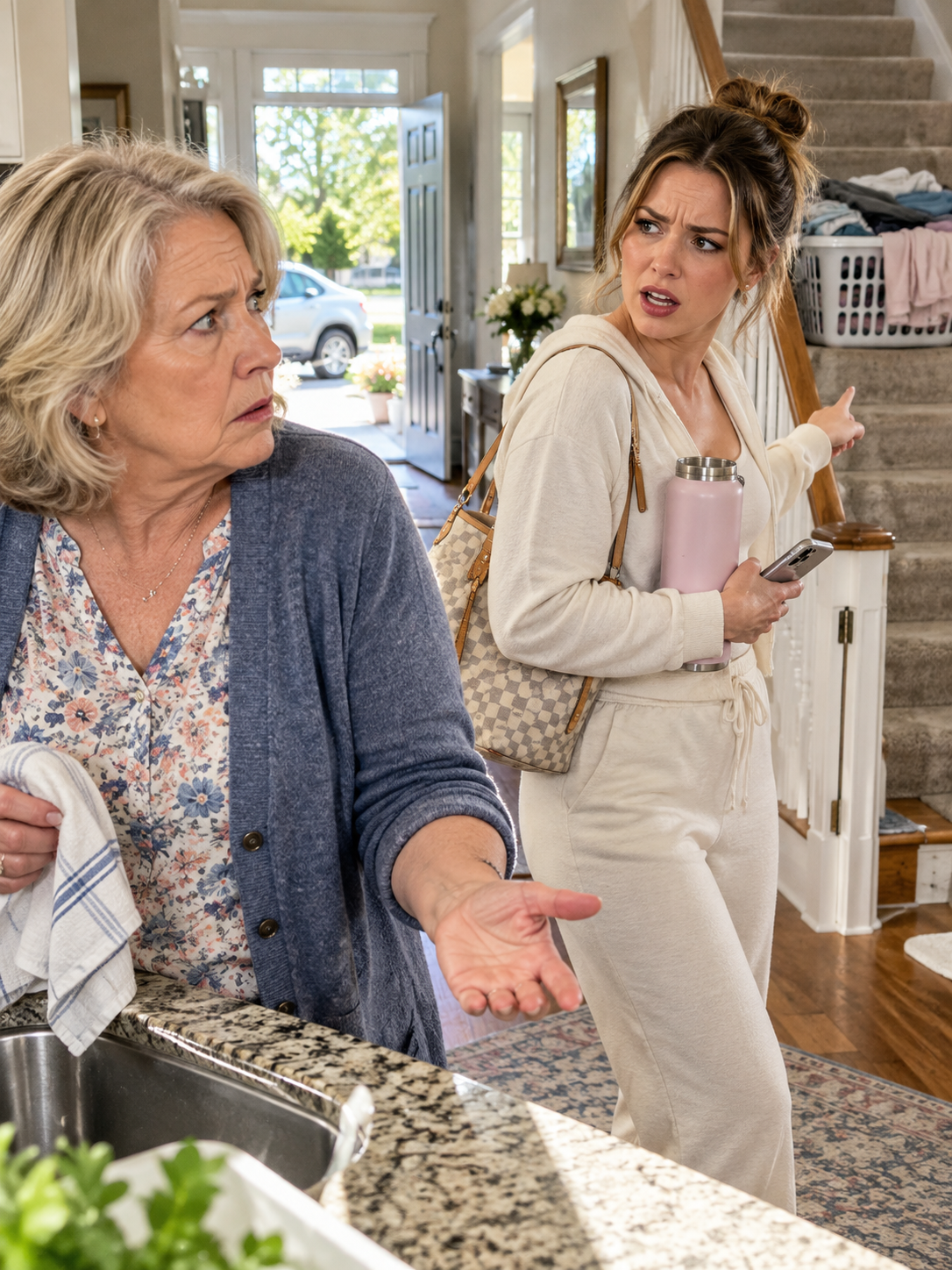
At four-thirty, a car door slammed outside. Mallory entered carrying two glossy shopping bags and talking over her shoulder to Paige about dinner reservations. “I’ll text you,” she called, then shut the door and noticed me sitting near the window.
Her smile faded when she saw the table.
“What’s all this?”
“You should read it.”
She picked up the first statement. Her eyes moved quickly across the yellow highlights, then more slowly. “Evelyn, these are household expenses.”
“Willow House Spa is a household expense?”
Mallory pressed her lips together. “Some of those charges were mine.”
“All of them were.”
“You don’t know that.”
“I called the bank.”
That was when she finally put the papers down.
She sat across from me and lowered her voice. “Okay. I used the card sometimes. But I thought Daniel had talked to you.”
“He hadn’t.”
“He told me you said we could use what we needed while we were here.”
“For groceries and utilities, Mallory. Not facials.”
Her cheeks reddened. “You make it sound disgusting.”
“I’m describing where the money went.”
She reached for her phone.
“Calling Daniel?” I asked.
“Yes, because this is getting completely out of proportion.”
Twenty-five minutes later, my son came through the front door still wearing his work boots.
Part 3: My son finally sees the cost of staying neutral
Daniel took one look at Mallory, one look at me, and then pulled out a chair. “Nobody yell,” he said.
“I haven’t,” I answered.
Mallory let out a sharp breath. “Your mother thinks I stole from her.”
Daniel’s forehead creased. “Did you use her card?”
“She wasn’t using it.”
The words landed harder than any shouting could have.
Daniel turned toward her. “That wasn’t my question.”
Mallory looked at the table.
I slid the statements toward him and let him read. Daniel had always been careful with money, mostly because we had once had so little of it. When he was twelve, he knew which grocery store marked down meat on Thursday evenings. When he was sixteen, he worked weekends at a hardware store because he wanted basketball shoes I could not afford. Watching him calculate those charges was like watching somebody recognize a language he wished he had forgotten.
“Eleven hundred and forty-three dollars,” he said.
Mallory wrapped both hands around her phone. “Over months.”
“That doesn’t make it smaller.”
“I was going to put it back.”
“With what?”
She looked at him then, wounded anger rising in her face. “Do you have any idea what it feels like to have to ask you before I buy shampoo?”
“I never made you ask me for shampoo.”
“No, you just look nervous every time money comes up.”
Daniel leaned back.
Mallory’s voice changed. Less defensive now. More tired. “I left my job because I hated who I was becoming there. Then I came here and suddenly I didn’t have income, I didn’t have my apartment, and every time Paige asked me to do anything, I was the woman saying no because she was living with her husband’s mother.”
“So you used my mother’s account to pretend you weren’t struggling?”
Mallory looked away.
I understood more than I wanted to. Pride can make sensible people do foolish things, especially when shame is whispering that everyone else is doing better. But sympathy did not turn my bank statements into permission.
“My mother cleaned offices at night,” Mallory said quietly. “She wore the same winter coat for twelve years. I promised myself I would never live like that.”
I folded my hands on the table. “And I worked Christmas mornings, double shifts, weekends, and years when my knees hurt so badly I cried in the parking lot before walking inside. You didn’t escape your mother’s struggle by spending my work.”
Mallory’s eyes filled, but she did not look away this time.
Daniel rubbed both palms over his face. “How did you even get the card?”
She hesitated.
There it was—the question I had been waiting for.
“I heard you two talking about the emergency account,” she said. “I found the information in the desk drawer. I requested a replacement.”
Daniel stared at her.
“I thought I’d use it once.”
“And then?”
“And then nothing happened.”
Nobody spoke for several seconds.
That sentence explained nearly everything. Nothing happened. I had noticed the first unfamiliar charge and stayed quiet because I feared hurting Daniel. Mallory interpreted my silence as invisibility. Daniel ignored the little signs because he feared conflict. Between the three of us, avoidance had become permission.
“I’m partly responsible for letting this go on,” I said. “Not for the charges. For refusing to speak when I first noticed them.”
Daniel shook his head. “Mom—”
“No. I should have spoken sooner. And you should have been paying attention to what was happening under my roof.”
He looked down. “I know.”
Mallory wiped beneath one eye. “So what happens now?”
I had already decided.
“You repay every dollar. You and Daniel find another place to live within six weeks. My account information comes off every device you use, and from today forward, nothing in this house belongs to you unless I specifically say you may use it.”
Mallory swallowed.
“And your laundry,” I added, “is still upstairs.”
To my surprise, Daniel almost smiled.
Mallory did not.
Not yet.
Part 4: Boundaries change our family more than punishment ever could
The next six weeks were awkward, but not cruel. I did not want cruelty. I wanted clarity.
Mallory found work at an insurance brokerage eleven days after our kitchen conversation. It was not glamorous, and she complained about the commute exactly once before catching herself. Every Friday she transferred fifty dollars into my account. Daniel took over their budget, not as her supervisor but as her partner, and for the first time I saw them discuss money without disguising fear as irritation.
We also stopped pretending everything was fine.
One evening Mallory came home after seven, dropped her purse by the stairs, and stood in the kitchen doorway while I chopped carrots.
“I was angry at you,” she said.
“For canceling the card?”
“For making Daniel see me differently.”
I kept chopping.
She continued. “Then I realized that’s not what happened. I made him see me differently.”
I set down the knife.
“That sounds closer.”
She nodded. “I’m still embarrassed.”
“You should probably be embarrassed for a while.”
That startled a laugh out of her. Small, reluctant, but real.
Their new apartment was a second-floor place above a pharmacy, with narrow windows and an old kitchen, but they could afford it without my help. On moving day, Daniel loaded boxes while Mallory cleaned the guest room. When she finished, she brought me an envelope.
Inside was a handwritten repayment schedule.
“I know a spreadsheet would look more professional,” she said, “but I thought handwriting made it harder to pretend it was somebody else’s problem.”
I looked at the numbers. Every remaining dollar was accounted for.
“This is good.”
She shifted her weight. “I’m sorry about the money.”
“I know.”
“And the car. And the groceries. And acting like your house was some kind of family storage unit with free services.”
“That part bothered me almost as much as the money.”
She gave a rueful nod. “I know that now too.”
Then she glanced toward the hallway. “I folded the towels.”
“I assumed you would.”
Daniel came inside for the last box and found us both smiling just enough to confuse him.
After they moved out, my house sounded different. Pipes clicked. The refrigerator hummed. A branch brushed the siding when the wind came from the north. These were ordinary sounds I had stopped hearing because I had spent nearly a year listening for somebody else’s footsteps.
I changed my passwords again. I moved my important papers into a locked cabinet. I met with a financial adviser and updated the instructions on my accounts. None of it felt dramatic; that was the point. Protecting yourself should not require a family explosion.
Mallory made every payment.
The following spring, she finished repaying me.
At Thanksgiving that year, she and Daniel arrived carrying a casserole, two pies, and no expectation that I would reimburse them for anything. Mallory helped clear the dishes after dinner without announcing it. Later, while she was reaching into the cupboard, I noticed a simple leather handbag I had never seen before resting on a chair.
“That new?” I asked.
She followed my eyes.
“Three months old.”
“It’s nice.”
“I saved for it.”
There was no challenge in her voice, only a quiet pride that sounded healthier than the version she had tried to buy with my money.
I nodded. “Then enjoy it.”
Daniel looked between us, perhaps waiting for history to enter the conversation.
It didn’t.
Some families survive by pretending nothing happened. I think ours survived because we stopped doing that. Mallory had taken something that was not hers, Daniel had mistaken avoidance for loyalty, and I had confused silence with kindness. None of us could undo those choices, but we could stop repeating them.
Before they left, Mallory hugged me near the front door.
“Happy Thanksgiving, Evelyn.”
“You too.”
She pulled back, hesitated, and smiled. “Laundry’s all done at our place, by the way.”
I laughed.
“Good,” I said. “Keep it that way.”
Then I watched my son and his wife walk toward their car together, carrying their own bags, paying their own bills, building a life that finally belonged to them.
And I closed the door on a house that belonged to me.
The End .
All characters and events in this story are fictional, created for storytelling and entertainment purposes. Thank you sincerely for reading. Your feedback and support are invaluable and motivate me to continue sharing more stories with you.

