
Part 2: A New Address Exposed What My Family Really Expected
The woman who answered the telephone introduced herself as Donna. She had a pleasant, slightly raspy voice and asked whether I was looking for a one-bedroom apartment or something larger. When I explained that I was sixty-three and hoped to find somewhere peaceful, she laughed softly.
“Peaceful we can offer. Boring, not so much. Our pottery people can get pretty competitive.”
I scheduled a viewing for the next afternoon.
Elora was a little more than an hour from Nathan’s neighborhood, tucked among rolling fields and old stone buildings. Riverview Terrace sat on a quiet street with mature trees and flower beds that someone clearly cared about. The entrance smelled faintly of coffee, and two women were arguing cheerfully over the correct way to prune roses.
Donna showed me a ground-floor apartment with large windows, a practical kitchen, and a small balcony overlooking trees near the Grand River.
“It’s not fancy,” she said, opening the balcony door. “But you get afternoon sun, and the garden plots are popular.”
I stepped outside. Somewhere below, water moved over rocks, and a breeze lifted the ends of my hair.
I hadn’t realized how long it had been since I’d stood somewhere without listening for a child calling my name.
Donna showed me the pottery studio, the common room where a Friday book club met, and a garden behind the building. There were unfinished bowls drying on wooden shelves and handwritten notices advertising watercolor afternoons and community dinners.
“When would you be ready to move?” she asked.
I looked around the bright apartment. “Sooner than I thought.”
I drove home without signing anything. That evening, I made myself tea and opened the folder containing the financial documents I’d kept after Robert’s death. My pension and investments were enough to pay the rent comfortably, even allowing for medical expenses and occasional travel.
I called Donna the following morning and arranged the lease.
For the first time in years, I signed an agreement that concerned only my own life.
I planned to tell Nathan and Kristen that weekend, but they approached me first.
After Saturday dinner, Nathan asked whether I could join them in the kitchen. A printed document lay on the island, neatly arranged in color-coded columns. Kristen had a pen beside it and looked unusually pleased with how organized everything was.
“We thought we’d put together a transition schedule,” Nathan said.
I sat down.
The document covered four months. Tuesdays and Thursdays were marked for school pickups, Wednesdays for activities, and every second Saturday for babysitting or family outings. March break had its own section requesting full-week coverage.
There were footnotes explaining where I should leave the children’s sports equipment and how much notice Nathan needed if I wanted a day off.
I examined the final page. “When did you prepare this?”
“Kristen put it together yesterday,” Nathan answered. “Her new position starts in two weeks, and my workload isn’t changing.”
Kristen leaned forward. “It’ll be easier once you’re in your own apartment. You won’t have to worry about our household routines, just the children.”
“Where does the schedule account for my plans?”
She hesitated. “We assumed you’d tell us if something came up.”
“And what happens if I’m unavailable?”
Nathan rubbed his forehead. “Mom, we’re only trying to keep things consistent.”
I turned the document toward them. “This assumes I’ll be living nearby.”
“Well, yes,” Kristen said. “That’s why Nathan sent those listings.”
“I’ve rented an apartment at Riverview Terrace in Elora.”
Nathan stared at me. “Elora?”
“Yes.”
“That’s over an hour away.”
“About an hour and twelve minutes, depending on traffic.”
He pulled his phone toward him as though a map might prove I was mistaken.
“Mom, how are we supposed to handle school pickups from there?”
“You’ll need to arrange childcare closer to home.”
Kristen put down her pen. “Marilyn, I’m starting a new job. I turned down another opportunity because this position offered better long-term prospects. We were counting on you.”
“I know you were.”
“Then why wouldn’t you discuss this with us before signing something?”
I looked at my son, remembering the younger Nathan who used to come home from school with his coat half-buttoned, asking whether I could help him solve problems he was too embarrassed to mention to his father. He had always trusted me to find a solution. Somewhere in adulthood, he’d stopped noticing that solutions sometimes cost the person providing them.
“Because I overheard your conversation last week,” I said.
Kristen’s gaze moved toward Nathan.
“You said that if I had any self-respect, I’d find my own place.”
She drew a breath. “Marilyn, I was frustrated. I didn’t mean for you to hear that.”
“But you meant it.”
“I meant that we’ve been crowded, and I haven’t felt comfortable in my own house. Sometimes I need to talk to my husband without considering whether someone else will hear.”
“That part I understand,” I said. “You deserve privacy. I deserve some, too.”
Nathan looked from her to me. “Mom, I didn’t realize you’d heard us.”
“I also heard you say I could leave as long as I kept collecting the children.”
He looked down at the printed schedule.
I placed my hand on the document, covering the colored squares. “You can’t ask me to become independent while planning to keep every hour of my week for yourselves.”
Kristen’s eyes filled, though her voice remained steady. “We never wanted you to feel unwanted.”
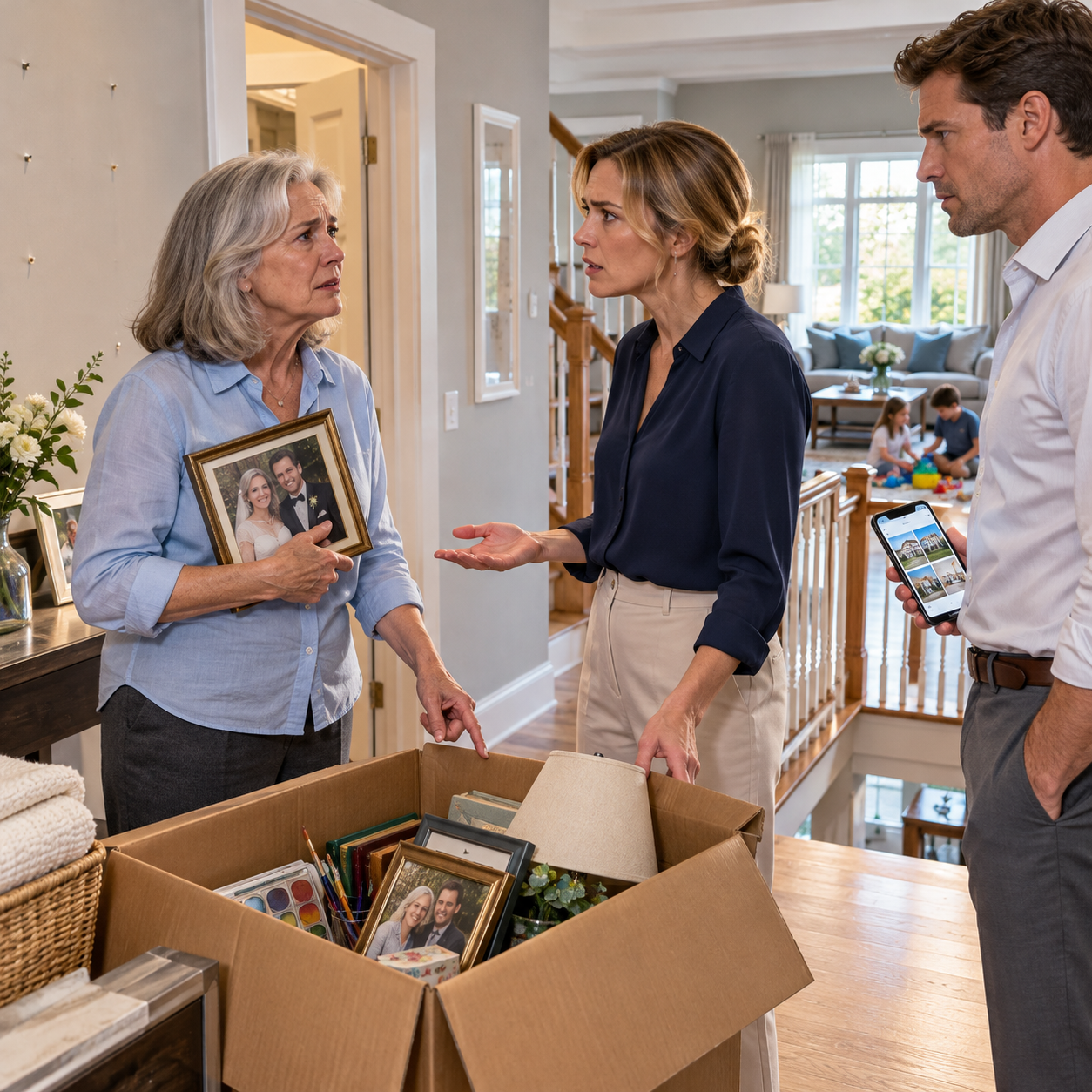
“Then why were my things boxed up in the hallway?”
Her face reddened. “I was making space for the children’s winter clothes. I should have asked.”
“Yes,” I said. “You should have.”
Nathan pushed the schedule aside. “So what are you saying? You won’t help us anymore?”
“I’m saying I’ll help when I choose to and when we agree ahead of time. I’ve set aside the second and fourth Sundays of each month for Chloe and Owen, if that works for everyone. The rest needs to be arranged without assuming I’m available.”
He sat back, staring at the papers Kristen had spent an evening preparing.
“I love those children,” I continued. “Moving away isn’t a punishment. But I won’t leave this house only to spend my retirement driving back here to keep running it.”
Nobody spoke for several seconds.
Then Nathan asked quietly, “Are you really unhappy here?”
I looked at the photograph still standing on the kitchen shelf, the one from Robert’s last Christmas. I remembered how Nathan had pulled out a chair beside him so the grandchildren could sit close.
“I was happy to be needed,” I said. “For a while, I thought that was the same thing as being happy.”
Kristen looked toward the dark kitchen window.
I stood and folded the schedule in half. “You’ll need to find another arrangement before I move. I’ll help you organize the school information, but I won’t sign up for this.”
I left their house key on the counter, then picked it up again.
“Actually,” I said, “I’ll return that on moving day. I still live here for another three weeks.”
For the first time all evening, Nathan gave a small, embarrassed smile.
“Right,” he said. “Of course.”
Part 3: Leaving the House Gave Me Back More Than Freedom
The next three weeks were uncomfortable, though not always in the ways I’d expected.
Nathan began leaving work early to collect Chloe. Kristen arranged for Owen to attend an extended afternoon program, then discovered that its closing time conflicted with one of her meetings. Twice, she came home carrying takeout while speaking sharply into her phone about deadlines.
I offered the name of a neighbor who sometimes babysat, but I didn’t volunteer to resume the schedule.
One evening, Nathan knocked on my bedroom door while I wrapped Robert’s photograph in tissue paper. He stood there watching me place it into a box.
“Do you remember when Dad built that garden gate?” he asked.
“Of course. He measured it three times and still made it crooked.”
Nathan smiled. “He said the ground was uneven.”
“The ground was perfectly level.”
He picked up a smaller photograph of himself at seventeen, wearing his graduation gown. “I think I forgot you had a whole life before you came here.”
I kept wrapping the frame. “You were part of that life, sweetheart. Just not all of it.”
On moving morning, Chloe was at school and Owen was visiting a friend. I’d already explained to them that Grandma was moving to an apartment near a river, where they could visit and make things out of clay.
Owen wanted to know whether the river contained sharks. Chloe asked whether she could choose the color of the guest blankets.
I assured them both that the new place would be safe, welcoming, and entirely free of sharks.
Nathan stood in the driveway as the movers loaded the truck. When the last box went aboard, he walked over and put his hands in his pockets.
“Mom, about that schedule,” he began. “I’m sorry.”
I waited.
“I convinced myself you liked taking care of everything. I never really asked.”
“I loved spending time with the children.”
“I know.”
“But groceries, laundry, transportation, managing appointments—that was work. I did it because your family needed help, and then it became something nobody noticed.”
He stared at a crack in the driveway. “I should have noticed.”
“Yes,” I said. “You should have.”
He hugged me, holding on longer than usual. Kristen came outside as I opened my car door, and for a moment we faced each other without our usual distractions.
“I hope you like it there,” she said.
“Thank you.”
She nodded, then glanced toward the empty guest-room window.
I could have asked her for another apology. Instead, I raised my hand in goodbye and followed the moving truck toward Elora.
My new apartment felt strange that first evening. No television upstairs, no backpacks dropped beside the stairs, no one asking where I’d put something. I heated soup, sat at the little kitchen table, and listened to the refrigerator hum.
After dinner, I cried for a while.
I missed Robert, although he’d never lived there. I missed Chloe’s sleepy hugs and Owen’s ridiculous questions, and even the familiar sound of Nathan coming through the door after work.
Then I washed my dishes and realized I didn’t have to prepare anyone else’s breakfast.
The following week, I unpacked my watercolor supplies and placed Robert’s photograph beside the balcony door. I bought a red geranium and signed up for the pottery studio. My first bowl leaned so far to one side that the instructor suggested calling it a modern sculpture.
By November, I’d joined the Friday book club. One member, a retired librarian named Ellen, invited me to coffee after discovering we both loved historical mysteries.
Soon my phone contained messages about books, recipes, and a community garden waiting list. I had people asking whether I’d like to join them, rather than assuming I would.
Chloe and Owen came on the second and fourth Sundays. We explored the farmers’ market in Fergus, took walks near the river, and made soup in my kitchen when winter arrived.
One Sunday, Chloe looked around my apartment and said, “Grandma, your house smells like paint and flowers.”
“Those are two of my favorite things.”
Owen pressed his face against the window. “Your river is extremely excellent.”
“I think so, too.”
I was still smiling about that when Nathan arrived alone one Saturday in February.
He looked older than I’d noticed before, with tired eyes and a faint crease between his eyebrows. I made coffee while he examined my crooked pottery bowl on the shelf.
“You made that?”
“With considerable difficulty.”
He laughed and sat down.
After a while, he told me about the first month without my help. They’d tried one after-school arrangement that fell apart when the caregiver moved, followed by another that didn’t accommodate Kristen’s schedule. Eventually, they’d found a nanny share with a family down the street.
“I had to leave work three times in two weeks,” he admitted. “My manager wasn’t thrilled.”
“And Kristen?”
“She’s adjusting. She’s good at her job, but it’s been harder than she expected.”
He turned his mug between his palms. “Every time something went wrong, I kept thinking about how you’d have handled it. Then I realized you probably had been handling things like that for years.”
I said nothing, giving him room to finish.
“I took advantage of you,” he said. “I didn’t sit down and plan to. But I did.”
“You did.”
He nodded, then looked around the apartment, taking in the plants, books, photographs, and unfinished watercolor drying near the window.
“Are you happy here, Mom?”
I thought about the mornings I spent reading without checking anyone’s schedule. The little circle of friends I’d made. The art supplies waiting in the corner and the river outside.
“Yes, Nathan,” I said. “I really am.”
He looked at me for a long moment before smiling.
“I’m glad,” he said.
This time, I believed him.
Part 4: The Truth Finally Changed How We Loved Each Other
Kristen called the following month.
At first, we spoke about ordinary things: Chloe’s school project, Owen’s swimming lessons, and Nathan’s demanding workload. Then she asked whether I had a few minutes to talk about something else.
“I’ve been thinking about the way things ended,” she said.
I sat down beside the balcony window.
“When I went back to work after Owen was born, I felt like I was failing at everything,” she continued. “The kids needed more than I could give them, Nathan was always working, and I was constantly afraid my employer would decide I couldn’t handle the responsibility.”
She stopped for a moment.
“When you moved in, everything became easier. I didn’t have to worry about the mornings or whether someone could collect Chloe. Eventually, I stopped seeing how much you were doing.”
I listened to the distant traffic outside.
“I also started feeling like I wasn’t really in charge of my own home,” she admitted. “Which wasn’t fair to you. Nobody asked you to be invisible. We just expected you to make things work.”
“Kristen, you could have told me you needed more privacy.”
“I know. Instead, I complained to Nathan and let you hear something cruel.”
Her voice grew uneven.
“I am sorry, Marilyn.”
The apology didn’t erase the cardboard box or the conversation on the landing. But it was the first time she’d spoken to me without trying to defend the arrangement we’d both helped maintain.
“Thank you for saying that,” I replied.
We stayed on the telephone for nearly forty minutes.
We didn’t suddenly become best friends. Some relationships don’t mend that way, especially after years of small misunderstandings and unspoken resentments. But we began asking each other honest questions, and neither of us pretended everything had always been fine.
Spring brought a garden plot at Riverview Terrace. Donna, who lived in town and knew far more about growing vegetables than I did, persuaded me to plant heritage tomatoes alongside my garlic and sweet peas. By August, the tomatoes had conquered half the garden, and I spent an afternoon making sauce with Ellen.
Nathan brought the children over to help pick what was left. Kristen came, too, carrying a homemade lemon cake.
She stood beside the garden and examined the sprawling tomato vines.
“These look amazing,” she said.
“They’re completely out of control.”
She laughed. “Some things grow better when you stop managing them.”
I raised an eyebrow, and she gave me a sheepish smile.
It was a small moment, but I carried it with me.
By October, I had lived on my own long enough that my old routine sometimes felt like a story about another woman.
One Sunday, I took Chloe and Owen to a little diner in Fergus. Chloe ordered blueberry pancakes, and Owen managed to get syrup on both sleeves before we’d finished eating. The waitress brought extra napkins and winked at me as though she’d seen this particular disaster before.
On the drive home, Owen fell asleep in the backseat. Chloe watched the fields through the window, occasionally tracing shapes in the condensation on the glass.
“Grandma,” she asked, “do you like living in Elora?”
“Very much.”
“Don’t you get lonely?”
I considered giving her the easy answer. At her age, I would have wanted every grown-up I loved to be perfectly happy.
“Sometimes,” I admitted. “Usually in the evenings. But I have friends here, and things I enjoy doing. And I love when you visit.”
She nodded thoughtfully.
“Mom cried when you moved.”
I glanced at her in the rearview mirror.
“Did she?”
“Yeah. I saw her in the kitchen. She thought I was asleep.”
Chloe looked down at her hands. “I thought maybe she’d be happy because she wanted her house back.”
I tightened my fingers gently around the steering wheel.
“People can want two different things, sweetheart. Your mom needed more space, but she was also sad that things had become difficult between us.”
“Are you mad at her?”
“Not anymore.”
“Good,” Chloe said. “Because she’s nicer when she isn’t worried all the time.”
I smiled at that. Children notice more than adults think, even when they don’t understand everything they see.
When we returned to Nathan’s house, Kristen was waiting in the driveway. She helped Owen out of the car while Nathan carried the children’s things inside.
“Did you have a good time?” she asked Chloe.
“The pancakes were enormous.”
Kristen turned to me. “Would you like to stay for dinner?”
There was no expectation in her voice, no hint of a chore waiting for me.
“Thank you, but I’m heading home. I have an early morning tomorrow.”
“Something exciting?”
“Pottery. I’m finally making a matching set of bowls.”
She smiled. “You’ll have to show us when they’re finished.”
“I will.”
As I drove back toward Elora, the fields darkened under the October sky. I wasn’t sad to leave my son’s house, and I wasn’t especially eager to be alone, either. Both places belonged to my life now, but only one was entirely mine.
That evening, I made tea and carried it onto the balcony. The river was low, reflecting the last copper light of the day. On the railing sat a small clay dish I’d made for Robert’s old wedding ring.
I thought about the woman who had stood on that dark landing with folded towels in her arms, waiting for someone to defend her.
For years, I’d mistaken being indispensable for being loved. I’d believed that if I stopped taking care of everyone, there might be nothing left connecting us.
But Nathan still called on Sunday evenings. Kristen sent photographs without asking for favors, and my grandchildren counted the days until our visits. We were becoming a family that could enjoy one another without confusing affection with obligation.
Inside, my calendar hung beside the refrigerator. Tuesday held pottery class, Friday held book club, and two Sundays were circled for Chloe and Owen. The remaining squares were mostly empty.
Once, that much empty space would have frightened me.
Now I looked at it and thought about the things I might choose to do. I could visit an old friend in Guelph, spend an afternoon painting by the river, or simply make coffee and read until noon.
I was sixty-three years old, and the years ahead were mine to fill.
Before going to bed, I put the empty teacup in the sink and turned off the kitchen light. Robert’s photograph caught a little moonlight from the balcony window, and I touched the edge of its frame.
“You’d like it here,” I whispered.
Then I went to sleep in my own home, surrounded by the quiet of a life I had finally learned to claim.
The End .
All characters and events in this story are fictional, created for storytelling and entertainment purposes. Thank you sincerely for reading. Your feedback and support are invaluable and motivate me to continue sharing more stories with you.


