
### Part 2: A Discarded Receipt Exposed Their Plans for My Property
The next morning, I made coffee before sunrise.
For twenty-two years, that kitchen had been the place where I paid bills, helped Garrett with homework, and learned how to live without my husband.
Now I sat at the same table examining a receipt that suggested my own family was preparing to take control of it.
At eight-thirty, I called Patricia Bane.
Patricia had handled Leonard’s estate. She was straightforward, careful with words, and never confused reassurance with advice.
“Margaret,” she said, “tell me exactly what happened.”
I told her about the apartment, the bedroom, the receipt, and the conversation I’d overheard.
She asked whether I had signed anything.
“No.”
“Have you given either of them written authority to act for you?”
“No.”
“Then don’t start now. And don’t confront them until you’ve gathered your records.”
She explained that a transfer required valid legal authorization and that my son and daughter-in-law couldn’t simply replace my name on a deed because they wanted the property.
We discussed how to protect my documents and how to handle their living arrangements lawfully.
Afterward, I called the county recorder’s office.
I requested a certified copy of my deed and confirmed the recorded ownership.
My name was the only one on it.
The mortgage had been paid off years earlier.
I also visited my bank, where a manager I’d known for nearly thirty years helped me review the safeguards on my accounts.
I wasn’t trying to punish anyone.
I wanted to know exactly what belonged to me, what authority I had given others, and what steps I needed to protect it.
That afternoon, Brena found me sorting papers at the dining room table.
“What’s all this?”
“Just organizing.”
She picked up an old photograph of Leonard holding Garrett beside our front steps.
“That’s sweet,” she said, then set it down. “We should probably start clearing some of these things out before the baby comes.”
I placed the photograph inside its envelope.
“That picture stays.”
Her smile tightened.
“Of course. I just meant we need space.”
There was always a practical reason.
The lamp blocked traffic. The pantry needed organizing. The bedroom was wasted on one person. The framed photographs made the rooms look crowded.
I began writing everything down.
Dates, conversations, changes to the house, and expenses they had discussed without asking my permission.
Not because I wanted a family war, but because I could no longer trust a casual conversation to mean what it appeared to mean.
Garrett and Brena had moved in eighteen months earlier, supposedly to save for their own home.
I had charged them no rent.
They contributed nothing regularly toward utilities, although Garrett occasionally bought groceries or handled small repairs.
I believed I was helping them build a secure future.
One morning, Garrett brought me coffee while I sat on the porch.
He put the cup beside my chair and lingered.
“Mom, Brena’s been stressed.”
“Pregnancy isn’t easy.”
“She’s worried about money. The baby. Everything.”
I looked at him.
“Is that why you’re trying to give her my house?”
He stared toward the yard.
“Nobody’s trying to take anything.”
“Then why did she hire a real estate attorney?”
His eyes moved sharply back to mine.
For several seconds, he said nothing.
Finally, he answered, “We thought maybe it would simplify things.”
“What things?”
“Estate stuff. The future. You know.”
“I’m not dead, Garrett.”
He pressed his lips together.
“I know that.”
He left his coffee untouched.
Two days later, Brena brought up the deed herself.
We were eating dinner when she mentioned that putting the house into their names could make everything easier.
“It’s really just a technicality,” she said. “It would save headaches down the road.”
I lowered my fork.
“Whose headaches?”
She looked at Garrett, then back at me.
“Everybody’s. You wouldn’t have to worry about maintaining such a big place.”
“I’ve maintained it for twenty-two years.”
“That’s exactly why you deserve a break.”
There was something almost sincere in her expression. I think Brena genuinely believed her version of the future would work better.
She wanted a house she couldn’t afford, a nursery she could arrange, and financial security before the baby arrived.
What she refused to acknowledge was the person she intended to displace.
That night, I called Patricia again.
We arranged another appointment.
She helped me prepare a written notice explaining that my permission for Garrett and Brena to occupy the home was ending. We checked the applicable requirements and arranged for a lawful thirty-day notice.
I also wrote a separate letter in my own handwriting.
In it, I explained that I loved my son, that I wished his family well, and that my generosity had never included permission to take my property.
The letter took me nearly three hours.
I crossed out several sentences.
Some sounded angry. Others sounded as though I was apologizing for owning my own home.
When I finished, I placed everything in a folder.
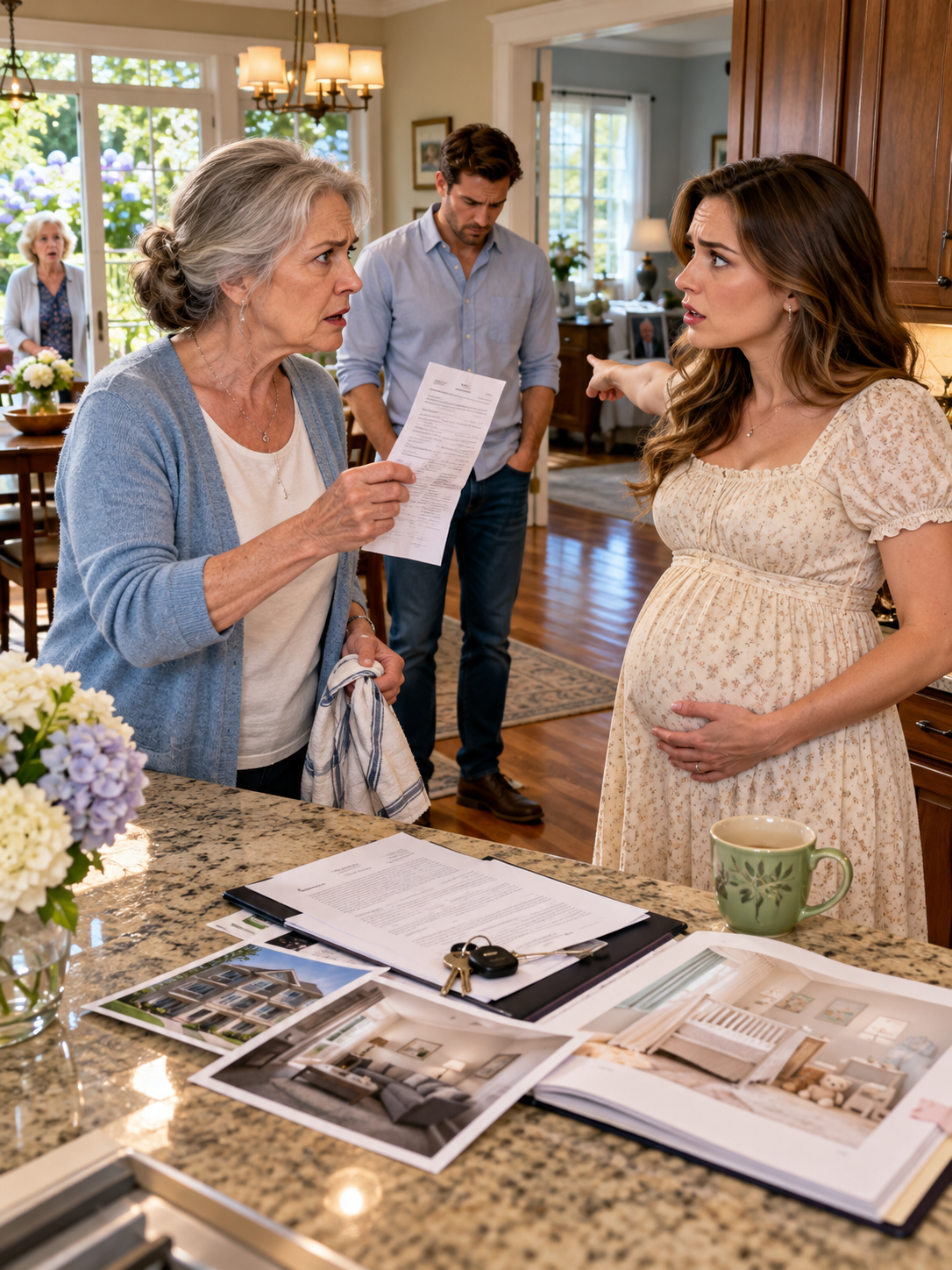
On Tuesday evening, after dinner, I asked Garrett and Brena to sit with me at the kitchen table.
### Part 3: Four Documents Turned Their Carefully Rehearsed Plan Against Them
Brena arrived carrying a glass of water. Garrett took the chair closest to the door.
I placed four documents between us.
A certified copy of the deed.
A letter from Patricia confirming my ownership and explaining my legal position.
My handwritten statement describing the terms under which they had been living in my house.
And the receipt from their attorney.
Brena reached for the receipt first.
“Where did you get this?”
“The recycling bin.”
“You went through our private paperwork?”
“It was under a pizza box in my kitchen.”
Her cheeks colored.
Garrett picked up the deed.
“Mom, what’s this about?”
“I wanted us to stop speaking in generalities.”
Brena pushed the receipt away.
“We were only exploring options.”
“Options involving transferring my home into your names?”
“We’re having a baby, Margaret. We’re trying to be responsible.”
“Then you should understand why I need to be responsible, too.”
Garrett rubbed his forehead.
“We weren’t going to do anything without your consent.”
I looked at him.
“Then why did you tell Brena I’d sign whatever you put in front of me?”
His hand stopped moving.
“How did you hear that?”
“Through my bedroom wall.”
Brena leaned back.
“Were you recording us?”
“No. I was standing in my bedroom.”
Neither spoke.
I looked at my son, remembering a little boy who used to bring me broken toys because he believed I could fix anything.
“Garrett, did you think I wouldn’t read a deed before signing it?”
He swallowed.
“I thought you’d understand what we were trying to do.”
“Did you understand what you were asking me to give up?”
He turned toward the window.
Brena’s voice was quieter when she spoke again.
“I don’t have the kind of security you do, Margaret. My parents never owned anything. I grew up moving whenever a landlord decided to sell.”
For the first time that evening, she sounded less rehearsed.
“I don’t want that for my baby.”
I understood the fear. I’d known something similar after Leonard died.
But I also knew the difference between seeking security and taking it from someone else.
“You and Garrett have good jobs,” I said. “You can build something of your own.”
“Not before the baby comes.”
“Then you may have to begin with something smaller.”
She shook her head.
“Why should we pay a fortune in rent when there’s a perfectly good house sitting right here?”
I let the question settle between us.
“Because someone owns that house.”
She looked away.
I slid the final document forward.
It was the thirty-day notice Patricia had prepared.
Garrett read the first paragraph, then the second.
“Mom.”
“You have thirty days to move out.”
Brena stared at me.
“You can’t be serious.”
“I am.”
“I’m four months pregnant.”
“I know.”
“Where exactly are we supposed to go?”
“I hope you’ll find somewhere comfortable. But you need to find it yourselves.”
She stood so abruptly that her chair scraped against the floor.
“We’ve already made plans!”
“So have I.”
“We paid a deposit on that apartment for you. We arranged for a painter to look at the nursery. We’ve spent money because we thought you were going to cooperate.”
I looked at the folder.
“You spent money based on a decision you made without me.”
She covered her face briefly, then turned toward Garrett.
“Are you going to say anything?”
My son was studying his hands.
Finally, he spoke.
“Maybe we should have talked to Mom first.”
Brena laughed once, without humor.
“Now you say that?”
I turned to Garrett.
“You’re thirty-four. I should have encouraged you to build your own home much sooner. I thought I was helping, but I made it too easy for you to stay.”
His eyes grew wet.
“Mom, please.”
“I love you. That hasn’t changed.”
I touched the notice.
“But this has.”
Brena argued for another ten minutes. She mentioned the baby, the apartment deposit, the expense of moving, and everything they had already purchased.
I listened.
When she had finished, I told them Patricia would handle any necessary questions about the notice.
Then I collected the papers and went upstairs.
Three days later, Garrett knocked on my bedroom door.
He looked exhausted.
“Can I come in?”
He sat in Leonard’s old chair by the south window.
For a while, he studied the worn fabric on the armrest.
“There’s something I haven’t told you.”
I waited.
“I’ve been worried about Brena for months.”
“About the baby?”
He nodded.
“She kept disappearing on weekends. Said she was visiting friends. Sometimes she’d come home and wouldn’t tell me where she’d been.”
He rubbed both hands over his face.
“After Tuesday night, we had this terrible argument. I finally asked whether she’d been seeing someone else.”
“What did she say?”
“She cried.”
He paused.
“She told me the baby might be her ex-boyfriend’s.”
I sat down on the edge of my bed.
“Does she know?”
“She says she doesn’t. The timing overlaps.”
He stared at the floor.
“She was hoping it would turn out to be mine.”
Outside the window, a delivery truck rattled down the street.
I thought about the nursery catalogs, the apartment on Sycamore Street, and the insistence that everything needed to happen quickly.
“Do you think she knew there was a possibility before she started talking about the house?”
Garrett nodded slowly.
“I think she did.”
I didn’t tell him what kind of person I thought his wife was. He was already trying to reconcile the woman he loved with the things she’d admitted.
Instead, I asked, “What are you going to do?”
“I don’t know.”
“Get proper legal advice from your own attorney. And get a paternity test through an appropriate medical provider.”
He looked at me.
“Do you hate her?”
“No.”
“Do you hate me?”
That question hurt more than anything Brena had said.
I crossed the room and rested my hand on his shoulder.
“No, sweetheart. But I can’t protect you from every choice you make. And I won’t let you protect yourself by taking something from me.”
He bowed his head.
For a long time, neither of us spoke.
Then he whispered, “I knew it was wrong. The house. All of it. I just kept telling myself we’d make it work somehow.”
### Part 4: The Truth Arrived After They Left My House
Brena moved out before the thirty days were over.
It was a rainy Saturday morning. A dark sedan stopped at the curb, and a man I didn’t recognize helped load her bags.
I watched from the kitchen window.
She carried out the pregnancy books, her diffuser, the expensive cedar-and-eucalyptus soap, and the whiteboard from my refrigerator.
The painter’s estimate remained on the counter.
She came through the kitchen one last time and found me standing beside the sink.
“Well,” she said, adjusting the strap of her purse, “I hope you’re happy.”
I considered my answer.
“I hope you and the baby are safe.”
Her expression changed, just for a moment.
I thought she might say something else.
Instead, she picked up her keys and left.
Garrett stayed another two days while he arranged a short-term rental near his office.
On Monday morning, he carried his final box to the car.
I went outside with him.
The same porch steps where Leonard had taught him to tie his shoes were damp from the weekend rain.
Garrett set down the box.
“I’m sorry, Mom.”
There was no speech about how he’d been pressured or misunderstood. He didn’t ask me to forget.
He simply opened his arms.
I held him the way I hadn’t held him since he was a teenager.
“You’ll be all right,” I said.
“I don’t feel like it.”
“I know.”
He stepped back, wiping his eyes with his sleeve.
“I’ll call you.”
“I’d like that.”
I watched his car turn the corner, then went inside.
The house had its own familiar sounds. The refrigerator hummed, the old heating pipes clicked, and the kitchen clock ticked above the doorway.
For the first time in months, nothing had been moved without my permission.
I returned my coffee to the pantry’s top shelf.
I put my reading lamp beside the window.
I washed the refrigerator door, where Brena’s whiteboard had been.
Then I took Leonard’s photograph from the drawer and placed it back on the mantel.
I didn’t feel triumphant.
I missed my son.
I was worried about the child Brena was carrying, a baby who had done nothing wrong and deserved a peaceful beginning.
But I could miss someone and still keep my boundaries.
In June, Garrett called with the results of the paternity test.
The baby wasn’t his.
He told me over the telephone, his voice unusually flat.
“She’s sure now, Mom.”
“I’m sorry.”
“Part of me thought I already knew. But I guess I kept hoping.”
I sat at the kitchen table.
“Are you alone?”
“Yeah. I’m at the apartment.”
“Have you eaten?”
He let out a tired laugh.
“No.”
“Come over Sunday. I’ll make dinner.”
He came that weekend carrying a loaf of bread from the bakery Leonard used to love.
We ate chicken and roasted potatoes and talked about ordinary things until the dishes were nearly cleared.
Then Garrett said, “I think about how close I came to signing you out of your own home.”
I looked up.
“You couldn’t have signed it away on your own.”
“I know that now. But I wanted you to agree. That’s what bothers me.”
He turned his water glass slowly.
“I knew the house was yours. I just stopped thinking about what it meant to you.”
I reached across the table and squeezed his hand.
That was the beginning of our way back.
Not an instant forgiveness that erased everything, but Sunday dinners, brief phone calls, and conversations that no longer required either of us to pretend.
That summer, I repainted the south-facing bedroom.
Not the pale gray Brena had selected from her nursery catalog.
I painted it the soft ivory Leonard and I had chosen together years earlier.
I remembered us standing in the hardware store, holding paint chips under terrible fluorescent lights, arguing cheerfully over colors until we both reached for the same shade.
I bought fresh curtains and a desk chair.
The room became my reading room again.
Around the same time, Ruthanne suggested I host dinner for a few friends.
Six women came that first evening. All of us were in our sixties, some widowed, some divorced, one happily single for thirty years.
We ate soup and warm bread around the dining room table.
Someone spilled wine. Someone laughed so hard she had to borrow a tissue.
The house felt full without belonging to anybody but me.
Later, while helping wash dishes, Ruthanne asked a question.
“Did you ever seriously consider taking that apartment on Sycamore Street? Just to keep the peace?”
I watched the soap bubbles swirl down the drain.
“No,” I said.
She tilted her head.
“Not even for Garrett?”
“I would have helped him find a home. I would have helped with a deposit if I could afford it.”
I dried a plate and placed it in the cupboard I’d built myself.
“But the peace they offered required me to disappear from my own life.”
Ruthanne nodded.
She had been holding my ladder the day I installed that bedroom window. She knew what it had taken to keep this place standing.
These days, Garrett comes for dinner occasionally. He is working through the end of his marriage and the future he thought he’d have. I don’t press him for details he isn’t ready to share.
I don’t know what Brena tells people about me.
Perhaps she believes I was selfish. Perhaps she sees a woman sitting alone in a house too large for her, refusing to share.
But I know what really happened.
I shared my home freely until sharing became surrender.
I loved my son enough to help him, and eventually enough to tell him no.
Some mornings, I sit in Leonard’s old chair by the south window with a cup of coffee.
The hydrangeas bloom outside. Light crosses the ivory walls, touches the bookshelves, and settles on the floorboards I refinished years ago.
I can almost hear Leonard on that October afternoon, when we first walked through the shabby rooms together.
“This one’s got a future, Maggie.”
He was right.
For years, I thought that future meant the life we’d planned together. Then I thought it meant holding on to everything he’d left behind.
Now I understand something different.
The house isn’t valuable because my name appears on the deed, although I made certain it stayed there.
It’s valuable because of the life I’ve continued to build inside it.
And at sixty-two, with white hair beginning to appear around my temples and a garden that needs tending, I still have a future here.
One I intend to decide for myself.
The End .
All characters and events in this story are fictional, created for storytelling and entertainment purposes. Thank you sincerely for reading. Your feedback and support are invaluable and motivate me to continue sharing more stories with you.


