
Part 2: A Cardboard Box Revealed How Far She Had Gone
That afternoon, I carried recycling into the garage.
The rain had stopped, but water still ran in narrow lines beneath the garage door. Julian’s suitcases were stacked along one wall beside boxes Vanessa had labeled with a black marker.
Winter clothes.
Kitchen overflow.
Chloe school.
Behind them sat another box.
Mom’s Things Storage.
I stood there reading those words.
Then I dragged it out.
The first thing I saw was our family portrait from the hallway—the one taken at Julian’s college graduation. Arthur had his hand on our son’s shoulder. I was wearing a blue dress I had nearly returned because I thought it made me look too pale.
Underneath it were two smaller photographs.
Then my mother’s quilt.
I lifted the quilt carefully. My mother had sewn it by hand during the last year of her life, even after arthritis made it painful for her to hold a needle. One corner still had a faint stain from the Christmas Arthur spilled coffee on it and spent an hour apologizing.
I carried the box into the dining room.
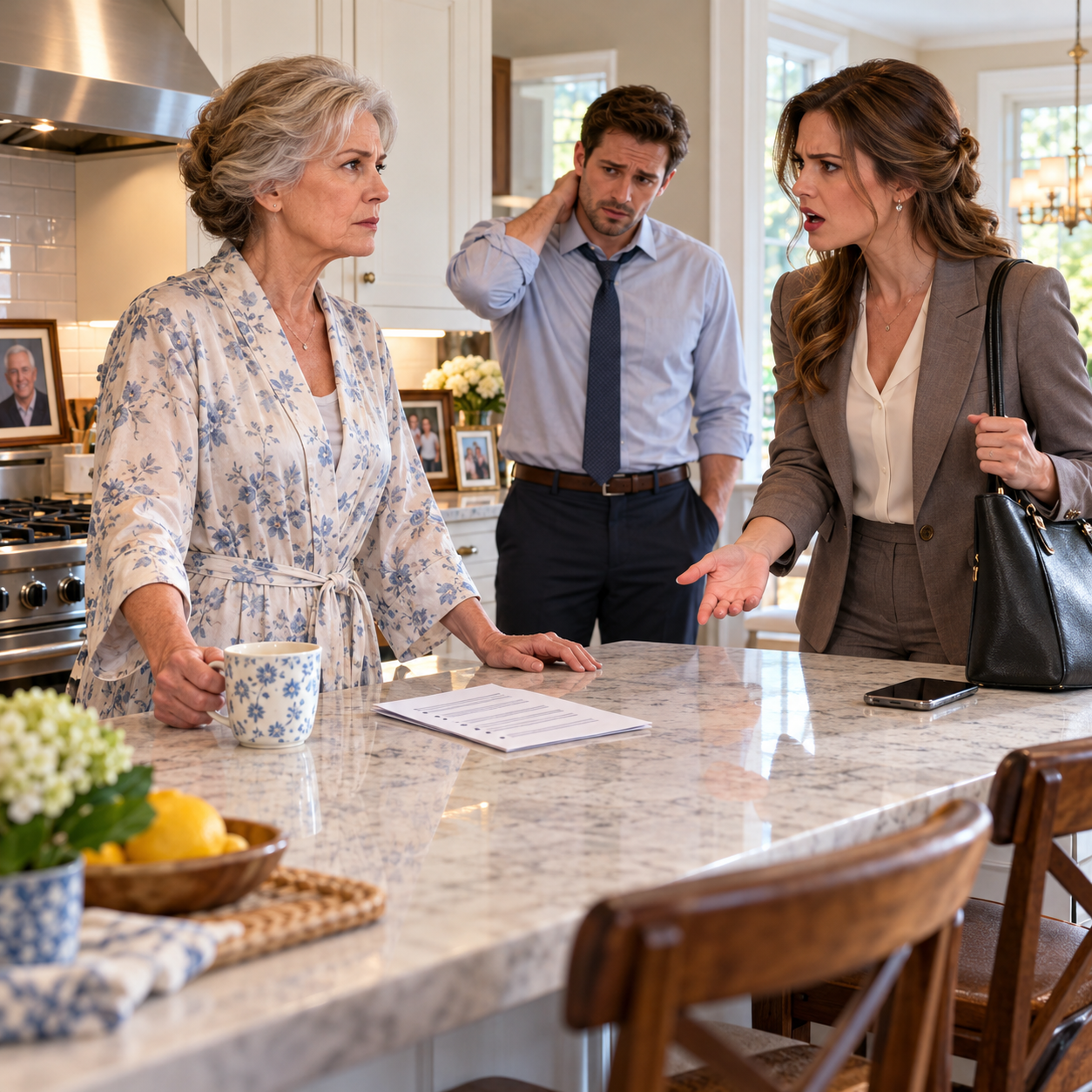
Vanessa sat at the table with her laptop open.
I set the box beside her.
She looked at the label, then at me.
“I was going to talk to you about that.”
“When?”
She closed the laptop.
“The house was crowded. I thought simplifying would help everybody.”
“My family photographs were crowding you?”
“That’s not what I said.”
“You didn’t say anything. You boxed them up.”
Her shoulders stiffened. “Elaine, three adults and a child are living here. I’m just trying to make the space functional.”
“It was functional before you arrived.”
Her eyes flicked toward the hallway.
For one brief moment, the sharpness disappeared from her face.
What I saw beneath it wasn’t cruelty.
It was fear.
She recovered quickly.
“You’re treating every suggestion like an attack.”
“And you’re treating every inch of my house like something you’ve been hired to reorganize.”
Julian appeared at the edge of the dining room.
Neither of us looked at him.
I lifted my mother’s quilt out of the box.
“This goes back on my chair.”
Vanessa said nothing.
“And the pictures go back on the wall.”
Still nothing.
“Is that going to be a problem?”
Her jaw moved once.
“No.”
That evening, I hung every photograph exactly where it had been.
Chloe helped me.
She held up a picture of Arthur wearing a paper birthday crown.
“Grandpa looked silly.”
“He worked very hard at it.”
She smiled.
From the hallway, Vanessa watched us for several seconds before walking away.
The next morning, I asked Julian to meet me in Arthur’s workshop.
Nothing in there had changed much. His tools still hung in careful rows. Pencil marks remained on the workbench. A coffee can full of screws sat beneath the window.
Julian looked around.
“I haven’t been in here since Dad died.”
“I know.”
He ran a thumb along the edge of the bench.
I didn’t begin with Vanessa.
I asked, “What really happened with the apartment?”
His hand stopped.
“I told you.”
“No. You told me the version that let you keep your pride.”
He stared at the floor.
I waited.
His shoulders sagged.
“We were four months behind.”
I said nothing.
He sat down on Arthur’s old stool.
“Vanessa lost her job in March. My commissions dropped. We used cards for groceries, then cash advances to cover cards. I kept thinking the next month would be better.”
“How much debt?”
He named the number quietly.
It was far worse than I expected.
“Does Vanessa know all of it?”
“Most.”
“Most?”
He rubbed both palms over his face.
“Not everything.”
There it was.
“Why?”
“Because she already looks at me like I’m the reason this happened.”
“And is that why she’s trying to control everything here?”
He gave a tired laugh.
“Probably. She reorganized the pantry three times at the apartment when we got the eviction notice.”
“Eviction notice.”
He looked up.
I let the word sit between us.
“So the building wasn’t sold.”
“No.”
“Your lease wasn’t simply ending.”
“No.”
I leaned against the workbench.
“Julian, being broke isn’t a moral failure.”
His eyes reddened, but he kept looking down.
“Lying to everyone who is trying to help you will become one.”
He nodded once.
That afternoon, the mail arrived.
Most of it was ordinary—catalogs, an electric bill, a pharmacy flyer.
Then I found a thin envelope addressed to Julian.
FINAL NOTICE.
The return address belonged to a lender I recognized.
I didn’t open it.
I didn’t need to.
When Julian came home, I placed it on the table.
He stopped walking.
“Does Vanessa know about this?”
He didn’t answer.
“Julian.”
“No.”
I tapped the envelope with one finger.
“Tonight.”
He swallowed.
“Mom—”
“You tell your wife the complete truth tonight, or tomorrow morning I will put every document we have on this table and you can explain it in front of me.”
His face tightened.
“That’s between me and Vanessa.”
“Not anymore. Your dishonesty has entered my house, affected my granddaughter, and turned me into the enemy in somebody else’s financial crisis.”
He picked up the envelope.
For once, he had nothing to say.
That night, through the wall, I heard raised voices from their bedroom.
Not every word.
Just pieces.
“…loan?”
“…trying to fix it…”
“…you let me blame her…”
Then Julian, louder than I had heard him speak in weeks.
“My mother is not the problem.”
Silence followed.
Then his voice again, lower but firm.
“We are.”
Part 3: My Son Finally Told His Wife The Whole Truth
The next morning, I made breakfast.
Not because Vanessa had demanded it.
Because I wanted pancakes.
Chloe wandered in wearing purple pajamas and climbed onto a chair.
“Are we in trouble?”
I turned from the stove.
“Why would you ask that?”
“Mom cried last night.”
Before I could answer, Vanessa entered.
No business suit. No perfect makeup. Her hair was tied back, and her eyes looked tired.
Julian came in behind her.
I put a plate in front of Chloe.
“Eat while it’s warm.”
Vanessa sat across from me.
For several seconds, no one spoke.
Then she looked at the hallway wall where the photographs had been restored.
“I shouldn’t have moved those.”
I waited.
She glanced at Julian.
“I thought if I could make things organized here, I could keep things from falling apart.”
Her voice thinned slightly.
“I know that doesn’t make sense.”
“It makes sense,” I said. “It just doesn’t make it acceptable.”
She nodded.
Julian stared at his hands.
“I told her everything.”
“Everything?”
He met my eyes.
“Everything.”
The personal loan. The credit cards. The missed rent. The late fees. The fact that he had borrowed money without telling his wife because he believed he could somehow repair the damage before she noticed.
Vanessa’s mouth twisted.
“I thought he was hiding maybe one card.”
Julian said, “I know.”
She looked at him.
“No. You don’t get to say that like it’s enough.”
He nodded slowly.
“You’re right.”
That was the first useful conversation I had heard between them since they moved in.
I went upstairs and brought down my original folder.
I placed the occupancy agreement on the dining table.
Then I placed another single page beside it.
Vanessa read the heading.
Thirty-Day Recovery Plan.
She looked up.
“You made us another contract?”
“Call it structure.”
A faint, humorless smile crossed Julian’s face.
Vanessa noticed the irony too.
I continued.
“You have thirty days to meet with a nonprofit financial counselor. Both of you. You create a real budget based on real numbers. Vanessa, you continue interviewing. Julian, you stop hiding bills and loans.”
Julian nodded.
“And the house?” Vanessa asked quietly.
“Nobody removes my belongings. Nobody gives me rules about where I may sit, whom I may invite over, or what I cook. Chloe is welcome here. You are both welcome here while you behave like guests who understand they’re being helped.”
I turned the original occupancy agreement toward Vanessa.
“You signed this.”
She looked at the page for a long moment.
“I know.”
“No. You signed it. Now read it.”
She did.
This time, every line.
Her expression changed when she reached the section stating that the house was held in trust and that occupancy granted no ownership or tenancy beyond the written term.
She looked up.
“So even if we stayed longer—”
“No.”
I didn’t need to finish.
She leaned back in her chair.
Julian glanced at me.
“You really planned for this.”
“I planned for life.”
Nobody argued.
Three days later, Vanessa got a second interview at a local commercial insurance firm.
Before she left, she stood in the kitchen holding her car keys.
“There are bagels,” I said.
A small embarrassed smile appeared.
“I already ate.”
“Good.”
She hesitated.
“Elaine… about that morning.”
“I remember it.”
“I know.”
She looked toward the front door.
“I was scared.”
“So was I.”
That surprised her.
“You?”
“I had invited my family into my home, and within days I was being told when I could use my own living room. Yes, Vanessa. I was scared.”
Her face softened.
“I didn’t think of it that way.”
“That was the problem.”
She nodded.
Then she left for the interview.
Two weeks later, she started the job.
The change inside the house was not magical.
There were still arguments.
Julian hated the budget.
Vanessa hated canceling subscriptions.
They both hated the financial counselor, a patient woman named Denise who apparently possessed the annoying habit of asking where every dollar went.
But they kept going back.
I watched my son begin opening envelopes instead of hiding them beneath magazines.
I watched Vanessa sit at the dining table with spreadsheets instead of household rule lists.
And slowly, my home began to feel like mine again.
One evening, Chloe curled beside me under my mother’s quilt while we read together.
Vanessa passed through the room, stopped, and looked at us.
For a second, I wondered whether the old tension would return.
Instead, she said, “Ten more minutes, then bedtime.”
Chloe groaned.
I smiled.
“Your mother’s the boss of bedtime.”
Vanessa gave me a grateful look and continued upstairs.
That was all.
No speech.
No apology.
Just a boundary where a boundary belonged.
Part 4: The House Stayed Mine And Our Family Changed
Near the end of the second month, Julian asked if we could all have dinner together on Friday.
His invitation sounded oddly formal.
I made lasagna. Vanessa brought salad. Chloe insisted on putting folded napkins beside every plate even though she folded them into shapes that resembled crushed hats.
After dessert, Julian reached into his pocket.
For one ridiculous second, I expected another financial disaster.
Instead, he placed a key on the table.
Their new apartment key.
Vanessa watched me carefully.
“We found a place,” he said.
I looked from him to the key.
“When?”
“Lease starts next month.”
“And you’re sure you can afford it?”
He laughed softly.
“Denise made us prove it three different ways.”
“Then I like Denise more than ever.”
Vanessa smiled.
They had paid down part of the high-interest debt. Julian had refinanced the personal loan into a structured repayment plan. Vanessa’s new salary covered their basic housing expenses, and Julian had stopped pretending commission checks were guaranteed income.
Nothing was solved overnight.
But it was honest.
That mattered more.
Vanessa reached into her bag and placed something beside the apartment key.
The household guidelines she had given me on her first night.
The paper was creased from where I had folded it.
“I found it in the drawer when I was looking for tape,” she said.
I looked at her.
“I didn’t read the rest of the drawer.”
Arthur’s watch was still there.
I appreciated that.
She pushed the page toward me.
“I was embarrassed when I reread it.”
Julian muttered, “You should’ve been.”
She gave him a look.
Then she turned back to me.
“I kept trying to convince myself I was just creating structure. But I think I was terrified of being dependent on someone I couldn’t control.”
Her fingers rested on the edge of the page.
“When we lost the apartment, I felt like everybody could see I’d failed. And instead of saying that, I walked into your house and acted like it was mine.”
I studied her face.
There was no performance in it.
No polished excuse.
Just a woman who had spent months frightened and had finally run out of ways to disguise it.
“You didn’t fail because you needed help,” I said.
She looked down.
“You nearly ruined the help because you couldn’t admit you needed it.”
A small laugh escaped her.
“That’s fair.”
Julian reached for her hand.
She let him take it.
I looked at my son.
“And you.”
He straightened slightly.
“Yes, ma’am.”
“Don’t hide disaster from your wife because you think protecting her means lying.”
“I know.”
“Do you?”
He squeezed Vanessa’s hand.
“I do now.”
Chloe, who had been drawing at the end of the table, looked up.
“Are we moving because Grandma kicked us out?”
Three adult heads turned toward her.
I pushed my chair back and opened my arms.
She came to me immediately.
“No, sweetheart. Your parents are moving because they’re ready to take care of their own home again.”
She considered that.
“Can I still sleep here sometimes?”
“As long as you never make me wake up at six to cook breakfast.”
Vanessa laughed first.
Then Julian.
Even Chloe laughed, though she had no idea why.
A month later, the moving truck pulled away from my driveway.
Vanessa stood on the porch holding the last box.
She looked toward the hallway behind me.
The family photographs were still there.
My mother’s quilt was still draped over the reading chair.
Arthur’s old sugar bowl still sat beside the coffee maker exactly where it had for years.
Nothing important had been erased to make room for them.
That, I realized, was the difference between making space for family and disappearing inside their needs.
Vanessa hugged me before she left.
Not stiffly.
Not out of obligation.
A real hug.
“Thank you for helping us,” she whispered.
I rested a hand against her back.
“Thank you for learning how to accept help.”
Julian hugged me next.
For a moment, I felt Arthur everywhere—in the porch rail he had repaired twice, in the oak tree he had planted when Julian was six, in our son’s face as he stepped back and cleared his throat.
“You were right,” he said.
“About what?”
He glanced toward the house.
“Clear boundaries.”
I smiled.
“Your father used to say a fence doesn’t mean you hate your neighbor.”
Julian smiled too.
“It just tells them where your tomatoes are.”
“Exactly.”
After they left, I walked through the house slowly.
Chloe’s room looked oddly bare without her stuffed animals scattered across the bed. The guest room smelled faintly of Vanessa’s perfume. Julian had left a phone charger plugged into the wall, which seemed so completely like him that I laughed when I found it.
Then I went downstairs.
The house was quiet again.
But it was not the same silence I had known after Arthur died.
That silence had been grief.
This one felt settled.
I made tea, carried it into the living room, and sat beneath my mother’s quilt.
For years, I had believed kindness meant making yourself easier for the people you loved. Less demanding. Less inconvenient. More accommodating.
Age taught me otherwise.
Love without boundaries can slowly become permission.
Permission to assume.
Permission to take.
Permission to mistake someone’s patience for weakness.
I had not saved my relationship with my son by giving him everything he wanted.
I had saved it by refusing to.
I had not helped Vanessa by allowing her fear to control my home.
I had helped her by forcing reality into the open.
And I had not protected Chloe by pretending adults never make mistakes.
She had watched her parents make them, face them, and begin repairing them.
Months later, our Sunday dinners continued.
Only now, Vanessa often arrived carrying dessert.
Julian still complained about budgeting, but usually while showing me how much they had paid down that month.
Chloe still ran straight for the yellow room upstairs.
And sometimes, when everyone had gone home and the last plate had been dried, I stood alone in the hallway beneath the old family photographs.
Arthur smiled down from the graduation picture.
I still missed him.
I always would.
But the home we built remained what we intended it to be: not a place where one person ruled another, and not a place where love required surrender.
A place where family was welcome.
A place where truth mattered.
A place where respect came through the door with you.
And if it didn’t, it learned quickly.
The End .
All characters and events in this story are fictional, created for storytelling and entertainment purposes. Thank you sincerely for reading. Your feedback and support are invaluable and motivate me to continue sharing more stories with you.

