
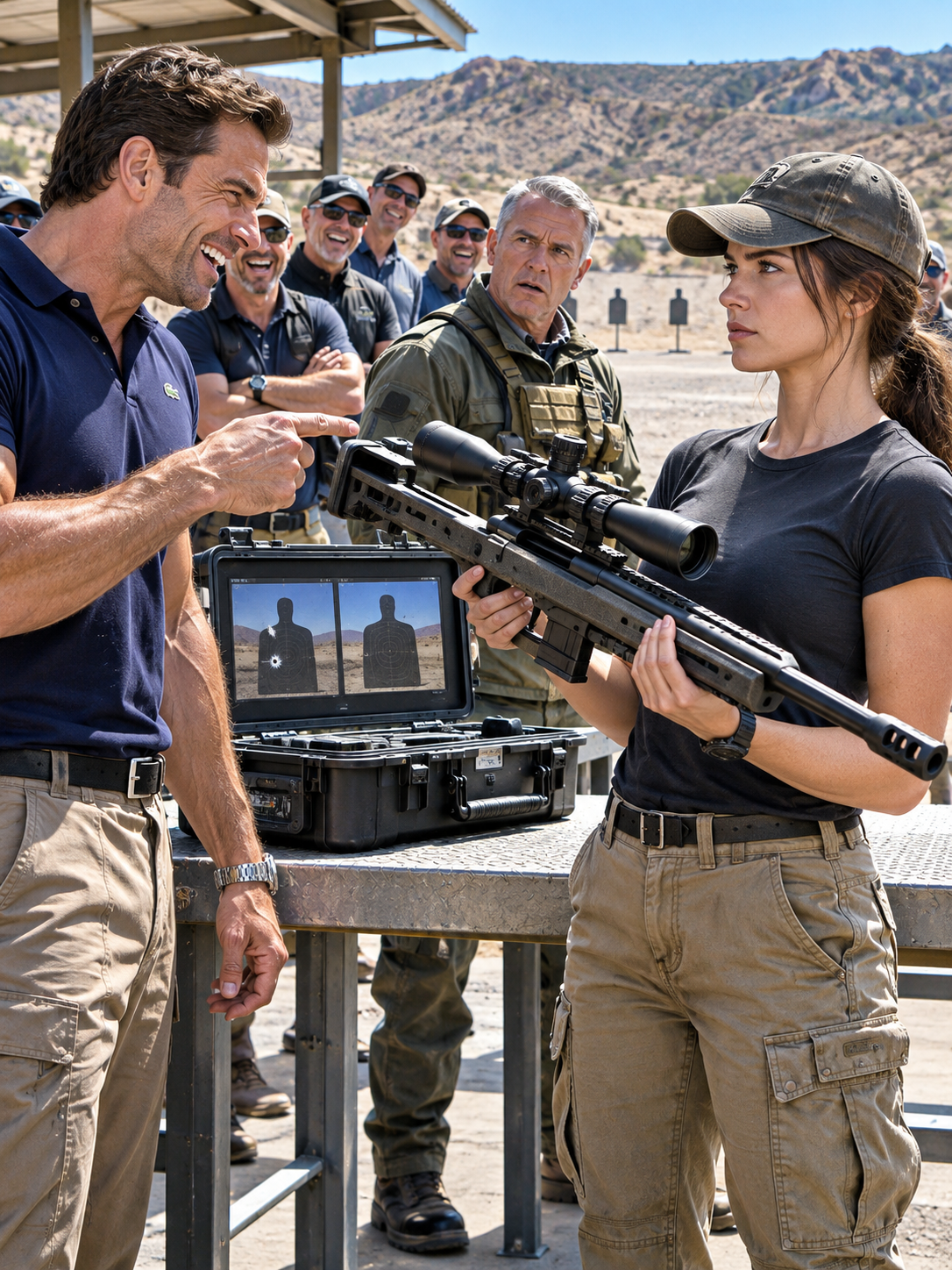
## Part 2: Three impossible shots silence an entire firing range
Lang ordered the rifle cleared, checked the lane, and waited until I had completed the required safety procedures. Darren remained behind the barrier, shaking his head for the benefit of his friends. “This ought to be entertaining,” he whispered to a man wearing a designer shooting vest. I lowered myself onto the firing pad, and the familiar feeling of a precision rifle beneath my hands brought back memories I had spent four years keeping to myself.
The weapon was expensive, certainly, but money had never been enough to purchase discipline. I settled behind the stock, adjusted the fit, and studied the distant canyon through the optic. Heat shimmered above the rocky ground while dry vegetation leaned under a shifting crosswind. I could hear Darren laughing behind me, but his voice seemed to belong to another world.
“Target one is three hundred yards,” Lang announced. “Shooter may engage on command.” I glanced toward the near silhouette, the same target Darren had missed twice, then turned my attention farther along the canyon. A battered thirty-inch steel plate stood against a distant granite ridge, almost invisible to the untrained eye. It was positioned precisely one thousand yards from our firing line.
I made the necessary adjustments, bringing the elevation to 8.2 milliradians and accounting for the crosswind with 1.1 milliradians of right correction. Lang shifted his spotting optic toward the far ridge. He understood what I was attempting, and I could feel his attention sharpen as he authorized the distant target. Behind us, Darren was still telling someone how difficult his rifle was to handle.
I settled into position and waited for the moment when my sight picture became perfectly steady. The first shot cracked across the canyon, and the rifle pushed against my shoulder in a firm, familiar motion. I worked the bolt smoothly, recovered my position, and sent the second round downrange. The third followed with the same controlled precision.
Then I stopped.
For several seconds, nothing happened except the hollow echo of the rifle reports rolling through the hills. Someone behind me whispered, “What was she aiming at?” Darren gave a dismissive snort. “Probably the dirt. She can’t even see the three-hundred-yard plate.”
A clear metallic clang drifted back from the distant ridge.
Then another.
Then a third.
Three unmistakable impacts rang through the canyon, each one coming from the farthest steel target on the property. The laughter died instantly. A man beside Darren lowered his sunglasses, while another stepped toward the spotting monitor with his mouth slightly open.
Master Chief Lang remained behind his binoculars, motionless. When he finally lowered them, his weathered face held an expression I had seen only a handful of times during my previous career. It was the look of a professional recognizing something that should have been impossible for an ordinary visitor.
“Ma’am,” he said quietly, “did you just put three clean center hits on the thousand-yard steel?”
I opened the action, completed the clearing procedure, and rose from the mat. Gravel clung to my knees as I brushed off my cargo pants. “Yes, Master Chief,” I replied.
Darren broke the silence with a forced laugh. “Well, that’s what happens when you spend enough money on good equipment. That carbon chassis practically does the work for you. Even my little sister can get lucky with something like that.” He gestured toward the rifle as though its price tag explained what everyone had just witnessed.
Lang never looked at him.
Instead, the instructor walked directly toward me, stopped at a respectful distance, and straightened his shoulders. His heels came together on the concrete, his back became perfectly rigid, and he raised his right hand to the brim of his cap.
A crisp military salute cut through the silence.
“Specialist Holbrook,” he said with unmistakable recognition. “It’s an honor to see you again, ma’am.”
The crowd froze, and Darren’s grin collapsed.
“Wait,” my brother demanded. “Why are you saluting my sister?”
Lang slowly lowered his hand.
“Because, Mr. Holbrook, you apparently have no idea who she is.”
## Part 3: A Navy SEAL instructor reveals my brother’s humiliating mistake
Darren stared at Lang as though the instructor had suddenly begun speaking another language. “That’s Taryn,” he said, pointing toward me. “My sister works in a shipping office. She sits behind a computer and tracks inventory.” A few men glanced in my direction, then toward Lang, waiting for an explanation that might make the scene understandable.
Lang’s expression hardened. “Your sister spent seven years as a lead civilian ballistics contractor supporting Naval Special Warfare Development Group at Dam Neck, Virginia.” The words seemed to drain the color from Darren’s face. “I was running training cadres around Virginia Beach in 2018. I remember her work, and I remember the standards she helped establish.”
Darren blinked several times. “Seven years?”
“Her technical manual on extreme-range cold-bore compensation and aerodynamic jump remains part of the reading our sniper students study,” Lang continued. “She didn’t simply learn how to shoot, Mr. Holbrook. She helped write the doctrine that trained people to perform under conditions where mistakes could cost lives.”
Nobody spoke.
The executives who had laughed when Darren handed me the rifle were now looking at him with something close to disbelief. One man slowly removed his shooting glasses, while another glanced at the custom rifle lying harmlessly on the cleared bench. Darren looked at me, searching my face for some sign that this was an elaborate joke. I held his gaze without smiling.
“That’s impossible,” he said finally. “She never told us anything about working with the Navy. She said she was a logistics analyst.” I nodded. “I am a logistics analyst, Darren. That’s what I do now.” His mouth opened, but Lang spoke before he could turn my answer into another insult.
“And before that, she helped establish standards your expensive equipment cannot compensate for ignoring.”
Darren seized on the reference to equipment as though it were a life preserver. “Speaking of equipment, my rifle obviously wasn’t zeroed correctly. Something must’ve shifted in the case during transport.” He pointed toward the optic. “That explains my first two shots. Any experienced shooter would understand that.”
Lang turned toward the electronic displays beside lane four. “Then perhaps you’d like to explain these readings.” The screen showed recorded impacts, synchronized lane footage, and the available sensor measurements from the session. Darren followed reluctantly as the instructor brought up his first attempt.
“Your first shot showed an abrupt movement just before the trigger broke,” Lang explained, indicating an eighty-millisecond disturbance in the recorded data. “You anticipated the recoil and pulled the rifle off alignment. Your second attempt showed a different problem. Your eye position shifted badly enough to introduce a significant sighting error.”
Darren’s jaw tightened. “I was adjusting for the sun.”
“No, sir. You were fighting the rifle instead of controlling yourself.” Lang switched to the distant target display, where three tightly clustered marks appeared near the center of the steel. “Your sister recognized the crosswind, made the proper corrections, and maintained consistency across three consecutive shots.”
He enlarged the grouping measurement on the monitor.
“Four point six inches at one thousand yards,” Lang announced. “Less than half a minute of angle.”
A quiet murmur passed through the spectators. The man who had laughed loudest at Darren now stared at the screen without attempting to hide his amazement. Lang faced my brother again, his voice calm but uncompromising. “Your sister didn’t get lucky. She demonstrated the kind of control people spend years learning. She helped build the standard you never bothered to study.”
Darren swallowed, then reached toward his rifle case.
Lang lifted his clipboard. “There’s another issue, Mr. Holbrook. You attempted to hand off a firearm before properly clearing it, despite explicit instructions. At this facility, disregard for range safety means immediate forfeiture of your lane privileges.”
“You can’t be serious,” Darren whispered.
“Completely serious. Pack your equipment.”
Darren looked around for support, but nobody defended him. His hands trembled as he closed the heavy Pelican case, the sharp clicks of its latches echoing across the suddenly quiet firing line. Without another word, he carried his expensive rifle toward the parking lot, passing the same executives he had spent the entire morning trying to impress.
I watched him go, remembering every family dinner when he had mistaken my silence for weakness. For years, he had been convinced that respect could be purchased, displayed, or demanded. Now he had encountered something his money couldn’t buy, and the lesson had cost him more than any rifle.
Before I followed, Lang stepped beside me and offered his hand.
“Still letting the work speak for itself, Holbrook?”
I shook his hand.
“Some habits don’t change, Master Chief.”
Behind him, the distant steel target swayed gently in the desert wind.
## Part 4: One silent drive home reveals the truth about respect
The drive back down the mountain highway was unlike any journey Darren and I had ever taken together. He gripped the steering wheel with both hands, his knuckles pale against the dark leather, while dry Southern California hills slipped past the windows. Usually, he filled every silence with advice about investments, career advancement, or the importance of surrounding yourself with successful people. This time, the only sound came from the tires rolling over the asphalt.
His expensive BMW suddenly felt smaller than it had that morning.
I rested my old baseball cap in my lap and watched the landscape pass. I wasn’t celebrating his embarrassment, although I couldn’t pretend it hadn’t been satisfying to see him confronted with reality. What stayed with me was the expression on his face when Lang mentioned my work at Dam Neck. Darren hadn’t simply discovered that I could shoot; he had discovered that the sister he considered ordinary had lived an entire professional life he had never cared enough to understand.
Four years earlier, I had returned to civilian work in San Diego because I wanted a different kind of life. My years supporting specialized military training had demanded extraordinary concentration, responsibility, and long hours devoted to problems that could not be solved through confidence alone. The logistics position suited me, and I genuinely enjoyed the precision of making complicated supply systems work. I had never considered it a step backward, no matter how often Darren described it that way.
At a traffic light, Darren finally cleared his throat. “That instructor,” he said, keeping his eyes on the windshield. “He really knew you?” I turned slightly toward him. “Yes. We worked in overlapping circles when he was involved with the training cadres.” Darren nodded, then rubbed his forehead with one hand. “And that manual he mentioned? You actually wrote it?”
“I was responsible for the technical work behind it,” I answered. “There were other professionals involved, Darren. People whose expertise deserved just as much respect.” He looked at me briefly, and I recognized the confusion beneath his humiliation. He had spent years believing that achievement existed mainly to impress other people. The idea that someone could accomplish something significant without advertising it seemed almost beyond his comprehension.
“Why didn’t you ever tell us?” he asked.
I thought about our parents, who had always been proud of Darren’s promotions and impressed by his expensive possessions. I thought about holiday dinners when he interrupted my answers before I could finish speaking. There had been opportunities to explain my past, but eventually I stopped offering information to people who seemed more interested in measuring my success than understanding my life.
“I tried talking about my work once,” I said. “You interrupted me to tell Dad about your quarterly sales numbers.” Darren stared at the road, and I watched that memory settle over him. He didn’t argue or claim I had misunderstood. He simply tightened his grip on the wheel.
After several miles, he spoke again. “I thought you were embarrassed about where your career ended up.”
I turned toward him. “I’ve never been embarrassed about my work.”
He swallowed. “Then why let everybody think you were just some ordinary office employee?”
That question hurt more than his laughter at the range, because it showed how little he understood even now. He believed the discovery of my military-related career had somehow made me worthy of respect. Before that, in his mind, I had been someone he could safely dismiss.
“Darren, I am an ordinary office employee now,” I said quietly. “I go to work, solve problems, pay my bills, and come home. There’s nothing shameful about any of that.” He glanced toward me, but I continued before he could respond. “You shouldn’t need a Navy instructor to salute someone before you decide they’re worth treating with dignity.”
For the first time that day, he had no defense.
We reached my neighborhood as the afternoon sunlight began stretching long shadows across the pavement. Darren turned into my driveway, shifted into park, and left the engine running. His phone lay untouched in the center console, and the visitor badge he had given me was still tucked beside the cup holder.
“Did you know who Lang was when we got there?” he asked.
“Immediately.”
Darren turned toward me. “And you didn’t say anything?”
I shook my head. “I wasn’t there to impress him, Darren. I wasn’t there to embarrass you, either. I went because you invited me.”
His eyes dropped toward the steering wheel.
For several seconds, he said nothing. Then his voice emerged, stripped of the polished confidence he normally carried everywhere.
“I made a fool of myself.”
I looked at him without answering.
“And I treated you badly,” he added, almost too softly to hear.
It wasn’t a grand apology, and it didn’t erase the years of condescension between us. But it was the first time I could remember Darren admitting that the problem might be his own behavior rather than someone else’s shortcomings.
“I’m sorry, Taryn,” he finally said.
I reached for the door handle, then stopped. “You know what the strangest part of today was?”
He shook his head.
“Lang didn’t salute me because I hit a target. He recognized years of work that mattered to people who had trusted me with serious responsibilities.” I watched Darren’s expression change as he absorbed the distinction. “You spent the morning trying to make strangers admire you. He spent his career teaching people to respect the work.”
Darren leaned back against his seat, looking suddenly older than the confident businessman who had walked into that range. “I guess I’ve been looking at things the wrong way,” he admitted.
“Maybe,” I said. “But you can change that.”
I opened the passenger door, and the cool afternoon breeze swept into the cabin. Before stepping out, I looked back at the brother who had spent so many years telling me what kind of person I was supposed to be. For once, I wanted him to hear what I had to say.
“People who know who they are don’t need an audience to prove it, Darren. They let their work stand on its own.”
He nodded slowly.
I picked up my cap, stepped onto the driveway, and closed the door gently. As I started toward my front steps, Darren lowered his window.
“Taryn?”
I turned.
He hesitated, then asked, “Do you think I could actually learn to shoot properly?”
I looked at him for a moment. The question was different from anything he’d asked me before. There was no boasting, no expensive equipment to display, and no audience waiting for an impressive answer.
“Of course,” I said. “But first, you have to be willing to learn.”
A small, embarrassed smile crossed his face.
I returned it.
“And Darren?”
“Yeah?”
“Keep practicing your fundamentals.”
I walked up my front steps without looking back.
For years, my brother had believed that respect belonged to whoever possessed the biggest title, the most expensive equipment, or the loudest voice. That Saturday, he learned something I had understood long before I ever picked up his rifle.
Real strength doesn’t need to announce itself.
And sometimes, the person everyone overlooks is the one who quietly helped write the standard by which everyone else is measured.
THE END.
All characters and events in this story are fictional, created for storytelling and entertainment purposes. Thank you sincerely for reading. Your feedback and support are invaluable and motivate me to continue sharing more stories with you.


