
Part 2: I Removed My Money Before Anger Could Choose for Me
Rebecca found a furnished one-bedroom in a retirement community twenty minutes away.
“Six-month lease,” she said. “Fireplace. Balcony. Elevator. And apparently the kitchen gets excellent afternoon light.”
“Send it.”
“Mom, are you sure?”
It was the first time she’d asked.
I looked through the doorway toward the empty hall.
“No,” I said. “But I’m finished pretending uncertainty means I should stay.”
Before doing anything else, I called an attorney Frank and I had used for estate planning. His office was closed, but his answering service reached him because we had known each other for years.
I explained what I owned and what I intended to remove.
“Take only what you can document as yours,” he advised. “Photograph it first. Don’t touch their property. Keep copies of everything.”
That steadied me.
This wasn’t going to become destruction disguised as independence.
I photographed receipts beside serial numbers. Then I found blue painter’s tape in the garage and marked my belongings.
The television.
My sectional.
Two lamps.
The dining-room sideboard that Claire had once called “perfect for the space.”
In the kitchen, the espresso machine, stand mixer, cookware, and microwave carried my receipts.
So did the washer and dryer.
I left the children’s bedrooms untouched.
I left every toy, book, bicycle, gaming system, stuffed animal and piece of furniture that belonged to Sophie and Noah.
They had not excluded me.
At eleven-forty, a moving crew arrived.
One of the movers, a broad-shouldered man named Luis, glanced at the Christmas tree surrounded by unopened gifts.
“Family move?” he asked.
“Just mine.”
He nodded once.
“Tell us what goes.”
For three hours, furniture passed through the front door wrapped in blankets.
As the sectional disappeared, I noticed pale rectangles on the floor where its legs had protected the hardwood from sunlight.
Evidence of absence.
By three, the living room looked strangely large.
I sat at the kitchen island with my laptop.
The recurring mortgage transfer took less than a minute to cancel.
$1,420.
Every first of the month.
Forty-seven payments.
I stared at the total in my spreadsheet.
More than sixty-six thousand dollars, not counting the original down payment or anything else I had purchased.
Next came utilities.
The gas, electric, and water accounts were all mine because Claire had disliked “administrative stuff.” I scheduled them to transfer back to the homeowners after forty-eight hours rather than shutting anything off.
Then I removed Claire as an authorized user from my credit card.
That one hurt more than I expected.
I remembered adding her before a family vacation because she was going to book the rental car.
Some temporary arrangements have a way of becoming permanent when nobody benefits from examining them.
I canceled the streaming package, wine club, grocery subscription, and shared cloud-storage upgrade.
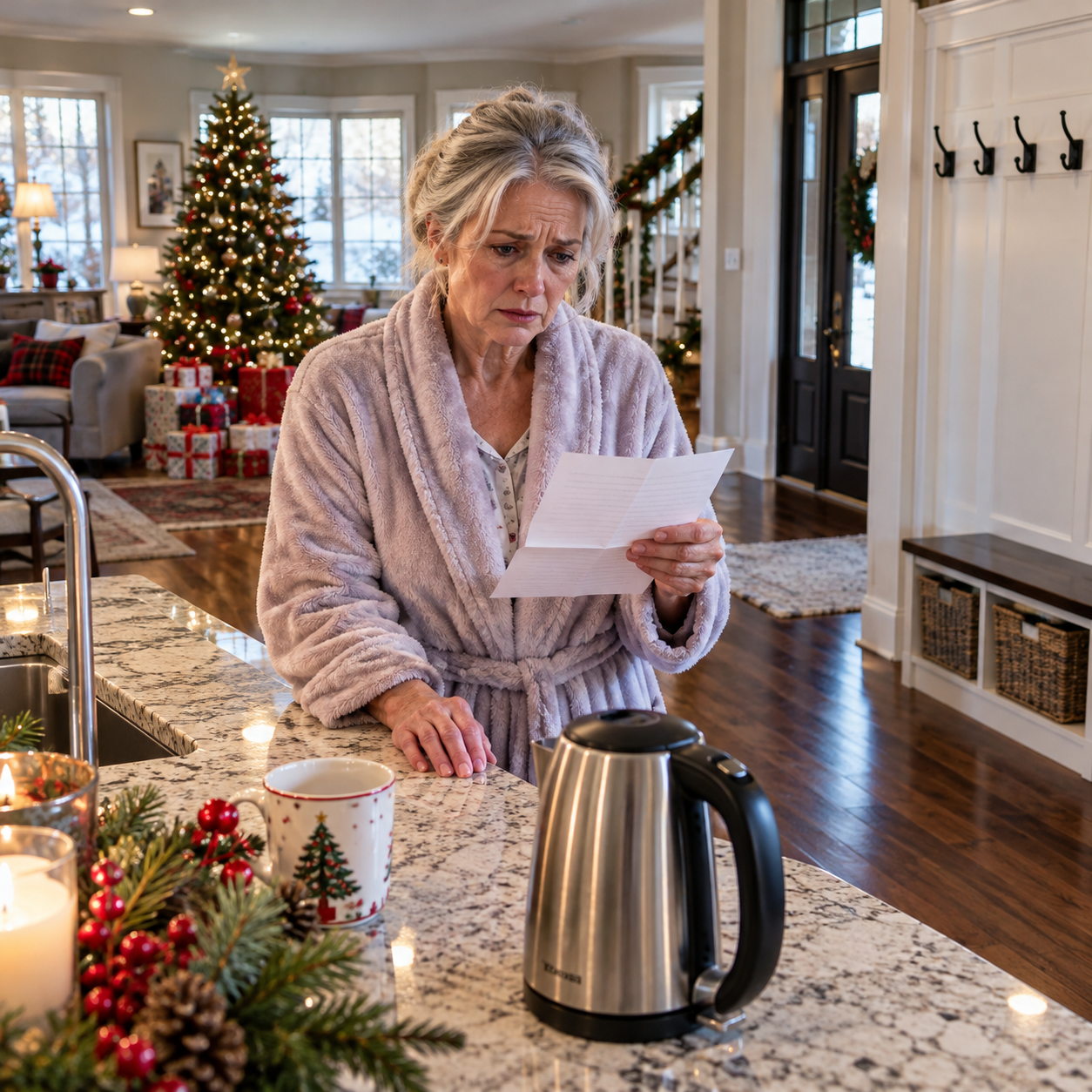
Then I opened Claire’s Christmas note again.
Disrupt your plans.
She had lived with me four years and believed—or needed herself to believe—that I had separate plans for Christmas.
I wrote my own note.
Daniel and Claire,
I have moved out and taken the belongings I purchased and can document as mine.
Beginning today, I will no longer contribute toward your mortgage or household expenses.
I am safe. I have somewhere to stay. The children’s belongings and gifts are untouched.
I don’t want an argument. I do want us to speak eventually, when we can do it honestly.
Mom
I hesitated over the signature.
Then I left Mom.
Whatever Daniel had failed to do, he was still my son.
I placed my note beside Claire’s.
At the front door, my hand rested on the key.
Four years earlier, Daniel had put it in my palm and said, “Your house now, too.”
Standing there on Christmas afternoon, I finally understood the difference between being welcomed into someone’s home and having a home of your own.
I pushed the key through the mail slot.
The apartment Rebecca found had cream walls, a gas fireplace, and a narrow balcony overlooking a frozen pond.
I brought my clothes, Frank’s photograph, my filing cabinet, six boxes of books, and the espresso machine.
At nine that night, Rebecca called.
“How are you?”
I stood at the balcony doors watching snow gather on the railing.
“Ask me tomorrow.”
“Fair.”
After a moment, she said, “For what it’s worth, I wish you were here.”
That sentence did what the morning hadn’t.
I covered my mouth and cried quietly while Rebecca stayed on the line.
Part 3: Their Return Forced Us to Name Four Years Honestly
Daniel’s first text arrived December 30 at 7:06 p.m.
Mom, where are you?
Three minutes later:
We found your note. Please call me.
Then:
The house is half empty.
At 7:31:
The mortgage transfer didn’t come through.
That one answered a question I hadn’t wanted to ask.
I waited until the next morning to call.
Daniel answered before the first ring had properly ended.
“Mom.”
“Hello, honey.”
“Where are you?”
“In an apartment.”
“Why?”
I looked around my small living room.
“You read my note.”
“I did, but this is… Mom, the washer is gone.”
“I bought the washer.”
“Claire says those things became part of the household.”
“Claire can speak to an attorney if she believes that.”
He breathed heavily into the phone.
“Can we please not talk like strangers?”
“Then talk to me like your mother.”
That stopped him.
In the background, I heard cabinet doors opening.
Finally Daniel said, “We can’t cover January comfortably.”
“Then you’ll need to make adjustments.”
“The trip cost more than we expected.”
I closed my eyes.
“Why did you go?”
“The kids wanted snow for Christmas.”
“That’s not what I asked.”
Another long pause.
Daniel had always confessed slowly, even as a child. At twelve, after breaking Frank’s fishing rod, he’d spent twenty minutes explaining the weather before admitting he’d stepped on it.
“Claire got offered the suite from someone at work,” he said. “It was discounted.”
“And?”
“And adding another adult complicated things.”
There it was.
Not hatred.
Not conspiracy.
Convenience.
A larger rental car. Another lift ticket. Meals. Space.
I had become an expense in a vacation largely supported by a household I subsidized.
“We thought you’d enjoy some quiet,” he added.
“No, Daniel. You hoped I wouldn’t object.”
Claire’s voice rose behind him.
Then she took the phone.
“Elaine, this has gotten completely out of proportion.”
Her tone wasn’t cruel. It was frightened.
For the first time, I heard what lived underneath her constant control.
“We didn’t abandon you,” she said. “We went away for five days.”
“On Christmas.”
“You don’t ski.”
“I wasn’t asking to ski.”
“We are under tremendous financial pressure, and now you’ve made it worse.”
That interested me.
“Claire, did you believe my contributions would continue indefinitely?”
“I believed we were a family.”
“So did I.”
Neither of us spoke.
Then she said, more softly, “You never said you were this unhappy.”
“I tried.”
“You complained about cabinets.”
“I talked about cabinets because talking about respect made Daniel leave the room.”
She gave a tired laugh that wasn’t amused.
“Do you know what it felt like having my mother-in-law in my house every day?”
There was finally honesty in her voice.
“I never felt like it was mine. Every time you bought something, I knew we couldn’t have afforded it ourselves. Every time someone complimented the house, I knew how much of it came from you.”
I sat down.
For years I’d interpreted her behavior as superiority.
Some of it had been shame.
That didn’t excuse it.
But it made her human.
“You could have told me that,” I said.
“I didn’t know how.”
“So you made me smaller instead.”
She didn’t answer.
Daniel came back on.
“Mom, what do you want us to do?”
“Nothing for me.”
“What does that mean?”
“It means I’m not asking you to repay four years. I’m not taking you to court. I’m not trying to hurt your children. I’m simply done financing your household.”
He whispered something I barely caught.
“We might lose the house.”
“You may need to sell it.”
“Just like that?”
“No. Not just like that. After four years.”
He cried then.
Quietly.
I let him.
In March, Rebecca told me Daniel and Claire had listed the house.
I didn’t drive past it.
I didn’t check the listing.
When it sold six weeks later, Daniel texted only:
Closing Friday. We’re moving into a townhouse near the kids’ school.
I wrote back:
I hope the move goes smoothly.
That was all.
Some boundaries don’t need speeches every time they hold.
Part 4: Losing the House Finally Taught Us What Family Required
Spring arrived slowly.
The frozen pond outside my apartment turned gray, then silver, then water again.
I joined a pottery class because Rebecca told me I needed something that involved my hands and had nothing to do with anybody else’s bills.
My first bowl leaned so badly it looked seasick.
My fifth was beautiful.
In June, Daniel called.
“Could we have lunch?”
“Just you?”
“Just me.”
We met at a diner halfway between my apartment and his townhouse.
When he walked in, he looked older.
Not ruined. Not broken.
Simply less protected from his own choices.
He sat across from me and folded his hands around his coffee cup.
“Claire knows I’m here.”
“I’m glad you’re not sneaking.”
He nodded.
Then he stared at his coffee.
“I’ve been trying to figure out what to apologize for.”
I waited.
“At first I thought it was the trip. Then I thought it was not telling you. Then the house sold and we started going through our finances, and…” He rubbed his thumb along the mug. “Mom, I knew.”
“Knew what?”
“That you were paying for too much.”
The waitress came by. Neither of us ordered.
Daniel continued.
“I knew Claire was uncomfortable with you living there. I knew you were uncomfortable with her. And every time either of you tried to make me deal with it, I acted like staying neutral made me a good husband and a good son.”
His mouth tightened.
“It made me neither.”
I looked out the window at traffic moving along the avenue.
“Your father hated conflict too.”
“I remember.”
“He just didn’t hide from it.”
Daniel nodded.
“I did.”
That mattered more than a dramatic apology would have.
No excuses.
No request for money.
No demand that I forgive Claire.
He simply named what he’d done.
“I forgive you,” I said.
His eyes filled.
“But listen carefully. Forgiveness isn’t a mortgage product.”
He laughed unexpectedly, then wiped his face.
“I know.”
“I won’t finance your household again.”
“I know.”
“I’ll buy Sophie birthday presents. I’ll take Noah to the zoo. I’ll spoil them within grandmotherly reason.”
“Reasonable.”
“But your bills belong to you and Claire.”
“They do.”
We finally ordered lunch.
Daniel paid.
The next month, he asked again.
That became our routine: the first Tuesday of every month at the same diner.
Sometimes we talked about the Christmas trip. Mostly we didn’t.
He told me Noah had started Little League and Sophie wanted purple streaks in her hair. I told him my pottery instructor wanted me to enter a bowl in the community art fair.
Claire and I remained cautious.
In August, she sent me a message.
Sophie wants you at her birthday. I hope you’ll come. I know things between us are complicated. I’m trying not to make that the children’s burden.
I read it twice before replying.
Thank you. I’ll be there.
At Sophie’s party, Claire opened the door.
For a second, neither of us seemed to know whether we were supposed to hug.
So we didn’t.
She stepped aside.
“She’s been watching the driveway for twenty minutes.”
Sophie came flying through the hallway.
“Grandma!”
I bent down and caught her.
Behind her, Noah shouted, “I saved you cake!”
Claire met my eyes over their heads.
There was no sudden reconciliation.
No confession that made four years disappear.
Just two women who had finally stopped pretending the arrangement between them had been healthy.
“Coffee?” she asked.
“Please.”
She handed me a mug.
Not the expensive espresso machine. That sat in my apartment.
This was ordinary drip coffee from an ordinary machine in a modest townhouse where Daniel and Claire paid their own mortgage.
It tasted perfectly fine.
On Christmas Eve that year, Daniel called.
“We’re doing Christmas morning here,” he said. “The kids want you to sleep over.”
I looked around my apartment.
My books filled the shelves. Frank’s photograph stood beside the fireplace. Three slightly imperfect bowls I’d made sat on the dining table.
“I’ll come for breakfast,” I said.
There was a brief pause.
“You’re sure?”
“Yes.”
“Okay. Nine?”
“Nine.”
No guilt.
No persuasion.
That was new.
Christmas morning, I woke in my own bed.
The apartment was quiet, but quiet no longer meant I’d been forgotten. It meant nobody had entered my life without asking. Nobody’s tension waited outside my bedroom door.
I made espresso and carried it to the balcony window.
A little after nine, I drove to Daniel’s townhouse.
Before I could knock, Sophie opened the door wearing reindeer pajamas.
“You came!”
“Of course I came.”
Inside, wrapping paper covered the floor. Noah was building something complicated with plastic bricks. Claire stood in the kitchen burning pancakes and laughing about it.
Daniel handed me a small box.
“We all picked it.”
Inside was a pottery stamp carved with my initials.
E.M.
My name.
Not written on a note explaining why I’d been left behind.
Not attached to a bank transfer.
Mine because it belonged to me.
I looked at my son.
“Thank you.”
He kissed my cheek.
Later, while the children argued over a board game, Claire sat beside me.
“I’ve thought about that Christmas,” she said quietly.
“So have I.”
“I wish I’d handled things differently.”
I watched Sophie accusing Noah of cheating.
“So do I.”
Claire nodded, accepting that I wasn’t going to rescue her from the discomfort of the moment.
Then she said, “I’m glad you came today.”
This time, I believed her.
I had once thought leaving that house meant I was giving up on my family.
I understand now that staying would have required me to keep giving up on myself.
The strange thing is, once the money stopped doing the work of holding us together, we finally had to decide whether love could.
Slowly, imperfectly, with boundaries none of us particularly enjoyed at first, we discovered that it could.
The End .
All characters and events in this story are fictional, created for storytelling and entertainment purposes. Thank you sincerely for reading. Your feedback and support are invaluable and motivate me to continue sharing more stories with you.

