
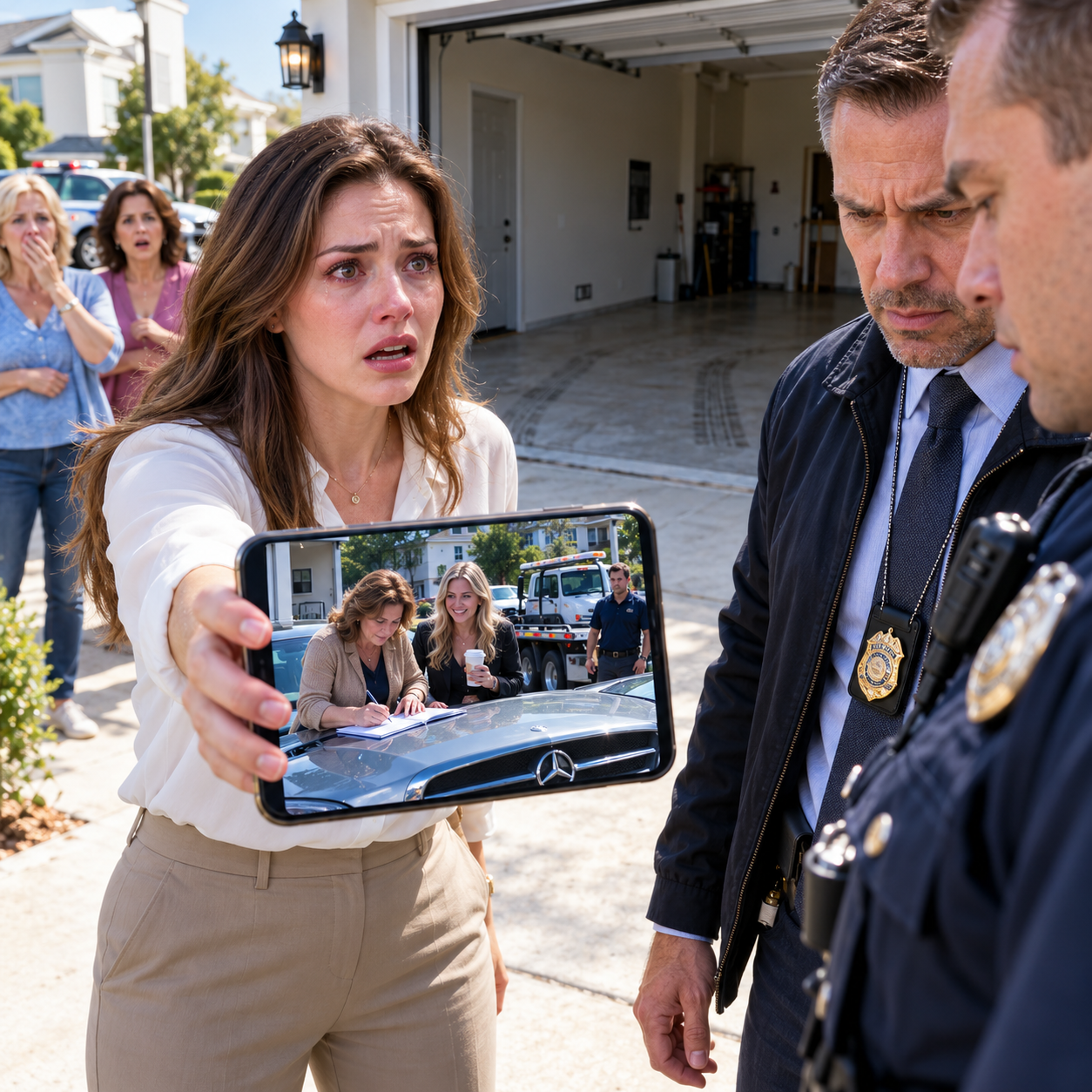
### Part 2: Stolen Documents Exposed the Secret Behind My Sister’s Desperate Plan
I pressed play and watched Sophie unlock my front door using the emergency key Mom had kept for years. She didn’t wander through the house or stop in the kitchen. She walked directly into my home office, stayed fourteen minutes, and emerged carrying a thin folder.
I went straight to my filing cabinet.
The folders were still there, but several had been moved. My vehicle purchase documents were out of order, and two things were missing: an older copy of my registration and a photocopy of my driver’s license.
I called Detective Reed immediately.
“Don’t touch anything else,” he instructed. “Photograph everything exactly as you found it.”
“Why would she come back after the car was gone?”
“The dealership may have requested additional identification. We’ll find out.”
Twenty minutes later, Mom texted: Are you going to keep acting dramatic, or can we talk like adults?
Another message followed.
Sophie’s debt is handled. That’s what matters.
I drove to Mom’s house that evening. Sophie wasn’t there, but Mom answered the door wearing the same impatient expression she’d used whenever I questioned her decisions as a teenager.
“Finally,” she said. “Are you finished punishing everyone with silence?”
I walked into her dining room and placed my phone on the table.
“How much did you get for my car?”
“Enough.”
“Where did the money go?”
“To your sister, where it was needed.”
“Did you sign my name?”
Mom crossed her arms. “I completed the paperwork because you weren’t available.”
“I was available. You never called.”
“Because you’d already said no!”
The room went quiet.
There it was. She knew I had refused and had decided my answer didn’t matter.
Mom pulled out a chair. “Anna, you have a successful career, savings, and a beautiful car. Sophie could have lost everything. You can recover from this.”
“Then why didn’t you sell something that belonged to you?”
“Don’t be ridiculous.”
“I’m asking you to make the same sacrifice you demanded from me.”
Her face reddened.
“I spent eighteen years raising you. Food, clothes, doctors, school supplies. Everything you have started with what I sacrificed.”
For a moment, I could only stare.
My mother was presenting the ordinary responsibilities of parenthood as a debt she could collect thirty years later.
“So raising me means you own whatever I earn?”
“You’re twisting my words.”
“No. You sold my property without permission because you thought I could afford to lose it.”
She looked away.
I unlocked my phone and played twelve seconds of video: Mom entering my garage, Sophie standing beside her, and the dealership employee waiting while Mom signed my name.
Color drained from her face.
“You recorded us?”
“My security system recorded my house.”
“You’d use that against your own mother?”
“You forged my signature.”
“Stop making this sound criminal!”
I held her gaze. “What would you prefer I call it?”
She didn’t answer.
I picked up my phone, but she followed me toward the hallway.
“You’re going to destroy this family over a car?”
I turned around.
“Then say what happened without mentioning Sophie. Say you sold your daughter’s car after she refused to give you money. Say you copied her signature and gave away something you didn’t own.”
Her lips parted, but no words came.
“A sacrifice is something you choose to give, Mom. You don’t get to choose it for somebody else.”
At 6:43 the next morning, Detective Reed called and asked me to come to the station.
He placed three documents across a metal table: the forged authorization, my missing driver’s license copy, and the dealership’s payment record.
The Mercedes had sold for $61,800.
After fees and a temporary holdback, $55,240 had already been transferred.
Reed tapped the recipient’s name.
Sophie Parker.
Then he showed me messages recovered from the dealership’s records.
One from Sophie specified that I’d be traveling until Thursday and that Tuesday morning would work best. Another assured the dealer that Mom had authorization and I wouldn’t be present. Sophie had also requested that the proceeds go directly into her own account.
Finally, Reed showed me a message Sophie had sent twelve minutes after leaving my house.
Got the ID copy. Sending now.
My sister hadn’t simply accepted money Mom handed her. She’d helped arrange the sale, supplied my personal information, and returned to my house when additional paperwork was needed.
Reed slid a formal statement toward me.
“Anna, are you willing to confirm that neither woman had your permission?”
I thought of all the times I’d apologized just to restore peace.
Then I picked up the pen.
“Yes.”
### Part 3: The Police Arrived With Evidence Nobody Could Explain Away
At 10:06 that morning, police knocked on my mother’s front door.
I wasn’t there, but my aunt later described how Mom had panicked when she heard the pounding and the officers identifying themselves. Investigators had come to question both women separately about the vehicle sale, forged documents, and transferred funds.
Mom called me repeatedly.
I let the phone ring.
Sophie sent six messages in three minutes.
Anna, answer me.
This is insane.
Mom was just trying to help.
The money is already gone.
Then came the message that revealed how little she understood.
Please don’t do this to me.
I stared at those six words. My sister had helped steal my car, used my identification, and accepted thousands of dollars she knew didn’t belong to her. Yet she still believed the consequences were something I was doing to her.
That afternoon, Detective Reed updated me on their interviews.
Sophie initially insisted she’d believed Mom had obtained my approval. When investigators showed her messages discussing my travel schedule, she claimed knowing I was away didn’t mean knowing I’d refused.
Then they produced a message about whether I might cause trouble afterward.
Her explanation changed.
She said Mom had assured her I’d eventually agree.
When confronted with footage of her retrieving my identification, Sophie claimed she’d only followed instructions because she was terrified of losing her business.
Mom’s story changed just as quickly.
She claimed my previous financial help to Sophie had made her believe I’d approve again. Investigators showed her my written refusal of the $54,000 request.
She said the payment deadline had forced her to act.
Finally, Reed asked why she’d copied my signature instead of signing her own name.
According to him, that was when Mom stopped answering.
The dealership immediately cooperated with investigators and froze the title process. Because the Mercedes hadn’t been resold, there was a way to reverse the transaction and eventually return it to me.
But the money was another matter.
Sophie had already sent $54,000 to creditors to settle multiple debts. Only $1,240 remained from the amount she’d received.
Mom apparently believed that once the money was spent, nobody could undo what she’d done.
She was wrong.
The sale, the false authorization, the unauthorized use of my identification, and the financial transfers all required formal resolution. Spending the money didn’t erase the obligation to repay it.
That evening, I drove to a hardware store and bought new locks.
I changed the garage code, replaced the alarm PIN, and removed Mom from the emergency contacts attached to my financial accounts. I froze my credit, reviewed account access, changed passwords, and contacted an attorney about updating documents that might allow either woman to act on my behalf.
Each change felt like closing a door I’d mistakenly left open.
Two days later, Mom called from an unfamiliar number.
“Anna, please,” she whispered. “You’ve made your point.”
“No, Mom. The police made theirs.”
“Sophie could lose her business.”
“Her business was already failing.”
“She could lose her apartment.”
“Then she needs to speak to her landlord and creditors.”
“Listen to yourself. You’ve become so cold.”
I looked at the new lock on my front door.
“I’ve stopped confusing rescuing someone with loving them.”
“She’s your sister!”
“And I was your daughter when you signed my name.”
Silence filled the line.
Finally, Mom asked, “What do you want from me?”
“The truth. Not another explanation about Sophie’s problems. Just acknowledge what you did.”
Her breathing became uneven.
“I was trying to save my daughter.”
I closed my eyes.
“You have two daughters, Mom.”
She didn’t answer.
I ended the call and sat in my quiet kitchen, staring at the phone. For the first time in years, I wasn’t waiting for another apology, another emergency, or another request for money.
I was waiting for the people who’d created the disaster to take responsibility for it.
### Part 4: The Final Truth Cost Them Everything They Expected Me to Sacrifice
Several weeks later, the dealership called.
My Mercedes was ready to be returned.
I stood in the showroom while an employee handed me the keys and the completed documentation. The car looked exactly as it had before: polished silver paint, spotless leather seats, and the familiar scratch near the driver’s door handle.
I ran my fingers over that scratch.
I’d worked years to buy this car. I’d saved, delayed vacations, and made payments without asking anyone for help. But as I opened the driver’s door, I realized the theft hadn’t hurt because the Mercedes was expensive.
It hurt because my mother and sister had looked at something I’d earned and decided my ownership was less important than their needs.
The financial consequences were unfolding separately.
Restitution became part of resolving the case. Sophie’s business collapsed when she could no longer borrow and refinance her way through its unpaid obligations. Mom had to use her own savings and liquidate investments to help satisfy the repayment requirements.
For years, she’d called it sacrifice whenever she expected me to pay.
Once the money came from her own accounts, she stopped using that word.
The investigation was formally documented, conditions were imposed as part of the resolution, and neither woman could pretend the transaction had been a harmless misunderstanding. There was no dramatic courtroom celebration, no moment when I felt happy watching my family suffer.
I wanted accountability, not revenge.
The last time we sat together during the resolution process, Mom looked older than I remembered. Her purse rested on her lap, and she kept smoothing the same wrinkle in her skirt.
“I hope someday you’ll understand why I did it,” she said.
“I understand perfectly.”
“Sophie was desperate.”
“Desperation didn’t give you ownership of my car.”
Sophie sat several chairs away, twisting a tissue between her fingers. Finally, she looked up.
“I thought you’d forgive us.”
I turned toward her.
“You said I’d be mad for a week.”
Her fingers stopped moving.
“What?”
“Tuesday morning. In my garage. You told Mom I always got over things.”
Sophie’s face went pale.
She hadn’t realized the camera recorded sound.
“Anna, I didn’t mean it that way.”
“You looked directly into my camera and smiled.”
She lowered her eyes.
“You knew I’d say no. You just believed you’d get away with ignoring me.”
Mom leaned forward. “Everyone makes mistakes.”
I looked between them.
“A mistake is missing a payment deadline. This took planning. You waited until I left town, arranged a buyer, entered my garage, copied my signature, took my identification, and transferred the money. Then you told me to accept it.”
Neither woman spoke.
I placed a copy of the documented transaction history on the table.
“That wasn’t one mistake. That was a series of choices.”
Sophie began crying quietly.
I remembered the first $8,400 I’d given her, then the nearly $13,000 after that. I remembered the family dinners where Mom praised Sophie’s ambitions and called my savings excessive. I remembered how every crisis ended with my being expected to surrender something because I was the dependable daughter.
Suddenly, the pattern was impossible to ignore.
They hadn’t believed I was generous.
They’d believed I could be pressured.
I stood, gathered my papers, and walked toward the door.
“Anna,” Mom called.
I stopped.
“Are you really going to cut us out of your life?”
I turned toward her.
“I’m not making that decision forever today. But you won’t have access to my money, my property, or my personal records again.”
Her eyes filled.
“What about forgiveness?”
“Forgiveness and access aren’t the same thing.”
I left without raising my voice.
In the months that followed, relatives chose sides. Some accused me of being heartless. Others apologized after learning I’d explicitly refused the money before Mom sold my car.
One aunt told me, “You only get one mother.”
“I know,” I answered. “I wish she’d remembered she had two daughters.”
Eventually, the calls stopped.
Sophie stopped asking me to negotiate with creditors or rescue her business. Mom stopped sending messages about sacrifice. For the first time, family silence wasn’t something I felt obligated to repair.
One bright Saturday afternoon, I drove through Savannah with the windows down. The Mercedes moved smoothly beneath me, its engine humming as I passed the street leading toward Mom’s neighborhood.
For a moment, my hand hovered near the turn signal.
I remembered childhood dinners, Mom brushing my hair before school, and Sophie following me everywhere when we were little. Those memories were real, and losing the relationship we’d once shared still hurt.
But so was the image of Mom forging my signature.
So was Sophie’s smile at the camera.
And so was the silence when I asked them to admit what they’d done.
I kept driving.
When I reached home, I entered the new garage code and parked in the familiar spot. I switched off the engine and looked at the empty passenger seat.
No angry calls. No demands. No emergency I was expected to finance.
I had my car back, but that wasn’t the most valuable thing I’d recovered.
My mother had believed that selling my Mercedes would solve Sophie’s $54,000 problem. Instead, it exposed the lie our family had lived with for years: that the person who worked hardest and planned most carefully was obligated to pay for everyone else’s decisions.
I stepped out, closed the car door, and watched the garage door descend.
For thirty years, I’d been the daughter who eventually gave in.
That morning, the police had finally shown my family that my refusal meant something.
And now, standing inside the home I’d worked so hard to build, I knew the truth that had taken me far too long to learn.
I could love my family without handing them ownership of my life.
And the next time I said no, it would be enough.
THE END.
All characters and events in this story are fictional, created for storytelling and entertainment purposes. Thank you sincerely for reading. Your feedback and support are invaluable and motivate me to continue sharing more stories with you.


